
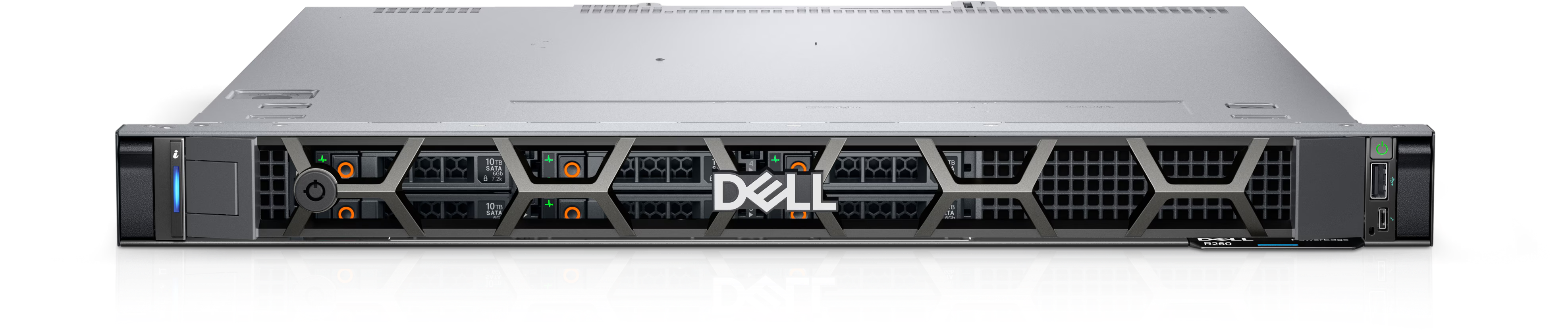
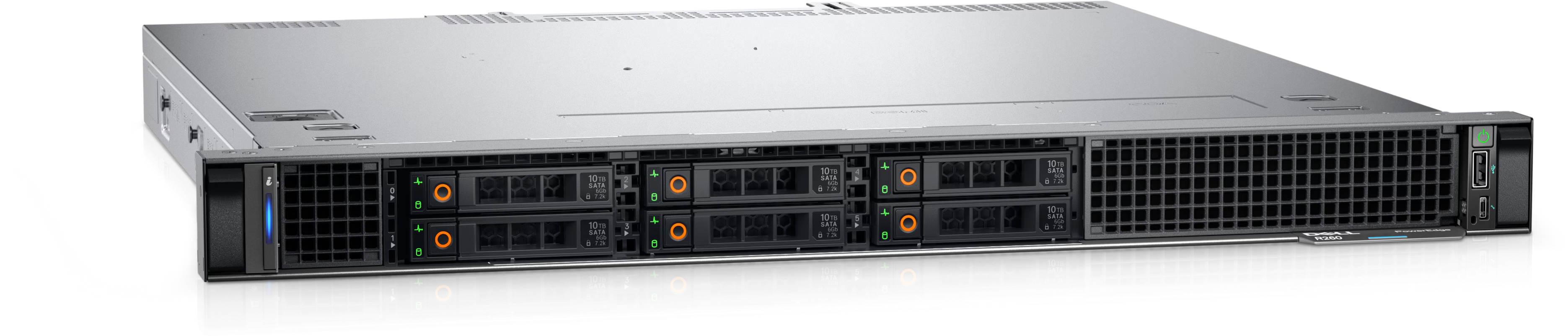
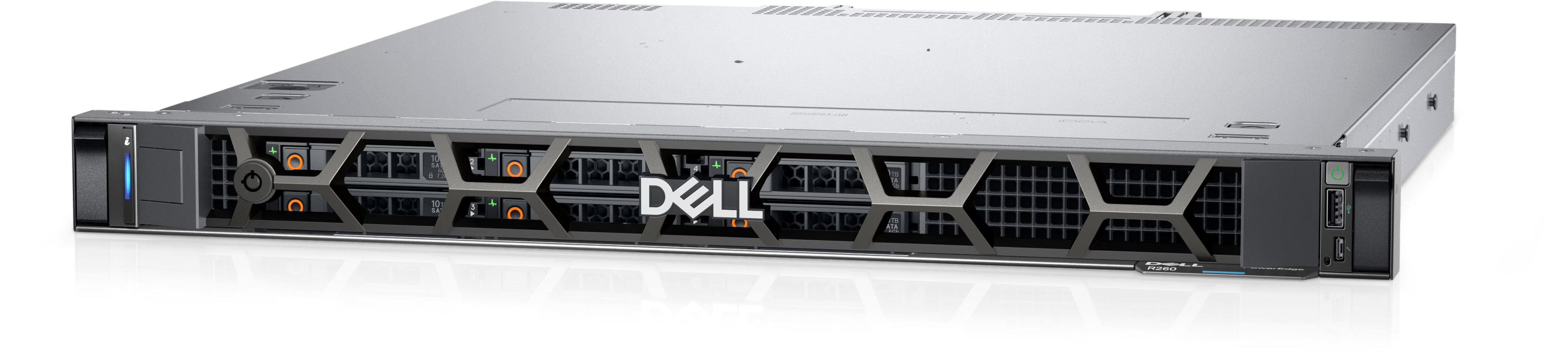
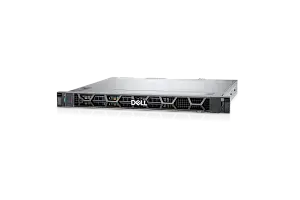
DELL PowerEdge R260 Server
Das könnte Sie interessieren




-
Condition
Refurbished
-
CPU
2×8GB DDR4 RDIMM 2133MHz
-
RAM
noHDD (up to 8 HDD 2.5'' SFF)
-
Condition
Refurbished
-
CPU
2×8GB DDR4 RDIMM 2133MHz
-
RAM
noHDD (up to 8 HDD 2.5'' SFF)
-
Condition
Refurbished
-
CPU
2×8GB DDR4 RDIMM 2133MHz
-
RAM
noHDD (up to 8 HDD 2.5'' SFF)
-
Condition
Refurbished
-
CPU
2×8GB DDR4 RDIMM 2133MHz
-
RAM
noHDD (up to 8 HDD 2.5'' SFF)

Processor
1 x Intel® Xeon® 6300 series or Intel® Xeon® E-2400 series processor with up to 8 cores, or Intel® Pentium® G7400/G7400T with 2 cores
Memory
DDR5: up to 4 x UDIMM (128 GB), speed up to 4400 MT/s, unregistered ECC only
Storage controllers
- Internal: HBA355i, PERC H355, PERC H755
- External HBA: HBA355e
- Boot: BOSS-N1 HWRAID 2 x M.2 SSDs or internal USB 3.0
- Software RAID: S160
Drive bays
Front bays
- Up to 2 x 3.5-inch cable SAS/SATA HDD
- Up to 6 x 2.5-inch hot-plug SAS/SATA HDD/SSD
Power supplies
- 450 W Platinum
- 700 W Titanium
Cooling and fans
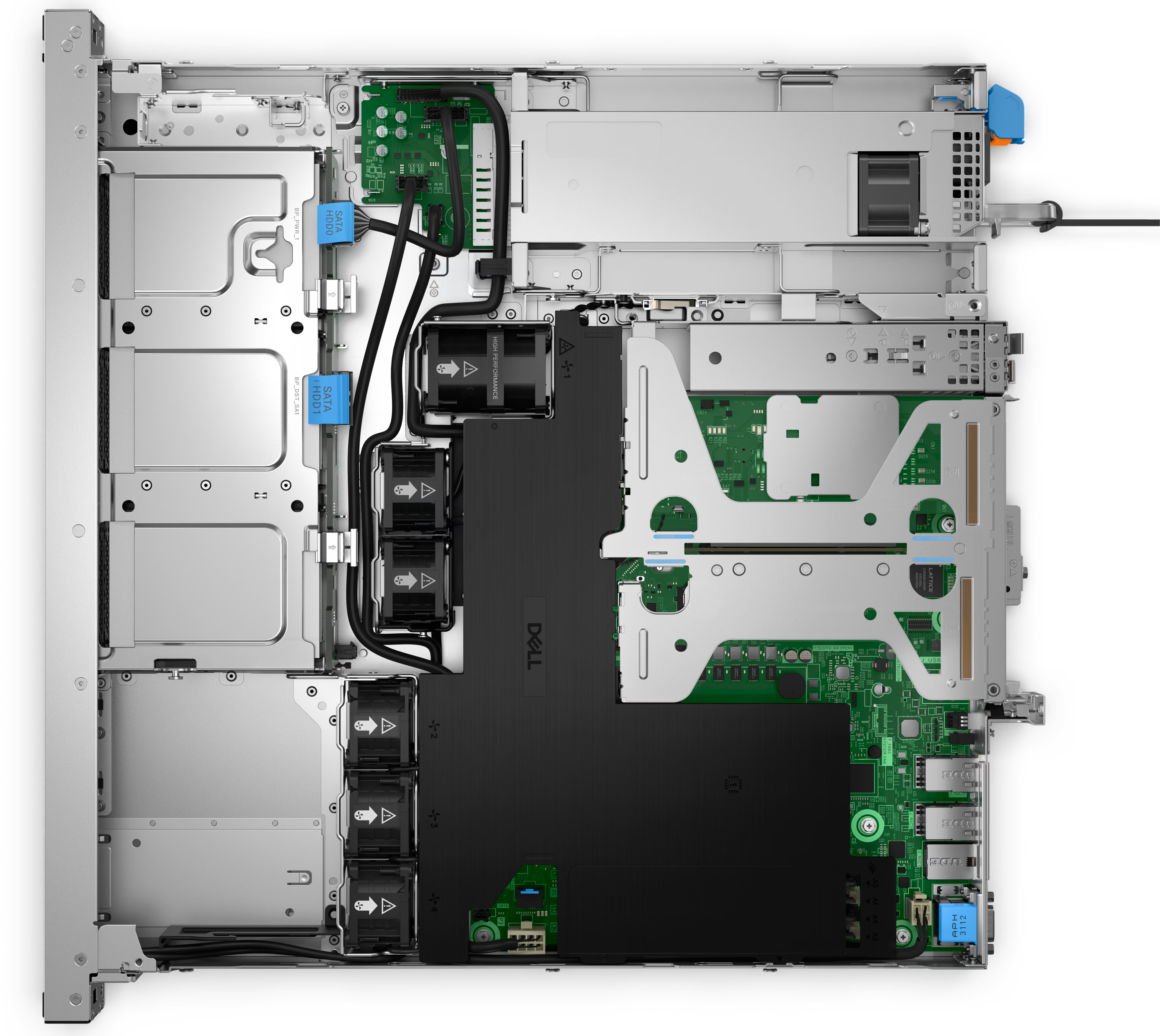
Air cooling; up to 6 cabled fans
Dimensions
- Height: 42.8 mm (1.68 inches)
- Width: 482.0 mm (18.97 inches)
- Depth: up to 496.8 mm (19.55 inches)
- Weight: not specified in the provided spec sheet
Form factor
1U rack server
Embedded management
- iDRAC9
- iDRAC Direct
- iDRAC RESTful API with Redfish
- iDRAC Service Module
Security
- Cryptographically signed firmware
- Data at Rest Encryption with SEDs and local or external key management
- Secure Boot
- Secured Component Verification with hardware integrity check
- Secure Erase
- Secured-core server
- Silicon Root of Trust
- System Lockdown, requires iDRAC9 Enterprise or Datacenter
- TPM 2.0 FIPS, CC-TCG certified, TPM 2.0 China NationZ
Networking
- 2 x 1GbE LOM
GPU options
N/A
Ports
Front ports
- 1 x iDRAC Direct (Micro-AB USB) port
- 1 x USB 2.0
Internal ports
- 1 x USB 3.2 Gen1
Rear ports
- 1 x Dedicated iDRAC Ethernet port
- 1 x USB 2.0
- 1 x USB 3.2 Gen1
- 1 x VGA
- 1 x Serial
PCIe
Up to 2 x PCIe Gen4 slots
Operating systems
- Canonical Ubuntu Server LTS
- Microsoft Windows Server with Hyper-V
- Red Hat Enterprise Linux
- SUSE Linux Enterprise Server
- VMware ESXi
Dell PowerEdge R260 overview
Dell PowerEdge R260 is a 1U, single-socket rack server for SMB infrastructure, near-edge applications, collaboration, messaging, file services and lightweight business applications. It is designed for environments that need short-depth 1U deployment, low acquisition cost, DDR5 ECC memory, BOSS-N1 boot and near-edge serviceability.
The R260 server is based on one Intel Xeon 6300 series or Intel Xeon E-2400 series processor with up to 8 cores, or one Intel Pentium G7400/G7400T processor with up to 2 cores. It supports 4 DDR5 ECC UDIMM slots, up to 128 GB and speeds up to 4400 MT/s, iDRAC9 and Dell OpenManage, embedded 2 x 1GbE LOM networking and optional OCP or PCIe networking where supported, PCIe Gen4 expansion and 2 x 3.5-inch cabled SAS/SATA HDD or 6 x 2.5-inch hot-plug SAS/SATA HDD/SSD drive options, with BOSS-N1 boot support.
The Dell PowerEdge R260 server is suitable for SMB infrastructure, near-edge applications, collaboration, messaging, file services and lightweight business applications. It should be treated as a compact entry rack server for SMB and near-edge locations, not as a generic replacement for every adjacent PowerEdge model.
When to choose Dell PowerEdge R260
Choose Dell PowerEdge R260 when the workload needs short-depth 1U deployment, low acquisition cost, DDR5 ECC memory, BOSS-N1 boot and near-edge serviceability in a validated Dell PowerEdge platform. It is a good fit for SMB infrastructure, near-edge applications, collaboration, messaging, file services and lightweight business applications where compute, RAM, local storage, networking and power must be sized as one configuration.
Compared with Dell PowerEdge R360, Dell PowerEdge R260 should be selected when its processor platform, form factor, I/O placement and drive layout match the project better. Compared with Dell PowerEdge T160, validate whether the workload needs Intel or AMD processors, rack or tower deployment, and the required storage or accelerator limits.
The R260 configuration should be validated carefully for processor type, memory population, drive bay layout, storage controller, BOSS or M.2 boot, OCP networking, risers, GPU or accelerator support where applicable, power supplies, fan type and cooling.
Chassis and drive bay options
Dell PowerEdge R260 supports several chassis and drive bay layouts. The right option depends on whether the server is being configured for balanced virtualization, high-density SSD storage, capacity-oriented storage, NVMe performance or accelerator-heavy workloads.
| Chassis option | Best for | Comment |
|---|---|---|
| Dell PowerEdge R260 2LFF | entry rack or tower deployments, SMB, ROBO and near-edge services | Supports 2 x 3.5-inch cabled SAS/SATA HDD, max 32 TB. This is the practical starting point when compact low-cost deployment and simple manageability matter. Final support depends on backplane, controller, cabling and Dell validation. |
| Dell PowerEdge R260 6SFF hot-plug | balanced virtualization, business applications and mixed enterprise workloads | Supports 6 x 2.5-inch hot-plug SAS/SATA HDD/SSD, max 46.08 TB. This is the practical starting point when standard serviceability and flexible drive selection matter. Final support depends on backplane, controller, cabling and Dell validation. |
| Dell PowerEdge BOSS-N1 boot options | separating OS or hypervisor boot from front data drives | BOSS-N1, BOSS-N1 DC-MHS or M.2 boot options can provide dedicated boot media, often with hardware RAID 1 on two M.2 NVMe SSDs depending on platform. Check the selected boot device, cable kit and controller rules. |
For balanced enterprise deployments, SFF or Universal drive configurations are usually the practical starting point. For capacity workloads, use the model-specific LFF or high-count SATA layouts where available. For latency-sensitive databases, high-I/O virtualization, analytics and AI data pipelines, NVMe or EDSFF E3.S configurations should be considered.
Final drive compatibility depends on the selected chassis, backplane, controller, BOSS or M.2 boot option, risers, GPU configuration, power supply and Dell support matrix. NVMe and EDSFF support should not be assumed from the server model name alone.
Recommended Dell PowerEdge R260 configurations by workload
| Workload | Recommended focus |
|---|---|
| ROBO / near edge | Compact server sizing, reliable boot, local protected storage, simple remote management and power planning. |
| Office / SMB infrastructure | Cost-effective CPU, ECC memory, protected local storage, quiet operation and Dell remote management. |
| Containers / Kubernetes | Balanced CPU and RAM, reliable boot media, local SSD or NVMe where needed and redundant network connectivity. |
| Backup / archive | Capacity-oriented drive layout, moderate CPU/RAM and network throughput sized for backup windows. |
| Web / microservices / scale-out | Power-efficient CPU selection, fast networking, predictable boot and storage design and repeatable node configuration. |
| Mixed enterprise workloads | Balanced CPU, RAM, storage and NIC choices, with headroom for failover, maintenance and growth. |
The R260 configuration should be chosen around the main reason for selecting this platform: short-depth 1U deployment, low acquisition cost, DDR5 ECC memory, BOSS-N1 boot and near-edge serviceability, Dell PowerEdge management and a storage layout matched to the workload.
How to choose CPU, RAM, RAID and storage
Dell PowerEdge R260 uses one Intel Xeon 6300 series or Intel Xeon E-2400 series processor with up to 8 cores, or one Intel Pentium G7400/G7400T processor with up to 2 cores. CPU selection should account for workload profile, software licensing, thermal limits and whether the application benefits more from core density, per-core performance or memory bandwidth.
RAM planning should start with VM density, database cache, container scheduling and future growth. Dell PowerEdge R260 supports 4 DDR5 ECC UDIMM slots, up to 128 GB and speeds up to 4400 MT/s. DIMM capacities and operating speeds depend on processor type and population rules.
For storage, select the drive layout around capacity, latency and serviceability. 2 x 3.5-inch cabled SAS/SATA HDD or 6 x 2.5-inch hot-plug SAS/SATA HDD/SSD drive options, with BOSS-N1 boot support Hardware RAID should be selected around validated PERC controller options, while HBA/JBOD mode is usually preferred for software-defined storage platforms that manage disks directly.
BOSS-N1, BOSS-N1 DC-MHS or M.2 boot options can separate OS or hypervisor boot from the main data drives where supported. Mixed SAS, SATA, NVMe and EDSFF designs must follow Dell controller and backplane rules.
Networking, PCIe, GPU and power should be validated as part of the same configuration. OCP NIC 3.0, PCIe risers, accelerator support, cooling options, fan type and PSU choice can all affect the final supported build.
Dell PowerEdge R260 vs related Dell PowerEdge models
| Model | When to consider |
|---|---|
| Dell PowerEdge R360 | Choose R360 when its 1U rack server, processor platform and storage limits fit the workload better. |
| Dell PowerEdge T160 | Choose T160 when its 3U tower server, processor platform and storage limits fit the workload better. |
| Dell PowerEdge T360 | Choose T360 when its 4.5U tower server, processor platform and storage limits fit the workload better. |
| Dell PowerEdge R660xs | Choose R660xs when its 1U rack server, processor platform and storage limits fit the workload better. |
| Dell PowerEdge R-Series Servers | Use the R-Series category when comparing broader rack server options. |
Dell PowerEdge R260 is the right reference point when the requirement matches its processor platform, form factor and storage design. It should not be positioned as interchangeable with older PowerEdge generations or with a different Intel or AMD platform without validating CPU, memory, storage, I/O and cooling rules.
Summary: is Dell PowerEdge R260 the right server for your workload×
Dell PowerEdge R260 is a strong Dell PowerEdge server for SMB infrastructure, near-edge applications, collaboration, messaging, file services and lightweight business applications. Choose it when you need short-depth 1U deployment, low acquisition cost, DDR5 ECC memory, BOSS-N1 boot and near-edge serviceability with one Intel Xeon 6300 series or Intel Xeon E-2400 series processor with up to 8 cores, or one Intel Pentium G7400/G7400T processor with up to 2 cores, 4 DDR5 ECC UDIMM slots, up to 128 GB and speeds up to 4400 MT/s and Dell PowerEdge management. Before purchase, confirm CPU type, RAM population, drive bay layout, RAID or HBA mode, BOSS or M.2 boot option, OCP networking, risers, GPU or accelerator support where applicable, cooling, PSU and warranty requirements.
Die Servermall-Garantie umfasst:
- Rund um die Uhr (auch an Feiertagen) erreichbarer Servermall-Kundenservice und -Support zur Behebung von Problemen mit generalüberholten Servern und zugehörigen Produkten sowie ausgewählten Softwareproblemen.
- 5 Jahre Garantie. Im Falle einer Problemdiagnose oder Reparatur führen wir diese kostenlos am Installationsort des Servers durch.
- Vor-Ort-Versand von Ersatzteilen an den Installationsort oder einen anderen von Servermall genehmigten und gemeinsam vereinbarten Geschäftsstandort des Kunden zur Behebung eines Produktproblems.
Abonnieren Sie unsere News und erhalten Sie $50 Rabatt auf den Server.
Kostenloser Versand innerhalb der EU bei Bestellungen von Ausrüstung ab $500 . Lieferung innerhalb von 4 Werktagen.
einen Server bei Servermall zu kaufen
Garantie
Wir möchten sicherstellen, dass unsere Geräte für Sie absolut zuverlässig sind. Deshalb werden alle unsere Geräte (auch neue) umfassend diagnostiziert, getestet und Teile ausgetauscht.
Tests
Wir statten unsere Geräte mit verschiedenen Dienstprogrammen und Software aus. Sie werden garantiert lange funktionieren.
Stromversorgung
Die Komponenten arbeiten mit voller Leistung und werden mehrere Tage lang getestet. Bei Zweifeln tauschen wir sie aus.
aller Geräte
Unsere Vorschriften sehen die gleichen Prüfungen für gebrauchte und neue Geräte vor. Übrigens: Wir ergänzen die offizielle Herstellergarantie durch unsere eigene Garantie.