AMD EPYC 9005 is worth choosing for new server projects in 2026–2027 if you need maximum core density, high memory bandwidth, headroom for virtualization, containers, AI inference, and infrastructure consolidation. At the same time, EPYC 9004 does not become obsolete: it remains a cost-effective choice when price, platform maturity, compatibility with the existing server fleet, availability of refurbished servers, and workloads that do not specifically bottleneck on the CPU are more important.
The comparison between EPYC 9005 and EPYC 9004 should not be reduced to the question of “which generation is newer.” In server infrastructure, the processor almost never operates separately from the rest of the system. Final performance and total cost of ownership are affected by memory, drives, network adapters, licenses, cooling, power, the hypervisor, firmware, and the workload architecture itself.
In 2026–2027, this choice is especially important for two reasons. On the one hand, companies need denser virtualization, containers, analytics, and local AI service deployment. On the other hand, infrastructure budgets are often limited, while strong previous-generation servers remain available on the market. That is why EPYC 9005 should be considered a platform for new high-density projects, while EPYC 9004 is a rational option where high performance is needed without paying extra for the very latest generation.
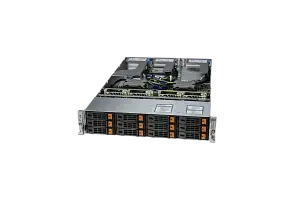
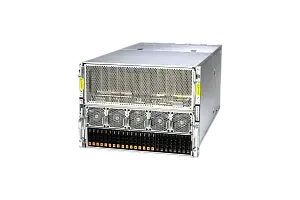
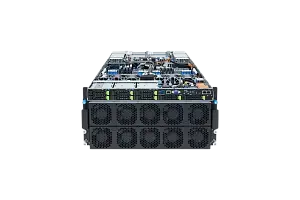
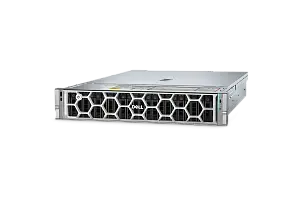
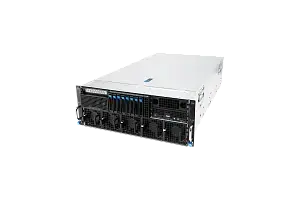
Servers powered by AMD EPYC 9005 and 9004
Free shipping on orders over 500 € in the EU, £500 in the UK, and $3,000 in the USA
Free shipping on orders over 500 € in the EU, £500 in the UK, and $3,000 in the USA
Free shipping on orders over 500 € in the EU, £500 in the UK, and $3,000 in the USA
Free shipping on orders over 500 € in the EU, £500 in the UK, and $3,000 in the USA
What changed between EPYC 9004 and EPYC 9005
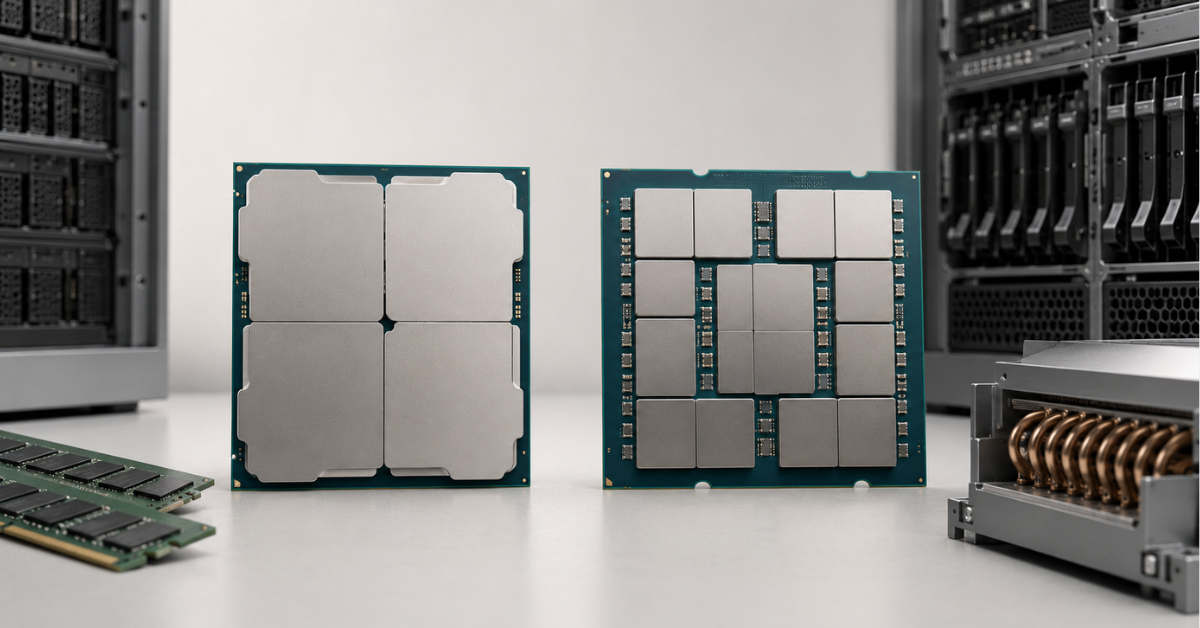
EPYC 9004 belongs to the 4th generation of AMD EPYC and is based on the Zen 4 and Zen 4c architectures. EPYC 9005 is the 5th generation, based on Zen 5 and Zen 5c. AMD specifies up to 192 cores for EPYC 9005 and up to 128 cores for EPYC 9004; both families use 12 channels of DDR5 memory, but EPYC 9005 has a higher stated memory speed in current models.
The architectural difference matters not only “on paper.” In simplified terms, it can be described as follows:
- Zen 5 is more interesting where single-core performance matters: databases, licensed software, some engineering calculations, and tasks with limited parallelism.
- Zen 5c is useful where density matters: many virtual machines, containers, background services, web workloads, and small independent processes.
- Zen 4 and Zen 4c in EPYC 9004 still deliver a high level of performance and are well suited for most server tasks, especially when the budget is limited.
The main difference of EPYC 9005 is not just more cores, but the ability to build a denser server. This matters for data centers where rack space, electricity, or the number of physical nodes is limited. One modern server with two high-end EPYC 9005 CPUs can replace several older machines, but only if the rest of the infrastructure is ready for that density.
At the same time, EPYC 9004 has a strong advantage: maturity and price. Servers based on this generation are already widely available, many models are well known to administrators, and configurations on the secondary and refurbished market can be noticeably more attractive. If the task does not require the maximum number of cores per socket, EPYC 9004 often provides a better balance of cost and useful performance.
One interesting point is that both processors use the SP5 socket (LGA 6096), so in theory infrastructure based on EPYC 9004 can be upgraded to EPYC 9005. However, motherboard compatibility must be considered: firmware and BIOS/UEFI updates may be required, and the platform must support the necessary thermal design power, as top-end EPYC 9005 CPUs can run noticeably hotter.
Brief comparison of EPYC 9005 and EPYC 9004
| Parameter | AMD EPYC 9005 | AMD EPYC 9004 | What it means in practice |
|---|---|---|---|
| Generation | 5th generation | 4th generation | EPYC 9005 is better suited for new purchases with a multi-year horizon |
| Architecture | Zen 5 / Zen 5c | Zen 4 / Zen 4c | EPYC 9005 is stronger in density and per-core performance |
| Maximum cores | Up to 192 | Up to 128 | EPYC 9005 is more attractive for virtualization, containers, and consolidation |
| Memory | 12 DDR5 channels, up to 6400 MT/s in current models | 12 DDR5 channels, up to 4800 MT/s | EPYC 9005 offers greater potential memory bandwidth |
| PCIe | PCIe 5.0 | PCIe 5.0 | Both platforms are suitable for NVMe, network adapters, and accelerators |
| Key strength | Density, new performance headroom, modern workloads | Price, maturity, availability | EPYC 9004 is often more cost-effective when budgets are limited |
| Main risk | Price, power, cooling, licenses | Less headroom for future growth | The choice depends on the workload, not only on the generation |
From the summarized specifications of individual models, EPYC 9005 offers a higher DDR5 frequency and greater theoretical memory bandwidth, while EPYC 9004 remains a strong platform with PCIe 5.0, 12 DDR5 channels, and a broad range of models, including versions with larger cache.
This table does not replace proper server sizing. For example, a 64-core processor with a high clock speed may be better for a licensed database than a 192-core model if the license is counted per core. And a server with a weaker processor but fast NVMe drives and enough memory may be faster in a real workload than a system with a maximum CPU and a weak storage subsystem.
Virtualization and private cloud
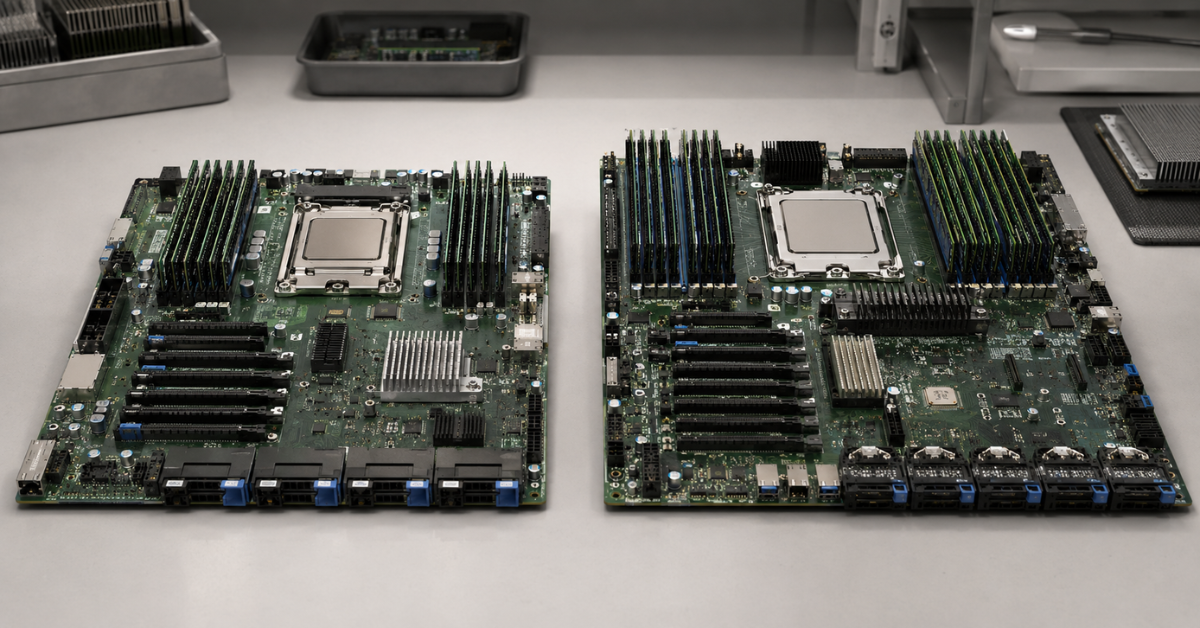
For virtualization, EPYC 9005 looks especially convincing. More cores per socket make it possible to place more virtual machines on one physical server, while faster memory helps where dozens or hundreds of VMs access RAM at the same time.
EPYC 9005 is especially appropriate for:
- private cloud;
- VDS/VPS platforms;
- dense server virtualization;
- environments with many small virtual machines;
- consolidation of older dual-socket servers;
- infrastructure where rack space must be saved.
If a company is upgrading a fleet from older platforms, the difference may be noticeable not only in performance. Sometimes it is more important that the number of physical nodes, network ports, power supplies, cables, and points of failure can be reduced. In these scenarios, AMD EPYC servers should be considered not as a “processor-for-processor” replacement, but as a foundation for rebuilding the entire compute density model.
However, high density has a downside. The more virtual machines are located on one server, the more serious the consequences of a node failure become. This means you need:
- proper clustering;
- power and network redundancy;
- sufficient RAM headroom;
- fast drives or external storage;
- well-planned VM migration;
- clear rules for distributing critical services.
EPYC 9004 remains a good option for virtualization if the current workload is not bottlenecked by the CPU, and 128 cores per socket in top configurations is far from small. In many environments, the limitation lies in memory, IOPS, network bandwidth, or licenses. If EPYC 9004 servers already provide the required VM density, a move to EPYC 9005 may not pay off quickly.
Choosing the Right Equipment
Our specialists will contact you and answer all your questions
Databases and analytics
In databases, a larger number of cores does not always mean better performance. For PostgreSQL, MySQL, Microsoft SQL Server, Oracle, ClickHouse, and other systems, threads are not the only factor: memory latency, disk speed, cache size, locks, query tuning, and licensing are also important.
EPYC 9005 will be stronger in tasks where the database can truly use many cores:
- analytical queries;
- parallel processing of large tables;
- high-load event stores;
- mixed environments where a database, cache, queues, and application services run simultaneously;
- systems where data is actively read from memory.
Faster DDR5 memory in EPYC 9005 is especially useful in workloads where the processor constantly waits for data from RAM. This can include analytics, log processing, aggregate calculations, and some engineering and scientific tasks.
However, for a classic transactional database, EPYC 9004 may be more cost-effective. If the bottleneck is the storage subsystem, locks, slow queries, or per-core licensing, buying a newer CPU will not solve the problem. Sometimes it is more reasonable to choose fewer cores, more memory, fast NVMe drives, and a properly tuned database.
EPYC 9004 models with larger cache should also be considered separately. For some cache-sensitive tasks, these processors can remain very competitive even compared with the newer generation. This is relevant for certain engineering calculations, financial models, some DBMS workloads, and scientific applications.
Containers and Kubernetes
In container environments, EPYC 9005 works well as a high-density platform. When many small services run on one node, the scheduler can distribute load more efficiently across a larger number of cores. This is especially useful for microservice architectures, internal development platforms, test environments, and cloud services.
EPYC 9005 is suitable if:
- the number of services in the cluster is growing quickly;
- more containers are needed per physical server;
- there are many background tasks, queues, workers, and APIs;
- placement density matters without a sharp increase in the number of nodes;
- the infrastructure is being built with a multi-year horizon.
At the same time, an overly dense Kubernetes node is not always a benefit. If too many critical services are concentrated on one server, its failure becomes more painful. Therefore, when moving to EPYC 9005, it is important not only to increase limits, but also to check the high-availability architecture.
For container environments, the following are especially important:
- sufficient memory per core;
- correct CPU and RAM limits;
- fast access to images and storage;
- network adapters with enough bandwidth headroom;
- proper distribution of system and user workloads;
- understanding NUMA, meaning how memory and cores are distributed inside the server.
EPYC 9004 remains sufficient for Kubernetes if the cluster is stable, the workload is predictable, and the bottleneck is not the CPU. It is often more cost-effective to add memory, speed up storage, or optimize settings than to change the platform only for a newer processor generation.
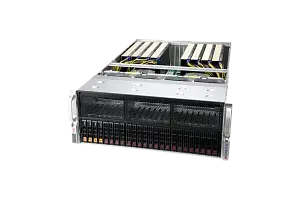
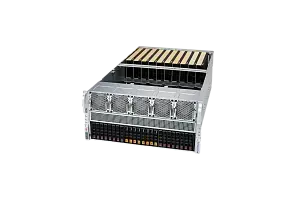
AI servers with NVIDIA
Free shipping on orders over 500 € in the EU, £500 in the UK, and $3,000 in the USA
Free shipping on orders over 500 € in the EU, £500 in the UK, and $3,000 in the USA
Free shipping on orders over 500 € in the EU, £500 in the UK, and $3,000 in the USA
Free shipping on orders over 500 € in the EU, £500 in the UK, and $3,000 in the USA
VDI and virtual workstations
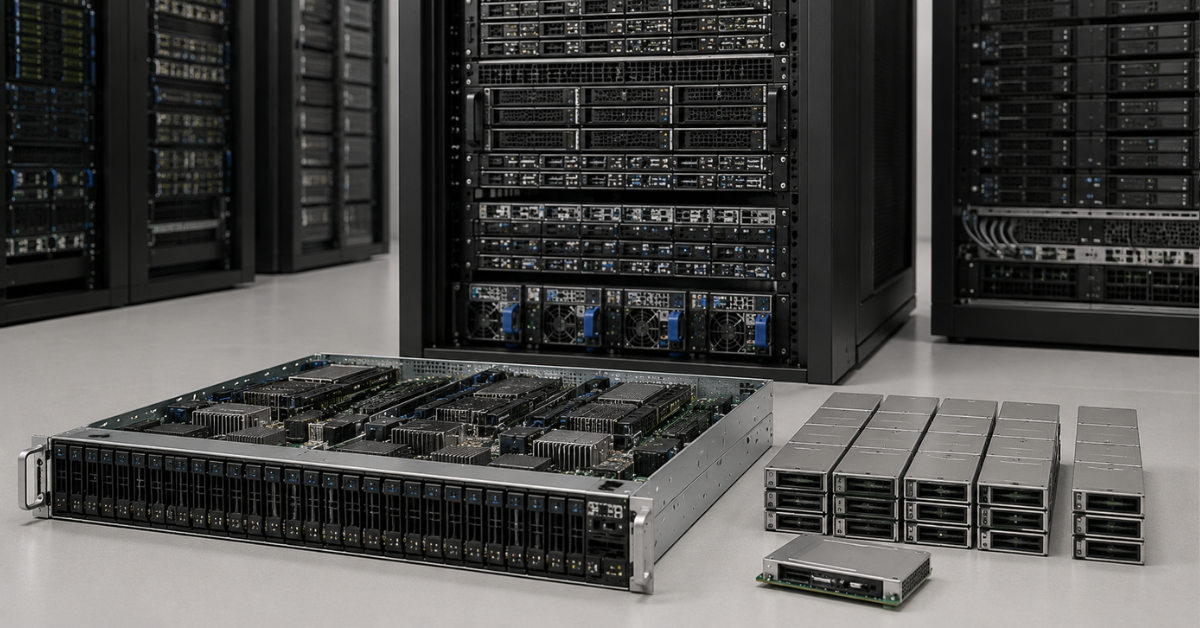
For VDI, or virtual desktop infrastructure, the processor is important, but it is not the only factor. In real projects, users often bottleneck not on cores, but on memory, graphics accelerators, network storage, user profiles, or morning peak loads.
EPYC 9005 is useful where many workplaces need to be placed on fewer servers. Examples include office staff, call centers, educational platforms, remote workplaces, and standard corporate applications. A large number of cores helps handle peaks when browsers, office applications, messengers, updates, and antivirus scans start at the same time.
However, VDI cannot be calculated only by the formula “users per core.” You need to consider:
- how much memory one user needs;
- whether video conferencing is used;
- whether GPUs are required for graphics;
- where user profiles are stored;
- how fast the storage subsystem works;
- what happens during mass user logon hours;
- how browsers and heavy web applications behave.
EPYC 9004 can be a more rational choice for ordinary office VDI workloads. If users do not create sustained high CPU load and the limitation is in RAM or storage, the newer platform will not provide proportional gains.
AI inference and servers with accelerators
EPYC 9005 should not be seen as a GPU replacement for large neural networks. Training large models and heavy inference still require GPUs or specialized accelerators. But this does not mean that the processor in an AI server is secondary.
The CPU affects:
- data preparation;
- GPU feeding;
- network stack operation;
- NVMe servicing;
- request routing;
- preprocessing of images, text, or events;
- operation of auxiliary services around the model.
EPYC 9005 is useful in scenarios where the server performs many tasks around the AI workload. For example, it receives requests, processes data, runs small models on the CPU, manages queues, serves vector search, or prepares batches for GPUs. In such cases, more cores and faster memory help keep accelerators loaded instead of forcing them to wait for data.
For small models, classic machine learning, ranking, recommendations, and feature processing, EPYC 9005 can be a self-sufficient platform. However, if the main work is already performed on GPUs, EPYC 9004 often remains a reasonable option: it provides enough cores and PCIe 5.0 lanes for servers with accelerators, while the budget can be directed toward GPUs, memory, and storage.
In AI projects, it is important to compare not only processors, but the entire system. Sometimes the better result will come not from moving from EPYC 9004 to EPYC 9005, but from adding faster NVMe drives, increasing RAM, or replacing the GPU.
HPC, engineering, and scientific computing
In high-performance computing, you cannot choose a processor only by the maximum number of cores. Different applications behave differently. Some scale well across dozens and hundreds of threads, others depend on frequency, others on cache, and others on memory bandwidth.
EPYC 9005 is especially interesting for tasks where there is:
- good parallelization;
- high memory load;
- many independent compute threads;
- a need for high node density;
- a new cluster with a multi-year operating horizon.
These may include certain engineering calculations, simulations, scientific tasks, financial computing, and large dataset processing. Higher memory bandwidth helps where calculations often wait for data from RAM.
EPYC 9004 remains a strong choice for cache-dependent tasks, especially when models with larger L3 cache are involved. For some engineering and scientific applications, a large cache can be more important than a newer architecture generation. Therefore, before buying for HPC, it is best to look at tests of the exact application or at least a closely related workload, rather than only general benchmarks.
If a program scales poorly beyond 32–64 cores, a high-end EPYC 9005 may be excessive. In that case, it is more reasonable to choose a processor with fewer cores but a higher frequency, or to invest in memory, inter-node networking, or accelerators.
Server consolidation
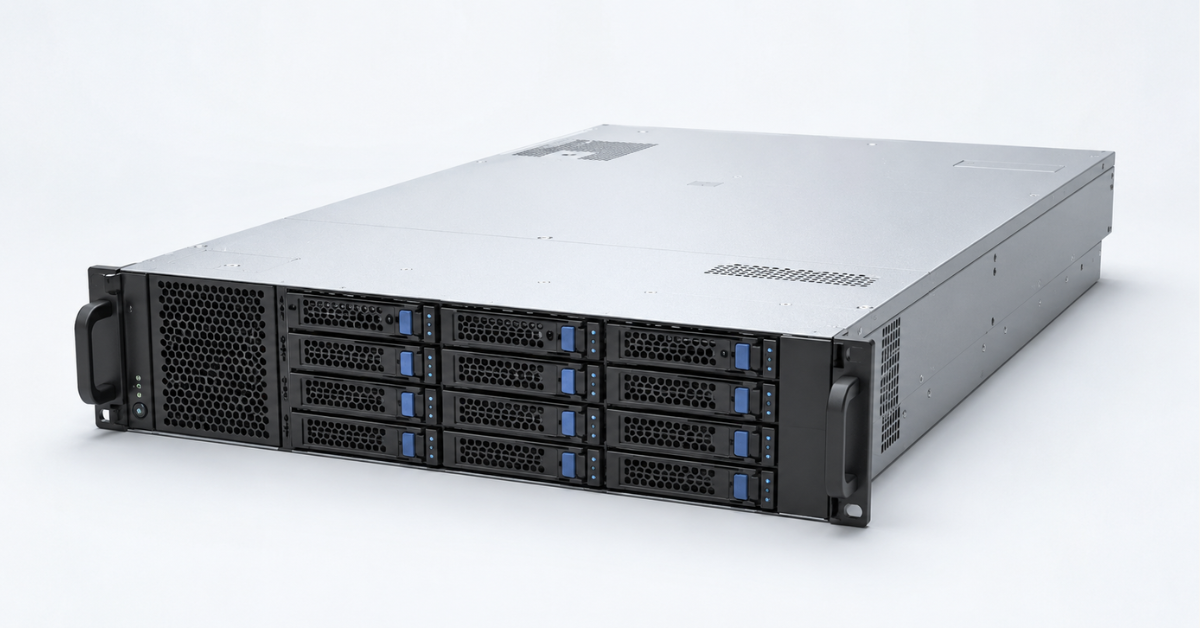
One of the main arguments in favor of EPYC 9005 is consolidation. If a company has a fleet of old servers, a new EPYC 9005 node can replace several previous-generation machines. This is especially noticeable in virtualization, container platforms, private clouds, and environments with many similar services.
Consolidation can reduce costs through:
- fewer physical servers;
- lower power consumption;
- freed rack space;
- fewer network connections;
- lower maintenance expenses;
- simpler infrastructure management.
However, the cost of the processor alone is not enough. The more important metric is the cost of useful workload: one virtual machine, one container, one VDI user, one transaction, or one compute job.
High density also has risks. If ten old servers are replaced by two new ones, the failure of one node becomes more critical. Therefore, EPYC 9005 is justified not by itself, but together with the right cluster architecture, redundancy, and a clear recovery plan.
EPYC 9004 can also be very attractive for consolidation. For example, if a company is upgrading not from EPYC 9004, but from older Intel Xeon or EPYC 7002/7003 systems, even the 4th generation will provide a major improvement. In this case, 16th-generation Dell PowerEdge servers may become a reasonable middle ground between performance, price, and availability.
Compatibility and upgrade
Both families are associated with the SP5 platform, but that does not mean any server with EPYC 9004 can simply be upgraded to EPYC 9005. Compatibility depends on the specific server model, BIOS version, power, cooling, board, supported processors, and the manufacturer’s policy.
Before an upgrade, you need to check:
- whether the server supports the specific EPYC 9005 model;
- whether the required BIOS version is available;
- whether the cooling system is designed for the selected TDP;
- whether the power supplies can handle the new configuration;
- whether the required memory speed is supported;
- whether there are limits on the number of RAM modules;
- whether the hypervisor supports the new CPU generation;
- whether the warranty remains valid after the upgrade.
Lenovo, for example, specifies support for 5th-generation EPYC 9005 on a number of ThinkSystem V3 servers that already supported 4th-generation EPYC Genoa, but this is an example within a specific server lineup, not a universal rule for all SP5 platforms.
In the refurbished segment, this point is especially important. Seeing “SP5” in the specifications is not enough. You need to confirm the full list of compatible CPUs, firmware version, cooling configuration, and actual vendor support. Otherwise, you may buy a server that is theoretically close to the new platform, but in practice cannot accept the required processor.
Economics of the choice in 2026–2027
EPYC 9005 is worth choosing if the server is being purchased for a new project and must remain relevant for several years. This is especially logical for infrastructure where it is already clear that the workload will grow: virtualization, containers, analytics, AI services, private cloud, and dense VDI infrastructure.
EPYC 9005 is also appropriate if the company has rack and power constraints. In that case, a more expensive server may pay off by reducing the number of physical nodes. But the calculation must account not only for the purchase price, but for total cost of ownership: electricity, cooling, licenses, maintenance, spare parts, and downtime risks.
EPYC 9004 is more cost-effective if:
- the budget is limited;
- the workload is already well covered by 64–128 cores;
- there is no sharp growth in CPU demand;
- the bottleneck is in RAM, drives, or the network;
- platform maturity matters;
- good refurbished configurations are available;
- licenses make a large number of cores economically inefficient.
For companies that need a server “here and now,” EPYC 9004 may be the more pragmatic choice. This is especially true for virtualization, databases, file services, corporate applications, or workloads without extreme density requirements.
EPYC 9005 is the choice with headroom. EPYC 9004 is the choice with a strong price-to-performance ratio. In 2026–2027, both options make sense, but for different tasks.
Choosing the Right Equipment
Our specialists will contact you and answer all your questions
How to choose by scenario
| Scenario | When to choose EPYC 9005 | When EPYC 9004 is enough |
|---|---|---|
| Virtualization | More VMs per node are needed, the workload is growing, consolidation matters | Current nodes are not CPU-bound, price matters |
| Databases | Analytics, parallel queries, and high memory load are required | The bottleneck is storage, licenses, locks, or cache |
| Containers | Many services, high density, long operating horizon | The cluster is stable and the limitation is not the CPU |
| VDI | Many users and high workplace density are needed | The limitation is RAM, GPU, or user profiles |
| AI inference | The CPU actively prepares data, serves GPUs, or runs small models | The main workload is on GPUs and the processor is not heavily loaded |
| HPC | The code scales well and depends on memory bandwidth | The application is sensitive to cache or frequency |
| Consolidation | Many old servers need to be replaced by fewer new ones | The fleet still copes, and savings are more important than maximum density |
Common mistakes when comparing EPYC 9005 and EPYC 9004
Comparing only the number of cores
192 cores look convincing, but they are useless if there is not enough memory, the network is overloaded, drives do not deliver the required IOPS, and applications cannot scale. In a server, balance matters.
Forgetting about licenses
Some products are licensed per core. In such cases, the maximum number of cores can sharply increase total cost of ownership. Sometimes it is more profitable to choose fewer fast cores and get the same useful performance at a lower cost.
Treating SP5 as a full compatibility guarantee
A common socket does not mean an automatic upgrade. BIOS support, sufficient power, cooling, and confirmation from the server manufacturer are required.
Ignoring memory per core
For virtualization, containers, and VDI, not only the number of threads matters, but also the amount of RAM per workload unit. A server with many cores and insufficient memory will quickly bottleneck not on the CPU, but on RAM.
Expecting EPYC 9005 to replace GPUs
For large neural networks and model training, a processor does not replace GPUs. EPYC 9005 strengthens the platform and helps serve data and accelerators, but it does not remove the need for GPUs where they are truly required.
Ignoring EPYC 9004 with large cache
For some tasks, EPYC 9004 with increased L3 cache can be a very strong option. If an application is cache-sensitive, the newer generation does not always automatically provide a better result.
When to buy a server on EPYC 9005
EPYC 9005 is worth choosing if the server is being purchased for a long period and must handle workload growth in 2026–2027 and beyond. It is a good option for dense virtualization, private cloud, Kubernetes, AI inference, analytics, new HPC clusters, and consolidation of an older server fleet.
EPYC 9005 is especially justified where rack space, power consumption, or the number of physical servers is limited. For example, modern 17th-generation Dell PowerEdge servers are already oriented toward such dense configurations, and Dell PowerEdge R7725 is described by the manufacturer as a 2U server supporting two AMD EPYC 9005 processors with up to 192 cores per processor.
However, EPYC 9005 should not be bought only because it is a new generation. If the workload does not use additional cores, if licenses become too expensive, or if the server bottlenecks on memory or storage, the effect of the upgrade will be weaker than expected.
When EPYC 9004 remains more cost-effective
EPYC 9004 remains a reasonable choice for many companies in 2026–2027. It is not an “old” processor in the everyday sense, but a mature and still modern server platform with DDR5, PCIe 5.0, a large number of cores, and a wide choice of configurations.
EPYC 9004 should be considered if you need a reliable server for:
- virtualization without extreme density;
- corporate databases;
- file and application services;
- medium-scale container environments;
- VDI for office users;
- a GPU server where the main workload falls on graphics cards;
- upgrading an older fleet with a limited budget.
For many tasks, EPYC 9004 will provide better economics: a lower entry price, more available configurations, predictable platform behavior, and an easier path to finding a suitable refurbished server. If the infrastructure is not bottlenecked by the CPU, paying extra for EPYC 9005 may be unjustified.
Conclusion
In 2026–2027, the right question is not “is EPYC 9005 or EPYC 9004 faster,” but “which platform will provide a lower cost of useful workload in your specific scenario.”
EPYC 9005 is worth choosing for new high-density projects where maximum core count, high memory bandwidth, consolidation, containers, virtualization, AI inference, and multi-year headroom matter. This generation is better suited for infrastructure that will grow and where the cost of rack space, energy, and management is just as important as the price of the server itself.
EPYC 9004 remains a cost-effective option if high performance is needed without paying extra for the new generation. It is especially strong where the workload is already understood, the budget is limited, platform maturity matters, and the main bottleneck is not the processor, but memory, storage, network, or licenses.
If the server is being purchased “for growth” and should become the foundation of new infrastructure, EPYC 9005 looks more promising. If the task is to get maximum performance for reasonable money, EPYC 9004 remains a very strong choice in 2026–2027.
Choosing the Right Equipment
Our specialists will contact you and answer all your questions
Content:
Free shipping on orders over 500 € in the EU, £500 in the UK, and $3,000 in the USA
Free shipping on orders over 500 € in the EU, £500 in the UK, and $3,000 in the USA
Free shipping on orders over 500 € in the EU, £500 in the UK, and $3,000 in the USA

Free shipping on orders over 500 € in the EU, £500 in the UK, and $3,000 in the USA