
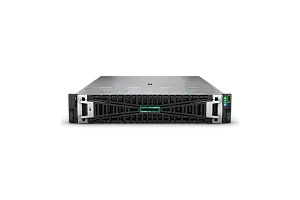
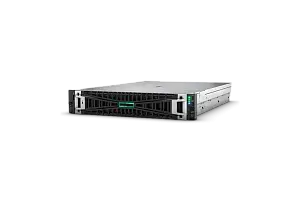
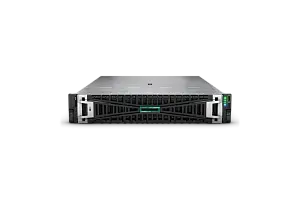
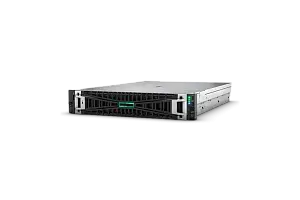
HPE ProLiant DL385 Gen11 Server



-
Condition
Refurbished
-
CPU
2×8GB DDR4 RDIMM 2133MHz
-
RAM
noHDD (up to 8 HDD 2.5'' SFF)
-
Condition
Refurbished
-
CPU
2×8GB DDR4 RDIMM 2133MHz
-
RAM
noHDD (up to 8 HDD 2.5'' SFF)
-
Condition
Refurbished
-
CPU
2×8GB DDR4 RDIMM 2133MHz
-
RAM
noHDD (up to 8 HDD 2.5'' SFF)
-
Condition
Refurbished
-
CPU
2×8GB DDR4 RDIMM 2133MHz
-
RAM
noHDD (up to 8 HDD 2.5'' SFF)

Free shipping on orders over 500 € in the EU, £500 in the UK, and $3,000 in the USA
Free shipping on orders over 500 € in the EU, £500 in the UK, and $3,000 in the USA
Free shipping on orders over 500 € in the EU, £500 in the UK, and $3,000 in the USA
Free shipping on orders over 500 € in the EU, £500 in the UK, and $3,000 in the USA
Processor
1 or 2 x 4th or 5th Generation AMD EPYC™ 9004/9005 Series processors, up to 160 cores depending on processor, up to 5.0 GHz, up to 1152 MB L3 cache
Memory
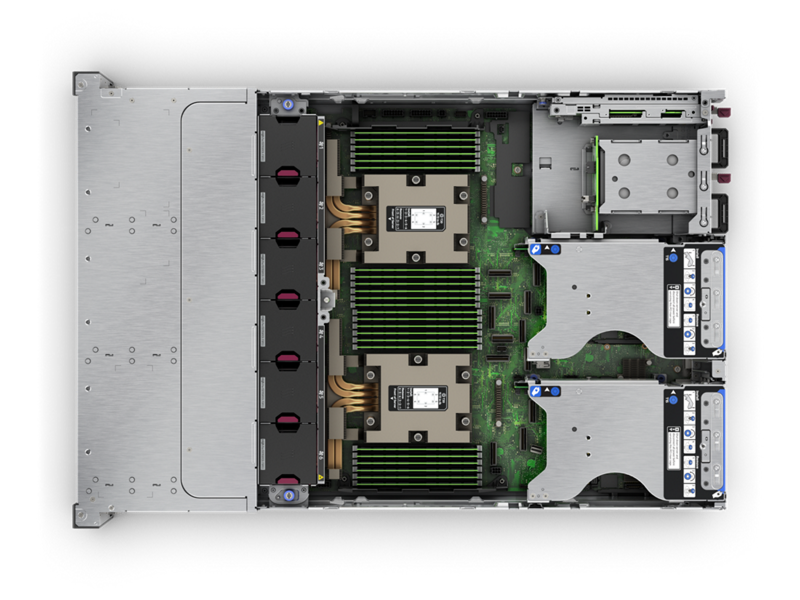
DDR5 RDIMM: up to 24 x HPE DDR5 Smart Memory DIMMs (6 TB), speeds up to 6400 MT/s depending on processor and population
Storage controllers
- HPE Tri-Mode storage controllers for SAS/SATA/NVMe configurations
Drive bays
Front drive support
- Up to 12 x LFF SAS/SATA drives with optional mid/rear drive support
- Up to 24 x SFF SAS/SATA/NVMe drives with optional mid/rear drive support
- Up to 48 x SFF SAS/SATA drives with dual front drive cages
- Up to 36 x EDSFF E3.S NVMe drives
Power supplies
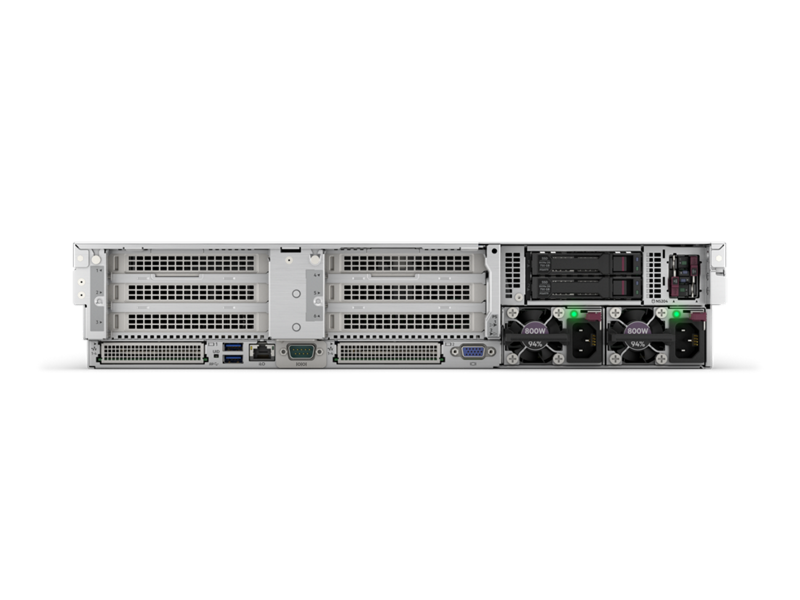
- 800 W Flex Slot Platinum
- 1000 W Flex Slot Titanium
- 1600 W Flex Slot Platinum
- 1600 W Flex Slot -48 VDC
Cooling and fans
Air cooling; 6 fans included, high-performance fan options depending on configuration
Dimensions
- Height: 87.5 mm (3.44 inches)
- Width: 448.0 mm (17.63 inches)
- Depth: up to 874.8 mm (34.44 inches)
- Weight: up to 41.41 kg (91.29 lb)
Form factor
2U rack server
Embedded management
- HPE iLO 6 Standard with Intelligent Provisioning
- HPE OneView Standard
- HPE iLO Advanced, optional
- HPE OneView Advanced, optional
- HPE Compute Ops Management
- Redfish API support
Security
- UEFI Secure Boot and Secure Start
- Immutable Silicon Root of Trust
- AMD Secure Processor integration for secure boot, memory encryption and secure virtualization
- IDevID certificates installed by default
- Secure Recovery with restoration of validated firmware
- Optional iLO security modes, TPM, chassis intrusion detection and bezel locking kits
Networking
- Choice of OCP and PCIe stand-up network adapters depending on model
- Wide range of speeds, cabling and chipsets
Ports
Front ports
- 1 x iLO Service Port
- 1 x USB 3.2 Gen1
- 1 x USB 2.0, optional
- 1 x DisplayPort, optional
Internal ports
- 1 x USB 3.2 Gen1
- 1 x USB 2.0
Rear ports
- 1 x dedicated 1GbE iLO Management Port
- 2 x USB 3.2 Gen1
- 1 x VGA
- 1 x Serial port, optional
PCIe expansion
Up to 8 x PCIe Gen5 slots and 2 x OCP slots
Optical drive
Optional DVD-ROM via Universal Media Bay; external support only
Operating systems and virtualization
- Microsoft Windows Server 2019, 2022, 2025
- VMware ESXi 7.0 U3; VMware ESXi 8.0, 8.0 U1, 8.0 U2, 8.0 U3; VMware ESX 9.0, 9.1
- Red Hat Enterprise Linux 8.6, 9.0, 10.0; AMD EPYC™ 9005 configurations require RHEL 8.10 or RHEL 9.4 minimum
- SUSE Linux Enterprise Server 15 SP4 and SLE Micro 5.3 for AMD EPYC™ 9004; SLES 16, SLES 15 SP5, SL Micro 6.2 and SLE Micro 5.5 for AMD EPYC™ 9005
- Canonical Ubuntu 20.04.5 LTS, 22.04 LTS, 24.04 LTS; AMD EPYC™ 9005 configurations require Ubuntu 22.04.5 LTS with 6.8.0 kernel minimum
- Oracle Linux 9.2 or 10.1 with UEK8U1 for AMD EPYC™ 9004; Oracle Linux 9.6 or 10.0 for AMD EPYC™ 9005
HPE ProLiant DL385 Gen11 overview
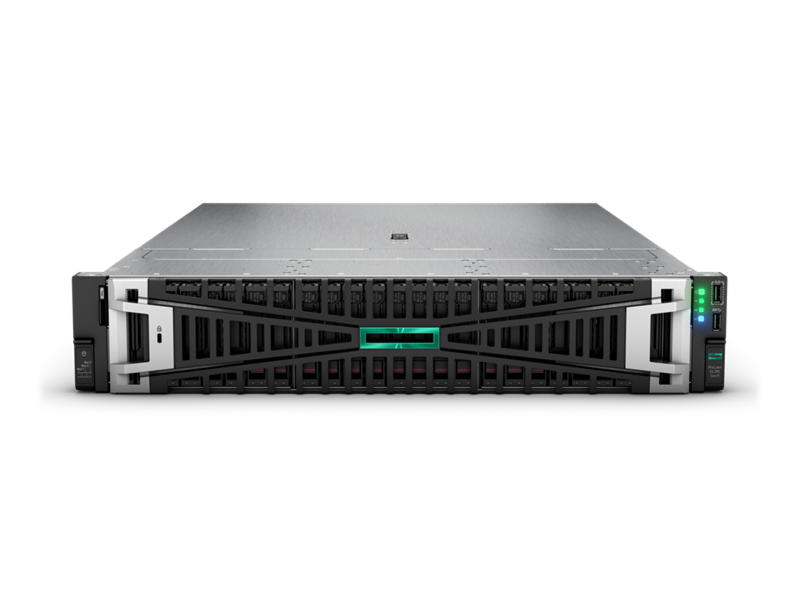
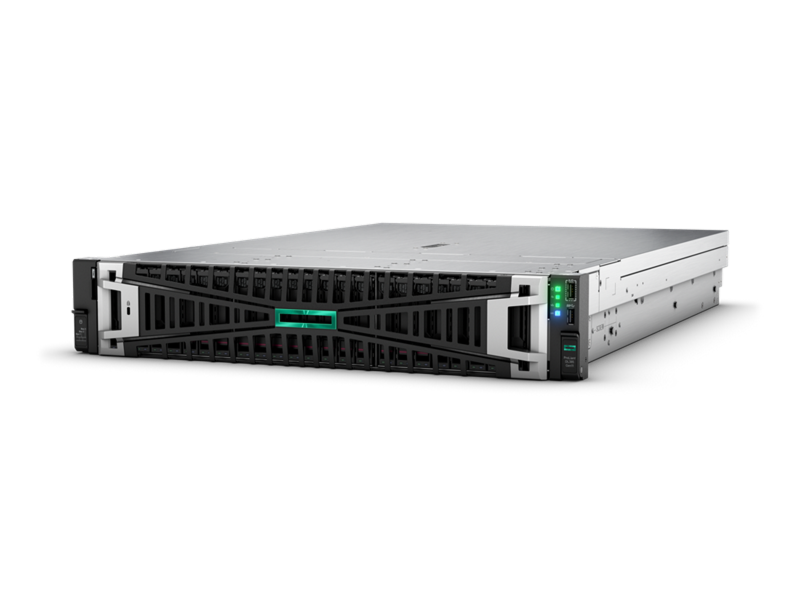
HPE ProLiant DL385 Gen11 is a flexible 2U, dual-socket rack server for enterprise workloads that need a strong balance of compute performance, memory bandwidth, storage flexibility, PCIe Gen5 expansion and accelerator support. As an HPE DL385 Gen11 2U rack server, it is based on 4th or 5th Generation AMD EPYC 9004/9005 processors, HPE DDR5 Smart Memory and HPE iLO 6 management.
The HPE ProLiant DL385 Gen11 server is suitable for virtualization, VDI, containers, databases, data management, software-defined storage, backup infrastructure, analytics, AI inference and GPU-accelerated applications. Compared with previous DL385 generations, Gen11 brings a newer AMD EPYC platform, DDR5 memory, PCIe Gen5 I/O, EDSFF storage options and stronger accelerator-oriented configuration choices.
When to choose HPE ProLiant DL385 Gen11
Choose HPE ProLiant DL385 Gen11 when the workload needs a standard 2U dual-socket AMD EPYC enterprise platform with room for compute, memory, local storage and accelerator growth. It is a good fit for virtualization clusters, private cloud nodes, container platforms, database servers, analytics systems, software-defined storage nodes and mixed infrastructure roles.
Compared with a 1U AMD server such as HPE ProLiant DL365 Gen11, the HPE DL385 Gen11 gives more physical space for drives, PCIe cards, GPU options, airflow and serviceability. If the project requires Intel processors, compare with HPE ProLiant DL380 Gen11; if single-socket AMD storage economics are the priority, compare with HPE ProLiant DL345 Gen11.
The HPE DL385 Gen11 configuration should be validated for processor generation, memory population, drive cage layout, storage controller, risers, OCP/NIC cards, power supplies, fans, heatsinks and cooling. This is especially important for NVMe, EDSFF, rear-drive, mid-tray, 48SFF and GPU CTO configurations.
Chassis and drive bay options
HPE ProLiant DL385 Gen11 supports several chassis and drive bay layouts. The right option depends on whether the server is being configured for balanced virtualization, high-density SSD storage, capacity-oriented HDD storage, NVMe performance, EDSFF flash storage or accelerator-heavy workloads.
| Chassis option | Best for | Comment |
|---|---|---|
| HPE DL385 Gen11 8SFF | Balanced virtualization, databases and mixed enterprise workloads | Starts with an 8 SFF layout and can expand with selected SFF, U.3 NVMe, mid-tray or rear SFF options. |
| HPE DL385 Gen11 8LFF | Capacity-oriented workloads, backup repositories and archive storage | Useful when 3.5-inch HDD capacity is important; selected builds can expand toward 12LFF plus mid-tray or rear options. |
| HPE DL385 Gen11 12LFF | Large local capacity, file services and storage-heavy infrastructure | Relevant when more front LFF capacity is required; rear 4LFF and mid-tray options can increase capacity in supported builds. |
| HPE DL385 Gen11 EDSFF NVMe configurations | High-performance NVMe storage and dense flash-oriented configurations | Supported CTO configurations can reach up to 36 EDSFF E3.S 1T drives; validate bandwidth, cabling, risers and cooling. |
| HPE DL385 Gen11 48SFF | Very dense SFF storage, SDS and high-capacity SSD pools | Designed for high SFF density with tri-mode controller options; validate controller bandwidth and serviceability. |
| HPE DL385 Gen11 GPU CTO configurations | VDI graphics, AI inference, analytics and GPU workloads | Selected builds support up to eight single-width or four double-width GPUs when power, risers and cooling are validated. |
For capacity workloads, LFF configurations are usually the practical starting point. For latency-sensitive databases, virtualization datastores and high-IO workloads, SFF SSD, U.3 NVMe or EDSFF NVMe configurations should be considered. NVMe and EDSFF support must be checked against the exact CTO model and backplane.
Final drive compatibility depends on the selected chassis, backplane or drive cage, storage controller, cabling, risers, cooling, power supplies and the HPE support matrix.
Recommended configurations by workload
| Workload | Recommended focus |
|---|---|
| Virtualization / private cloud | CPU cores, large DDR5 memory, SSD/NVMe where needed and redundant networking. |
| VDI | High RAM density, predictable CPU performance, fast profile storage and validated GPU when required. |
| Databases / data management | CPU choice aligned with licensing, enough RAM for cache, low-latency SSD/NVMe and protected storage. |
| Backup / archive | Capacity-oriented chassis, HDDs, moderate CPU/RAM and network throughput sized for backup windows. |
| Software-defined storage / HCI | Drive layout, HBA/JBOD or controller mode, cache strategy and redundant networking. |
| Mixed enterprise workloads | Balanced CPU, RAM, storage and NIC choices with headroom for maintenance and growth. |
How to choose CPU, RAM, RAID and storage
HPE ProLiant DL385 Gen11 supports 4th and 5th Generation AMD EPYC processors. Higher core counts help virtualization, containers, SDS and VDI, while higher frequency helps per-core-sensitive databases and business applications. Licensing should be checked before selecting the highest core count CPU.
4th Gen AMD EPYC configurations use DDR5-4800 options, while 5th Gen AMD EPYC configurations use DDR5-6400 options. High-TDP CPUs, GPU, 48SFF, EDSFF and mid-tray layouts can change heatsink, fan and cooling requirements.
Plan RAM around VM density, database cache, SDS cache, failover and growth. The platform provides 24 DIMM slots, 12 channels per processor and up to 6 TB with 24 × 256 GB RDIMM in supported two-processor configurations. LRDIMM and Persistent Memory are not supported.
Hardware RAID is suitable for classic protected arrays. For ZFS, Ceph, VMware vSAN, Proxmox/ZFS and other SDS designs, HBA/JBOD or software-controlled storage is usually preferred. HPE software RAID is not supported on AMD Gen11 servers.
LFF HDDs are capacity-oriented, SFF SSDs suit mixed applications, and U.3 NVMe or EDSFF NVMe fits latency-sensitive databases and high-IO workloads when supported by the exact CTO build.
HPE ProLiant DL385 Gen11 vs related HPE models
| Model | When to consider |
|---|---|
| HPE ProLiant DL365 Gen11 | Choose DL365 Gen11 when 1U AMD EPYC density is more important than maximum local storage or GPU flexibility. |
| HPE ProLiant DL345 Gen11 | Choose DL345 Gen11 for single-socket AMD EPYC 2U storage economics. |
| HPE ProLiant DL380 Gen11 | Choose DL380 Gen11 when Intel Xeon standardization is required. |
| HPE ProLiant DL325 Gen11 | Choose DL325 Gen11 for compact 1U single-socket AMD deployments. |
| HPE ProLiant DL385 Gen10 Plus v2 | Consider DL385 Gen10 Plus v2 when DDR4 and PCIe Gen4 are sufficient. |
Summary: is HPE ProLiant DL385 Gen11 the right server for your workload×
HPE ProLiant DL385 Gen11 is a strong 2U AMD EPYC enterprise server for virtualization, VDI, containers, databases, software-defined storage, backup, analytics, AI inference and selected GPU workloads. Choose it when you need DDR5 memory, PCIe Gen5, flexible SFF, LFF, U.3 NVMe, EDSFF and GPU-oriented layouts. Consider HPE ProLiant DL365 Gen11 for 1U AMD density, HPE ProLiant DL380 Gen11 for Intel 2U infrastructure or HPE ProLiant DL345 Gen11 for single-socket AMD storage economics. Before purchase, confirm CPU generation, RAM, storage, RAID/HBA, network, risers, cooling, PSU, GPU and warranty requirements.
asked
questions
Ask to consultant
The Servermall warranty includes:
- Access on a 24x7 basis (including holidays) to the Servermall Customer Service and Support organization for troubleshooting assistance of Servermall Refurbished Servers and Associated Goods and select software issues.
- 5 year warranty. In case of problem diagnostics or repair, we will do on the server installation site. For free.
- On-site dispatch of replacement parts to the Installation Site or other mutually agreed upon Customer’s business location approved by Servermall to address a Product problem.
Subscribe to our news and get a 50 € discount on the server.
Free shipping on orders over 500 € in the EU, £500 in the UK, and $3,000 in the USA. Delivery from 4 working days.
to Buy a Server
from Servermall
warranty
testing
We want to make sure that our equipment is fully reliable for you. That’s why all our equipment (even new) is subject to complete diagnostics, testing, and part replacement.
testing
We fully load our equipment with various utilities and software. Rest assured, it’ll work for a very long time.
Power supply
The components work at full capacity and are tested for several days. If we are not sure about something, we replace it.
of all equipment
Our regulations imply the same testing for both used and new equipment. Oh, and by the way, we complement the official manufacturer’s warranty with our own warranty.