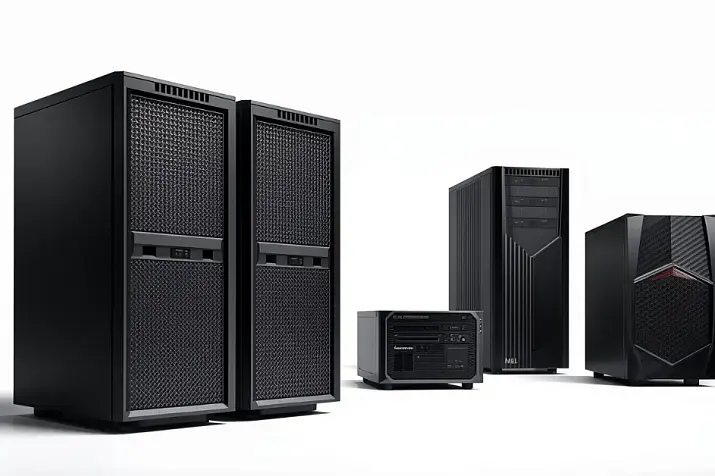
Choosing between the DELL PowerEdge R250 and DELL PowerEdge R350 is a common dilemma for companies seeking compact single-processor 15th generation servers. Both solutions are built on Intel Xeon E-2300 processors and target small to medium-sized businesses, yet they differ significantly in expansion capabilities, performance, and use case scenarios.
The primary distinction lies in scalability and functionality: the R250 is an entry-level 1U platform supporting up to 4 drives with limited expansion options, while the R350 offers a more versatile solution with support for up to 8 drives, hot-swap power supplies, and enhanced connectivity options. Where the R250 excels at simple tasks like file storage or basic web hosting, the R350 can handle more demanding workloads including small-scale virtualization and enterprise applications.
In this comprehensive comparison, we'll examine the technical specifications of both models, analyze their advantages and limitations, and provide clear recommendations for selecting the optimal solution for various business requirements.
DELL R250 vs R350 Comparison Table
| Specification | DELL PowerEdge R250 | DELL PowerEdge R350 |
|---|---|---|
| Model | DELL PowerEdge R250 | DELL PowerEdge R350 |
| Form Factor | 1U Rack | 1U Rack |
| Processor | Intel Xeon E-2300 (up to 8 cores) or Intel Pentium (up to 2 cores) | Intel Xeon E-2300 (up to 8 cores) or Intel Pentium (up to 2 cores) |
| Maximum Memory | 128 GB DDR4 (4 UDIMM slots, up to 3200 MHz) | 128 GB DDR4 (4 UDIMM slots, up to 3200 MHz) |
| Drive Bays | Up to 4 × 3.5" or 2 × 3.5" (cabled) | Up to 4 × 3.5" or 8 × 2.5" (hot-swap) |
| Maximum Storage Capacity | Up to 30.72 TB | Up to 128 TB |
| RAID Controllers | PERC H345, H755, HBA355i, S150 | PERC H355, H355f, H345, H345f, H755, H755f, HBA355i, HBA355f, S150 |
| Power Supplies | 450W Bronze/Platinum (cabled, non-hot-swap) | 600W Platinum (hot-swap, redundant) |
| PCIe Slots | 2 slots (low profile) | 3 PCIe Gen4 slots (low profile) |
| Network Adapters | 2 × 1GbE (embedded) | 2 × 1GbE (embedded) |
| iDRAC | iDRAC9 Express/Enterprise | iDRAC9 Express/Enterprise |
| Cooling | Standard fans (non-hot-swap) | Up to 4 cabled fans |
| Dimensions (H×W×D) | 42.8 × 482.6 × 598.64 mm | 42.8 × 482 × 598.94 mm |
| Use Cases | Basic tasks, file servers, print services, web hosting | Small-scale virtualization, database applications, medium workloads |
DELL PowerEdge R250: Overview and Specifications

The DELL PowerEdge R250 is a compact single-processor 1U server designed for organizations with fundamental computing requirements. Built on the Intel Xeon E-2300 platform, this model offers an optimal price-to-functionality ratio for small deployments.
DELL R250 Technical Specifications
- Processor: One Intel Xeon E-2300 series (up to 8 cores) or Intel Pentium (up to 2 cores), base configuration features Intel Xeon E-2324G (4 cores, 8MB cache, 3.10 GHz)
- Memory: 4 DDR4 UDIMM slots, maximum 128 GB, speeds up to 3200 MHz (2666 MHz for Pentium), base configuration includes 8 GB
- Storage: Up to 4 × 3.5" hot-swap SAS/SATA drives (maximum 30.72 TB with SSDs) or 2/4 × 3.5" cabled options
- RAID Controllers: PERC H345, H755, HBA355i, S150 (SATA disks only, 8 disks maximum)
- Boot Options: Internal Dual SD Module, USB, BOSS-S1 (2 × M.2 SSDs)
- Power Supplies: 450W Bronze (100-240 VAC, cabled) or 450W Platinum (100-240 VAC, cabled) — non-hot-swap
- Cooling: Standard cabled fans
- Network Adapters: 2 × 1GbE LOM (embedded)
- Expansion Slots: 2 × PCIe Gen4 (low profile, half length)
- Management: iDRAC9 Express/Enterprise, iDRAC Direct, iDRAC RESTful API with Redfish
- Security: TPM 2.0, Secure Boot, Silicon Root of Trust, Cryptographically signed firmware
- Dimensions: 42.8 mm (H) × 482.6 mm (W) × 598.64 mm (D) with bezel
- Supported OS: Ubuntu Server LTS, Citrix Hypervisor, Windows Server with Hyper-V, RHEL, SUSE Linux Enterprise Server, VMware ESXi
Who Should Choose DELL R250
The DELL PowerEdge R250 is an ideal choice for organizations requiring:
- Basic file servers — compact solution for file storage and sharing in small offices
- Print servers — managing print queues and centralized print processing for workgroups
- Simple web hosting — hosting corporate websites with moderate traffic or internal portals
- Entry-level application servers — running lightweight business applications without high resource demands
- Small business office servers — centralized data management for companies with 10-50 employees
- Development and testing environments — cost-effective platform for application development and testing
- Basic edge computing — simple data processing tasks in branch or remote offices
The primary advantage of the R250 lies in its affordability and simplicity. The absence of hot-swap power supplies and limited expansion slots make it less suitable for mission-critical applications, but ideal for scenarios where maintenance simplicity and low initial cost take priority.
Choosing the Right Equipment
Our specialists will contact you and answer all your questions
DELL PowerEdge R350: Overview and Specifications
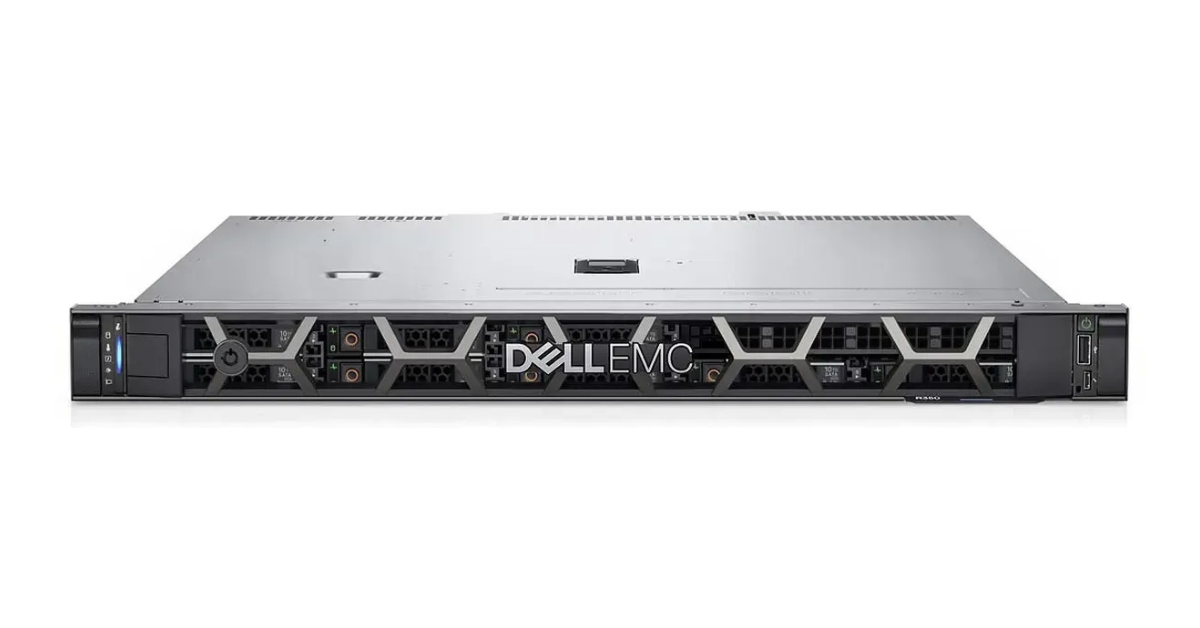
The DELL PowerEdge R350 is a more feature-rich model in the 15th generation single-processor server lineup, offering enhanced scalability options and improved fault tolerance. This platform is designed for companies with moderate computing and data storage requirements.
DELL R350 Technical Specifications
- Processor: One Intel Xeon E-2300 series (up to 8 cores) or Intel Pentium (up to 2 cores), base configuration features Intel Xeon E-2314 (4 cores, 8MB cache, 2.80 GHz)
- Memory: 4 DDR4 UDIMM slots, maximum 128 GB, speeds up to 3200 MHz (2666 MHz for Pentium), base configuration includes 8 GB
- Storage: Up to 4 × 3.5" SAS/SATA (maximum 64 TB) or up to 8 × 2.5" SAS/SATA (maximum 128 TB) with hot-swap capability
- RAID Controllers: PERC H355, H355f, H345, H345f, H755, H755f, HBA355i, HBA355f, S150 — extended options
- Boot Options: Internal Dual SD Module, USB, BOSS-S2 (2 × M.2 SSDs with hardware RAID)
- Power Supplies: 2 × 600W Platinum (100-240 VAC or 240 VDC) with hot-swap and redundancy
- Cooling: Up to 4 cabled fans
- Network Adapters: 2 × 1GbE LOM (embedded)
- Expansion Slots: 3 × PCIe Gen4 slots — more expansion opportunities
- Management: iDRAC9 Express/Enterprise, iDRAC Direct, iDRAC RESTful API with Redfish, iDRAC Service Module
- Security: TPM 1.2/2.0, TCM 2.0, Secure Boot, Silicon Root of Trust, System Lockdown
- Dimensions: 42.8 mm (H) × 482 mm (W) × 598.94 mm (D) with bezel
- Supported OS: Ubuntu Server LTS, Citrix Hypervisor, Windows Server with Hyper-V, RHEL, SUSE Linux Enterprise Server
- OEM Version: Full customization available — from bezel to BIOS and packaging
Who Should Choose DELL R350
The DELL PowerEdge R350 is optimal for organizations requiring:
- Small to medium-scale virtualization — running 5-15 virtual machines with moderate resource requirements
- Database servers — hosting small to medium databases (SQL Server, MySQL, PostgreSQL) with fault tolerance requirements
- Enterprise applications — ERP, CRM, and other business applications for companies up to 100 users
- Medium-load file servers — centralized storage with enhanced capacity requirements (up to 128 TB)
- Email servers — Microsoft Exchange or other mail servers for medium-sized organizations
- Domain controllers — Active Directory and other directory services with reliability requirements
- Monitoring and management — servers for infrastructure monitoring systems, backup, and centralized management
- Development and testing environments — more powerful platform for DevOps and CI/CD pipelines
The key advantage of the R350 is hot-swap power supplies with redundancy, ensuring continuity for mission-critical applications. The increased number of PCIe slots and support for up to 8 × 2.5" drives make this model significantly more flexible for various use case scenarios.
Detailed Capability Comparison
Processor Performance
Both models use the same Intel Xeon E-2300 processor line, meaning identical computing capabilities when selecting the same CPU. The base R250 configuration ships with Xeon E-2324G (4 cores, 3.10 GHz), while the R350 comes with Xeon E-2314 (4 cores, 2.80 GHz). Both models support upgrades to 8-core E-2388G processors with frequencies up to 5.1 GHz in turbo mode.
However, real-world performance in multitasking scenarios will be higher for the R350 due to more efficient cooling and the ability to install additional expansion cards for accelerating specific tasks.
Memory and Bandwidth
Both servers offer 4 DDR4 UDIMM slots with maximum capacity of 128 GB and speeds up to 3200 MHz. This means identical memory capabilities. However, the R350 has an advantage in configurations with more DIMM modules thanks to improved cooling, allowing stable frequencies even when all slots are fully populated.
Storage Subsystem
This is where differences become critical:
DELL R250:
- Up to 4 × 3.5" drives (maximum 30.72 TB with SSDs)
- Cabled connection options (2 or 4 drives)
- Limited RAID controller support
- Base configuration uses RAID S150 (SATA only, 8 disks maximum)
DELL R350:
- Up to 8 × 2.5" drives (maximum 128 TB) or 4 × 3.5" (maximum 64 TB)
- Hot-swap for all configurations
- Extended RAID controller support, including advanced H755f models
- Ability to use SAS drives for improved performance
The R350 clearly wins in scenarios requiring large storage capacity or high disk subsystem performance. Hot-swap drives also enable maintenance without system downtime.
Fault Tolerance and Reliability
The critical difference between models lies in their approach to reliability:
DELL R250:
- Single power supply without hot-swap
- Standard cooling without redundancy
- Suitable for non-critical applications or with external UPS
DELL R350:
- Redundant 2 × 600W power supplies with hot-swap
- Ability to continue operations if one PSU fails
- Suitable for 24/7 mission-critical applications
If your application requires high availability, the R350 is the only reasonable choice between these two models.
Expansion Capabilities
The R250 offers 2 PCIe Gen4 slots (low profile), while the R350 provides 3 PCIe Gen4 slots. The additional slot in the R350 allows simultaneous installation of a network card, RAID controller, and an expansion card (such as additional USB ports or specialized I/O card).
Management and Monitoring
Both models feature iDRAC9 — Dell's intelligent remote management platform. Functionality is identical in Express and Enterprise versions, enabling remote management, health monitoring, firmware updates, and problem diagnostics via web interface or API.
Power Consumption and Heat Output
The R250 with 450W power supply has lower energy consumption in basic configurations, making it more economical for simple tasks. The R350 with two 600W power supplies consumes more energy but provides redundancy and the ability to connect more powerful components.
At full load with maximum drives and peripherals:
- R250: approximately 250-350 Watts
- R350: approximately 300-450 Watts
Our most popular servers

Free shipping on orders over 500 € in the EU, £500 in the UK, and $3,000 in the USA
Free shipping on orders over 500 € in the EU, £500 in the UK, and $3,000 in the USA
Free shipping on orders over 500 € in the EU, £500 in the UK, and $3,000 in the USA

Free shipping on orders over 500 € in the EU, £500 in the UK, and $3,000 in the USA
Practical Use Case Scenarios
Scenario 1: Small Business (10-30 employees)
Requirements: File server, printing, basic document storage, no 24/7 operation required
Recommendation: DELL PowerEdge R250
Rationale: For a small office with basic needs, the R250 provides sufficient performance at minimal cost. A configuration with 4-core Xeon E-2324G, 16 GB RAM, and 4 × 2 TB SATA drives in RAID 5 will ensure reliable storage and fast file access. The absence of redundant power supplies is compensated by installing an external UPS.
Scenario 2: Medium Business with Critical Applications (50-100 employees)
Requirements: Database server, virtualization, high availability required, 24/7 operation
Recommendation: DELL PowerEdge R350
Rationale: Mission-critical applications require hardware-level redundancy. The R350 with dual power supplies, 8-core processor configuration, 64 GB RAM, and 8 × 960 GB SAS SSDs in RAID 10 will provide necessary performance and fault tolerance. Hot-swap drives enable maintenance without work interruption.
Scenario 3: Development and Testing Virtualization
Requirements: Running 5-10 virtual machines, development environment, medium load
Recommendation: DELL PowerEdge R350
Rationale: Virtualization requires good disk subsystem performance and sufficient memory capacity. The R350 with 6-8 core processor, 128 GB RAM, and 4 × 1.92 TB NVMe SSDs will ensure comfortable operation of VMware ESXi or Hyper-V hypervisor with multiple virtual machines.
Scenario 4: Branch or Remote Office
Requirements: Local storage, caching, ease of maintenance, limited budget
Recommendation: DELL PowerEdge R250
Rationale: For branches without dedicated IT personnel, maintenance simplicity and reliability are more important than maximum performance. The R250 with iDRAC9 enables remote management from the head office, while the compact configuration minimizes server room requirements.
Scenario 5: Backup Server
Requirements: Large storage capacity, medium performance, daily backup operations
Recommendation: DELL PowerEdge R350
Rationale: Backup requires maximum storage capacity. The R350 with configuration of 8 × 16 TB SATA drives (128 TB) in RAID 6 will provide sufficient space for storing multiple data copies with protection against dual disk failures.
Choosing the Right Equipment
Our specialists will contact you and answer all your questions
Selection Recommendations
Choose DELL PowerEdge R250 if:
- Your budget is limited and you need a basic server solution
- Applications don't require 24/7 operation or have low availability requirements
- You need up to 4 drives and capacity up to 30 TB
- You require a simple file server, print server, or basic web hosting
- You have an external UPS for backup power
- Your organization is small (up to 30-50 users)
- You don't need hot-swap components
- You're looking for a testing or development environment solution
Choose DELL PowerEdge R350 if:
- High availability with power supply redundancy is required
- You plan to virtualize multiple virtual machines
- You need storage capacity exceeding 30 TB (up to 128 TB)
- Hot-swap drive capability without system shutdown is important
- Applications are mission-critical and operate 24/7
- You need to run medium-load databases
- More expansion slots are needed for additional cards
- You plan to use the server for enterprise applications (ERP, CRM)
- Your organization is medium-sized (50-150 users)
Selection Criteria: Checklist
Before making a decision, answer these questions:
- How critical are the applications? If work cannot be interrupted — choose R350
- What data volume needs to be stored? More than 30 TB — only R350
- Is virtualization needed? For more than 2-3 VMs, R350 is recommended
- What's the project budget? Limited budget — R250 will be optimal
- Is there on-site IT personnel? For remote offices without IT — R250 is simpler to maintain
- Is future expansion planned? R350 offers more upgrade opportunities
- What level of redundancy is required? Critical systems require redundant PSUs in R350
Configuration Advice
For DELL R250:
- Minimum: Xeon E-2324G, 16 GB RAM, 2 × 2 TB SATA HDD
- Optimal: Xeon E-2356G, 32 GB RAM, 4 × 2 TB SSD in RAID 5
- Maximum: Xeon E-2388G, 128 GB RAM, 4 × 7.68 TB SSD
For DELL R350:
- Minimum: Xeon E-2324G, 16 GB RAM, 4 × 2 TB SATA HDD
- Optimal: Xeon E-2378G, 64 GB RAM, 8 × 960 GB SSD in RAID 10
- Maximum: Xeon E-2388G, 128 GB RAM, 8 × 15.36 TB SAS SSD
Price-to-Performance Ratio
When choosing between R250 and R350, it's important to consider not only initial cost but also total cost of ownership (TCO) throughout the server lifecycle.
Ownership Cost Factors
DELL R250:
- Lower initial cost (20-30% cheaper than base configuration)
- Lower power consumption in simple configurations
- Simpler maintenance (fewer components)
- However, may require more frequent replacement as requirements grow
DELL R350:
- Higher initial cost but better scalability
- Redundancy reduces downtime risk and associated costs
- Hot-swap components minimize maintenance time
- Greater performance headroom for business growth
ROI Calculation
For mission-critical applications, the cost of one hour of downtime can significantly exceed the price difference between models. If your application generates revenue or its stoppage is critical for business processes, the investment in R350 with redundant PSUs will pay for itself after preventing a single incident.
For non-critical applications where 2-4 hour recovery time is acceptable, savings from R250 can be directed toward creating a backup server or improving the backup system.
Top-selling network switches
Free shipping on orders over 500 € in the EU, £500 in the UK, and $3,000 in the USA

Free shipping on orders over 500 € in the EU, £500 in the UK, and $3,000 in the USA

Free shipping on orders over 500 € in the EU, £500 in the UK, and $3,000 in the USA

Free shipping on orders over 500 € in the EU, £500 in the UK, and $3,000 in the USA
Development Prospects and Modernization
DELL R250 Upgrade Options
- Processor: up to 8-core Xeon E-2388G
- Memory: up to 128 GB (4 × 32 GB)
- Storage: limited to 4 drives
- Expansion: 2 PCIe slots
- Limitations: impossible to add redundant power
DELL R350 Upgrade Options
- Processor: up to 8-core Xeon E-2388G
- Memory: up to 128 GB (4 × 32 GB)
- Storage: up to 8 × 2.5" or 4 × 3.5" drives
- Expansion: 3 PCIe slots
- Advantage: redundant power included from the start
Both models have similar processor and memory upgrade potential, but the R350 offers significantly more opportunities for storage and peripheral expansion. This makes it a more future-proof solution for growing businesses.
Alternative Options
If neither the R250 nor R350 meets your requirements, consider the following alternatives from the DELL lineup:
If more performance is needed:
DELL PowerEdge R450 — dual-processor 1U server supporting 3rd Gen Intel Xeon Scalable processors, up to 1 TB RAM, and more powerful cooling system. Ideal for medium to large-scale virtualization environments.
DELL PowerEdge R550 — dual-processor 2U server supporting up to 16 drives with enhanced storage capabilities. Suitable for medium to high-load databases.
If tower format is needed:
DELL PowerEdge T150 — tower server on Xeon E-2300 platform similar to R250, but in chassis for office installation without rack.
DELL PowerEdge T350 — tower version of R350 with same capabilities but in tower format for office installation.
If budget is limited:
Consider purchasing certified refurbished servers from previous generations — for example, DELL R340 or DELL R440 14th generation, which can offer similar functionality at lower cost.
Conclusion
The choice between DELL PowerEdge R250 and DELL PowerEdge R350 ultimately comes down to balancing budget, fault tolerance requirements, and infrastructure growth plans.
R250 is a cost-effective solution for non-critical applications, small businesses, and scenarios where simplicity is more important than redundancy. Its advantages include low entry cost, easy setup and maintenance, compactness, and energy efficiency.
R350 is a professional solution for businesses requiring reliability, scalability, and readiness for growth. Redundant power supplies, hot-swap drives, increased storage capacity, and additional expansion slots make it the optimal choice for mission-critical applications and virtualization.
For most medium-sized organizations, the investment in R350 is justified by additional reliability and expansion capabilities. However, for small businesses with limited budgets and basic requirements, the R250 represents an excellent price-to-functionality ratio.
Regardless of your choice, both models are quality DELL products with full support for modern operating systems, hypervisors, and enterprise management tools, guaranteeing compatibility with your existing infrastructure and easy integration into corporate environments.
For detailed consultation and assistance in selecting the optimal configuration, visit the ServerMall server catalog, where you'll find a complete range of DELL server solutions with detailed specifications and current pricing.