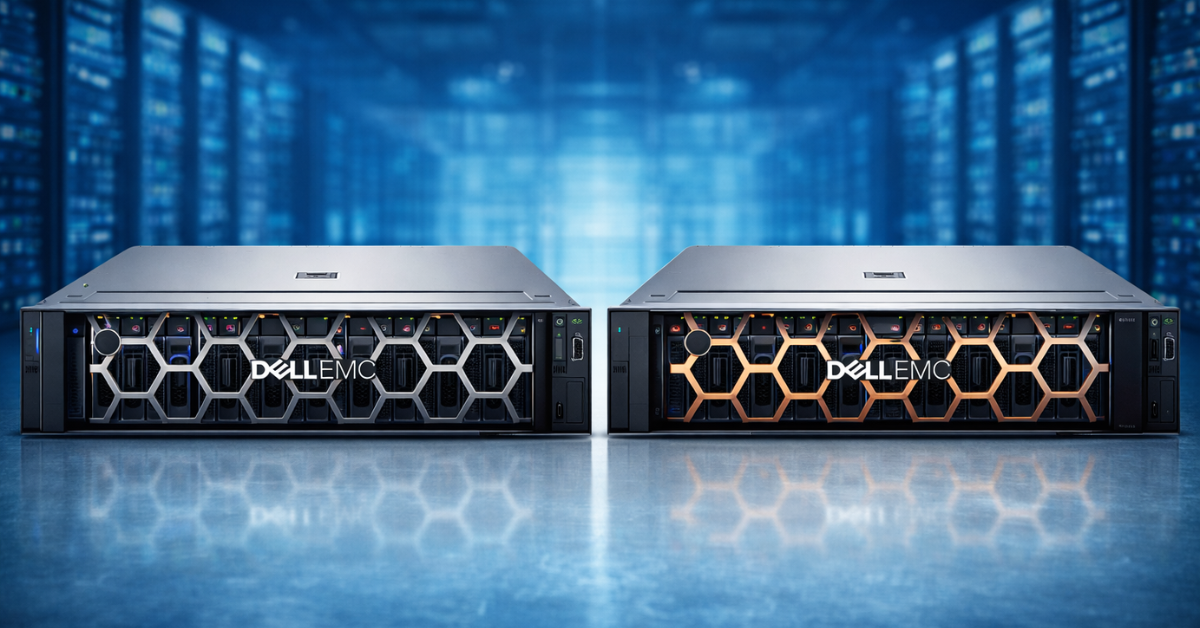
When choosing between the DELL PowerEdge R750 and DELL PowerEdge R750xs, IT administrators and business owners face a critical decision that determines the performance and scalability of their infrastructure. Both models belong to DELL's 15th generation servers and are built on 3rd Generation Intel Xeon Scalable processors, but they have fundamental differences in architecture, expansion slot count, and maximum memory capacity.
The DELL PowerEdge R750 represents a universal workhorse for enterprise data centers with support for up to 32 DDR4 memory slots and a maximum RAM capacity of 4 TB when using LRDIMM modules. The server features up to 8 PCIe Gen4 slots, providing exceptional flexibility for installing GPU accelerators, network adapters, and other expansion cards. The R750 is ideal for virtualization, databases, big data analytics, and applications requiring high computational power.
The DELL PowerEdge R750xs, on the other hand, is optimized for deployments where storage density is critical while maintaining high performance. The xs model features 16 DDR4 memory slots with a maximum capacity of 1 TB and offers up to 6 PCIe Gen4 slots. The key advantage of the R750xs lies in its expanded storage capabilities: support for up to 24 drives in the front chassis versus 24 on the R750, but with different bay configurations making the xs version attractive for storage systems, file servers, and tasks where disk subsystem capacity is the priority.
DELL R750 and R750xs Comparison Table
| Feature | DELL PowerEdge R750 | DELL PowerEdge R750xs |
|---|---|---|
| Processors | Up to two 3rd Gen Intel Xeon Scalable, up to 40 cores each | Up to two 3rd Gen Intel Xeon Scalable, up to 32 cores each |
| Memory Slots | 32 DDR4 DIMM slots | 16 DDR4 DIMM slots |
| Maximum RAM | Up to 4 TB (LRDIMM) / 2 TB (RDIMM) | Up to 1 TB (RDIMM) |
| Memory Speed | Up to 3200 MHz | Up to 3200 MHz |
| Front Bays | Up to 12×3.5" / 16×2.5" / 24×2.5" / 8×NVMe | Up to 12×3.5" / 16×2.5" / 8×NVMe / hybrid configurations |
| Rear Bays | Up to 2×2.5" or 4×2.5" | Up to 2×2.5" |
| PCIe Gen4 Slots | Up to 8 slots (up to 6×x16) | Up to 5 PCIe Gen4 + 1 PCIe Gen3 slots |
| GPU Support | Up to two double-width 300W or four single-width 150W or six single-width 75W | Not supported |
| Power Supplies | 800W / 1100W / 1400W Platinum/Titanium | 600W / 800W / 1100W / 1400W Platinum/Titanium |
| Form Factor | 2U Rack | 2U Rack |
| Depth | 758.3 mm (without bezel) | 707.78 mm (without bezel) |
| Use Cases | Virtualization, databases, HPC, AI/ML | Storage systems, file servers, archiving |
DELL PowerEdge R750: Flagship Versatility

The DELL PowerEdge R750 server represents the benchmark for performance in the dual-processor, two-unit server segment. The platform architecture is built around 3rd Generation Intel Xeon Scalable processors with support for up to 40 cores per socket, delivering up to 80 cores in a single system. This configuration makes the R750 an ideal solution for tasks requiring massive parallel data processing.
DELL PowerEdge R750 Technical Specifications
- Processors: Up to two 3rd Gen Intel Xeon Scalable, up to 40 cores per processor
- Memory: 32 DDR4 DIMM slots, supports RDIMM up to 2 TB or LRDIMM up to 4 TB, speeds up to 3200 MHz
- Persistent Memory: Up to 16 Intel Persistent Memory 200 series (BPS) slots, 8 TB maximum
- Storage Controllers: PERC H745, HBA355I, S150, H345, H755, H755N (internal); PERC H840, HBA355E (external)
- Boot Modules: BOSS-S1 or BOSS-S2 (RAID 2×M.2 SSD 240 GB or 480 GB)
- Front Bays: Up to 12×3.5" SAS/SATA (max 192 TB), or up to 8×2.5" NVMe (max 122.88 TB), or up to 16×2.5" SAS/SATA/NVMe (max 245.76 TB), or up to 24×2.5" SAS/SATA/NVMe (max 368.84 TB)
- Rear Bays: Up to 2×2.5" or 4×2.5" SAS/SATA/NVMe (max 30.72 TB or 61.44 TB)
- Power Supplies: 800W Platinum, 1100W Titanium, 1400W Platinum (AC/240 Mixed Mode), 1100W DC (-48 to -60 V)
- Cooling: Standard air cooling, optional processor liquid cooling
- Fans: Up to six hot-plug (Standard/High Performance SLVR/High Performance GOLD)
- Expansion Slots: Up to 8 PCIe Gen4 slots (up to 6×x16) with SNAP I/O module support
- GPU Support: Up to two double-width 300W, or four single-width 150W, or six single-width 75W accelerators
- Network Options: 1×OCP 3.0 (x8 PCIe lanes), embedded 2×1 GbE LOM adapter
- Management: iDRAC9, iDRAC Direct, Quick Sync 2 wireless module
- Security: Cryptographically signed firmware, Secure Boot, Secure Erase, Silicon Root of Trust, System Lockdown, TPM 1.2/2.0
- Dimensions: Height 86.8 mm (3.41"), width 482 mm (18.97"), depth 758.3 mm (29.85") without bezel
- Form Factor: 2U rack server
Who Should Choose DELL PowerEdge R750
The DELL PowerEdge R750 targets organizations requiring maximum compute density and configuration flexibility. The server excels with virtualization platforms VMware vSphere, Microsoft Hyper-V, and Citrix Hypervisor thanks to the massive memory capacity of up to 4 TB. The ability to install up to six GPUs makes the R750 an attractive choice for artificial intelligence, machine learning, and deep neural network training tasks.
Enterprise databases Oracle, Microsoft SQL Server, PostgreSQL, and MySQL gain significant performance improvements from the large processor core count and high-speed DDR4-3200 memory. For Enterprise Resource Planning (ERP) systems like SAP HANA, the R750 offers Intel Optane Persistent Memory support, enabling ultra-fast in-memory transaction processing.
The high-performance computing (HPC) sector also benefits from the R750 architecture: scientific calculations, financial modeling, engineering analysis, and rendering gain a powerful platform with compute resource scalability. Eight PCIe Gen4 slots enable specialized configurations with FPGA accelerators, high-speed 100GbE/200GbE network adapters, and NVMe drives for maximum storage throughput.
Choosing the Right Equipment
Our specialists will contact you and answer all your questions
DELL PowerEdge R750xs: Storage Optimization

The DELL PowerEdge R750xs model positions itself as a specialized solution for deployments where the balance between processing performance and data storage capacity is critical. The "xs" (extra storage) designation clearly indicates the platform's focus: while maintaining a powerful compute base with two 3rd Gen Intel Xeon Scalable processors, the server is optimized for accommodating a large number of drives in a compact 2U form factor.
DELL PowerEdge R750xs Technical Specifications
- Processors: Up to two 3rd Gen Intel Xeon Scalable, up to 32 cores per processor
- Memory: 16 DDR4 DIMM slots, supports RDIMM up to 1 TB, speeds up to 3200 MHz
- Storage Controllers: PERC H345, H355, H745, H755, H755N, HBA355i, S150 (internal); PERC H840, HBA355E (external)
- Boot Modules: Internal Dual SD Module, BOSS-S2 (RAID 2×M.2 SSD), USB
- Front Bays: 0 bays or up to 8×3.5" SAS/SATA (max 128 TB), or up to 12×3.5" SAS/SATA (max 192 TB), or up to 8×2.5" SAS/SATA/NVMe (max 61.44 TB), or up to 16×2.5" SAS/SATA (max 122.88 TB), or hybrid configuration 16×2.5" SAS/SATA + 8×2.5" NVMe (max 184.32 TB)
- Rear Bays: Up to 2×2.5" SAS/SATA/NVMe (max 15.36 TB)
- Power Supplies: 600W/800W Platinum, 1100W Titanium, 1400W Platinum (Mixed Mode 100-240Vac or 240Vdc), 1100W DC (-48 to -60 V)
- Cooling: Standard air cooling
- Fans: Up to six hot-plug (Standard/High Performance Silver/High Performance Gold)
- Expansion Slots: Up to 5 PCIe Gen4 slots + 1 PCIe Gen3 slot (3×x16 Gen4 low profile, 2×x16 Gen4 low profile optional, x8 Gen3 x4 lane low profile)
- GPU Support: Not supported
- Network Options: 1×OCP 3.0, embedded 2×1 GbE LOM adapter
- Management: iDRAC9, iDRAC Direct, Quick Sync 2 wireless module
- Security: Cryptographically signed firmware, Secure Boot, Secure Erase, Silicon Root of Trust, System Lockdown, TPM 1.2/2.0
- Dimensions: Height 86.8 mm (3.41"), width 482 mm (18.97"), depth 707.78 mm (27.85") without bezel
- Form Factor: 2U rack server
Who Should Choose DELL PowerEdge R750xs
The DELL PowerEdge R750xs is designed for organizations building scalable data storage systems in software-defined architectures. Software-Defined Storage (SDS) platforms such as VMware vSAN, Microsoft Storage Spaces Direct, Red Hat Ceph Storage, and Nutanix gain an ideal hardware foundation: high disk density combined with sufficient compute power for metadata processing and data replication.
Enterprise-class file servers and NAS systems find the optimal balance of characteristics in the R750xs. Support for up to 12 drives in 3.5" format enables creating high-capacity arrays for storing unstructured data, media content, backup archives, and video surveillance systems. Hybrid configurations combining SAS/SATA HDD for capacity and NVMe SSD for caching provide high performance at an acceptable storage cost.
Backup and disaster recovery systems benefit from the R750xs' expanded drive accommodation capabilities. Solutions like Veeam Backup & Replication, Commvault, and Veritas NetBackup find sufficient capacity for local backup repositories, while processor power ensures fast data deduplication and compression.
Databases with large volumes of historical data, analytics systems, and data warehousing are also target applications for the R750xs. Although RAM is limited to 1 TB versus 4 TB on the senior model, this is sufficient for many scenarios where the working dataset fits in memory while the bulk of information is stored on disks with high sequential access speeds.
Key Architectural Differences
Memory Subsystem
The most significant difference between the R750 and R750xs lies in the memory subsystem architecture. The DELL PowerEdge R750 features 32 DDR4 DIMM slots distributed across eight channels per processor (8 channels × 2 processors × 2 DIMMs per channel). This configuration provides maximum memory bandwidth and enables reaching 4 TB when using 128 GB LRDIMM modules.
The R750xs has 16 DDR4 DIMM slots with eight channels per processor configuration, but only one DIMM per channel (8 channels × 2 processors × 1 DIMM per channel). This limits maximum memory to one terabyte using 64 GB RDIMM modules. Importantly, memory bandwidth when all slots are populated remains identical between both models thanks to the same number of channels, but the R750 offers greater scaling potential.
PCIe Expansion Slots
The DELL PowerEdge R750 offers up to eight PCIe Gen4 slots with configuration up to six x16 slots, providing maximum flexibility for installing expansion cards. SNAP I/O module support enables using low-profile adapters in some slots without sacrificing the total number of available connectors. This architecture is critical for configurations with multiple GPUs, high-speed network adapters, and specialized accelerators.
The R750xs features five PCIe Gen4 slots plus one PCIe Gen3 slot, with all slots having a low-profile form factor to ensure compatibility with expanded drive configurations. The lack of GPU support is a direct consequence of prioritizing space for drive bays and the reduced number of expansion slots.
Storage Configurations
Both models support a wide range of drive configurations, but with different emphases. The R750 focuses on performance with options up to 24 drives in 2.5" format including eight slots for NVMe SSDs, providing maximum random access speeds for databases and virtualization. The 12-drive 3.5" configuration provides a balance between capacity and performance.
The R750xs offers a unique hybrid configuration of 16×2.5" SAS/SATA + 8×2.5" NVMe, enabling tiered storage creation with hot data on NVMe and archival data on SAS/SATA within a single server. The 12-drive 3.5" configuration provides maximum capacity up to 192 TB using 16 TB HDDs each, making the platform attractive for object storage and archiving systems.
Performance Comparison
Compute Power
The DELL PowerEdge R750 with two Intel Xeon Platinum 8380 processors (40 cores each at 2.3 GHz base, Turbo up to 3.4 GHz) delivers 80 compute cores and 160 threads through Hyper-Threading. This configuration provides exceptional performance in multi-threaded applications: SPECrate2017_int_base testing shows results in the 500-550 range depending on memory configuration and cooling.
The R750xs with two Intel Xeon Gold 6348 processors (32 cores each at 2.6 GHz base, Turbo up to 3.5 GHz) delivers 64 cores and 128 threads. SPECrate2017_int_base results are in the 420-460 range. Despite fewer cores, the higher base frequency of Gold processors provides competitive performance in single-threaded tasks and applications with moderate parallelism.
Memory Bandwidth
Both platforms support DDR4-3200 memory with eight channels per processor, providing theoretical bandwidth up to 204.8 GB/s per processor or 409.6 GB/s per system in a dual-processor configuration. STREAM Triad testing shows real bandwidth around 380-390 GB/s for both models with all memory slots populated.
The critical difference manifests in scenarios with large working datasets. The R750 with 4 TB memory enables keeping multi-terabyte databases entirely in RAM, completely avoiding disk subsystem access. The R750xs with a 1 TB maximum requires more careful planning of data distribution between memory and drives, using SSDs as an intermediate caching tier.
Storage Performance
The R750 in a configuration with eight NVMe SSDs (such as Intel Optane P5800X at 1.6 TB each) provides aggregate performance around 56 million input/output operations per second (IOPS) for random 4KB reads and throughput up to 112 GB/s for sequential operations. These characteristics are critical for high-load OLTP databases and virtualization systems with many virtual machines.
The R750xs in a hybrid configuration of 8×NVMe + 16×SAS SSD demonstrates performance around 35-40 million IOPS on the hot tier (NVMe) and additionally 1.5-2 million IOPS on the warm tier (SAS SSD). A configuration with 12×3.5" 16TB HDDs each (such as Seagate Exos X16) provides throughput up to 3 GB/s for sequential reads, sufficient for streaming video and backup systems.
Our most popular servers

Free shipping on orders over 500 € in the EU, £500 in the UK, and $3,000 in the USA
Free shipping on orders over 500 € in the EU, £500 in the UK, and $3,000 in the USA
Free shipping on orders over 500 € in the EU, £500 in the UK, and $3,000 in the USA

Free shipping on orders over 500 € in the EU, £500 in the UK, and $3,000 in the USA
Use Case Scenarios
Virtualization and Cloud Infrastructure
The DELL PowerEdge R750 is an excellent choice for enterprise-class virtualization platforms. A 4 TB memory configuration enables hosting 100-150 medium-sized virtual machines (16-32 GB RAM each) or 30-50 large virtual machines (64-128 GB RAM each). VMware vSphere with vMotion and DRS gains sufficient resources for dynamic load balancing across cluster hosts.
The R750xs is better suited for hyperconverged infrastructure (HCI) deployments based on VMware vSAN or Nutanix, where each node acts simultaneously as a compute server and storage node. A 1 TB memory configuration supports 30-40 medium-sized virtual machines, while the expanded disk subsystem provides local storage for all VMs using tier architecture: NVMe for active data and SAS/SATA for cold data.
Databases and Analytics
For large transactional databases like Oracle Database, Microsoft SQL Server, or PostgreSQL, the DELL PowerEdge R750 with maximum memory is preferable. In-memory databases like SAP HANA require holding the entire dataset in RAM, and the R750 configuration with 4 TB RAM enables processing datasets of 3-3.5 TB accounting for operating system and buffer reserves.
The R750xs targets data warehousing and OLAP system scenarios where large volumes of historical data are stored on disks with periodic aggregations in memory. Solutions like Apache Hadoop, Cloudera, or Hortonworks find in the R750xs a balance between compute resources for MapReduce tasks and capacity for storing the distributed Hadoop Distributed File System (HDFS).
Artificial Intelligence and Machine Learning
The DELL PowerEdge R750 with support for up to six NVIDIA A100 or A40 GPUs becomes a powerful platform for training deep neural networks. A configuration with four A100 GPUs (80 GB HBM2e each) and 2 TB system DDR4 memory provides performance around 2.5 petaflops in half-precision operations (FP16) for computer vision and natural language processing tasks.
The R750xs does not support GPUs, excluding it from consideration for intensive ML/AI workloads. However, the server can serve as a training dataset storage node in distributed ML clusters, providing high-speed access to petabytes of images, video, or text corpora via NFS or S3-compatible object protocols.
Data Storage Systems
The DELL PowerEdge R750xs is the optimal choice for building software-defined storage systems. Red Hat Ceph Storage in a configuration with 12 drives of 3.5" at 16 TB per node and three replication nodes provides usable capacity around 192 TB per server or 576 TB for a minimum three-node cluster. Performance reaches 3-4 GB/s per node for sequential reads.
The R750 can be used in SDS systems requiring high performance with moderate capacity. A configuration with 24 NVMe drives of 3.84 TB provides 92 TB capacity per server with performance up to 50 million IOPS, critical for block storage supporting high-load databases or real-time transaction processing systems.
Choosing the Right Equipment
Our specialists will contact you and answer all your questions
Scalability and Expansion
Network Infrastructure
Both platforms support an embedded 2×1 GbE adapter based on Intel i350 and one OCP 3.0 slot for installing modular network adapters. The DELL PowerEdge R750 with eight PCIe slots enables installing up to four dual-port 100GbE network adapters or two quad-port 25GbE adapters for building high-performance HPC clusters or converged Ethernet networks for iSCSI/NFS traffic.
The R750xs with five PCIe Gen4 slots supports up to two 100GbE network adapters or three 25GbE adapters, sufficient for most data storage scenarios. It's important to consider that when using the maximum drive configuration, some slots may be occupied by additional SAS controllers or adapters for rear drive bays.
Management and Monitoring
Both models feature an integrated iDRAC9 controller with support for remote management, virtual console, and virtual media. The Quick Sync 2 wireless module enables server configuration via mobile application without network connection. Integration with OpenManage Enterprise provides centralized server fleet management, firmware update automation, and component health monitoring.
The DELL PowerEdge R750 with optional iDRAC9 Datacenter module supports advanced security features including Secure Enterprise Key Manager for disk encryption key management and System Lockdown to prevent unauthorized BIOS and firmware configuration changes. The R750xs offers identical management capabilities, ensuring a uniform administration experience in heterogeneous environments.
Power Consumption and Cooling
Power Supplies
The DELL PowerEdge R750 offers power supplies rated at 800W Platinum, 1100W Titanium, and 1400W Platinum with 1+1 or 2+2 redundancy configuration options. Typical server power consumption in a configuration with two Xeon Gold 6348 processors (235W TDP each), 512 GB DDR4 memory, and eight NVMe SSDs is 550-650W under average load and up to 900-1000W under peak loads with Turbo Boost enabled.
The R750xs with 600W/800W Platinum, 1100W Titanium, and 1400W Platinum power supplies demonstrates typical power consumption of 450-550W in a configuration with two processors, 256 GB memory, and 12 HDDs in 3.5" format. Less memory and no GPUs result in 15-20% lower overall power consumption compared to a similarly loaded R750.
Cooling Systems
Both models use hot-swappable fans with N+1 redundancy support. The DELL PowerEdge R750 offers optional liquid cooling for processors in configurations with high TDP processors (250W+) in environments with limited air conditioning performance. Liquid cooling reduces processor temperatures by 15-20°C, enabling sustained maximum Turbo Boost frequencies under continuous load.
The R750xs uses standard air cooling with three fan performance levels: Standard, High Performance Silver, and High Performance Gold. Fan performance level selection depends on processor TDP, number of installed drives, and ambient temperature in the data center. High Performance Gold fans are recommended for environments above 27°C or configurations with maximum HDD count.
Selection Recommendations
Choose DELL PowerEdge R750 if
- Maximum RAM capacity above 1 TB is required for in-memory databases, large virtualization environments, or HPC applications
- Multiple GPU installation is planned for artificial intelligence, machine learning, rendering, or scientific computing tasks
- More than 6 PCIe slots are needed for combinations of high-speed network adapters, FPGA accelerators, and specialized controllers
- Priority is maximum random access performance using a large number of NVMe drives
- Deploying mission-critical Tier 1 applications with requirements for maximum fault tolerance and performance
- Planning to use Intel Optane Persistent Memory for hybrid memory configurations with capacity up to 8 TB
Choose DELL PowerEdge R750xs if
- Maximum data storage capacity is critical in a compact 2U form factor with support up to 192 TB per server
- Deploying software-defined storage system based on Ceph, vSAN, Storage Spaces Direct, or another SDS platform
- Enterprise-class file server or NAS system with large capacity is needed
- Planning to build backup system with local data repositories
- Tiered storage architecture is required combining NVMe for hot data and HDD for archival storage
- Budget is limited but balance between processing performance and storage capacity is necessary
- RAM volume up to 1 TB is sufficient for planned workloads
Technical Selection Criteria
When choosing between R750 and R750xs, analyze the workload profile by the following parameters:
- Compute to storage ratio: if the application requires intensive computing with minimal data volume (e.g., financial modeling), choose R750; if large-volume storage with moderate computing is needed (e.g., video archive), prefer R750xs
- Working dataset size: applications with working sets exceeding 1 TB require R750 for in-memory data placement; if the working set is under 512 GB, R750xs provides sufficient performance at lower cost
- Expansion requirements: need for multiple GPUs, specialized accelerators, or numerous network adapters dictates R750 choice; for standard configurations R750xs offers sufficient slots
- Budget: R750xs provides lower initial cost with comparable processor configuration and base memory, but requires additional expense when maximum storage capacity is needed
Conclusion
The DELL PowerEdge R750 and R750xs represent two specialized platforms within a single server generation, optimized for different use scenarios. The R750 is a universal flagship with maximum memory expansion capabilities, GPU support, and numerous PCIe slots, making it the ideal choice for resource-intensive computational tasks, high-density virtualization, and artificial intelligence applications.
The R750xs focuses on optimizing the storage capacity to compute power ratio, offering expanded drive accommodation capabilities while maintaining sufficient processor performance and memory volume for most data storage scenarios, file services, and hyperconverged infrastructure.
The choice between models is determined by specific project priorities: if maximum processing performance with scalability to 4 TB memory and accelerator installation is critical, the DELL PowerEdge R750 has no alternatives. When building dense storage systems with balanced performance and capacity is required, the DELL PowerEdge R750xs provides the optimal solution.
Both platforms support all modern operating systems and hypervisors, have identical management capabilities through iDRAC9, and integrate with the OpenManage ecosystem for centralized administration. Regardless of the chosen model, DELL's 15th generation servers provide a reliable foundation for enterprise IT infrastructure with guaranteed support and component upgrade capabilities throughout the platform lifecycle.
Explore the complete catalog of DELL and HPE servers at ServerMall to select the optimal configuration for your tasks. Our specialists are ready to consult on component selection and assist in designing server infrastructure of any scale.