HPE ProLiant DL110 is a specialised short-depth 1U single-processor server designed for telecommunications edge infrastructure, vRAN and other network workloads that require high throughput and low latency. The product line begins with Gen10 Plus: DL110 Gen9 and DL110 Gen10 models never existed. Gen10 Plus remains suitable for expanding an existing fleet and reducing costs, Gen11 is the more practical choice for most new projects without a narrow specialisation, while Gen12 is intended primarily for modern vRAN nodes, integrated 25GbE networking and precise time synchronisation. Gen12 is not an unconditional improvement in every respect, however: it has fewer memory and M.2 slots than Gen11.
What is the HPE ProLiant DL110?
The DL110 belongs to the HPE ProLiant DL rack server family, but it differs substantially from the familiar DL360 and DL380. It is not a general-purpose machine for every data centre, but a platform for distributed telecom operator nodes and edge sites.
Its main features include:
- a short-depth 1U chassis suitable for telecom cabinets where a full-depth server may not fit;
- a single processor, which reduces the system's size, power consumption and cooling complexity;
- power, networking, management and expansion-card connections accessible from the front;
- reverse airflow aligned with the front-access layout;
- support for either conventional AC power or the −48 V DC supply widely used in telecommunications;
- a ruggedised design and the ability to build a configuration that meets NEBS Level 3 and ETSI requirements.
Front access is not merely a cosmetic feature. In a telecommunications cabinet, an engineer must be able to reach cables and replaceable modules from one side without a full service aisle at the rear. For the same reason, the server uses fans and power supplies with the required airflow direction.
NEBS Level 3 describes equipment resistance to various thermal, electrical, seismic and other conditions typical of telecommunications facilities. Compliance cannot be established from the DL110 name on the chassis alone. HPE restricts the processors, memory, power supplies, cards and settings permitted in a certified configuration. When standards compliance is mandatory, the exact bill of materials and the Carrier Grade addendum must be checked rather than relying on the model's general specifications.
Which DL110 generations are available?
The history of the DL110 is shorter than that of most well-known ProLiant families. The first model was introduced as the DL110 Gen10 Plus, followed by the DL110 Gen11 and HPE ProLiant Compute DL110 Gen12.
This means that searching for a DL110 Gen9 or DL110 Gen10 is pointless. Those generations exist in the DL360, DL380 and other families, but their sequence does not apply to the DL110. In this case, the Gen10 Plus designation is not an update to an earlier DL110 Gen10; it marks the beginning of a new specialised product line.
Comparing Gen10 Plus, Gen11 and Gen12
| Specification | Gen10 Plus | DL110 Gen11 | DL110 Gen12 |
|---|---|---|---|
| Processor | 1 × 3rd Gen Intel Xeon Scalable, up to 32 cores in published configurations | 1 × 4th Gen Intel Xeon Scalable, including models with vRAN Boost, up to 32 cores | 1 × Intel Xeon 6 SoC; current QuickSpecs list the 40-core 6716P-B |
| Memory | 8 × DDR4, up to 1 TB | 8 × DDR5, up to 1 TB | 4 × DDR5-6400, up to 512 GB |
| Expansion cards | Up to 3 × PCIe 4.0 x16 and OCP 3.0 | Up to 3 × PCIe 5.0 x16 and OCP 3.0 | 2 × PCIe 5.0 x16, or OCP 3.0 options with combination restrictions |
| Local storage | Up to 4 × M.2 SATA/NVMe | Up to 4 × M.2 SATA/NVMe; up to 7.68 TB NVMe in total | Up to 2 × M.2 NVMe; up to 3.84 TB in total |
| Networking and synchronisation | Network cards and accelerators via PCIe/OCP | PCIe 5.0 and vRAN accelerators | 8 × onboard 25GbE, up to 20 × 10/25GbE ports; GNSS and DPLL modules |
| Management | iLO 5 | iLO 6 | iLO 7 |
| Primary use | Mature 5G and edge nodes; expansion of an existing fleet | New 5G nodes with DDR5 and PCIe 5.0 | Dense network I/O, precise timing, vRAN and headroom for network development |
The table illustrates the unusual design priorities of Gen12. In general-purpose servers, a new generation often increases maximum memory and drive capacity. The DL110 Gen12 instead allocates resources and chassis space to integrated networking, synchronisation and specialised processor functions. It should therefore not be selected on generation number alone.
Choosing the Right Equipment
Our specialists will contact you and answer all your questions
HPE ProLiant Gen10 Plus
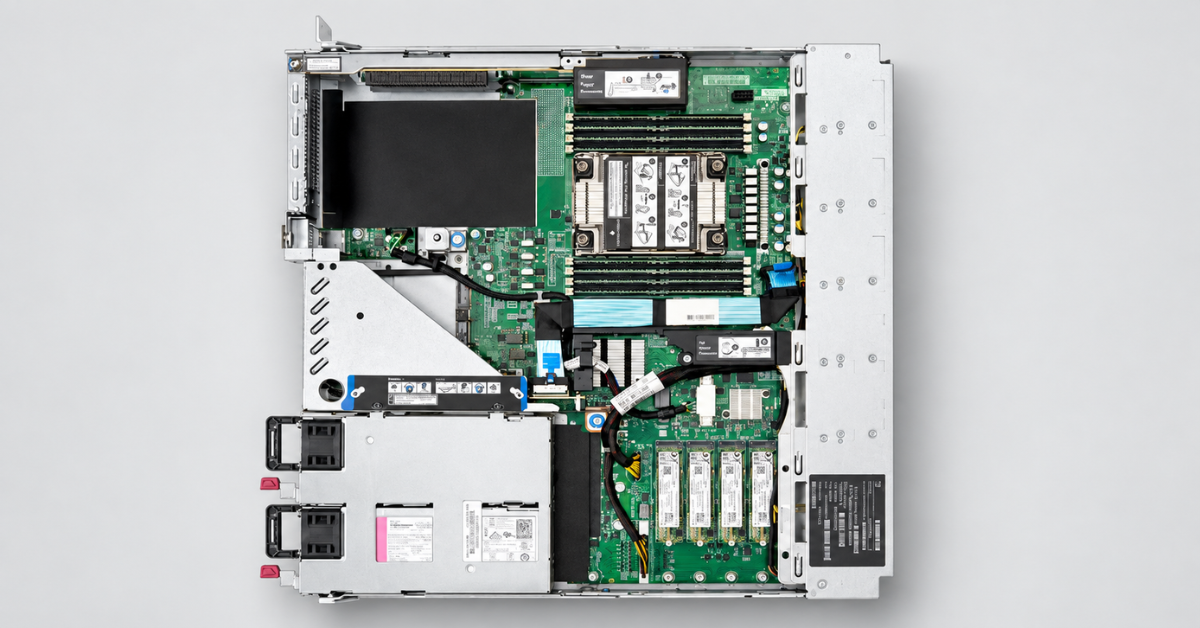
Available platforms from this generation are listed in the HPE ProLiant Gen10 Plus section.
The DL110 Gen10 Plus was introduced as a platform for operators moving towards software-defined network functions and radio access network virtualisation. It uses one 3rd Gen Intel Xeon Scalable processor. HPE's published list includes models with N, T and U suffixes: N models are optimised for network workloads, T models are intended for long lifecycle and telecom-site thermal conditions, and U models are designed for single-socket systems.
Eight DDR4 slots provide eight memory channels. Maximum capacity reaches 1 TB with eight 128 GB modules. Expansion options include two full-size PCIe 4.0 x16 slots in the primary riser and a third slot in an optional riser. A separate OCP 3.0 slot accommodates a network adapter without consuming a standard PCIe slot.
Local storage is limited to four internal M.2 drives. This is suitable for a boot volume, system logs, containers and a small working dataset, but it does not turn the DL110 into a storage server. The model has no standard front-access SFF or LFF drive cages.
Gen10 Plus remains relevant in two situations:
- an organisation needs to expand a uniform fleet without moving to DDR5, PCIe 5.0 and a new operational baseline;
- the project must meet a limited budget by using a refurbished or warehouse-stock configuration with the required network cards and accelerators, which can cost substantially less than Gen11.
When comparing prices, consider not only the chassis but also scarce risers, accelerator power cables, network adapters, rails, power supplies and the iLO licence. Official limits and compatible components are listed in the HPE QuickSpecs.
HPE ProLiant DL110 Gen11
Current-generation platforms are listed in the HPE ProLiant Gen11 section.
Gen11 is the most direct evolution of the original DL110 layout. It retains eight memory slots and four M.2 drives but moves to DDR5 and PCIe 5.0. One 4th Gen Intel Xeon Scalable processor can provide up to 32 cores and a thermal design power of up to 205 W in published configurations. Specialised models with integrated Intel vRAN Boost are available, reducing the need for a separate accelerator for some virtualised radio access network operations.
Eight DDR5 channels support up to 1 TB of memory. Three full-size PCIe 5.0 x16 slots and OCP 3.0 provide more bandwidth for network cards and accelerators than Gen10 Plus. Four M.2 NVMe drives can provide up to 7.68 TB of total capacity in the configuration specified by HPE.
Management is handled by iLO 6 with a silicon root of trust. One notable chassis feature is the absence of a conventional VGA connector. For local access, HPE provides an iLO service port and a USB-to-Ethernet adapter, while day-to-day management is performed remotely. This is normal for a distributed node but may surprise an engineer accustomed to connecting a monitor directly to a server in a rack or during bench preparation.
DL110 Gen11 is suitable when the project requires:
- DDR5 and PCIe 5.0 without reducing memory capacity or the number of M.2 drives;
- flexibility in the choice of network card and separate accelerator;
- a new platform for 5G without a mandatory dependency on the integrated network architecture of Gen12;
- up to 1 TB of memory for denser placement of virtual network functions.
The exact combination of processors, memory, storage, power supplies and risers should be verified against the Gen11 QuickSpecs.
HPE ProLiant Gen12
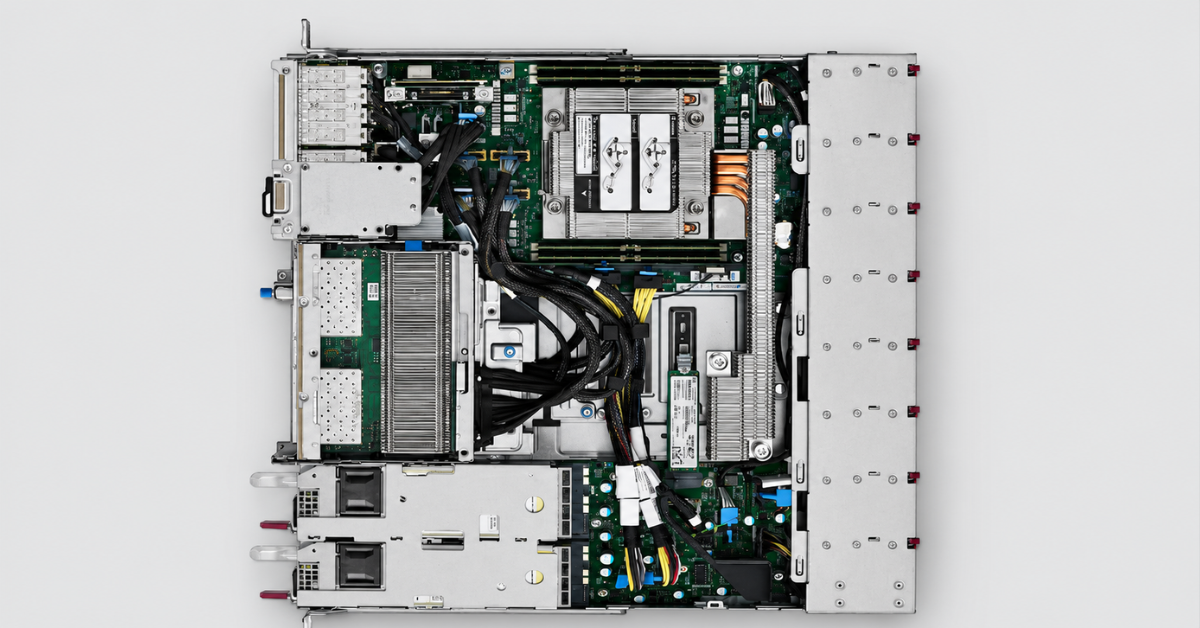
New-generation platforms are listed in the HPE ProLiant Gen12 section.
Gen12 changes the architecture substantially. The current documentation lists the Intel Xeon 6 6716P-B, a single-socket system-on-chip with 40 cores, a 2.1 GHz clock speed, 160 MB of cache and a 235 W thermal design power. The processor integrates functions for networking, media processing and vRAN, while Intel AMX extensions are available on every core for matrix computation.
The system board carries eight 25GbE ports. With additional adapters, the server supports up to twenty 10/25GbE ports, although the actual number depends on the selected risers and OCP modules. For a telecommunications node, this matters more than a nominal increase in the number of general-purpose PCIe slots.
Another change concerns time synchronisation. Optional GNSS and digital phase-locked loop modules allow the server to receive a reference time signal and maintain stability during a temporary loss of that signal. In a distributed radio network, timing accuracy affects more than event logs: the coordinated operation of network elements depends on it.
Gen12 has four DDR5-6400 slots and a maximum capacity of 512 GB. The system board supports two M.2 NVMe drives with a combined capacity of up to 3.84 TB. Both figures are lower than those of Gen11. The layout also imposes a configuration trade-off: installing a riser with two PCIe 5.0 x16 slots excludes some OCP options, so networking and acceleration must be designed as one integrated configuration.
iLO 7, additional O-RAN security mechanisms and modern integrated networking make Gen12 a logical choice for new specialised nodes. For conventional virtualisation, where memory capacity matters more, Gen11 may be more practical. Current restrictions are listed in the Gen12 QuickSpecs.
What DL110 specifications often leave out
A short-depth chassis still requires a cabinet check
The DL110 belongs to the short-server category, but its generations have different dimensions and mounting options. Gen11 is approximately 43 cm deep, while the maximum Gen12 dimension listed in the specifications exceeds 47 cm. Cable bend radius, space for front-mounted power supplies and airflow requirements must also be taken into account.
Standard L-shaped brackets are intended primarily for two-post mounting. Compatible ears and short rails are used in four-post cabinets. Rails from a similar ProLiant model cannot be assumed compatible without checking the part number.
Power and cooling must be selected together
The 48 V option is required at telecommunications sites with a centralised battery system. A conventional server room usually uses AC power supplies. In addition to voltage, verify:
- power capacity with the processor, accelerator and network cards included;
- the availability of a second power supply for redundancy;
- airflow direction;
- the connector type and permitted connection scheme at the site;
- the heat output of the complete configuration rather than the base chassis.
Incorrect airflow direction can disrupt cooling throughout the entire cabinet. Permitted extended operating temperatures also depend on the system configuration: a statement that the server can operate at elevated temperatures does not mean that every accelerator will work within the same range without restrictions.
M.2 is not a general-purpose storage subsystem
The DL110 has no conventional row of hot-swappable front drives. Its internal M.2 drives are suitable for the operating system and local data used by a network function. If an application needs tens of terabytes, hardware RAID with protected cache, a large number of SSDs or frequent drive replacement without opening the chassis, another server or an external storage system is the more practical choice.
Intel VROC software RAID support depends on drive type, operating system and licensing. Supported RAID levels cannot be determined solely from the presence of two or four M.2 drives.
Slots cannot be counted independently
The specifications may list several PCIe and OCP slots, but an actual build depends on the riser, card height and length, power consumption, auxiliary power cable and thermal conditions. A 100/200Gbps network card, a vRAN accelerator and service adapters compete for limited space. This must be checked particularly carefully with Gen12, where selecting a dual-slot PCIe riser prevents the use of certain OCP options.
Which workloads suit the HPE DL110?
The DL110 provides its greatest advantages when compute resources are located close to the radio network or traffic source:
- vRAN virtualised radio access networks and Open RAN architectures;
- distributed DU and CU functions;
- mobile-core user-plane functions, including UPF;
- firewalls, encryption, load balancing, routing and other software-defined network functions;
- fronthaul and transport gateways;
- local content delivery and traffic processing with strict latency requirements;
- containerised and virtualised workloads at an edge site.
Containers and virtual machines are deployment methods for network functions in this context, not evidence that the server is universal. A conventional hypervisor can run on the DL110, but the high cost of a specialised chassis is rarely justified for a typical office or small corporate cluster.
The DL110 should not be selected simply because it is short and occupies 1U. For databases, large numbers of virtual machines, local arrays, backup or a general-purpose application server, memory capacity, drive cages and expansion options are usually more important.
DL110, DL360 or DL380
DL110
Best suited to telecommunications edge infrastructure: a short chassis, front-access connections, optional 48 V power, NEBS configurations, network accelerators and precise time synchronisation. The price of this specialisation is limited memory and local storage.
DL360
The DL360 is a general-purpose dual-socket 1U platform with more memory slots and conventional drive-cage options. It is better suited to virtualisation, compute nodes and enterprise applications in a standard data centre. The differences between versions are covered in “HPE ProLiant DL360 Gen9–Gen12: Comparison and Selection”.
DL380
The 2U chassis provides more space for drives, controllers, network cards and accelerators and makes a high-power configuration easier to cool. The DL380 is the more practical option when a general-purpose platform with expansion headroom is required. Details are available in “HPE ProLiant DL380 Gen12 vs Gen11 vs Gen10 Plus: 2026 Guide”.
Moving to the DL360 or DL380 does not mean that these models are better in every respect. They are deeper, designed for conventional server racks and do not replace the telecommunications-specific features of the DL110.
Choosing the Right Equipment
Our specialists will contact you and answer all your questions
Which HPE ProLiant DL110 generation should you choose?
| Scenario | Suitable platform | Reason | What to consider |
|---|---|---|---|
| Expansion of an existing DL110 Gen10 Plus fleet | Gen10 Plus | Consistent DDR4, iLO 5, components and operating procedures | Lifecycle, accelerator availability and software support |
| New 5G or edge project with a flexible card configuration | Gen11 | DDR5, PCIe 5.0, up to 1 TB of memory and four M.2 drives | The price of a fully equipped configuration |
| New vRAN node with many network ports and precise synchronisation | Gen12 | Integrated 8 × 25GbE, Xeon 6 SoC, GNSS/DPLL and iLO 7 | Up to 512 GB of memory, two M.2 drives and PCIe dependence on OCP |
| Conventional virtualisation, a database or local storage | DL360 or DL380 | More memory, drives and general-purpose expansion | Chassis depth, power and cooling in a standard rack |
Gen10 Plus makes sense not because of the lowest bare-chassis price, but when a complete compatible build with a clear lifecycle is available. Gen11 usually offers the best balance of versatility within the DL110 family. Gen12 should be selected when the project genuinely uses its network integration and synchronisation capabilities; paying extra for these features makes little sense for a conventional hypervisor.
Ordering and operating considerations
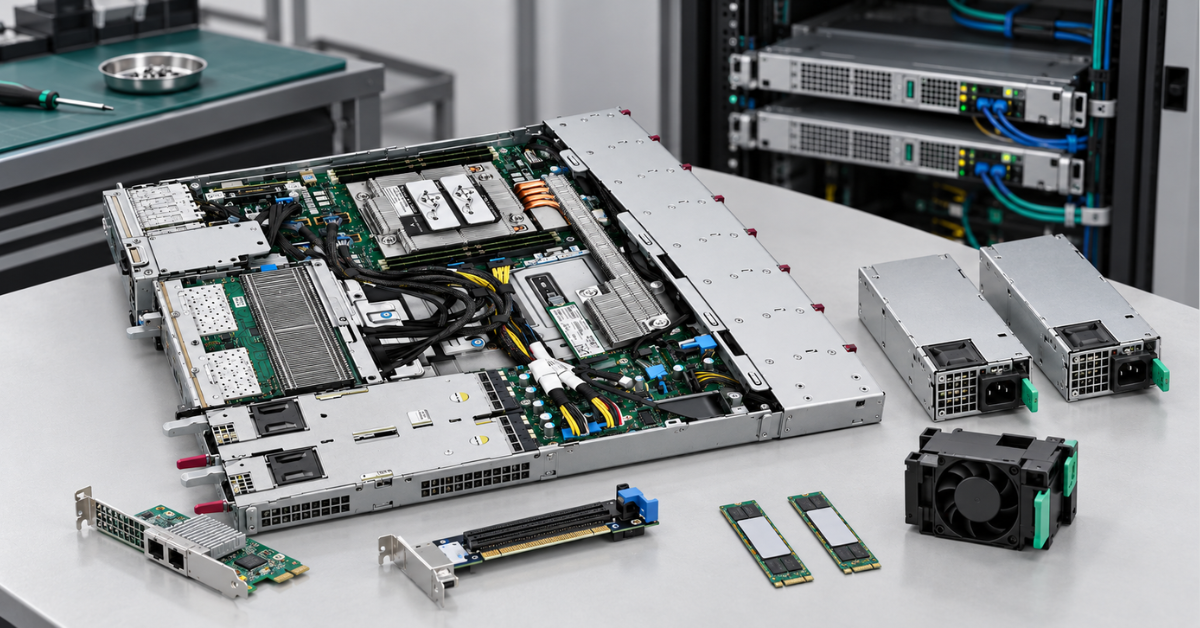
Validate the configuration as a complete system
The processor determines permitted memory operating modes and the thermal load. The riser choice affects the number of cards, OCP options and the accelerator. An accelerator changes power-cable and fan requirements. The power supply must match not only the required wattage but also the input voltage and airflow direction. A list of compatible part numbers is therefore more important than the sum of the maximum figures in a marketing description.
The component list is even more restricted for carrier certification: only specified HPE components and settings qualify for the required compliance level. Replacing a network card, drive or power supply with a nominally compatible component can take the system outside the validated configuration.
Software support depends on the generation
Before ordering, define the operating system, hypervisor, vRAN software platform and accelerator drivers. Support for a processor and network card in Linux does not equal certification of the complete server by a particular solution provider. For distributed infrastructure, the HPE firmware bundle version, centralised update capability and access conditions for updates are also important.
Basic iLO features allow administrators to monitor system health and perform some operations remotely, but the remote console and advanced features depend on the licence. Include this cost in the generation comparison from the outset.
Redundancy within one node does not ensure service continuity
The DL110 supports two power supplies and hot-swappable fans. This reduces the number of failures that cause an outage, but the server remains a single-socket system with one system board. A critical network function requires multiple nodes, redundant traffic paths, external synchronisation, separate power feeds and a tested recovery procedure.
When buying a refurbished Gen10 Plus, the history of its components, the condition of both power supplies and the fans, the presence of the required risers and mounting hardware, and the supplier's warranty are particularly important. An inexpensive base server quickly stops being good value if rare parts must be sourced separately.
Frequently asked questions about the HPE ProLiant DL110
Can the DL110 be used for conventional virtualisation?
Technically, yes: supported operating systems and hypervisors can run virtual machines. However, the DL110's specialisation is justified by network workloads and telecommunications sites. For a corporate cluster, the DL360 or DL380 usually provides more memory, storage and expansion options for a comparable budget.
Does the DL110 have conventional drive cages?
No. Local storage uses internal M.2 drives: up to four in Gen10 Plus and Gen11, and up to two in Gen12. A different server or an external storage system is required for a high-capacity array.
Why does Gen12 have less memory than Gen11?
Gen12 is optimised not for maximum memory density but for network I/O, integrated acceleration and synchronisation. Four DDR5-6400 channels and a 512 GB limit are a deliberate balance in this platform rather than an error in the comparison.
Does every DL110 comply with NEBS Level 3?
No. The chassis is designed for these conditions, but validated compliance applies to a specific set of components and settings. Procurement based on formal requirements should use the current Carrier Grade addendum and an approved factory configuration.
Should Gen10 Plus be replaced with Gen11 or Gen12?
If the existing node handles its workload and remains supported by the software platform, replacement solely for a newer generation number is unnecessary. Gen11 is justified by the move to DDR5, PCIe 5.0 and a newer processor. Gen12 adds integrated networking, Xeon 6 SoC functions and precise synchronisation. The financial impact should be assessed across the entire cluster, including licences, power consumption, spare parts and migration work.
Conclusion
HPE ProLiant DL110 is a highly specialised product line, and its generations cannot be assessed by the rules applied to general-purpose servers. Gen10 Plus remains a rational choice for existing fleets and mature 5G solutions. Gen11 provides the most conventional balance of memory, local storage and PCIe 5.0. Gen12 is designed for new network nodes that require integrated 25GbE, Xeon 6 SoC, GNSS/DPLL and O-RAN security features. If these capabilities are unnecessary and memory, storage or versatility takes priority, the DL360 or DL380 will usually be the better choice.
Choosing the Right Equipment
Our specialists will contact you and answer all your questions