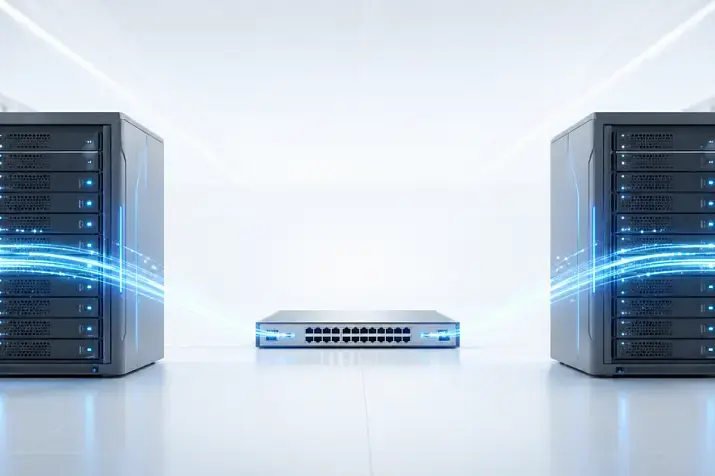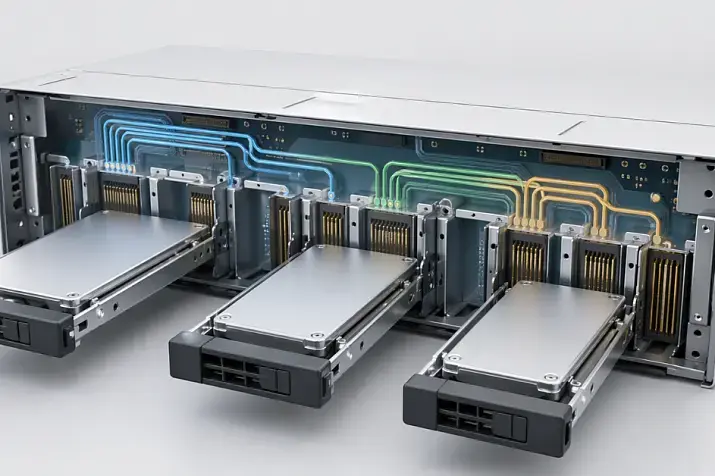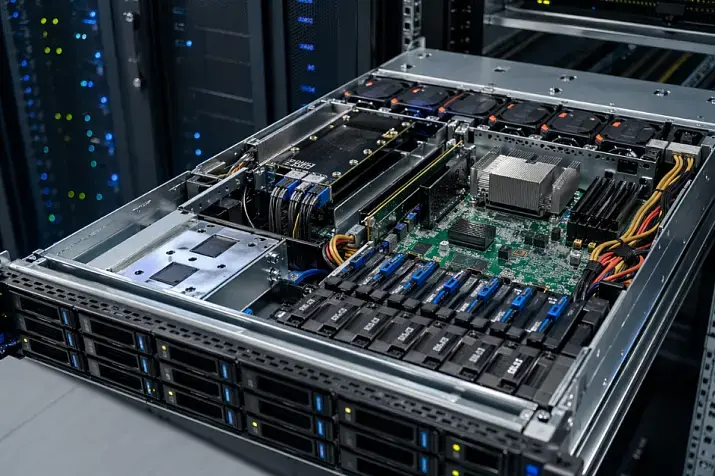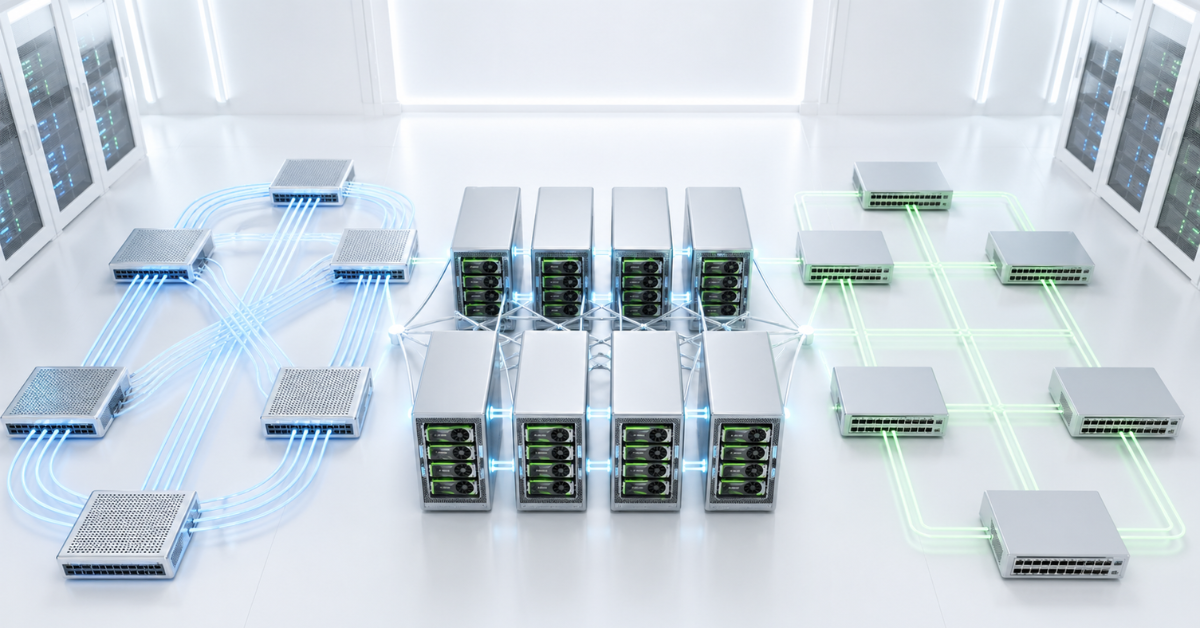
InfiniBand is most often chosen for large GPU clusters, high-performance computing, and workloads where minimal latency, predictable node-to-node communication, and efficient distributed application performance are critical. Ethernet is better suited to environments where universality, compatibility with existing infrastructure, gradual scaling, and more familiar operations matter more. However, not every Ethernet network is suitable for AI servers and HPC: it needs to be a data center-grade network with fast adapters, appropriate switches, RDMA over RoCE support, and properly configured congestion management.
Why the network is so important for AI servers and HPC
In a conventional server infrastructure, the network is often perceived as transport: delivering user requests, connecting file storage, enabling backups, and linking services to one another. For AI servers and HPC (High-Performance Computing), the situation is more complex. Here, the network becomes part of the computing system because servers do not simply receive and send data; they constantly exchange intermediate results while the workload is running.
In artificial intelligence workloads, several servers with GPU accelerators may train one model together. They exchange parameters, gradients, parts of the dataset, and service information. If the network cannot keep up, expensive GPUs sit idle. In HPC environments, cluster nodes may synchronize calculations, pass intermediate results, and wait for one another at each computation stage. That is why not only the maximum port speed matters, but also how consistently the network behaves under load.
Several characteristics are especially important for such workloads. Bandwidth shows how much data can be transferred per unit of time. Latency shows how quickly communication between nodes begins. Predictability shows how steadily the network performs when dozens or hundreds of servers transmit data at the same time. Congestion shows what happens when there is more traffic than the network can handle without queues and losses. CPU load shows how many processor resources are spent not on useful computing, but on servicing the network stack.
Signs that the network is becoming a bottleneck:
- after adding new GPUs, model training speeds up less than expected;
- GPU accelerators periodically sit idle during data exchange;
- compute nodes wait for one another;
- latency between servers affects total task execution time;
- the cluster actively uses distributed storage;
- compute, storage, and service traffic run over the same network infrastructure;
- synthetic benchmarks show high speed, but the real workload scales poorly.
The main conclusion is simple: for AI and HPC, the network cannot be chosen only by the principle “the more gigabits, the better.” You need to look at how it behaves specifically under distributed load.
Our most popular servers

Free shipping on orders over 500 € in the EU, £500 in the UK, and $3,000 in the USA
Free shipping on orders over 500 € in the EU, £500 in the UK, and $3,000 in the USA
Free shipping on orders over 500 € in the EU, £500 in the UK, and $3,000 in the USA

Free shipping on orders over 500 € in the EU, £500 in the UK, and $3,000 in the USA
What InfiniBand is
InfiniBand is a specialized high-performance network for clusters where servers need to exchange data quickly, frequently, and with minimal latency. It is used in supercomputers, scientific computing, engineering simulation, large GPU clusters, and infrastructures for training large models.
Unlike a general-purpose network, InfiniBand was originally designed for workloads where communication between nodes is part of the computation itself. It supports RDMA, or direct access to the memory of a remote server with minimal involvement from the central processor. This reduces latency and lowers the CPU overhead of network transfer.
Modern InfiniBand platforms, such as NVIDIA InfiniBand, are aimed at scientific computing, artificial intelligence, and cloud data centers. NVIDIA describes Quantum InfiniBand as a platform for high-performance network connectivity in scientific computing, AI, and data centers.
It is important to understand that InfiniBand is not just a network adapter with a fast port. It is a separate ecosystem: adapters, switches, cables, drivers, libraries, topology, diagnostic tools, and compatibility requirements. If you install an InfiniBand card in a server but do not design the entire network properly, the expected effect may not appear.
Modern clusters use speeds of 100, 200, 400 Gbit/s and higher depending on the hardware generation. But port speed alone does not explain the value of InfiniBand. Its purpose is low latency, predictable behavior under load, support for direct memory-to-memory communication, and optimization for compute applications.
InfiniBand is especially useful where servers do not work independently, but constantly synchronize with one another. For example, when training a large model across dozens of nodes or in scientific simulation where each computation step depends on data exchange between parts of the cluster.
What Ethernet means in the context of AI and HPC
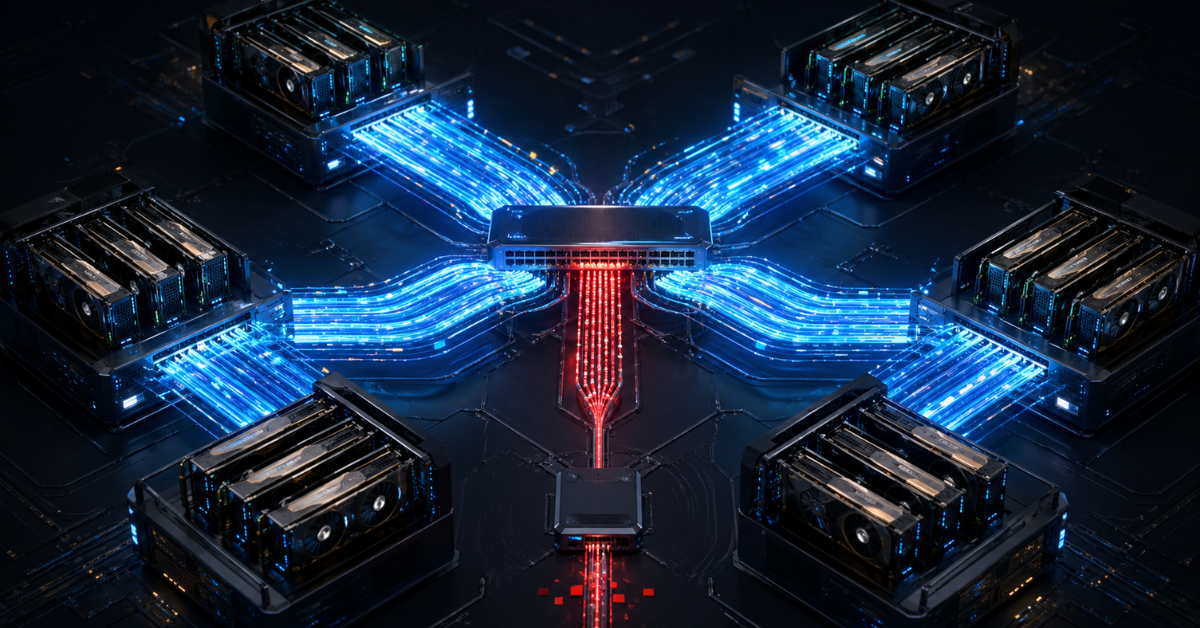
Ethernet is the most familiar and widespread networking technology in data centers. Most engineers know Ethernet well, most servers and switches support it, and integration with existing infrastructure is usually simpler than deploying a separate specialized network.
But in the context of AI and HPC, it is important to separate ordinary Ethernet from high-performance Ethernet for data centers. A conventional network, even with 25, 100, or 400 Gbit/s ports, does not automatically become a good network for a GPU cluster. Compute workloads require the right network adapters, switches with traffic management support, a carefully planned topology, monitoring, and RDMA over RoCE support.
RoCE makes it possible to use RDMA over Ethernet. In other words, Ethernet receives some of the advantages of InfiniBand: data exchange between nodes with fewer layers, lower latency, and lower CPU load. But RoCE has an important condition: the network must be carefully configured. If packet loss, incorrect priorities, or congestion appear, network behavior can become unstable.
Vendors are developing dedicated Ethernet platforms for AI workloads. For example, Spectrum-X Ethernet is positioned by NVIDIA as an Ethernet platform for AI networks, designed for scaling large AI workloads and using RoCE between GPU servers.
Therefore, Ethernet can be a good choice for AI and HPC, but only if it is not “an ordinary network with fast ports,” but a specially designed server network. Otherwise, it is possible to buy expensive network cards and switches without achieving stable acceleration in real workloads.
Choosing the Right Equipment
Our specialists will contact you and answer all your questions
Key differences between InfiniBand and Ethernet
| Criterion | InfiniBand | Ethernet for AI and HPC | What it means in practice |
|---|---|---|---|
| Purpose | Specialized network for compute clusters | Universal network that can be adapted for AI and HPC | InfiniBand is often easier to bring to high predictability in a dedicated cluster, while Ethernet is more flexible in mixed infrastructure |
| Latency | Usually designed for minimal latency | Can be fast, but depends more heavily on configuration | For latency-sensitive HPC and GPU workloads, latency may matter more than peak speed |
| RDMA | A natural part of the architecture | Used through RoCE | Ethernet requires more careful configuration of losses, priorities, and congestion |
| Scaling | Well suited to dense clusters | Scales broadly, especially in data centers with strong network expertise | It is important to calculate not only ports, but also topology, cables, switches, and bandwidth headroom |
| Compatibility | Requires specialized infrastructure | Easier to fit into an existing environment | Ethernet is more convenient where a mature data center network already exists |
| Cost | May be more expensive as a separate stack | Often looks more affordable, but AI-ready Ethernet also requires expensive components | The full cost of the network should be compared, not the price of a single card |
| Operations | Requires specific knowledge | More widely familiar, but RoCE requires separate qualification | “The team knows Ethernet” does not always mean “the team knows RoCE” |
This table does not mean that one option is always better than the other. InfiniBand and Ethernet solve similar tasks in different ways. The choice depends on the cluster size, workload type, budget, existing infrastructure, and the team’s competencies.
When InfiniBand is the better choice
InfiniBand should be considered primarily for dedicated compute clusters where the network must provide minimal latency and predictable node-to-node communication. This is especially important in workloads where servers operate as a single system, not as a set of separate machines.
InfiniBand is usually justified if:
- a dedicated HPC cluster is being built;
- a dense GPU cluster is used for training large models;
- minimal latency and stable exchange between nodes are important;
- applications actively use distributed computing and collective communication;
- GPU utilization must be maximized;
- the cluster is being designed from scratch;
- there is budget for specialized adapters, switches, and cabling infrastructure;
- there are engineers who know how to maintain this type of network;
- maximum performance is more important than universality.
A non-obvious point: InfiniBand is not needed simply where there is “a lot of data.” It is especially useful where computations require constant synchronous exchange between nodes. If one server is waiting for another and GPUs sit idle, the efficiency of the entire cluster drops.
Typical scenarios for InfiniBand include training large language models, distributed AI workloads on dozens or hundreds of GPUs, scientific simulation, engineering calculations, molecular dynamics, climate models, supercomputing environments, and clusters where the work of nodes is tightly coupled.
In Dell architectural materials for AI and HPC, Ethernet and InfiniBand are both considered possible network options for such solutions, meaning the choice depends not on the popularity of a specific technology, but on the requirements of a specific architecture. This is clearly shown in the Dell architecture for AI and HPC, where networking building blocks with Ethernet and InfiniBand are presented.
If the task is to build the highest-performing cluster for model training or calculations, where every percentage point of GPU efficiency matters, InfiniBand often becomes the more reliable choice in terms of performance. But this is true only when the entire network is designed properly, not when individual fast adapters are simply purchased.
When Ethernet is the better choice

Ethernet is better suited to environments where infrastructure must be universal, compatible, and manageable with familiar tools. For many companies, this is more important than achieving the absolute minimum latency. This is especially true if AI workloads are not isolated, but run inside a general data center alongside virtualization, storage, backups, corporate services, and cloud infrastructure.
Ethernet is worth choosing if:
- the infrastructure is already built around Ethernet;
- a universal data center is needed, not only an HPC cluster;
- AI workloads are mixed with ordinary server services;
- compatibility with existing networking practices is important;
- the cluster will grow gradually;
- the budget is limited;
- the team knows Ethernet well;
- flexible integration with storage, cloud, and the corporate network is needed;
- workloads do not require extremely low latency between all nodes.
But there is an important caveat: for AI and HPC, you cannot use just any Ethernet. You need high-speed network adapters, RDMA over RoCE support, switches with the required traffic management functions, correct priority configuration, congestion control, loss monitoring, and the right topology.
Ethernet is especially appropriate for small GPU clusters, inference infrastructure, private clouds, mixed data centers, and environments where gradual modernization matters. If a company already has a strong networking team and mature Ethernet infrastructure, moving to specialized Ethernet for AI may be more practical than deploying a separate InfiniBand stack.
Ethernet for AI is not ordinary Ethernet
One of the most common mistakes is to assume that a 100, 200, or 400 Gbit/s port automatically makes a network suitable for an AI cluster. In practice, high port speed guarantees neither low latency nor stable operation when many nodes exchange data at the same time.
For AI and HPC, it matters how the network behaves under congestion. If several servers send large volumes of data simultaneously, queues may appear in switches. If the network loses packets or assigns priorities incorrectly, RoCE can become unstable. As a result, the real workload will run more slowly, even though the equipment specifications show impressive speeds.
Several mechanisms are used to keep Ethernet stable in these scenarios. PFC temporarily pauses traffic of a specific class to avoid losses. ECN helps signal congestion in advance. DCB combines a set of functions for managing data center traffic. RoCE allows data to be transferred using RDMA over Ethernet.
These mechanisms are useful, but they do not work “magically.” They must be configured together: network cards, switches, the operating system, drivers, firmware, the application, and the topology must be aligned. If everything is enabled without understanding the design, the opposite effect is possible: pauses, unstable latency, and difficult diagnostics.
That is why the phrase “we will choose Ethernet” for an AI cluster needs clarification. Will it be an ordinary server network? A network with RoCE? A network with dedicated storage and training traffic? Are there separate traffic classes? Is there monitoring for pauses and losses? Is there a validated configuration? Without these answers, the comparison with InfiniBand will be incomplete.
Network topology: why the connection scheme matters more than it seems
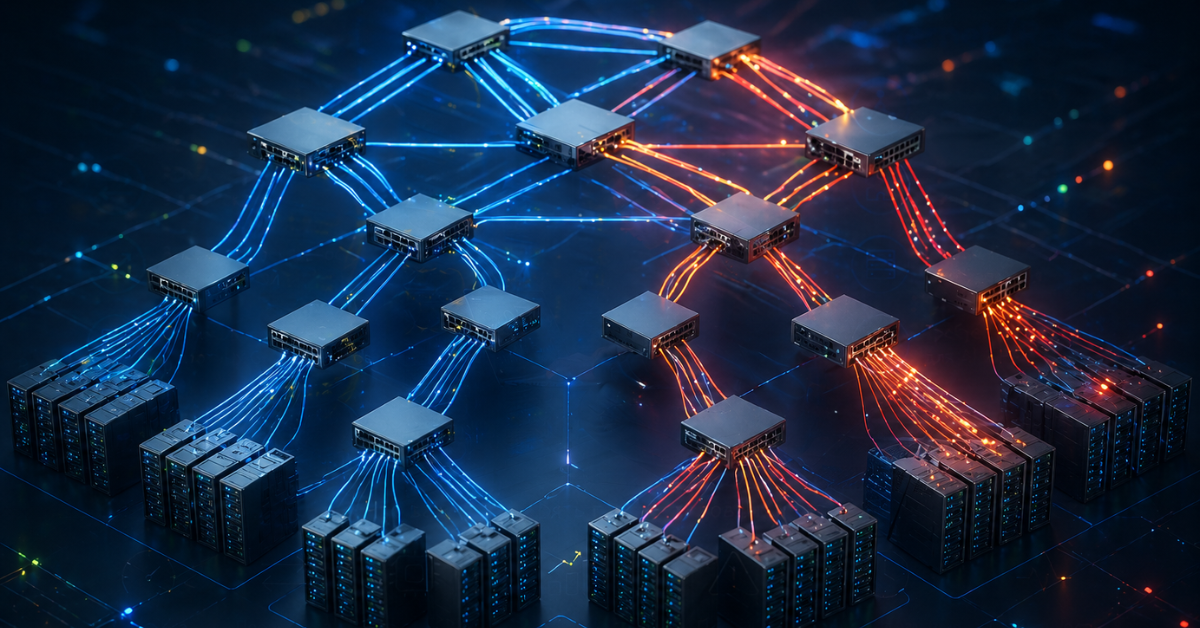
Choosing a network is not only about choosing an adapter. The entire connection scheme between servers and switches matters. With a small number of nodes, a relatively simple architecture may be enough. But as the cluster grows to dozens or hundreds of servers, topology becomes one of the main performance factors.
One important issue is oversubscription. This is a situation where the total bandwidth of servers is higher than the bandwidth of the uplinks between switches. In an ordinary corporate network, this may be acceptable: not all servers use the maximum at the same time. In AI and HPC, this logic often does not work because a distributed task can force many nodes to exchange data simultaneously.
Sometimes it is better to build a smaller cluster with the right topology than to connect more servers to a weak network. If GPUs are expensive, their idle time caused by network limitations quickly turns into direct financial loss.
Topology must account for more than speed. The number of switch tiers, port headroom, cables, transceivers, line lengths, power consumption, cooling, fault tolerance, and expansion capability all matter. For large clusters, consistent configuration of all ports is also important. One incorrectly configured section of the network may appear only under load, when diagnostics becomes especially difficult and the impact spreads across the whole infrastructure.
An interesting example of an alternative approach is HPE Slingshot, where a high-performance network for HPC and AI combines the requirements of compute fabrics with Ethernet-style compatibility. HPE describes Slingshot as a high-performance interconnect for HPC and AI clusters with high bandwidth, low latency, and support for machine learning, analytics, and scientific applications.
How the network affects AI model training
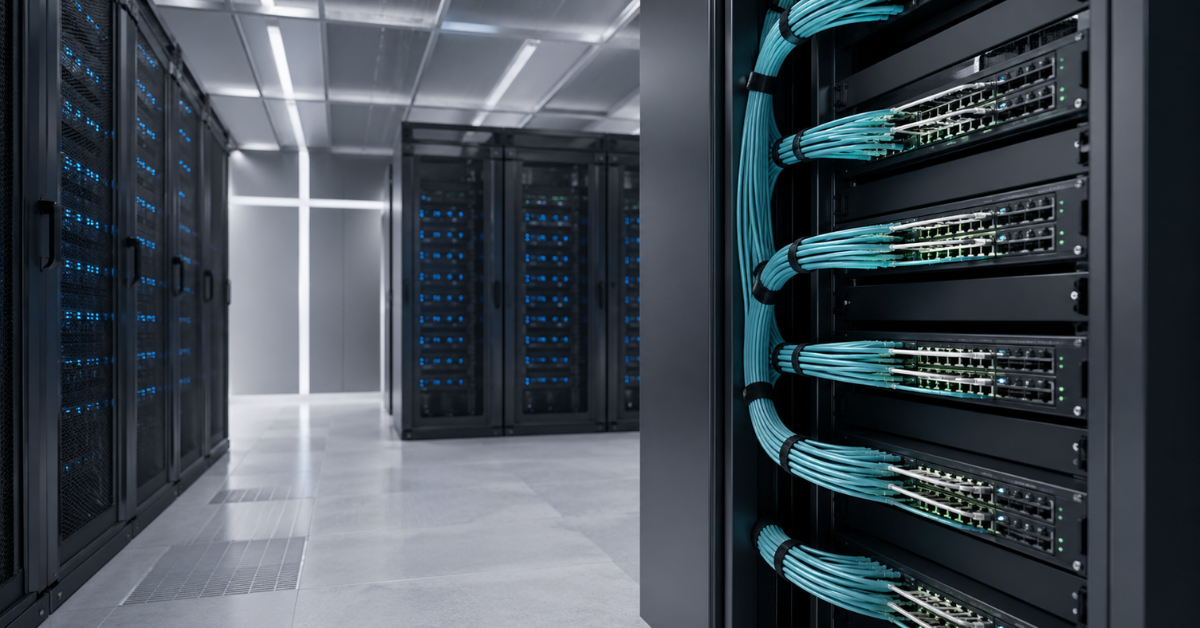
An AI cluster is not just several powerful servers placed next to one another. If a model is trained in distributed mode, servers must constantly exchange data. GPU accelerators compute their parts of the task, and then the results must be synchronized. If exchange is slow, GPUs wait for the network. The more nodes there are, the more noticeable this problem becomes.
For smaller models and a few GPUs, the difference between networks may be moderate. The bottleneck may be not the network, but memory, disks, training code, or data preparation. But as the model and the number of servers grow, the network can become the main scaling limitation.
A bad sign is when adding new GPUs barely speeds up training. Formally, compute power has increased, but the overall task is not completed much faster. This may mean that the cluster has run into data exchange limits. In such a situation, not only peak bandwidth matters, but also latency, stability, behavior under simultaneous transmission, and RDMA efficiency.
For training large models, the network must be treated as part of the computing platform. CPUs, GPUs, memory, local drives, distributed storage, and the inter-server network must be balanced. A weak network architecture cannot be compensated for only by buying more expensive GPUs.
How the network affects HPC workloads
In high-performance computing, a task is often divided among many nodes. Each node calculates its own part, but they do not always work completely independently. At different stages, they need to exchange intermediate results, synchronize, and pass data to neighboring nodes.
For such workloads, latency can be no less important than bandwidth. If one node waits for the others, the whole task slows down. If there are many synchronization points, even small delays at each step noticeably increase total calculation time.
HPC workloads may include engineering calculations, fluid and gas dynamics simulation, climate models, physics, chemistry, bioinformatics, numerical modeling, scientific simulations, and stock market analytics. In some tasks, the network is critical; in others, local memory or processors matter more. Therefore, there is no universal answer: you need to look at the specific application and its data exchange profile.
For HPC, it is especially risky to choose a network only by peak speed. Real performance depends on how the network behaves under full load, how it handles many small exchanges, how stable latency is, and how quickly the cluster recovers after failures.
Choosing the Right Equipment
Our specialists will contact you and answer all your questions
Cost: why comparing only the price of a network card is not enough
When choosing between InfiniBand and Ethernet, you cannot compare only the cost of one adapter. You need to calculate the full cost of the network. It includes network cards, switches, cables, transceivers, licenses, support, installation, port headroom, power consumption, cooling, and team qualification.
InfiniBand may be more expensive at the start because it requires specialized hardware and skills. But in workloads where every minute of GPU cluster time is expensive, a more predictable network can pay for itself. If expensive GPUs sit idle because of network limitations, savings on switches become illusory.
Ethernet often looks cheaper and more convenient, especially if part of the infrastructure already exists. But Ethernet for AI is not an office switch with fast ports. High-quality adapters, switches with the required functions, cables, transceivers, and RoCE configuration also cost money. Therefore, the statement “Ethernet is always cheaper” oversimplifies the situation.
The right question is: which network will deliver the required performance at an acceptable total cost of ownership? Sometimes it will be InfiniBand. Sometimes it will be specialized Ethernet. Sometimes it will be ordinary Ethernet without RDMA, if the workload does not require dense exchange between nodes.
Operations and support
A network for AI and HPC must not only be purchased, but also maintained. This is especially important for companies that have not previously worked with compute clusters.
InfiniBand requires specific knowledge: diagnostics, firmware, compatibility, fabric configuration, performance validation, and understanding of application behavior. Ethernet is familiar to more engineers, but RoCE and AI networks also require separate qualification. Experience configuring corporate Ethernet cannot be assumed to automatically cover GPU cluster tasks.
The team should answer several questions in advance:
- who will design the network;
- who will configure adapters and switches;
- who will investigate the cause of performance degradation;
- whether there is experience with RDMA, RoCE, or InfiniBand;
- whether there is a test bench;
- how drivers and firmware will be updated;
- who is responsible for compatibility between servers, network cards, switches, and software;
- how monitoring of errors, latency, pauses, and losses will be organized.
A good practice is to use validated reference architectures from vendors, especially if the cluster is being built for a critical workload. Assembling a solution independently from unrelated components may be cheaper on paper, but more expensive in diagnostics and downtime.
Top-selling network switches
Free shipping on orders over 500 € in the EU, £500 in the UK, and $3,000 in the USA

Free shipping on orders over 500 € in the EU, £500 in the UK, and $3,000 in the USA

Free shipping on orders over 500 € in the EU, £500 in the UK, and $3,000 in the USA

Free shipping on orders over 500 € in the EU, £500 in the UK, and $3,000 in the USA
Common mistakes when choosing a network for AI and HPC
Most often, problems appear not because of bad technology, but because of incorrect expectations. InfiniBand and Ethernet can both work well if they are chosen for the task and configured correctly. But both options can disappoint if the network is designed according to an oversimplified logic.
Common mistakes:
- choosing the network only by port speed;
- assuming that 100, 200, or 400 Gbit/s Ethernet is automatically suitable for AI;
- buying InfiniBand without understanding application requirements;
- saving on switches while using expensive GPU servers;
- forgetting about topology;
- mixing training, storage, and ordinary service traffic without segmentation and priorities;
- not accounting for cables and transceivers;
- not checking driver and firmware compatibility;
- not testing the real workload;
- looking only at peak bandwidth;
- not accounting for latency, pauses, and behavior under congestion;
- overestimating the team’s competencies;
- not planning monitoring before putting the cluster into production.
The most dangerous mistake is buying network equipment and designing the network after the servers as a secondary component. For AI and HPC, the network must be designed together with the compute part. Otherwise, you can end up with powerful servers that cannot reveal their capabilities.
Practical selection scheme
| Scenario | What matters most | Preferred option | Comment |
|---|---|---|---|
| Small AI server or 1–2 nodes | Simplicity and cost | Ethernet | InfiniBand is usually excessive |
| Small GPU cluster | Balance of speed, budget, and growth | Ethernet with RoCE or InfiniBand | If training is latency-sensitive, InfiniBand is worth considering |
| Large cluster for model training | Latency, stability, scaling | InfiniBand or specialized Ethernet for AI | Ordinary Ethernet is not suitable |
| HPC cluster for scientific computing | Latency and collective communication | More often InfiniBand or a specialized HPC network | Ethernet is possible, but only with the right architecture |
| Mixed data center | Compatibility and universality | Ethernet | Easier to integrate with existing infrastructure |
| Inference and AI model serving | Availability and service scaling | Usually Ethernet | Ultra-low latency between nodes is often less critical than during training |
| Distributed storage for AI and HPC | Latency, I/O, stability | Ethernet with RoCE or InfiniBand | The choice depends on the storage system and compatibility |
This scheme helps narrow the choice quickly, but it does not replace testing. The final decision should be made after assessing the real workload, scale, budget, application requirements, and team capabilities.
How to test before purchase or deployment
Hardware specifications do not show the whole picture. A network may look excellent in the specification, but behave differently under real load. Therefore, before a large purchase, it is advisable to test not only synthetic speed, but also working scenarios.
For AI, you need to look at GPU utilization, training time, scaling efficiency when adding nodes, exchange latency, and stability under long-term load. If GPUs are loaded unevenly or often wait for data exchange, the network may be one of the limiting factors.
For HPC, you need to measure the execution time of the real application, scaling efficiency, latency between nodes, and behavior during collective communication. Sometimes a network with high peak bandwidth loses in workloads where many short exchanges and stable latency matter.
For distributed storage, you need to look at I/O latency, IOPS, bandwidth, behavior under mixed load, the impact of the network on the CPU, and resilience under failures.
Useful metrics:
- GPU utilization;
- latency between nodes;
- bandwidth;
- scaling efficiency;
- CPU load on network operations;
- network errors;
- losses and pauses;
- real workload execution time;
- stability after prolonged load;
- behavior when a port or switch fails.
It is important to test not only the “best case,” but also congestion. Weak points in topology, incorrect priorities, insufficient buffers, and configuration errors reveal themselves specifically under high load.
Brief checklist before choosing
Before choosing a network for AI servers or an HPC cluster, it is worth answering several questions:
- how many servers and GPUs will be in the cluster now;
- how quickly the cluster will grow;
- whether the workload is training, inference, HPC, or mixed;
- how sensitive the application is to latency;
- whether constant exchange between nodes is needed;
- whether RDMA transfer is needed;
- whether the software platform supports InfiniBand or RoCE;
- whether existing Ethernet infrastructure is available;
- whether the team has the required expertise;
- what budget is allocated for the entire network;
- whether switches, cables, transceivers, and support have been accounted for;
- whether the solution can be tested before purchase;
- what will become the bottleneck after installing the new network;
- whether there are fault tolerance requirements;
- who will maintain the network in a year.
If there are no answers to these questions, it is too early to choose a technology. First, you need to understand the workload, scale, and constraints. Only then should specific adapters, switches, and topologies be compared.
Conclusion
InfiniBand is a strong choice for specialized HPC environments and large AI clusters where minimal latency, predictability, and efficient node-to-node communication are important. It is especially appropriate where the cluster is built around distributed training, scientific computing, or other workloads sensitive to inter-server communication.
Ethernet is a rational choice for universal data centers, mixed workloads, gradual scaling, and infrastructures where compatibility with the existing network matters. But for AI and HPC, it must be not ordinary Ethernet, but a properly designed data center network with suitable adapters, switches, RoCE, congestion management, and monitoring.
Modern Ethernet for AI can already compete with InfiniBand in a number of scenarios, but only with competent architecture. Simply installing fast network cards is not enough. Likewise, InfiniBand will not solve the problem if the application cannot efficiently use a distributed network or if the cluster is assembled without considering topology.
The right question is not “which is faster — InfiniBand or Ethernet,” but “which network is better suited to a specific workload, scale, budget, and team.” If the cluster is built around maximally dense distributed training or HPC calculations, InfiniBand will often be the most reliable choice in terms of performance and predictability. If the infrastructure must be universal, grow gradually, and integrate with an existing data center, Ethernet is the better option to consider, but only in a data center-grade implementation with correct RDMA support, congestion management, and a validated topology.
Choosing the Right Equipment
Our specialists will contact you and answer all your questions
Content:

Free shipping on orders over 500 € in the EU, £500 in the UK, and $3,000 in the USA

Free shipping on orders over 500 € in the EU, £500 in the UK, and $3,000 in the USA
Free shipping on orders over 500 € in the EU, £500 in the UK, and $3,000 in the USA

Free shipping on orders over 500 € in the EU, £500 in the UK, and $3,000 in the USA