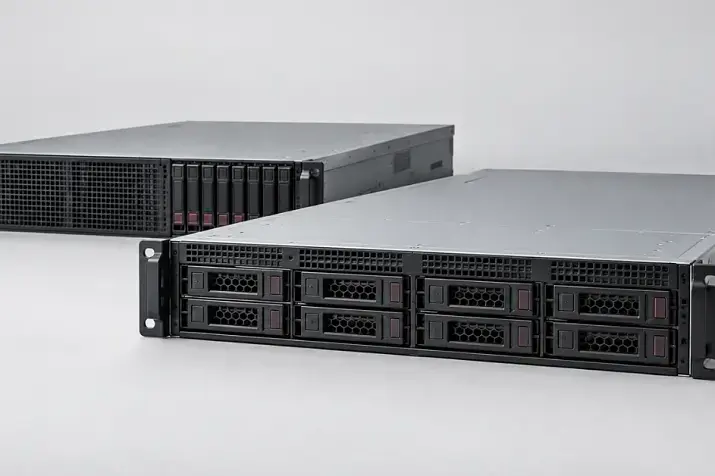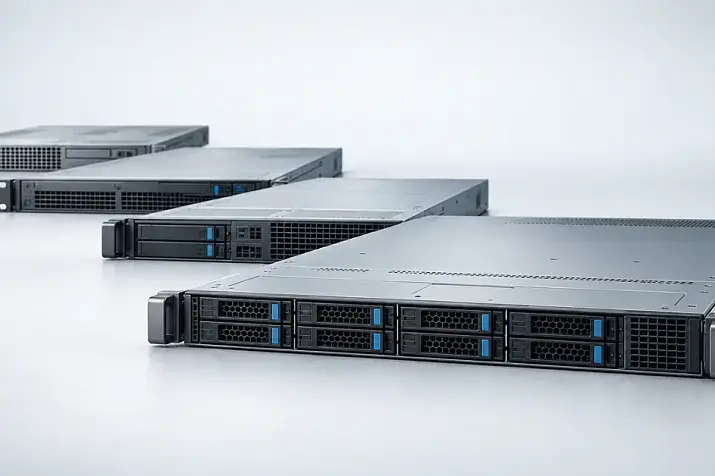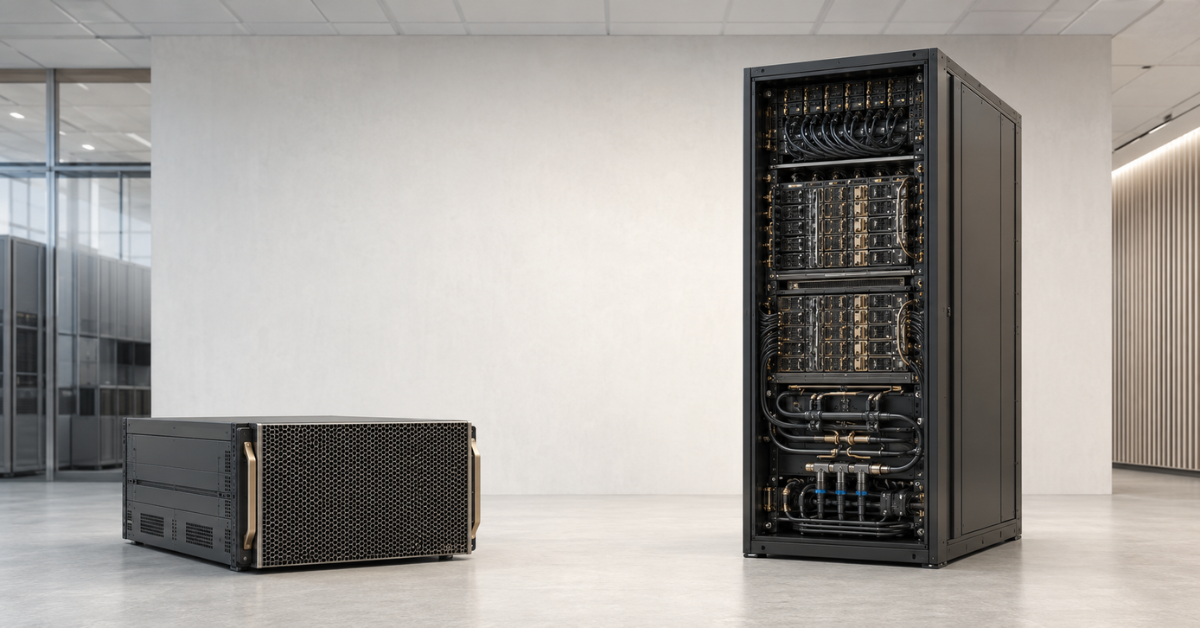
NVIDIA DGX B300 is usually sufficient when the model, together with its context, KV cache, and working data, fits within eight tightly connected GPUs and the company needs it for inference, RAG, fine-tuning, and internal AI services. DGX GB300 should be considered when a single workload must efficiently use dozens of GPUs, fast data exchange between them is critical, and the system will continuously run large-scale inference, training, or post-training. These are not two versions of the same server: B300 is a self-contained 10U node, while GB300 is a liquid-cooled compute rack with different networking, power, and operational requirements.
NVIDIA DGX servers
Free shipping on orders over 500 € in the EU, £500 in the UK, and $3,000 in the USA
Free shipping on orders over 500 € in the EU, £500 in the UK, and $3,000 in the USA
Free shipping on orders over 500 € in the EU, £500 in the UK, and $3,000 in the USA

Free shipping on orders over 500 € in the EU, £500 in the UK, and $3,000 in the USA
Two different levels of AI infrastructure
Comparing the systems only by accelerator count is misleading. DGX B300 has eight Blackwell Ultra GPUs, while DGX GB300 has 72. The ninefold difference matters less than the way the GPUs are interconnected.
The infrastructure can be scaled in three ways:
- One AI server. Eight GPUs operate within a local NVLink domain.
- A server cluster. Several B300 systems are connected through InfiniBand or Ethernet, but each node retains its own eight-GPU domain.
- A rack-scale system. In GB300, all 72 GPUs are connected through NVLink switching as a single compute complex.
Therefore, the right question is not “how many GPUs does the company need?” but “how many tightly connected GPUs does one workload require?” A hundred accelerators can be used efficiently by independent workloads without a single domain or an expensive rack-scale platform. Conversely, one large distributed workload can exceed the limits of eight GPUs even with a relatively small number of users.
What NVIDIA DGX B300 is
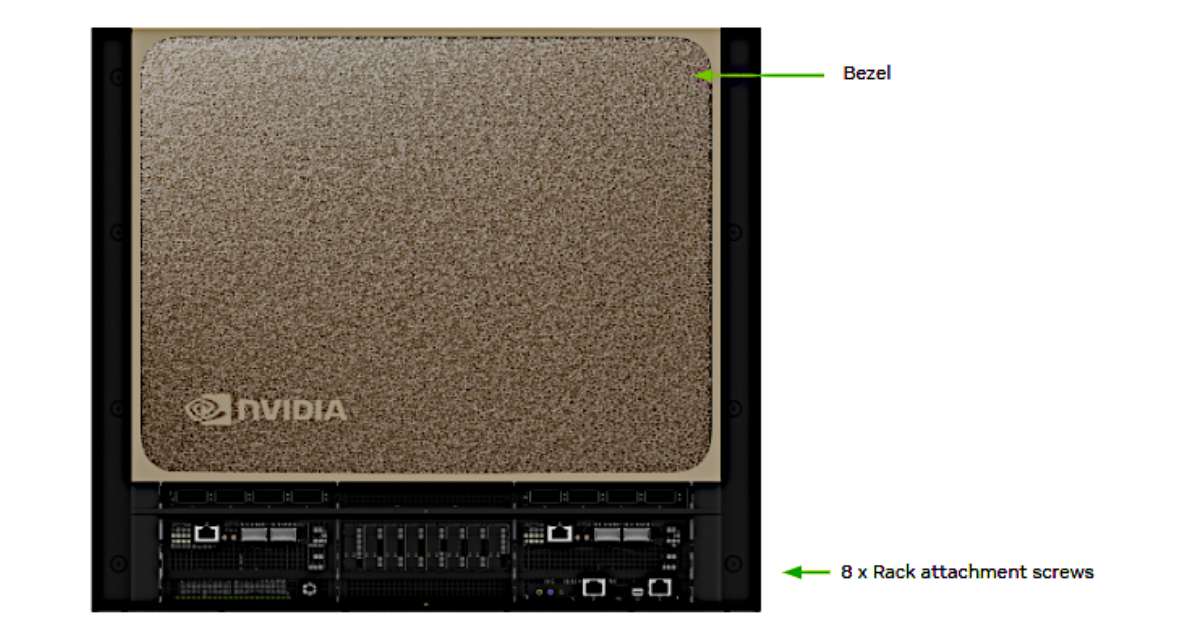
Official front view of NVIDIA DGX B300 with the front bezel installed.
Image source: NVIDIA DOCS
DGX B300 is a turnkey AI server for training, fine-tuning, inference, and analytical workloads. According to NVIDIA’s official specification, it contains eight Blackwell Ultra SXM GPUs, two Intel Xeon 6776P processors, two NVLink switches, and 2.1 TiB of total GPU memory. It also provides eight ConnectX-8 interfaces at up to 800 Gbit/s, two BlueField-3 DPUs, two boot NVMe drives, and eight local 3.84 TB NVMe drives. The server occupies 10U and consumes about 14 kW in operation.
The documentation lists both 2.1 and 2.3 TB of memory. These figures describe the same configuration: eight 288 GB modules provide 2,304 GB in decimal notation, which is approximately 2.3 TB or about 2.1 TiB in binary notation.
B300 uses the x86 architecture familiar in enterprise infrastructure. This simplifies migrating internal applications, monitoring agents, and containers that already run on Intel Xeon servers. The GPUs perform the main computations, while the processors handle data preparation, networking, scheduling, and system tasks.
The system supports AC power and connection to a DC busbar. Cooling is air-based, but the requirements are substantially higher than for a conventional dual-socket server: NVIDIA’s guide specifies maximum power consumption of 14.5 kW, a weight of up to 168 kg, and airflow of up to 1,500 cubic feet per minute.
Therefore, having 10U of free space in a standard rack is not enough. Before installation, the PDU capacity, power-line redundancy, heat removal, weight limits, and availability of a high-speed network must be checked.
How NVIDIA DGX GB300 is designed
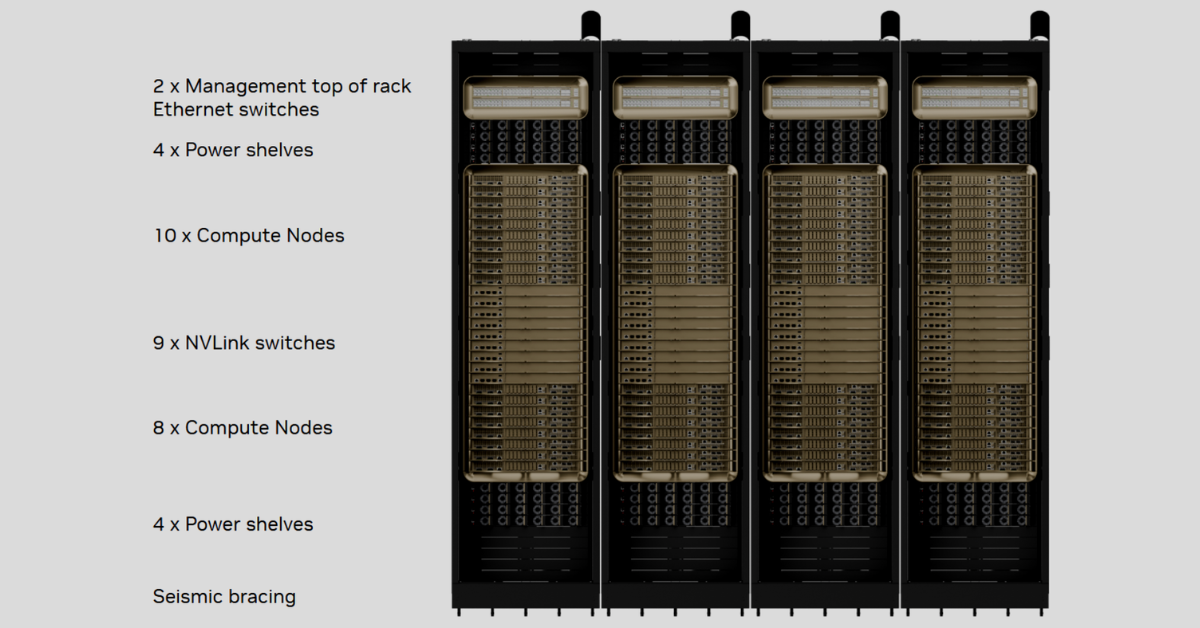
Official DGX GB300 NVL72 rack layout.
Source: NVIDIA DOCS
DGX GB300 is a ready-to-deploy rack-scale system based on the GB300 NVL72 architecture. It combines 72 Blackwell Ultra GPUs with 36 Grace processors based on the Arm architecture. GPU memory capacity reaches 20 TB, while total high-speed memory including Grace memory reaches 37 TB. The compute network uses 72 ConnectX-8 interfaces, while storage and infrastructure functions are handled by 18 BlueField-3 DPUs.
The rack includes:
- 18 compute trays with four GPUs and two Grace CPUs each;
- nine NVLink switch trays;
- power shelves and a DC busbar;
- management modules;
- direct liquid-cooling loops;
- leak sensors at both module and rack level.
NVLink connects all 72 GPUs with aggregate bandwidth of approximately 130 TB/s. A full rack can consume up to 142 kW. Local NVMe drives in the compute modules are intended primarily for the operating system and fast cache rather than as a replacement for shared data storage.
The CPU architecture also differs: B300 uses Intel x86 processors, while GB300 uses Arm-based Grace processors. A modern containerised AI stack can usually be migrated without major redesign, but proprietary libraries, closed-source agents, and applications without builds for the other architecture must be validated before migration.
Choosing the Right Equipment
Our specialists will contact you and answer all your questions
DGX B300 vs DGX GB300: key differences
| Parameter | NVIDIA DGX B300 | NVIDIA DGX GB300 |
|---|---|---|
| System level | Standalone AI server | Full compute rack |
| GPU | 8 × Blackwell Ultra | 72 × Blackwell Ultra |
| CPU | 2 × Intel Xeon 6776P | 36 × NVIDIA Grace |
| CPU architecture | x86 | Arm |
| GPU memory | Approximately 2.3 TB | Approximately 20 TB |
| NVLink domain | 8 GPUs | 72 GPUs |
| Cooling | Air cooling | Direct liquid cooling |
| Power consumption | Up to 14–14.5 kW | Up to 142 kW per rack |
| Scaling | By adding nodes | Within the rack and by connecting multiple racks |
| Typical workloads | Enterprise inference, RAG, and fine-tuning | Large-scale inference, training, and post-training |
Peak petaflop figures do not show how fast a specific model will run. Performance depends on the compute format, context length, request batch size, model partitioning method, GPU utilisation, storage speed, and the share of time spent exchanging data. Therefore, dividing GB300 performance by the B300 figure does not produce a universal acceleration factor.
When one DGX B300 is enough
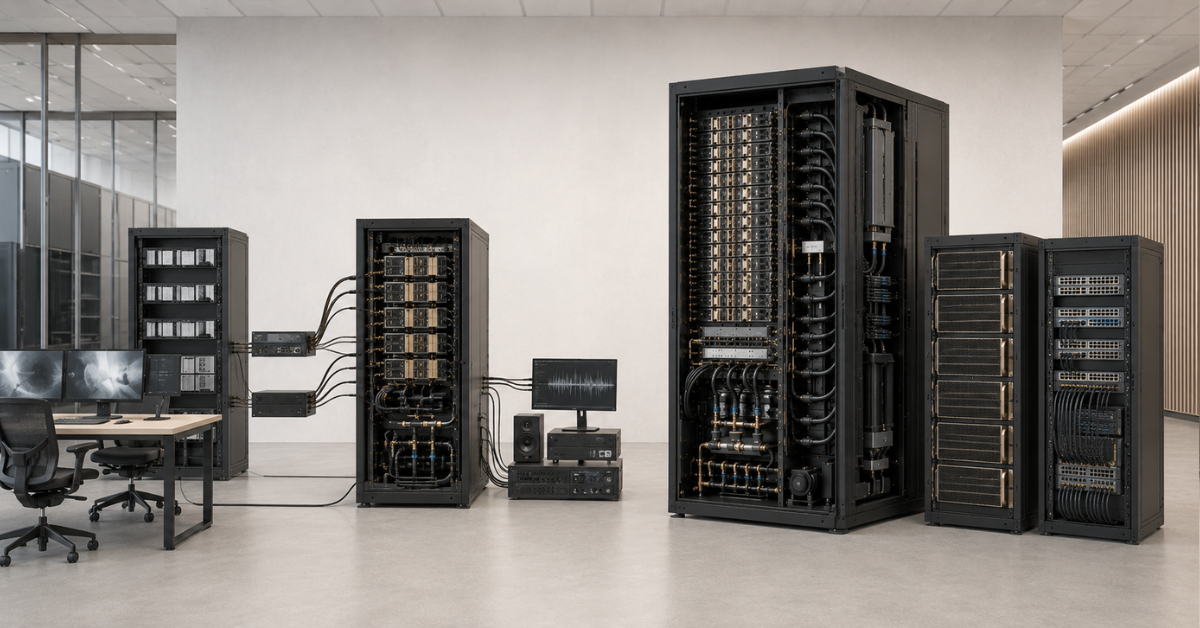
The model fits within eight GPUs
Model weights are not the only factor to assess. Memory must also hold:
- the KV cache for active sequences;
- input and generated context;
- inference runtime work buffers;
- activations, gradients, and optimiser states during training;
- headroom for stable operation without constant data offloading.
If the complete working set fits within the 2.3 TB of memory across eight GPUs with adequate headroom, moving to NVL72 solely for greater aggregate memory is usually unnecessary. Quantisation, batching, KV-cache settings, and the software platform should be evaluated first.
Enterprise inference and internal services
A single B300 can support:
- an assistant for internal documents;
- code generation and validation;
- support-request processing;
- document summarisation;
- knowledge-base search;
- specialised models for images, audio, and video.
The number of users alone says little about the actual workload. A thousand employees submitting short prompts may create less load than a few analysts working with long context and reasoning models. Capacity planning requires requests per second, input and output token volumes, required latency, and the peak-load profile.
If one model instance cannot provide enough throughput, it is often more efficient to add a second B300 and launch another replica. This works when requests are independent and can be distributed by a load balancer.
RAG
RAG rarely requires 72 tightly connected GPUs merely because the document archive is large. The service includes data preparation, embedding generation, retrieval, reranking, context assembly, and answer generation.
The bottleneck may be the vector database, NVMe performance, document transfer, or poor text chunking. GB300 will not automatically remove these limitations. For enterprise RAG, it is more practical to separate retrieval and generation pipelines and reserve GPUs for workloads that genuinely benefit from more than CPU processing.
Fine-tuning and ML team workloads
B300 is suitable for LoRA, QLoRA, adapter training, adapting models to corporate data, and several independent experiments. Full fine-tuning requires more memory because gradients, activations, and optimiser states are stored alongside the weights, but the need for GB300 is still determined by model size and the distribution scheme, not by the word “fine-tuning” itself.
Standalone servers also support gradual growth. A company can start with one B300, add a second for redundancy or another team, and then build a cluster with a shared network and storage. This reduces the risk of buying a large rack before a sustained workload exists.
When DGX GB300 is required
NVIDIA DGX servers
Free shipping on orders over 500 € in the EU, £500 in the UK, and $3,000 in the USA
Free shipping on orders over 500 € in the EU, £500 in the UK, and $3,000 in the USA
Free shipping on orders over 500 € in the EU, £500 in the UK, and $3,000 in the USA
Free shipping on orders over 500 € in the EU, £500 in the UK, and $3,000 in the USA
One workload requires dozens of connected GPUs
The main argument for GB300 is the need for continuous data exchange between parts of a single workload. This is typical of tensor and pipeline parallelism, distributed training, large mixture-of-experts models, and other schemes in which computation is divided across dozens of GPUs.
In a B300 cluster, communication within a server uses NVLink, while communication between servers uses an external network. Even high-speed InfiniBand and Ethernet have different topology and latency characteristics. The larger the share of collective operations, the more the network affects execution time and the more valuable a single 72-GPU domain becomes.
Large-scale inference
A high request volume does not always require GB300. If the model fits within B300, independent requests can be distributed across multiple replicas on separate servers.
An NVL72 rack becomes more justifiable when several conditions apply at the same time:
- one model instance requires more than eight GPUs;
- very long context is used;
- the KV cache consumes a significant share of memory;
- reasoning models generate many intermediate tokens;
- agentic systems run long chains of calls;
- high throughput is required under strict latency targets;
- the hardware will run at high utilisation around the clock.
In this case, the value comes not only from compute performance but also from high GPU density, intra-rack connectivity, and centralised workload management.
Training and post-training
GB300 is designed for long-running synchronous workloads in which idle time across dozens of accelerators is especially costly:
- training large foundation models;
- full fine-tuning of models with a large parameter count;
- reinforcement learning;
- generation and evaluation of large synthetic-data sets;
- increasing test-time compute during inference;
- pipelines in which multiple models generate, verify, and evaluate answers.
If a workload requires hundreds or thousands of GPUs, one GB300 is not the final system but a scalable infrastructure building block with shared networking, storage, and management.
When an AI factory is genuinely needed
An AI factory is a continuously operating production environment, not merely a room containing many accelerators. It is characterised by multiple production services, centralised queues and quotas, round-the-clock workloads, telemetry from the GPU to the rack level, regular model updates, and recovery requirements.
Running isolated experiments and supporting several internal services does not by itself make GB300 necessary. The rack is justified when such an environment has already been designed and can keep it consistently occupied with useful work.
Why nine DGX B300 systems are not equal to one DGX GB300
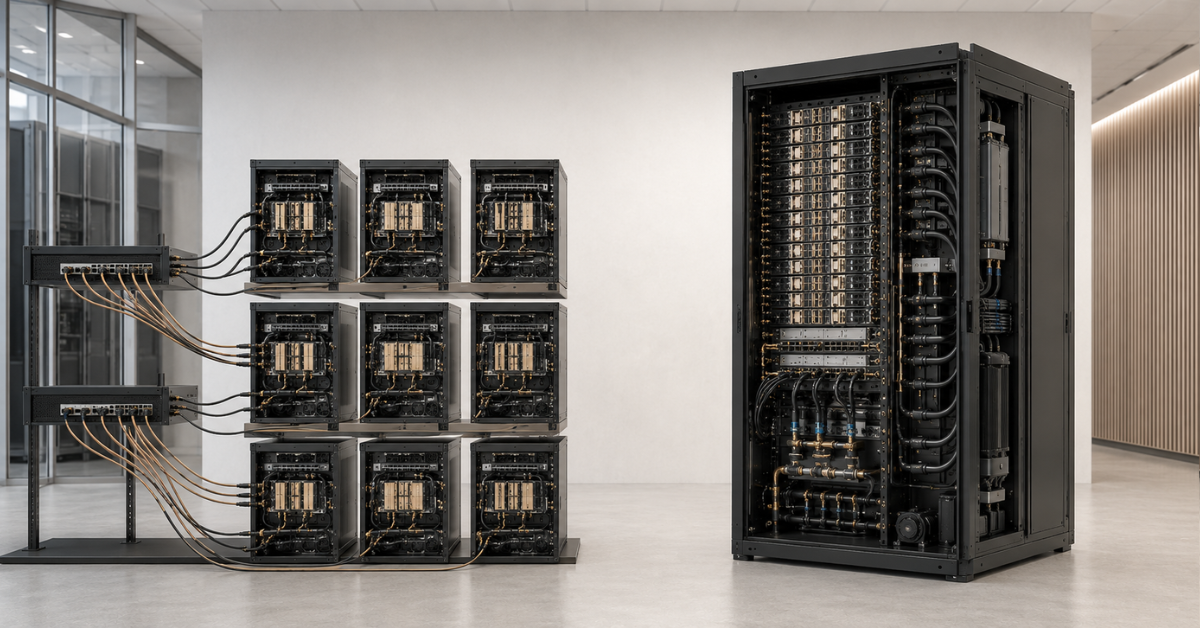
Nine B300 systems and one GB300 both provide 72 GPUs. Their total memory capacity is also close: approximately 20.7 TB across nine B300 systems versus 20 TB in GB300. However, the nine servers form nine separate eight-GPU domains. Data moves between them through network adapters and external switches.
In GB300, all 72 GPUs are part of one NVLink system. This does not turn them into a single super-GPU with one pool of physical memory, but it provides tighter connectivity for collective operations and the components of a distributed model.
Several B300 systems may be preferable when:
- models fit within eight GPUs;
- teams and workloads are independent;
- performance scales by launching additional replicas;
- procurement is staged;
- individual nodes must be serviced without stopping the entire pool;
- project isolation is important.
GB300 has the advantage when one workload continually crosses the boundaries of an eight-GPU node and inter-server communication reduces efficiency. The decisive factor is not the total number of accelerators but the interconnect topology.
Choosing the Right Equipment
Our specialists will contact you and answer all your questions
Data center requirements
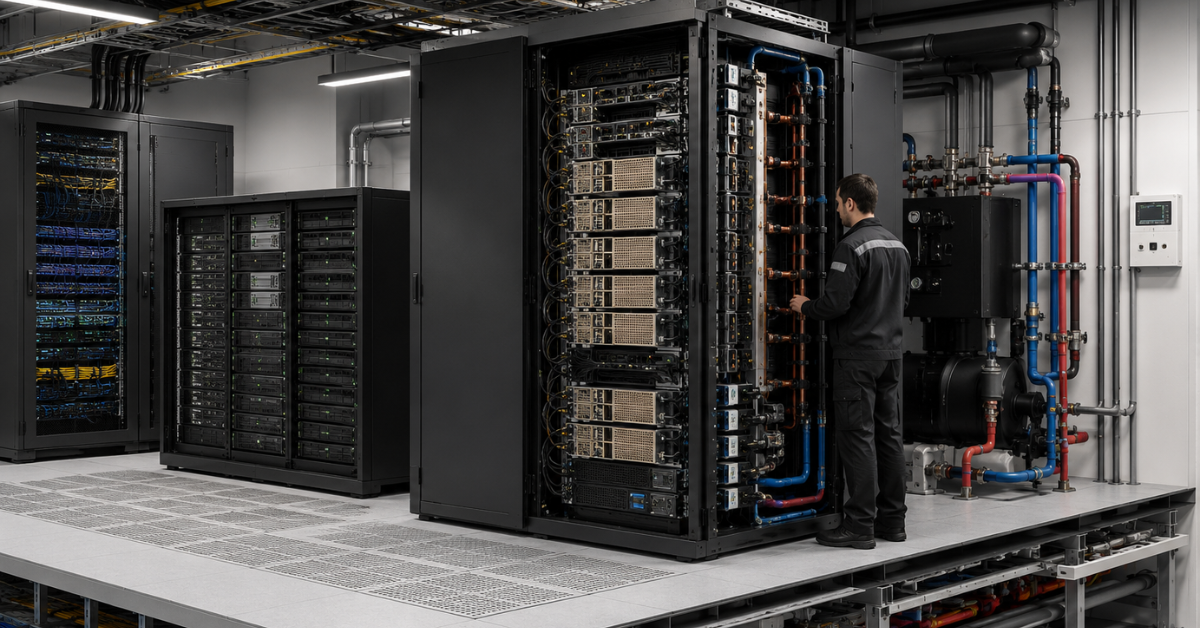
The decision cannot be left to the ML team alone. Before procurement, data center architects must assess power, cooling, weight, networking, and service requirements.
For DGX B300
The system requires:
- 10U of free rack space;
- up to 14.5 kW of power per node;
- sufficient airflow;
- redundant power feeds;
- high-speed ports for compute networking and storage;
- external storage for data sets and checkpoints.
One B300 can exceed the power capacity of an older rack. Four servers occupy a standard 40U rack, but their combined consumption approaches 58 kW, so power and heat-removal limits may be reached long before rack space runs out.
For DGX GB300
A facility designed for high-density liquid-cooled systems is required. It must support:
- coolant supply and return;
- a coolant distribution unit;
- temperature, pressure, and leak monitoring;
- power infrastructure for up to 142 kW per rack;
- a separate management network;
- a compute network for connecting racks;
- a storage-access network;
- maintenance of the liquid-cooling loop.
A conventional commercial data center may support powerful GPU servers but not this density or direct liquid cooling. In that case, the alternatives are a specialised facility, a partner’s infrastructure, or cloud access.
The local NVMe drives in both systems do not replace shared storage for data sets, checkpoints, and the model registry. Dozens of expensive GPUs will sit idle if data cannot be supplied quickly enough, so networking and storage must be designed together with the compute layer.
Economics: the cost of useful work matters more than the rack price
Total cost of ownership includes:
- hardware, networking, optics, and cabling;
- shared storage;
- power and cooling preparation;
- software and support;
- the infrastructure team’s work;
- power headroom and spare components;
- application migration and the cost of downtime.
It is more useful to compare the cost per million tokens, training time, requests per watt, compliance with target latency, and average GPU utilisation. High peak performance is uneconomical when the system spends most of the week waiting for work.
GB300 can reduce the cost per unit of output under sustained utilisation and for workloads that exploit 72-GPU connectivity. For irregular experiments, several B300 systems or a combination of on-premises servers and cloud resources usually reduces financial risk.
Resource concentration must also be considered: servicing one rack affects a large amount of compute capacity. High density therefore requires redundancy for workloads, data, and facility systems.
Typical selection scenarios
| Situation | Most likely option | Why |
|---|---|---|
| Enterprise assistant and RAG | One or two DGX B300 systems | The model usually fits within 8 GPUs; a second node provides redundancy |
| Several independent ML teams | DGX B300 cluster | Resources are easier to isolate and nodes are easier to service |
| LoRA, QLoRA, and application-specific fine-tuning | DGX B300 | NVL72 will often be excessive |
| High volume of short requests | Several DGX B300 systems | Requests can be distributed across model replicas |
| One model requires dozens of GPUs | DGX GB300 | A single 72-GPU domain is important |
| Long context and reasoning models under sustained load | DGX GB300 | Memory capacity, density, and fast communication are required |
| Training a large foundation model | DGX GB300 or multiple racks | Long-running synchronous computation is required |
| The data center does not support liquid cooling | DGX B300 or an external facility | GB300 cannot be installed like a conventional server |
| The workload is still experimental | B300 plus cloud capacity for peaks | Lower risk of underutilised hardware |
Alternatives to a turnkey DGX platform
DGX combines compute, networking, system software, and support in a validated platform. However, companies can choose GPU servers from OEM vendors and specify the processors, drives, networking, and accelerators themselves.
For example, the current generation includes Dell PowerEdge 17G servers, including models for high-density computing. Configurations based on AMD EPYC are also available, allowing PCIe lanes, CPU cores, and system memory to be balanced differently.
This approach provides more flexibility and simplifies phased upgrades, but the customer becomes responsible for PCIe and NVLink topology, GPU compatibility, the network fabric, cooling, the software stack, and fault tolerance.
An OEM server with eight B300 GPUs may be similar to DGX B300 in compute resources, but it does not automatically become equivalent in integration and support. A set of separate GPU servers also does not replace GB300 when the workload requires a single NVL72 domain.
How to move from one server to a rack
The transition can be completed in stages:
- deploy one B300 for the first production models;
- add a second node for redundancy and parallel workloads;
- build a cluster with shared networking and storage;
- collect data on GPU utilisation, latency, and inter-node communication;
- identify workloads that run inefficiently within the boundaries of eight GPUs;
- prepare a facility with suitable power and liquid cooling;
- deploy GB300 for the most tightly connected workloads.
A mixed architecture is often more economical than a complete replacement. B300 systems can continue to support smaller models, development, and independent inference, while GB300 receives the workloads for which its topology provides a measurable advantage.
To simplify migration, containers, model formats, checkpoint storage, telemetry, and resource scheduling should be standardised in advance. Workloads can then move between standalone nodes and racks without being tightly bound to one deployment model.
What to choose
DGX B300 is suitable for most companies building enterprise AI services, developing RAG, performing application-specific fine-tuning, and serving models that fit within eight GPUs. Several B300 systems remain a logical choice for independent teams and requests that can be distributed across model replicas.
DGX GB300 is required when the limiting factor is the size of the connected compute domain. If one model or training workload must continuously exchange data across dozens of GPUs and the data center is ready for up to 142 kW of power and direct liquid cooling, NVL72 provides an advantage that cannot be achieved simply by adding servers together.
A move to GB300 should be supported by measurements: memory use, communication share, queue length, target latency, GPU utilisation, and the cost of useful work. Until such data is available, B300 or a cluster of several nodes usually provides a more flexible and lower-risk growth path.
Choosing the Right Equipment
Our specialists will contact you and answer all your questions
Free shipping on orders over 500 € in the EU, £500 in the UK, and $3,000 in the USA
Free shipping on orders over 500 € in the EU, £500 in the UK, and $3,000 in the USA
Free shipping on orders over 500 € in the EU, £500 in the UK, and $3,000 in the USA
Free shipping on orders over 500 € in the EU, £500 in the UK, and $3,000 in the USA