So, in the previous part we reached a slightly uncomfortable conclusion: classical microelectronics is not immortal. You can stack transistors into skyscrapers, split chips into chiplets, invent increasingly cursed packaging technologies, and squeeze another few nanometers out of physics with the determination of an overcaffeinated engineer — but eventually the universe starts pushing back. Electrons tunnel through barriers they absolutely should not cross, heat turns into a full-time enemy, and transistors slowly approach atomic scale, where classical physics basically shrugs and leaves the chat.
Which naturally raises the question: what happens next?
And this is where things start getting wonderfully weird. Because quantum computers are not “just faster PCs,” nor are they magical silver bullets that will replace your laptop, gaming rig, or cloud server. They are something far stranger: machines that weaponize the very quantum effects that make modern microelectronics miserable in the first place.
So today we’re going to talk about the architecture of quantum computers: superconducting qubits frozen near absolute zero, ion traps holding individual atoms in vacuum chambers, photonic systems firing single particles of light through optical circuits, quantum teleportation, quantum networks, decoherence, and why the entire surrounding universe seems personally offended by the existence of quantum computation.
Our most popular storage systems

Free shipping on orders over £500 in the EU, £500 in the UK, and $3,000 in the USA

Free shipping on orders over £500 in the EU, £500 in the UK, and $3,000 in the USA

Free shipping on orders over £500 in the EU, £500 in the UK, and $3,000 in the USA

Free shipping on orders over £500 in the EU, £500 in the UK, and $3,000 in the USA
Quantum Computer Architecture: everything around them is trying to kill them
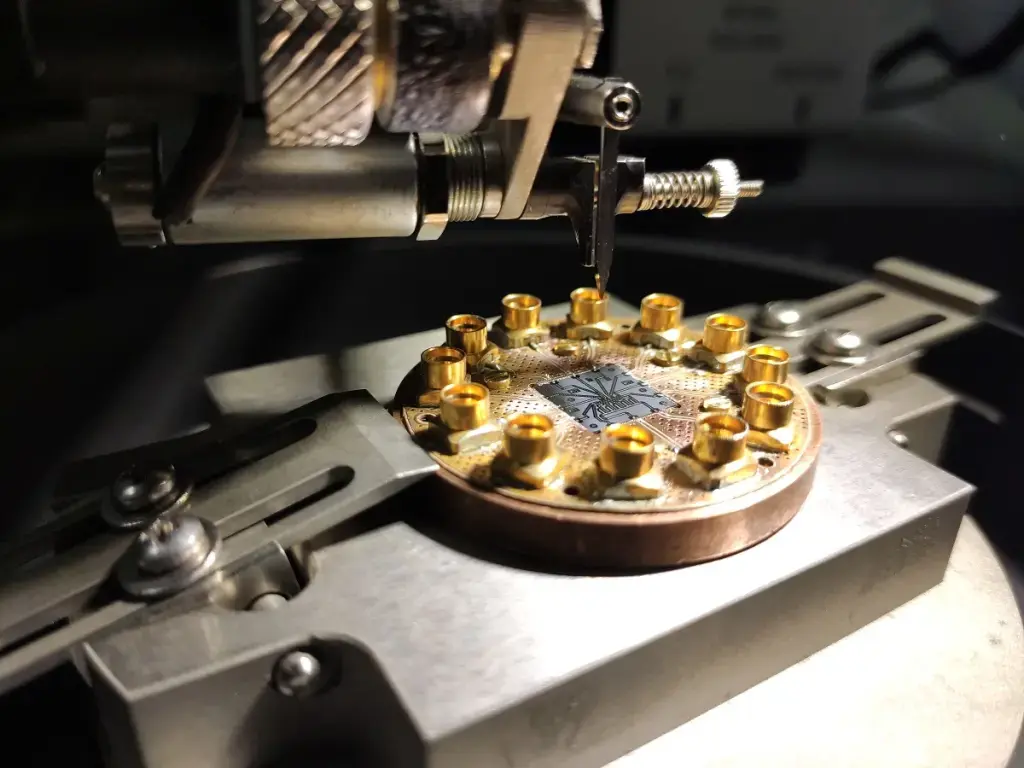
I’m going to briefly walk through the architecture of quantum computers. And yes, I do see a quantum computer as a kind of architecture in its own right — but one that’s fundamentally different from traditional microelectronics.
First, let’s answer the obvious question: why is a quantum processor, or QC, faster than a conventional computer in the first place? Quantum computers exploit the weird properties of quantum mechanics that make them powerful: superposition, entanglement, and interference (boosting the right answers while suppressing the wrong ones). A QC is only potentially faster for certain types of problems: searching unstructured databases, simulating molecular interactions, optimizing logistics problems, or factoring numbers for cryptography.
Every technology mentioned below is still essentially a prototype. The whole point of quantum processors is to tackle insanely complex calculations that classical microelectronics — even inside the biggest data centers on Earth — either can’t handle at all or would take absurd amounts of time to complete. This is what people call quantum supremacy or quantum advantage. There have already been a few controversial claims that quantum supremacy has been achieved. Google made one attempt with a superconducting quantum computer, while IBM argued that it wasn’t really supremacy at all. A bit later, researchers in China also claimed they’d achieved supremacy with the photonic quantum computer Jiuzhang — named after an ancient Chinese mathematical text. Supposedly, it completed a calculation in 200 seconds that would have taken the fastest non-quantum supercomputer more than 1.5 billion years.
But it’s important to keep one thing in mind: these are highly specialized tasks running highly specialized algorithms. A quantum computer only wins in those narrow areas. You’re not going to run Telegram or host a web server on one.
Quantum Processing Unit (QPU) — not exactly a processor
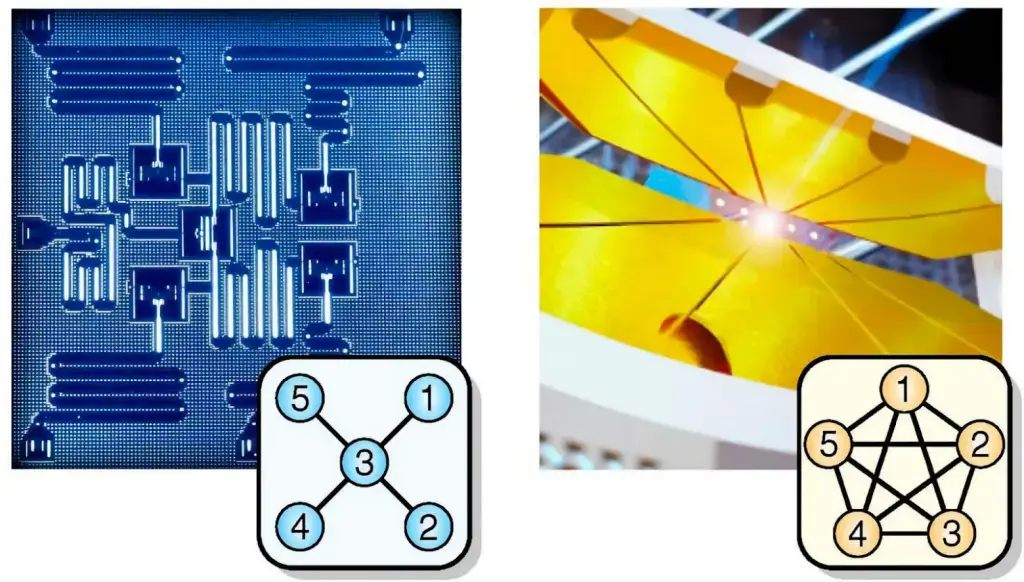
Comparison of two early quantum computer architectures: (a) superconducting qubits connected through microwave resonators, and (b) a linear chain of trapped ions connected through laser interactions.
There are several different approaches to building quantum systems and processors. You can think of them as the equivalent of CISC, RISC, and VLIW architectures in classical computing — except the differences here are far more dramatic. And yes, a modern quantum computer (and its processor) can’t operate on its own. It has to be connected to a classical server and a bunch of conventional electronics to process the results of quantum calculations and control all the supporting systems.
In the world of classical microelectronics, you can build an elementary processor using just two transistors. Together, those transistors can perform a basic logical operation — for example, the NOT gate, which flips the input: feed in a 1, get a 0, and vice versa. Or the NAND gate, which only outputs 0 if both inputs are 1. In every other case, the output is 1.
An elementary quantum processor starts with two qubits — that’s the minimum needed to run quantum algorithms like Shor’s or Grover’s. The qubits interact through quantum gates.
Quantum gates are basically operations that modify the state of qubits inside a quantum computer. In a classical machine, logic gates like NOT or NAND manipulate bits (0 or 1). Quantum gates work with qubits, which, thanks to superposition, can simultaneously exist as both 0 and 1 with certain probabilities.
So the simplest possible quantum processor is essentially anything capable of operating on two qubits.
Broadly speaking, there are currently three major approaches to building quantum systems and processors:
Superconducting systems: here, qubits are implemented as microchips built on special substrates, and they require a cryostat (more on that later) to maintain extremely low temperatures. Each chip is connected to control electronics that manage the qubits’ states, create superposition and entanglement, and generally keep the whole thing functioning. In most cases, every qubit needs its own dedicated controller.
A superconducting quantum processor looks like something halfway between a traditional microchip and a piece of scientific equipment designed for experiments in extreme conditions.
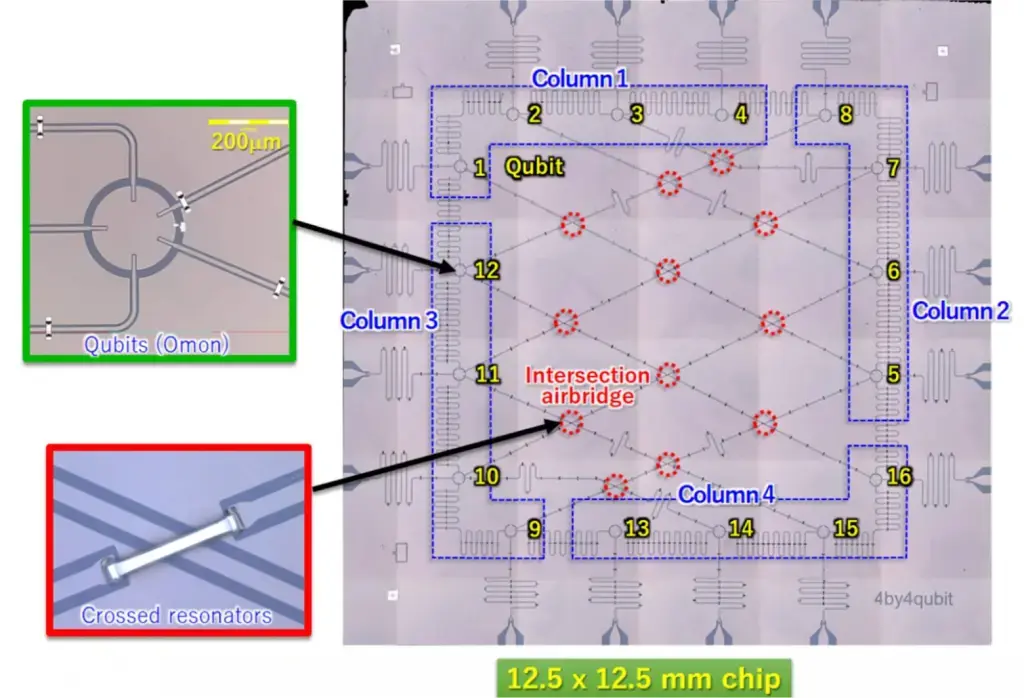
A 16-qubit integrated superconducting chip using a quasi-2D network topology. The layout is equivalent to a 4×4 array; the image on the left shows an enlarged intersection using an air bridge between a qubit and a resonator.
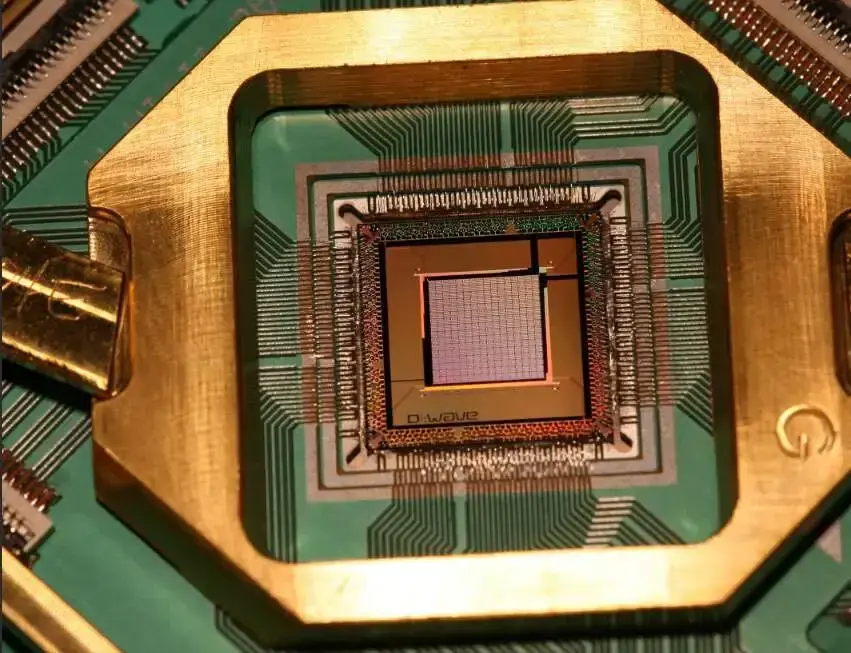
The D-Wave quantum processor (QPU) consists of a lattice of tiny niobium metal loops, each representing a single qubit.
Ion-based systems: here, qubits are ions trapped in space using electromagnetic fields. These systems rely on lasers or microwaves to manipulate ion states and perform computations. Microwave signals aren’t as precise as lasers, but they consume less energy and are often more stable. The microwave approach tends to appear in systems where ultra-high precision isn’t critical, or where engineers are trying to reduce complexity. Classical electronics control the ions’ positions and help stabilize them using sophisticated cooling systems that minimize unwanted motion.
This kind of quantum processor looks more like a miniature particle-trapping device wrapped in layers of complex electronics.
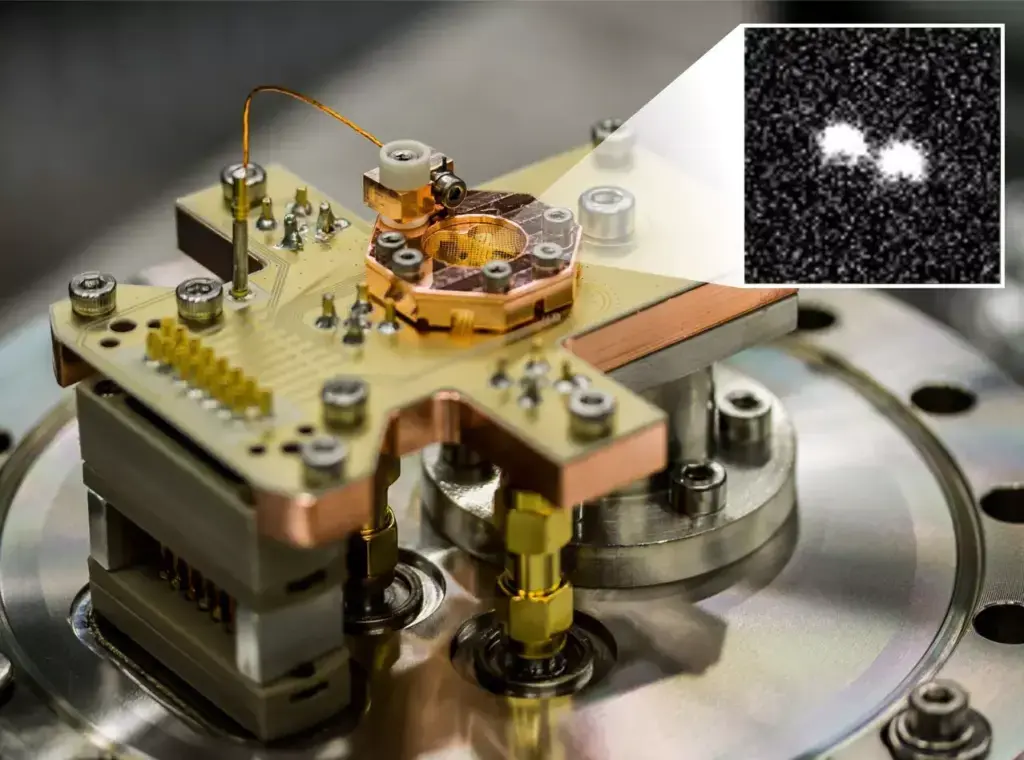
The chip sits beneath the copper octagon in this machine. In the vacuum just above its surface, it traps ions as qubits and manipulates them using microwaves.
Photonic systems: here, qubits are photons carrying information through optical waveguides — transparent structures that transmit light with minimal loss. These systems don’t require extreme cooling; room temperature is perfectly fine. Control electronics generate entangled states and manage interactions between photons inside specialized optical circuits and waveguides, using mirrors, prisms, and other components to manipulate light. Working with photons also requires highly precise equipment capable of detecting and processing optical signals.
A photonic quantum computer looks like an optical laboratory, although the processor itself can be surprisingly compact.
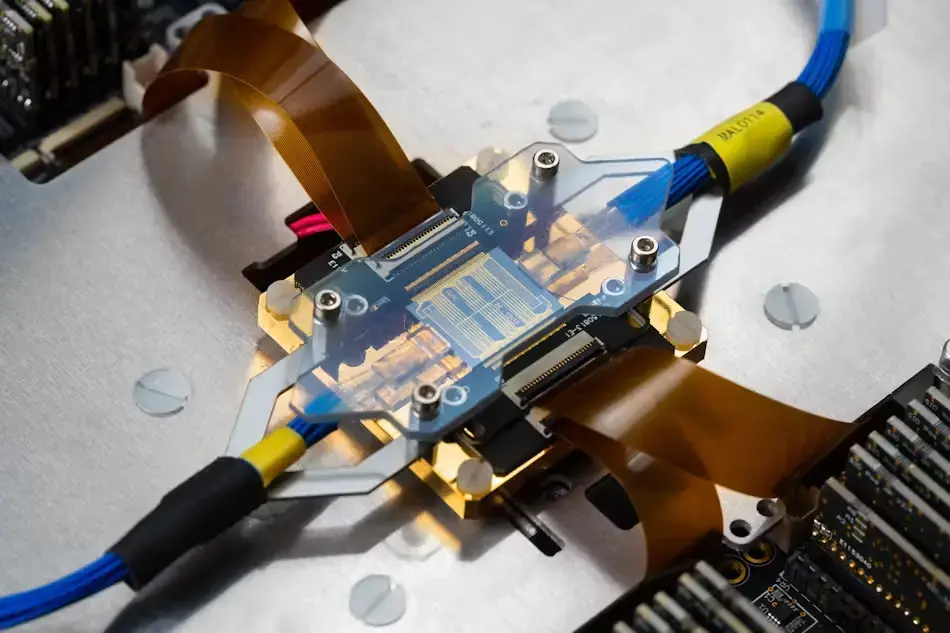
A 12-mode universal quantum photonic processor assembly. The photonic integrated circuit (PIC) includes both optical and electrical interconnects and contains more than 150 tunable elements for full programmability.
Each approach represents a completely different architectural and engineering solution — entire technological ecosystems, if you like — all attempting to achieve stable and efficient quantum computation in different ways. And of course, there are other directions too: neutral atom systems based on alkali metals, as well as spin qubits. They’re just less common.
And yes, we should mention good old nuclear magnetic resonance (NMR). It was one of the earliest quantum computing approaches, although it’s gradually fading into the background because scaling it up is extremely difficult. In NMR systems, qubits are the spin states of atomic nuclei inside molecules placed in a strong magnetic field. Nuclear spins can preserve quantum states thanks to their magnetic moments. Radio-frequency (RF) pulses are used to control the qubits by triggering transitions between spin energy levels.
Why was this technology so useful in the early days — and why is it still attractive for small desktop systems with just a couple of qubits? Because it doesn’t require extreme cooling or a vacuum. The molecules exist in liquid solutions or solid-state crystals at room temperature. Control electronics generate RF pulses, synchronize their воздействие on the qubits, and record the resulting response signals.
That’s the current state of things. Let’s keep going.
Cooling, Optical, and Laser Systems: protecting quantum computers from decoherence
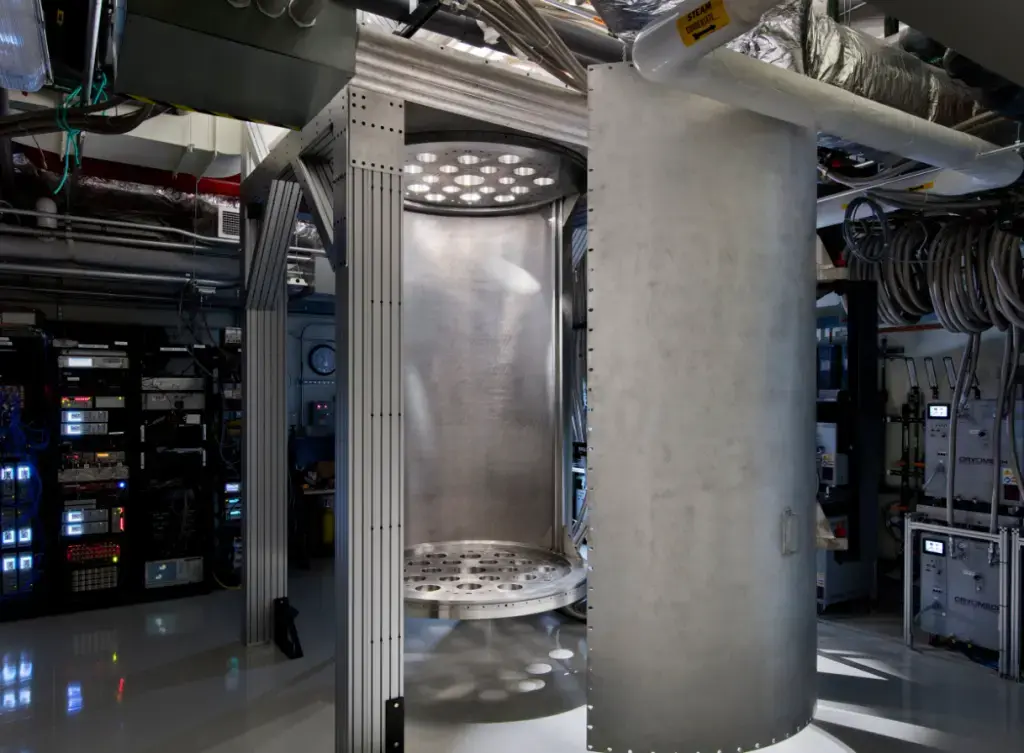
A giant cryogenic refrigerator at IBM’s research headquarters in Yorktown Heights, New York.
In a regular PC, overheating causes throttling — the system lowers clock speeds to protect itself. And it’s not just the CPU: memory, SSDs, GPUs, and pretty much everything else can throttle too. Usually this only temporarily reduces performance, or the chip simply hits a thermal ceiling. In more extreme cases, the system shuts itself down automatically to avoid damaging components — or setting the sysadmin on fire emotionally. The solution is relatively straightforward: better cooling systems with higher thermal dissipation capacity (TDP), load monitoring, and so on.
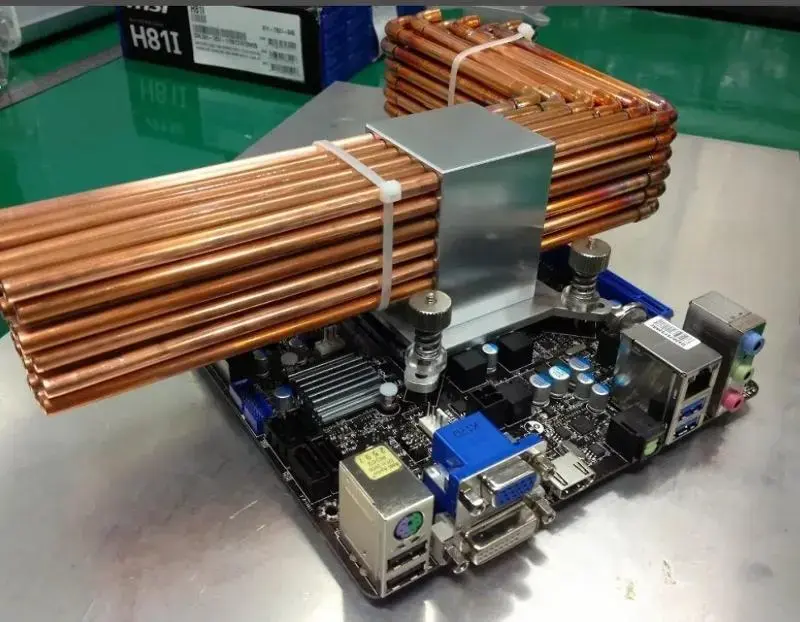
The average overclocker proudly squeezing another 311 MHz out of their CPU.
There are also issues like vibrations, loud noise (which is basically vibration again), mechanical shocks, and similar physical effects. Though honestly, you usually have to try pretty hard to break modern hardware this way. HDDs, cooling fans, sockets, connectors, and certain sensors are relatively sensitive, sure. That’s why ruggedized servers exist: rubber dampers, shock-absorbing mounts, reinforced server racks, sealed enclosures — basically the same kind of protection your waterproof smartphone uses.
But quantum computers are a little more complicated.
Actually, scratch that — they’re absurdly complicated.
Normal office conditions simply don’t work for them unless the whole environment is specially isolated. Any external disturbance can destroy the quantum states of qubits — a phenomenon known as decoherence — which immediately leads to computational errors. So quantum computers require extremely strict environmental control.
To cool superconducting quantum computers, engineers build cryogenic systems and cryostats: gigantic multi-stage refrigerators. So yes, the “quantum computer the size of a fridge” joke isn’t really a joke. And no, the -24°C from your freezer won’t cut it here — we’re not storing frozen dumplings. A cryostat cools qubits to temperatures around -270°C, incredibly close to absolute zero (-273.15°C), though never exactly reaching it. At these temperatures, materials become superconductive: electrons move with almost no energy loss, thermal noise and electromagnetic interference are minimized, and electrical currents remain stable. In superconducting systems, the cryostat itself makes up most of the machine’s physical size. It also consumes huge amounts of power and requires expensive maintenance from highly specialized engineers.
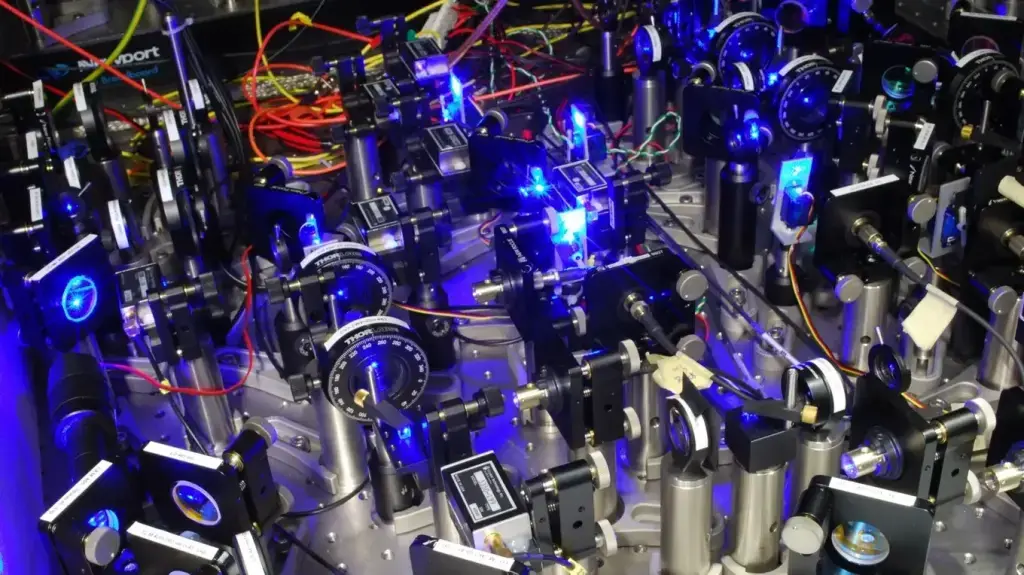
Cooling gases made of atoms or molecules into the quantum regime requires sophisticated laser systems.
Ion-based quantum computers use advanced Doppler cooling. Lasers tuned to specific frequencies slow ions down to nearly absolute zero, reducing their vibrations. On top of that, these systems require deep vacuum environments so the ions barely interact with stray atoms from the outside world. Lasers and optical equipment also operate more effectively in a vacuum. All of this helps maintain precise control over quantum states, reduces decoherence, and improves computational stability.
Photonic qubits are perfectly comfortable at room temperature, but they’re sensitive to vibrations, dust, temperature fluctuations, and even changes in ambient lighting. And generating as well as detecting single photons requires extremely sophisticated equipment: laser systems, optical resonators, specialized fiber optics, and precision mirror assemblies.
Cables and microwave lines in quantum computers
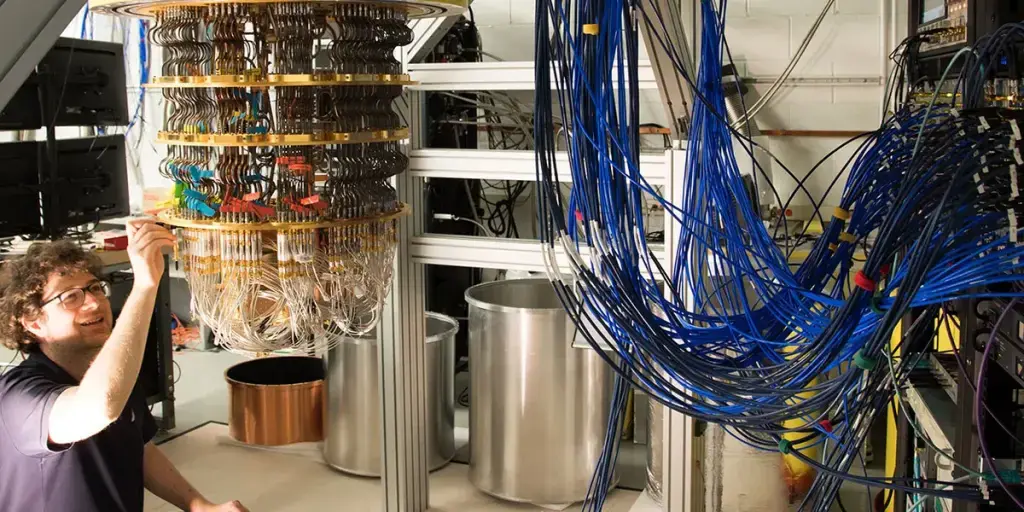
A Google engineer inspecting the company’s quantum computing system. A forest of cables feeds the 72-qubit quantum processor.
Of course there’s cable management — quantum computers need cables too.
Superconducting systems use microwaves to switch qubit states and execute logical operations, which means they require dedicated microwave transmission lines connecting the controllers to the qubits. In practice, these are coaxial cables: specialized conductors with a central core made of conductive or superconductive material — often solid or stranded silver — surrounded by insulation, shielding, and an outer protective layer. Their entire purpose is minimizing signal loss during transmission.
Ion-based quantum computers use completely different cabling because their qubits are ions controlled through electromagnetic fields and lasers rather than superconducting microchips. So these systems rely heavily on fiber-optic cables and electrode wiring made from copper or silver for electromagnetic traps. Ion traps may also use highly complex arrangements of conductive rails and electrode plates which, combined with a vacuum environment, keep ions suspended in stable states.
Photonic qubits are controlled by light itself. Because of that, photonic systems use optical waveguides and fiber-optic cables to transmit and manipulate photon signals. Information travels through visible or infrared light.
Power systems for quantum computers
This part is a little less exotic: ultra-precise DC power modules, voltage converters, electromagnetic interference filters, and redundant backup power systems. Quantum computer power supplies are designed to be exceptionally stable in voltage, output power, and operating frequency. Naturally, everything is built with redundancy in mind — the failure of a single component shouldn’t bring down the entire machine.
Most of a quantum computer’s energy consumption goes toward maintaining the environment: cooling systems, lasers, and auxiliary hardware. The quantum operations themselves are actually relatively energy-efficient. In classical microelectronics, it’s usually the opposite.
Quantum memory doesn’t really exist yet — but there’s something close
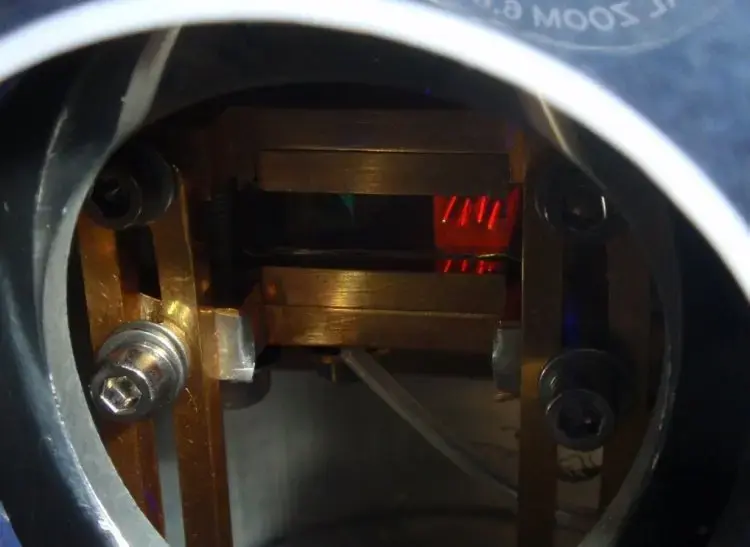
A cryostat containing an Eu:YSO crystal used for experimental quantum memory. Four laser beam paths are visible passing through the crystal.
Long-term quantum memory is still very much a prototype technology today. There are countless experimental approaches. Some rely on rare-earth elements like yttrium or terbium, while others use silicon-vacancy (Si-V) color centers inside diamonds.
The biggest problems are the lifespan of the quantum memory before decoherence kicks in, and the extremely low efficiency of retrieving stored information. A few microseconds — or even seconds, if you’re lucky — isn’t exactly an impressive benchmark.
Still, progress is happening. Stable quantum memory nodes could dramatically expand the capabilities of quantum computers and potentially open the door to practical quantum teleportation.
Including across deep space.
Quantum networking and quantum teleportation
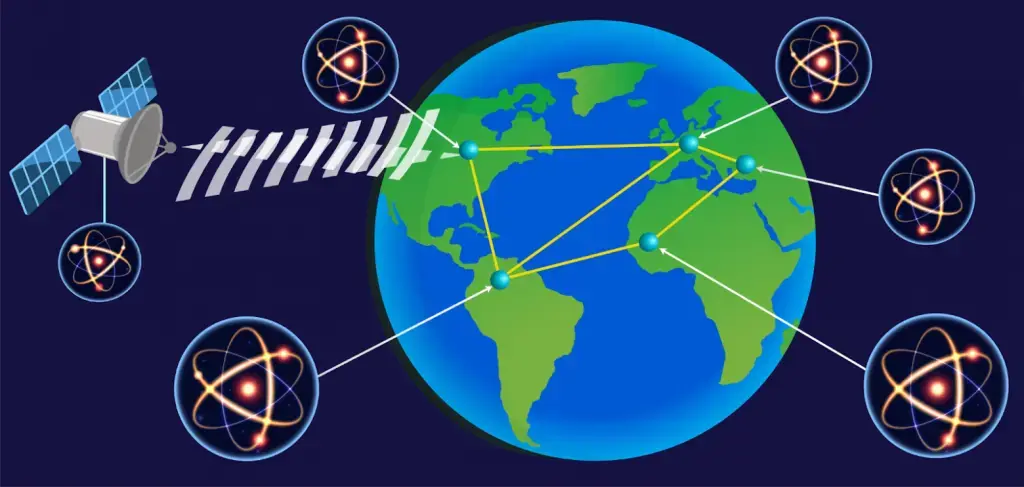
The quantum internet is not a replacement for the existing internet — at least not anytime in the foreseeable future. It’s more like an extension, an upgrade pack on steroids. A quantum network could connect quantum processors, devices, and sensors for quantum-secure communication. It could also synchronize spacecraft, satellites, telescopes, and atomic clocks with incredible precision, compensating for relativistic effects caused by gravity and motion. In theory, GPS-level navigation accuracy could improve from several meters down to just a few centimeters.
And this is where we return to teleportation — quantum teleportation, naturally.
Quantum teleportation doesn’t transport physical objects. Instead, it transfers a quantum state between two entangled particles. You’ve probably already imagined instantaneous communication thanks to entanglement: some astronaut named Yuri floating near Jupiter while chatting with mission control on Earth in real time.
Unfortunately, that’s not how our universe works.
A classical communication channel is still required, and that means we’re stuck with the speed of light.
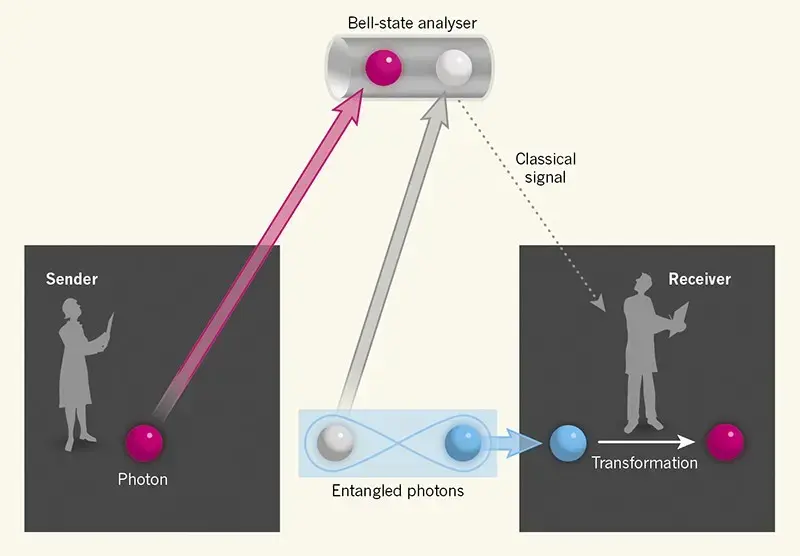
Here’s what would actually happen: a ground station wants to transmit the quantum state of particle ψ to astronaut Yuri. The station performs a measurement on its own particle ψ together with one half of an entangled pair. This destroys the original quantum state of ψ but creates the correlations needed to transfer the state. The measurement results — two classical bits of information — are then sent to Yuri over a conventional communication channel, like a radio signal. About 50 minutes later, Yuri receives the data and uses it to transform his entangled particle into the state of the original ψ particle — its spin, polarization, and so on.
Quantum measurements like these could achieve levels of precision impossible with classical techniques. That might become useful for deep-space navigation or experiments related to general relativity. Earth-based measurements could serve as stable references for time and energy, while Yuri performs experiments deep inside Jupiter’s gravitational field.
This principle could also be used for quantum cryptography. Intercepting the classical signal is possible, but decoding it without access to the entangled particle would be effectively impossible.
Our most popular servers

Free shipping on orders over £500 in the EU, £500 in the UK, and $3,000 in the USA

Free shipping on orders over £500 in the EU, £500 in the UK, and $3,000 in the USA
Free shipping on orders over £500 in the EU, £500 in the UK, and $3,000 in the USA

Free shipping on orders over £500 in the EU, £500 in the UK, and $3,000 in the USA
Our future: the limits of classical microelectronics and whatever comes next
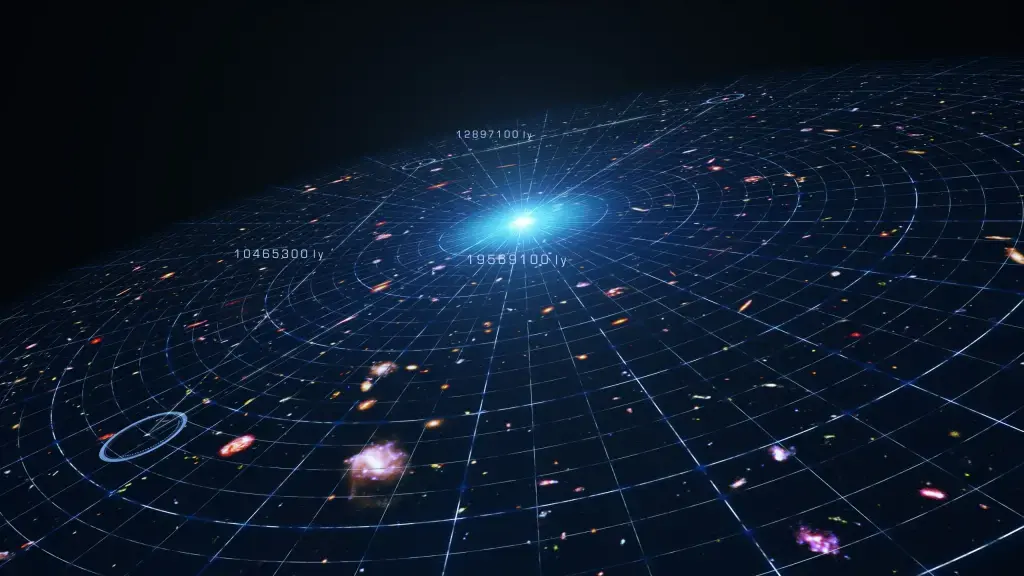
Let’s ignore the darker versions of the Fermi paradox for a second — planetary heat death, nuclear winter, rogue AI, and all the other wonderfully cheerful ways civilization could end. Let’s go with the optimistic scenario instead.
No matter how hard we try, the laws of physics are non-negotiable. The idea of the “perfect chip” isn’t a hypothesis — it’s an inevitable destination. And honestly, that’s not necessarily a bad thing. Massive data centers, giant compute clusters, and wireless networks distributing computational results to users — that’s probably what consumer technology will look like once we hit the ceiling. And for everyday life, that level of computing power would be more than enough: work, gaming, smart homes, content creation, everything.
Local computing would gradually become unnecessary because physical limits would constrain the perfect chip and its minimum possible size. A smartphone would contain some number of these ideal chips, while a desktop computer — assuming those still exist — would contain a few more. The logic isn’t too different from how Apple currently scales its silicon lineup with the M2, M2 Pro, M2 Max, and M2 Ultra families.
For specialized scenarios like cave diving or remote автономous exploration, dedicated standalone hardware would still exist. But in daily life, we’d mostly interact with network-connected input/output devices: displays of every imaginable kind, maybe even contact lenses projecting directly onto your retina, plus gesture controls, touch layers, and similar interfaces. The heavy computation itself would happen remotely inside data centers.
If a user needs more compute power, they simply rent it on demand. Future 6G, 7G, and whatever-comes-next networks would reduce latency to the point where ordinary users barely notice it.
That’s just my assumption, though. It’s also possible that a perfect chip would eventually become cheap enough and powerful enough for absolutely everything an ordinary person needs, which would put it everywhere — in wearable electronics and beyond.
As for quantum computers specifically:
Absolute quantum supremacy probably isn’t coming. Quantum computers won’t replace supercomputers or compute clusters; they’ll become specialized alternatives for certain workloads. Quantum chemistry simulations, molecular modeling, bioinformatics, planetary-scale climate prediction, global logistics optimization, or ultra-secure quantum cryptography — those are the kinds of tasks where they could matter enormously.
Quantum computers could also be integrated directly into existing cloud infrastructure and data centers. End users wouldn’t need to know whether their calculations came from a quantum machine or a classical server. Everything would simply feel fast, reliable, and accurate. The interfaces and devices we already use would continue evolving alongside quantum computing — even if they eventually hit their own physical limits too.
At least, that’s how I think things might unfold.
What do you think?
P.S. Some people believe quantum computers are a dead end too, and that the real future lies in biocomputers or ternary-logic processors — basically taking the old era ternary computer concept and cranking it up to infinity.
Choosing the Right Equipment
Our specialists will contact you and answer all your questions
Content:

Free shipping on orders over £500 in the EU, £500 in the UK, and $3,000 in the USA

Free shipping on orders over £500 in the EU, £500 in the UK, and $3,000 in the USA
Free shipping on orders over £500 in the EU, £500 in the UK, and $3,000 in the USA

Free shipping on orders over £500 in the EU, £500 in the UK, and $3,000 in the USA