A server with NVMe does not always need Tri-Mode RAID or a Tri-Mode HBA. If the platform can connect NVMe drives directly by design and the task does not require hardware RAID or a mixed SAS/SATA/NVMe drive bay, a separate Tri-Mode controller often brings little practical benefit. It becomes truly useful when different drive types must be combined within one storage subsystem, when RAID is needed for supported NVMe/U.3 configurations, or when the server has to be easier to service and expand.
What Tri-Mode means in simple terms
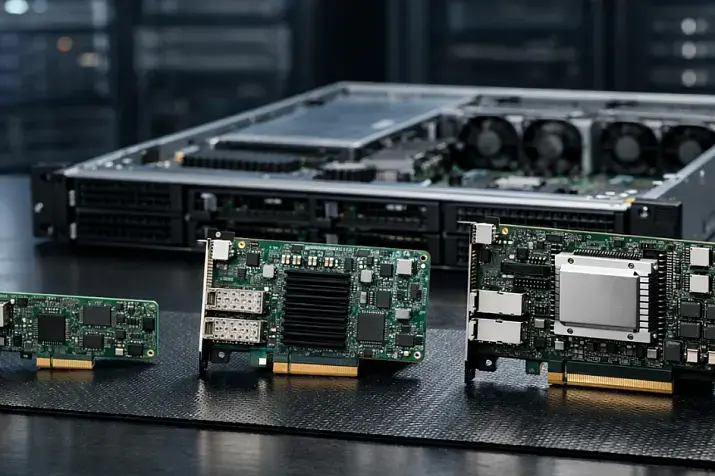
Tri-Mode is the ability of one adapter or controller to work with three types of drives at once: SAS, SATA and NVMe. That is its core purpose: not to “speed up NVMe by itself”, but to allow a server platform to handle different drives through one connection architecture. Broadcom describes Tri-Mode as a technology where one RAID adapter or HBA can work with NVMe, SAS and SATA at the same time.
This is where the first confusion appears. Tri-Mode is not a separate class of drives and not a synonym for RAID. It is a characteristic of an adapter. Such an adapter can be a RAID controller, or it can be an HBA. In one case it manages arrays; in the other, it simply gives the system access to drives without classic hardware RAID. That is why the phrase “Tri-Mode is needed for NVMe” does not explain much by itself: first you need to understand which operating mode is actually being discussed.
How an HBA differs from a RAID controller
An HBA is an adapter that connects a server to drives and usually passes those drives to the system almost “as they are”. It is used where the storage logic is built higher up: by the operating system, the hypervisor or software-defined storage. A RAID controller, by contrast, manages arrays, fault-tolerance policies, cache and disk group maintenance itself.
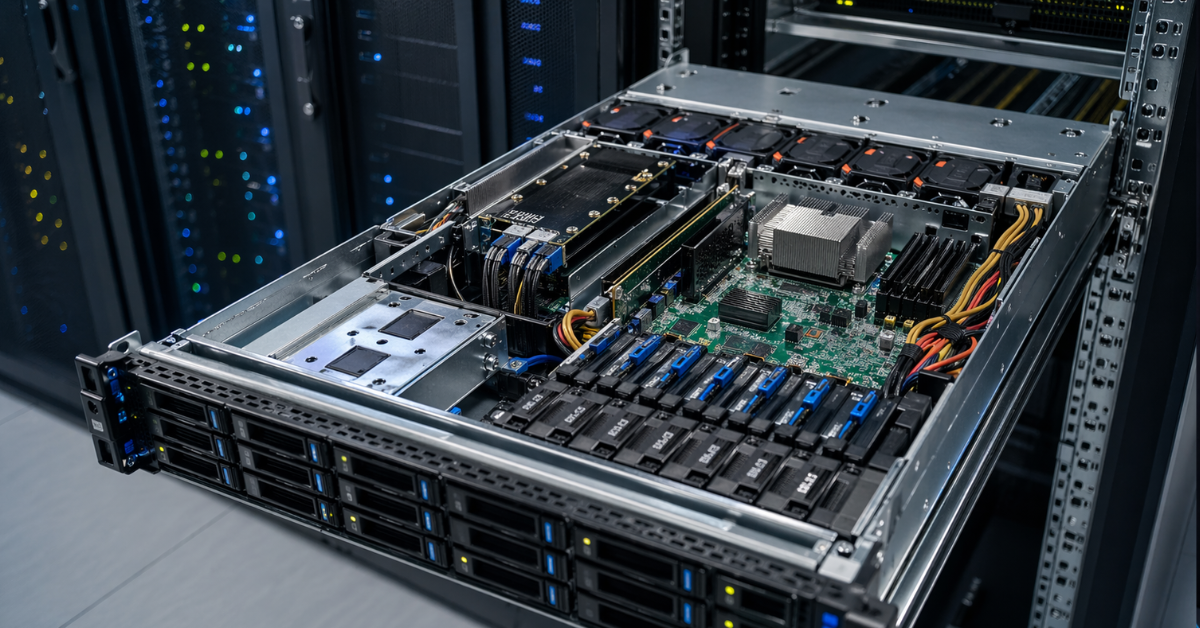
With SATA and SAS, this logic has long been familiar: there is a controller, a drive bay, drives and a RAID array. With NVMe, things are more complicated because NVMe was originally designed to work over PCIe and is often connected to the platform directly, unlike SAS or SATA. Because of this, NVMe in one server may go directly to the processor, through a backplane, through built-in platform tools or through a Tri-Mode controller. All of these options can be official, but they are not interchangeable.
In simple terms:
- HBA is usually chosen when direct access to drives is needed and the RAID logic lives at the OS/software level.
- A RAID controller is usually chosen when a familiar hardware array and standard enterprise operation are needed.
- Tri-Mode matters when the server must work not only with SAS/SATA, but also with NVMe in the same storage architecture.
Most popular servers
Free shipping on orders over 500 € in the EU, £500 in the UK, and $3,000 in the USA
Free shipping on orders over 500 € in the EU, £500 in the UK, and $3,000 in the USA
Free shipping on orders over 500 € in the EU, £500 in the UK, and $3,000 in the USA
Free shipping on orders over 500 € in the EU, £500 in the UK, and $3,000 in the USA
Why NVMe is not that simple
NVMe is not just “another SSD”. It is a storage interface over PCIe with much lower latency and a different queue logic than SAS/SATA. Therefore, a server with NVMe cannot be evaluated by the old habit: “there are drives, so a RAID controller is needed”. In many configurations, NVMe does not require a separate RAID adapter at all and works normally through direct attach. Lenovo materials on NVMe implementation show directly that such drives can be used as individual devices and as the basis for software arrays, without a mandatory classic RAID controller.
This leads to an important point: NVMe does not need an abstract “controller with NVMe support”, but a compatible chain of server, backplane, cables, drives, PCIe lanes and firmware. That is why, in practice, there are many situations where “the NVMe drive is supported” formally, but the required RAID mode is not. Dell, HPE and Lenovo describe support not in general terms, but through specific server configurations, backplanes and drive types.
Confusion appears especially often with U.2 and U.3. From the outside, they may look almost the same to the user, but in server practice the differences matter: compatibility depends on the drive bay, controller and connection scheme. HPE, for example, separately indicates scenarios where a backplane can work either in direct attach mode or through a Tri-Mode controller, while Lenovo describes limitations on mixing form factors and drive types in one configuration.
Choosing the Right Equipment
Our specialists will contact you and answer all your questions
When Tri-Mode is actually needed
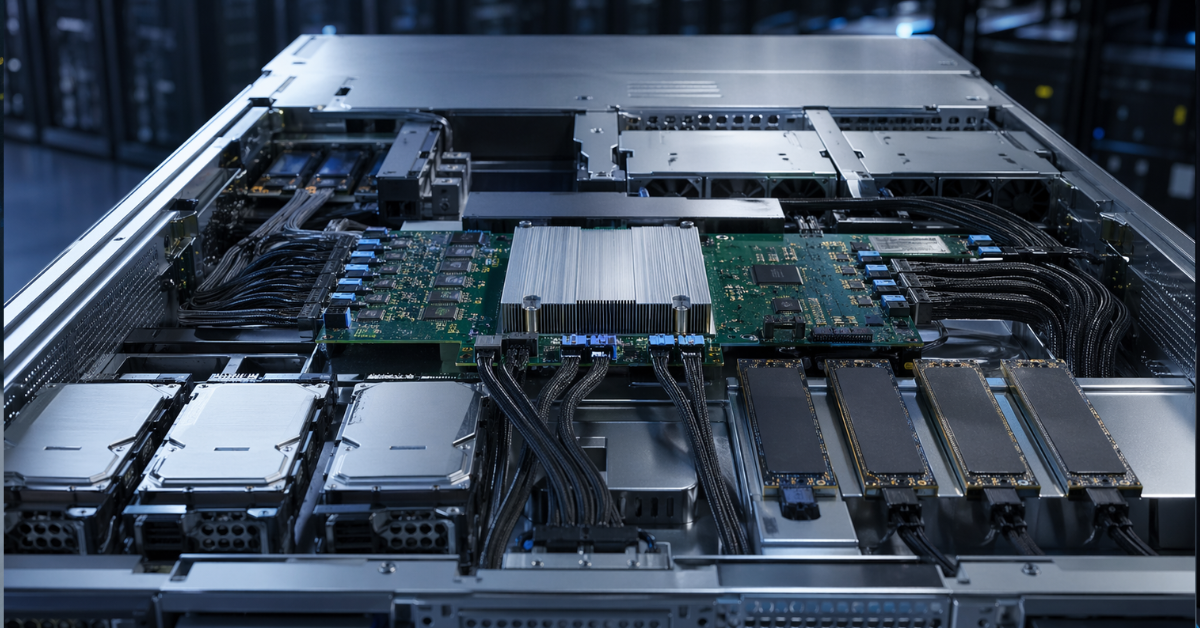
Tri-Mode is needed when the server must be not just “with NVMe”, but equipped with a universal and manageable storage subsystem.
The first typical case is a hybrid drive bay where SAS, SATA and NVMe are combined in one platform. In this architecture, Tri-Mode removes some connection limitations and makes it possible to build a single, more predictable path for several media types. This is exactly the scenario for which Broadcom promotes Tri-Mode: one subsystem handles three storage classes at once.
The second case is servers with a U.3 backplane, where RAID for NVMe is implemented not arbitrarily, but through a specific Tri-Mode controller and a specific cable scheme. Here the controller is needed not “for show”, but because the required mode is simply not provided by the platform without it. HPE separates CPU direct attach and support through Tri-Mode-controller support for U.3 NVMe, SAS and SATA.
The third case is enterprise servers where not only speed and fault tolerance matter, but also predictable maintenance: unified monitoring logic, clear drive replacement, validated firmware and vendor support. In such an environment, the controller is sometimes valuable not so much as a way to “speed up the drive”, but as a way to avoid building a complex scheme out of several semi-official solutions.
The fourth case is gradual modernization. Today the server has SAS or SATA drives; in a year, some slots are moved to NVMe (U.3). If the server and controller were originally selected with Tri-Mode in mind, such migration is usually cleaner than a full rebuild of the storage subsystem.
When a server with NVMe does not need Tri-Mode
There is also the opposite situation, and it is very common: the server is built entirely around NVMe, the platform officially supports direct attach, and the workload does not require hardware RAID specifically at the controller level. In that case, a separate Tri-Mode adapter may be unnecessary. It will not make NVMe “truly server-grade”, will not by itself guarantee better performance and will not fix platform limitations if they were not designed at the backplane and PCIe lane level.
Tri-Mode is also often unnecessary where storage is built in software: in software-defined storage, in hyperconverged environments, in some virtualization and database configurations where direct access to NVMe and a minimal number of intermediate components are more important. In such an architecture, an HBA or even direct attach may be more logical than a classic RAID controller.
Finally, Tri-Mode is not needed “just in case”. If the server does not require a mixed drive bay, if the expansion plan is vague, and if hardware RAID for NVMe is not supported by the vendor for this exact model, the controller may become an expensive and useless intermediate layer.
Comparison of approaches
| Option | What it does | When it fits | Pros | Cons | Main risk of error |
|---|---|---|---|---|---|
| Tri-Mode RAID | Works with SAS, SATA and NVMe and manages arrays | Hybrid drive bays, supported RAID on U.3/NVMe, enterprise configurations | Unified subsystem, hardware RAID, easier operation | More expensive, depends on platform and backplane | Buying a controller that formally “supports NVMe” but does not fit the specific server |
| Tri-Mode HBA | Provides access to SAS, SATA and NVMe without classic hardware RAID | Software-defined storage, direct access to drives | Flexibility, less controller-side logic | Does not solve the hardware RAID task by itself | Confusing an HBA with a RAID controller |
| Direct NVMe attach | Drives are connected directly through the platform’s supported design | Servers where NVMe is designed in from the start | Minimum intermediate components, lower latency | Hardware RAID is not always available, and mixing drive types is not always convenient | Assuming that if the drive is visible, all modes are supported too |
| Software RAID over NVMe | The OS or hypervisor builds the array | Virtualization, software-oriented storage, some cluster systems | Flexibility, independence from a specific RAID controller | Requires proper configuration and platform understanding | Underestimating maintenance requirements |
| Classic SAS/SATA RAID | Hardware RAID for SAS/SATA without a focus on NVMe | Traditional servers without complex NVMe logic | Clear and mature scheme | Often does not solve the required task for NVMe | Projecting old SAS/SATA logic onto any NVMe server |
This table shows that Tri-Mode is not “the best option overall”, but one of the tools. The choice should be based not on the adapter name, but on the server architecture.
Main limitations and hidden pitfalls
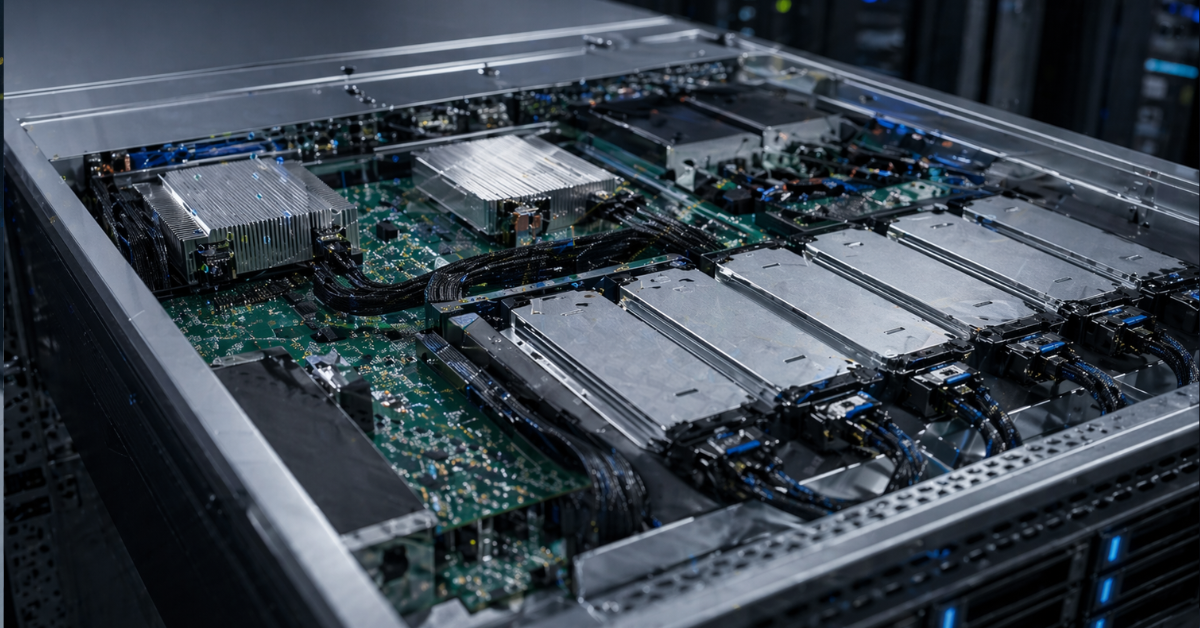
The most expensive mistakes when choosing Tri-Mode or HBA are usually related not to speed, but to compatibility.
First, not every backplane supports the same operating mode. One server may allow direct NVMe attach in some slots, another may require a Tri-Mode controller, and a third may support mixed scenarios only through certain cables and a certain riser. HPE reflects this directly in connection options, where some configurations work through the system board and others through a Tri-Mode type-a controller.
Second, NVMe support does not mean RAID support for NVMe. A user may see “U.2/U.3 NVMe support” in the server specifications and assume that any RAID array is possible too. In practice, these are often different levels of compatibility. Dell, Lenovo and HPE describe RAID capabilities not separately from the platform, but only within specific configurations.
Third, there are limitations on mixing drive types and form factors. Lenovo separately specifies drive installation rules and combination limits, which is important for anyone who expects to “buy other NVMe drives later and simply combine everything into one array”. In server practice, this does not always work.
Fourth, PCIe lanes, cooling, system boot and monitoring must not be forgotten. NVMe drives and controllers can be hot, resource-intensive and demanding in terms of board layout. If the design is careless, the problem will not appear at the moment of purchase, but later: overheating, instability, inconvenient drive replacement or an unexpected limit on the number of drives.
Is Tri-Mode needed in different scenarios?
For virtualization, the answer depends on the role of local storage. If NVMe drives are used as a fast local layer for virtual machines and the platform supports direct attach, Tri-Mode is often not mandatory. If a hybrid drive bay or hardware RAID in a supported configuration is needed, it may be justified.
For a database, minimal latency and a clear access path to the drives are usually more important. Therefore, direct NVMe attach or software logic on top of it often wins here. Tri-Mode makes sense where it is needed for architecture and support, not for the abstract idea that “the controller should manage everything”.
For a file server and backups, NVMe is often not the central part of the configuration at all. In such systems, Tri-Mode is useful primarily with mixed drive bays and when there is a need to build a unified, manageable storage scheme. If the server mainly lives on SAS/SATA and NVMe performs a narrow role, it is sometimes easier to keep the storage subsystem more traditional.
For hyperconverged infrastructure and software-defined storage, direct access to drives and software-level logic are often more important. There, a Tri-Mode HBA may be more appropriate than a full RAID controller, and sometimes even that is unnecessary if the platform already provides standard access to NVMe.
For an ordinary enterprise application server that must be predictable in maintenance, Tri-Mode can be a good compromise: not as an “NVMe accelerator”, but as a way to organize storage, monitoring and future expansion. But only if it is explicitly supported by the platform.
Choosing by workload type
| Scenario | What is usually more reasonable | Why | What to check |
|---|---|---|---|
| New enterprise server | Tri-Mode RAID or the platform’s supported standard scheme | Support, maintenance and predictability matter | Backplane, cables, NVMe RAID mode |
| Virtualization server | Direct NVMe or Tri-Mode, depending on the platform | Depends on the role of local storage and the fault-tolerance policy | Whether hardware RAID is needed and how drives are visible to the hypervisor |
| Server with a U.3/NVMe drive bay | Only a vendor-supported configuration | U.3 is often tightly tied to the connection type | Compatibility of the drive bay, controller and firmware |
| Hybrid system with SAS/SATA and NVMe | Tri-Mode is more often justified | A unified subsystem is needed for different drive types | Mixing drive types, slot limits |
| Budget server | Direct attach or a simple scheme | The controller may be unnecessary spending | Whether hardware RAID is actually needed |
| System focused on minimal latency | Usually direct NVMe | Fewer intermediate components | Boot support, monitoring, cooling |
| Server with complex remote maintenance | A supported and maximally standard scheme | Ease of replacement and diagnostics is more important than elegant theory | Drive visibility in monitoring and service logic |
Choosing the Right Equipment
Our specialists will contact you and answer all your questions
The question is not whether Tri-Mode is “good”, but what problem you are trying to solve in this specific server.
Common selection mistakes

- Assuming that any server with NVMe automatically requires Tri-Mode. In practice, many platforms work normally with NVMe directly, and this is an official mode.
- Confusing an HBA with a RAID controller. If these roles are not separated at the very beginning, the choice will almost certainly be wrong.
- Buying a controller without checking the backplane and cables. In a server, storage architecture is always a chain, not a single board.
- Mixing up “the drive is supported” and “RAID is supported for it”. This is one of the most expensive mistakes in NVMe configurations.
- Expecting Tri-Mode to provide maximum speed by itself. Its strength is not magical acceleration, but architectural flexibility and supported operating modes.
- Ignoring boot, cooling and monitoring. Even a correctly selected controller will not save the system if the server is inconvenient to maintain or is built at the limit of heat and PCIe lane capacity.
What to choose in practice
If the server is built entirely on NVMe and the platform officially supports direct attach, the starting point should not be Tri-Mode, but the question of whether a hardware controller is needed at all. In many such configurations, the answer will be “no”. Direct access or software storage logic is often simpler and cleaner.
If a hybrid subsystem is needed, where SAS, SATA and NVMe live side by side, Tri-Mode becomes a much more logical choice. This is where its main advantage becomes clear: not speed as such, but the ability to bring different drive classes into one server-side logic without a chaotic connection scheme.
If hardware RAID is required for supported U.3/NVMe configurations, only the solution officially specified for the particular server should be chosen. Not simply “Broadcom Tri-Mode”, not simply “RAID with NVMe”, but the exact combination of server, drive bay, cables and controller.
If software-defined storage is being built, an HBA or direct attach is often more useful than a classic RAID controller. If the server must be as predictable as possible for enterprise operation, a supported Tri-Mode RAID solution may be more convenient, even if in pure theory it could be avoided.
Top-selling network switches
Free shipping on orders over 500 € in the EU, £500 in the UK, and $3,000 in the USA

Free shipping on orders over 500 € in the EU, £500 in the UK, and $3,000 in the USA

Free shipping on orders over 500 € in the EU, £500 in the UK, and $3,000 in the USA

Free shipping on orders over 500 € in the EU, £500 in the UK, and $3,000 in the USA
Pre-purchase checklist
Before choosing Tri-Mode RAID, Tri-Mode HBA or direct NVMe attach, it is worth answering several questions:
- Which exact drives will be used: SATA, SAS, U.2 NVMe, U.3 NVMe? Or perhaps E3.S?
- Is hardware RAID needed specifically for these drives?
- Does the server support Tri-Mode at the drive bay, backplane and cable level?
- Does this model support RAID for NVMe, or only direct access?
- Is an HBA needed instead of a RAID controller?
- How many PCIe lanes are actually available for drives?
- Is a mixed drive configuration planned now or later?
- How will system boot be organized?
- Are drives and errors visible in the server’s standard monitoring?
- Could direct attach or software RAID be simpler and more reliable for your task?
Conclusion
Tri-Mode RAID and Tri-Mode HBA are not mandatory add-ons for every server with NVMe, but tools for specific architectures. If the server needs a hybrid SAS/SATA/NVMe subsystem, supported hardware RAID for U.3/NVMe or predictable enterprise maintenance, Tri-Mode can be very appropriate. If the platform works normally with NVMe directly and the task does not require this exact controller, buying it may only complicate the configuration and increase the budget without a noticeable practical benefit. In server topics, the winner is almost always not the most “modern” component, but the one that is truly supported by the entire platform as a whole.
Choosing the Right Equipment
Our specialists will contact you and answer all your questions
Content:

Free shipping on orders over 500 € in the EU, £500 in the UK, and $3,000 in the USA

Free shipping on orders over 500 € in the EU, £500 in the UK, and $3,000 in the USA

Free shipping on orders over 500 € in the EU, £500 in the UK, and $3,000 in the USA

Free shipping on orders over 500 € in the EU, £500 in the UK, and $3,000 in the USA