For most enterprise RAG systems, local AI assistants, and inference of models with up to 70 billion parameters, a server with one or more RTX PRO 6000 GPUs is a sensible starting point. The B200 is needed when a large model must be distributed across tightly interconnected accelerators while serving many requests simultaneously. The B300 is justified when requirements for GPU memory, long context, and inference density for reasoning models are even higher. The H100 or H200 may be more cost-effective if the workload already fits within their capabilities and a ready-made platform is available at a lower price.
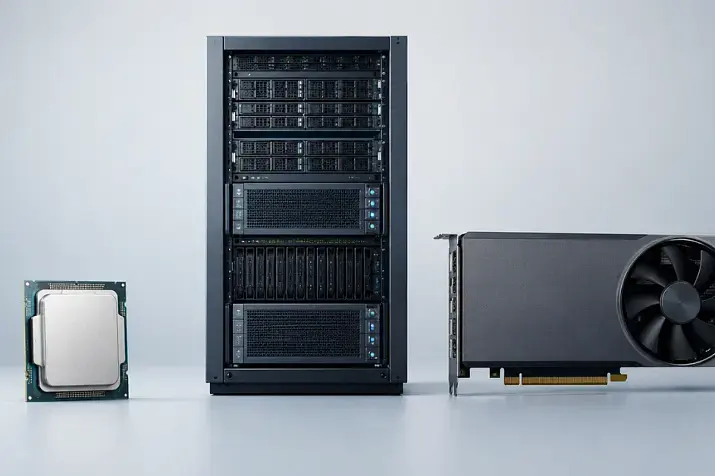
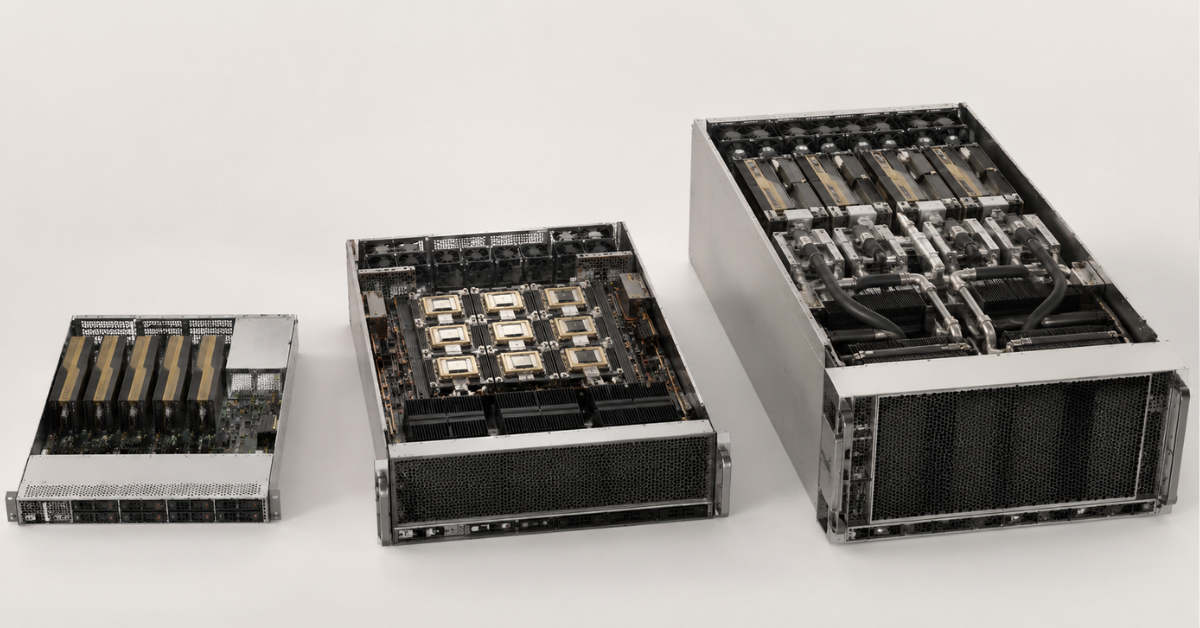
Blackwell spans several classes of hardware. The RTX PRO 6000 is a standalone PCIe card for a general-purpose GPU server. The B200 and B300 are usually purchased as part of an HGX platform, where eight SXM accelerators are connected through NVLink and NVSwitch. This means the comparison should cover not only the GPUs, but also the server architecture, model size, expected workload, number of users, and data-centre requirements.
AI servers with NVIDIA
Free shipping on orders over 500 € in the EU, £500 in the UK, and $3,000 in the USA
Free shipping on orders over 500 € in the EU, £500 in the UK, and $3,000 in the USA
Free shipping on orders over 500 € in the EU, £500 in the UK, and $3,000 in the USA
Free shipping on orders over 500 € in the EU, £500 in the UK, and $3,000 in the USA
Three Levels of Blackwell Servers
RTX PRO 6000 Blackwell Server Edition
The RTX PRO 6000 Server Edition has 96 GB of error-correcting GDDR7 memory, bandwidth of about 1.6 TB/s, and configurable power consumption of up to 600 W. The card is designed for server-grade air or liquid cooling and is suitable not only for LLMs, but also for video, 3D, digital twins, and other workloads, including engineering applications.
A server can be configured with one, two, four, or eight cards, with resources divided between services. For example, one GPU can run a generative model, the second can handle embeddings and reranking, and the third can process images.
Server Edition should not be confused with Workstation Edition or Max-Q Workstation Edition. They have the same memory capacity, but differ in design, cooling, and permitted power levels. A rack server requires a version whose support has been confirmed by the system manufacturer.
B200
The B200 is a data-centre accelerator with 180 GB of HBM3e. In a typical HGX configuration, eight B200 GPUs are installed on a shared baseboard and connected through NVLink/NVSwitch. This architecture is designed for workloads in which one model or training process continuously exchanges data across multiple GPUs.
HBM3e provides not only greater capacity but also higher memory bandwidth. This matters when reading the weights of a large model, forming large request batches, and running distributed inference.
B300 and GB300
The B300 belongs to the Blackwell Ultra generation. A single GPU physically includes up to 288 GB of HBM3e, while an eight-accelerator node provides about 2.3 TB of aggregate GPU memory. Some manufacturers may specify around 270 GB of usable memory per GPU because part of the capacity is reserved for service functions and reliability.
The B300 targets large models, including reasoning models, as well as long-context workloads and high concurrency. Bandwidth of up to 8 TB/s per GPU helps the system work faster with model weights and a large KV cache.
It is important to note that the B300 and GB300 are not the same thing. The B300 can operate in an HGX server with Intel Xeon or AMD EPYC processors. The GB300 combines Blackwell Ultra with a Grace CPU and is used in specialised Grace Blackwell rack-scale platforms, including NVL72.
Why Eight RTX PRO 6000 GPUs Are Not Equivalent to Eight B200 GPUs
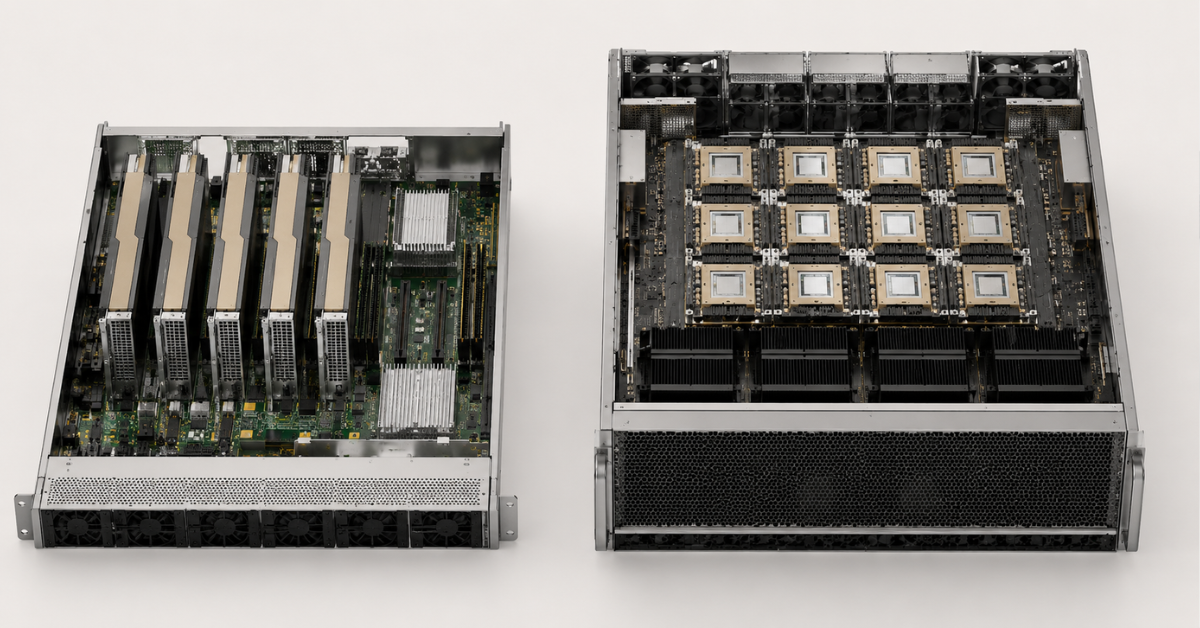
Eight RTX PRO 6000 GPUs provide 768 GB of physical GDDR7 memory, but that memory remains distributed across separate PCIe cards. The application must explicitly partition the model, data, or requests across the GPUs.
In HGX, memory is also physically located on separate accelerators. The difference is that NVLink and NVSwitch provide high-speed communication between them. The official HGX architecture specifies 180 GB for the B200, 288 GB for the B300, and up to 1.8 TB/s of GPU-to-GPU bandwidth.
| Criterion | RTX PRO 6000 Server Edition | HGX B200 | HGX B300 |
|---|---|---|---|
| Form factor | Standalone PCIe card | 8 SXM GPUs on an HGX baseboard | 8 Blackwell Ultra SXM GPUs |
| Memory per GPU | 96 GB GDDR7 ECC | 180 GB HBM3e | Up to 288 GB HBM3e |
| GPU interconnect | Via the PCIe topology | NVLink and NVSwitch | NVLink and NVSwitch |
| Scaling | Flexible, starting with one GPU | Tightly interconnected node | Tightly interconnected node |
| Primary workloads | Private AI, RAG, LoRA, video, and 3D | Large models, training, high concurrency | Long context, reasoning models, maximum density |
| Risk of overspending | Buying many cards without solving the communication bottleneck | Underutilising an expensive node | Failing to use the additional memory |
If each GPU serves a separate model or request queue, a PCIe server scales efficiently. With tensor parallelism, however, the computations of a single layer are distributed across multiple GPUs and activations must be exchanged continuously. The interconnect then becomes part of the compute path, giving HGX a fundamental advantage.
Two servers with four RTX PRO 6000 GPUs each can sometimes be better than one eight-GPU node: resilience improves, and independent services are easier to distribute. For one monolithic model, however, this design increases the requirements for the inter-server network.
Choosing the Right Equipment
Our specialists will contact you and answer all your questions
How Much GPU Memory Does an LLM Actually Need?
An initial estimate can be made from the size of the model weights:
- BF16 or FP16 — approximately 2 bytes per parameter;
- FP8 or INT8 — about 1 byte;
- 4-bit storage — about 0.5 bytes;
- additional headroom is required for buffers, service data, and the inference engine.
A 70-billion-parameter model occupies about 140 GB in BF16, 70 GB in 8-bit form, and 35 GB in 4-bit form. This does not mean that any file of that size is guaranteed to run: memory consumption depends on the architecture, quantisation, context length, batch size, and software engine.
A 405-billion-parameter model requires more than 200 GB for the weights alone, even in 4-bit form. But fitting the weights is only the first part of the calculation.
KV Cache
During generation, the model stores intermediate representations of previous tokens in the KV cache, or key-value cache. Its size grows with:
- context length;
- the number of concurrent sequences;
- the number of layers and the model dimension;
- the cache storage precision.
A model may run reliably for one user and exhaust memory with dozens of concurrent sessions. Therefore, 96 GB is often sufficient for an internal assistant but insufficient for a high-volume service processing large documents.
The additional memory of the B300 is often used not for larger weights, but for handling more requests without offloading the KV cache to system RAM or network storage.
Mixture-of-Experts Models
In MoE models, only some blocks are activated to process each token. This reduces computation, but the full set of weights still needs to be stored. Required memory therefore cannot be estimated only from the number of active parameters.
For MoE workloads, the total parameter count, number of active experts, distribution method, and volume of communication between GPUs all matter.
When the RTX PRO 6000 Is Sufficient
The RTX PRO 6000 is a versatile server GPU for workloads where flexibility matters more than maximum density. One or two cards can often meet a company's requirements without the need to support thousands of concurrent users.
Suitable scenarios include:
- an enterprise assistant and RAG;
- code generation and analysis;
- inference of 7B–70B models in an optimised format;
- LoRA and QLoRA fine-tuning;
- speech recognition and video processing;
- moderately sized multimodal models;
- several independent AI services;
- a pilot without a reliable workload profile.
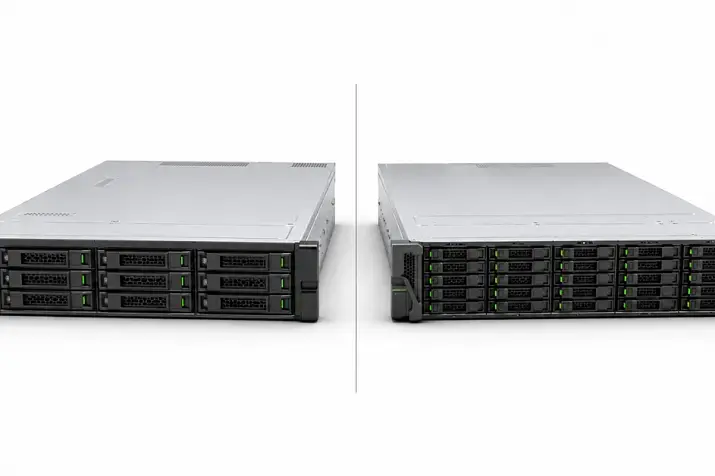
The advantage of a PCIe platform is the ability to start with a smaller configuration. For example, Dell PowerEdge XE7740 with RTX PRO 6000 can serve as a foundation for several accelerators without moving directly to HGX. The number of supported cards, their power requirements, cooling, and PCIe lane allocation should be checked in advance.
Four or eight RTX PRO 6000 GPUs are justified when the GPUs perform independent work for different models, tenants, or queues. If one large model is distributed across all cards, PCIe bus bandwidth may limit scaling.
When the B200 Becomes a Justified Choice
The B200 is needed when the workload can use the advantages of HGX rather than simply requiring many GPUs:
- the model does not fit on one accelerator;
- one request is processed by multiple GPUs;
- all model weights are fully fine-tuned;
- the speed of collective operations is important;
- the service supports many users;
- large request batches are used;
- multiple HGX nodes are combined into a cluster.
Dell PowerEdge XE9780 with eight B200 GPUs is a tightly interconnected AI platform. HBM3e can accommodate large model weights and a larger KV cache, while NVLink/NVSwitch reduces overhead when the model is distributed within the node.
However, the B200 will not remove bottlenecks elsewhere in the system. Sufficient RAM, fast NVMe storage, a storage network, high-speed inter-node connectivity, and a software stack that uses parallelism efficiently are all required. If data is supplied slowly or the GPUs sit idle between requests, an expensive HGX server will not deliver the expected economics.
When the B300 Is Justified
The B300 primarily addresses capacity and density. It is required when the B200 already limits the model size, context length, or number of concurrent sequences.
Suitable workloads include:
- very large dense and MoE models;
- reasoning models with long internal generation;
- high-volume inference with a large KV cache;
- long context at high concurrency;
- full fine-tuning of large models;
- infrastructure designed for maximum performance per rack;
- a long-lifecycle project with continuous utilisation.
PowerEdge XE9780 with B300 is worthwhile when the additional HBM eliminates cache offloading, reduces the number of servers, or supports the required number of sessions.
The B300 is excessive for a small RAG system, several 7B–70B models, or infrequent workloads. Peak figures are often quoted for FP4 and LLM workloads; they cannot be compared directly with BF16, FP16, or FP64. Low precision is useful only when the model and software stack support it without an unacceptable loss of quality.
AI servers with NVIDIA RTX PRO 6000, B200 and B300 GPUs
Free shipping on orders over 500 € in the EU, £500 in the UK, and $3,000 in the USA
Free shipping on orders over 500 € in the EU, £500 in the UK, and $3,000 in the USA
Free shipping on orders over 500 € in the EU, £500 in the UK, and $3,000 in the USA
Free shipping on orders over 500 € in the EU, £500 in the UK, and $3,000 in the USA
How the Choice Changes with the Workload
Private AI
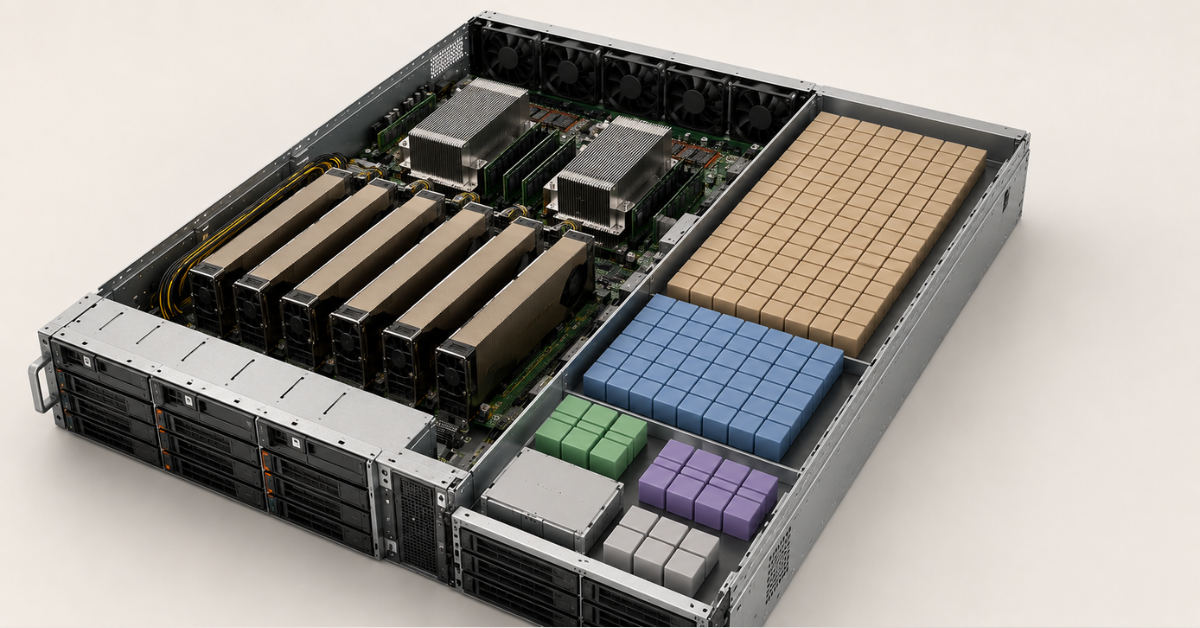
For a local assistant, internal data search, and several specialised models, one or two RTX PRO 6000 GPUs are usually sufficient. Proper data access, user separation, logging, and redundancy are more important.
A B200 or B300 is logical when the platform serves thousands of employees, several departments use large models simultaneously, and downtime affects critical processes.
RAG
RAG (Retrieval-Augmented Generation, in which the model works with an external knowledge base) is not, by itself, a reason to purchase a B200 or B300. The pipeline includes:
- document extraction and cleaning;
- embeddings;
- a vector database and search;
- reranking;
- the generative model.
The bottleneck may be indexing, search quality, storage, or document preparation. For many enterprise systems, an RTX PRO 6000 is sufficient for generation, while a smaller GPU or even a CPU can handle the supporting stages.
A B200/B300 is needed when the model is large, request volume is high, documents create a long context, and the latency target does not allow data to be offloaded from GPU memory.
Inference
Inference has two different objectives: minimum latency for an individual user and maximum overall server throughput.
The following should be evaluated:
- time to first token;
- subsequent generation speed;
- latency under peak load;
- the number of concurrent sequences;
- whole-node performance;
- the share of requests that exceed the acceptable response time.
The best GPU for a single request does not necessarily deliver the lowest cost per million tokens under high-volume load.
Fine-Tuning and Multimodal Models
LoRA and QLoRA modify a relatively small share of the parameters and require less memory than full fine-tuning. The RTX PRO 6000 is often sufficient for adapting small and medium-sized models.
The B200 and B300 are needed when all weights are updated, large batches are used, training runs across multiple GPUs, or the cycle must be completed within strict deadlines.
The RTX PRO 6000 is also convenient for mixed workloads involving text, images, video, 3D, and professional graphics. The B200/B300 is selected not because images are present in the input, but because of the model scale, training requirements, and concurrency.
What Else Determines Performance Besides the GPU?
Choosing the Right Equipment
Our specialists will contact you and answer all your questions
Processors and System Memory
The CPU performs tokenisation, data preparation, API processing, request routing, and RAG operations. An excessive number of cores will not automatically make the model faster, but a weak processor or poor PCIe topology can restrict data delivery.
RAM is required for loading weights, caches, datasets, the vector database, and potentially offloaded parts of the model. In a dual-socket system, memory should be distributed evenly across channels and NUMA nodes.
NVMe and Networking
Fast NVMe drives reduce model and checkpoint loading times and accelerate datasets and the local cache. Sustained performance under mixed workloads, write endurance, fault protection, and capacity for several model versions are important.
In a standalone server, the network handles clients, storage, and management. In a B200/B300 cluster, it becomes part of the compute system. A slow inter-node network reduces the efficiency of distributed training even when GPUs within a node are connected by NVLink.
Power and Cooling
A single RTX PRO 6000 consumes up to 600 W, so eight cards may require up to 4.8 kW for the GPUs alone. Processors, memory, drives, network cards, and fans add further demand.
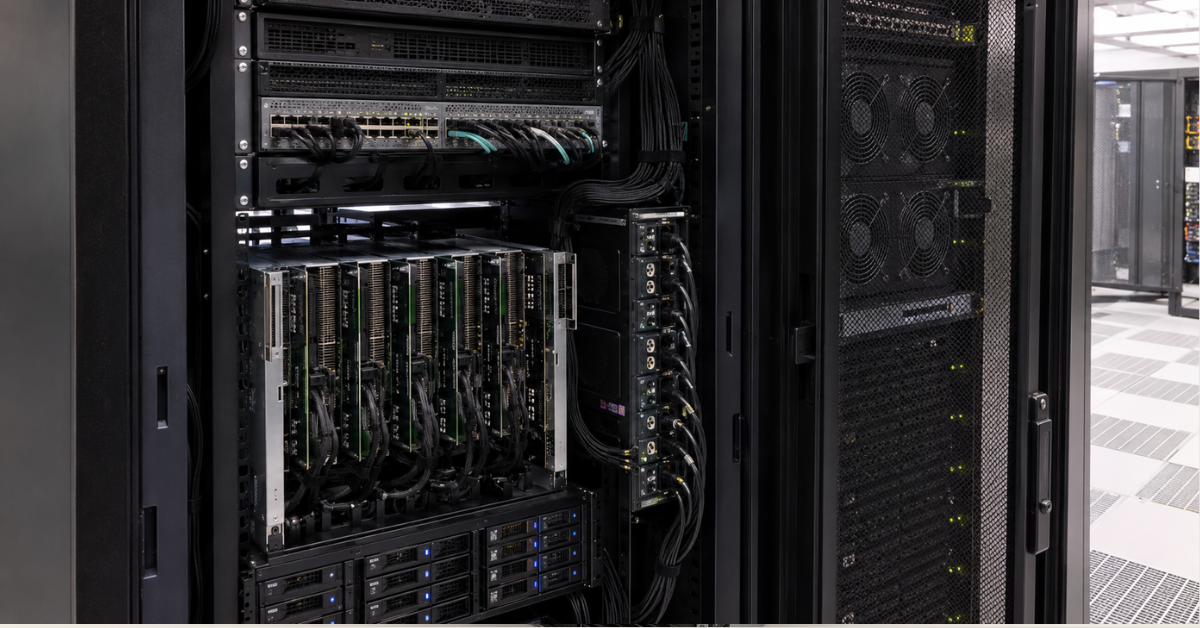
The DGX B300 is a 10U system consuming about 14.5 kW, with twelve power supplies and heat output of approximately 49,500 BTU/h. It requires a prepared rack, suitable PDUs, sufficient airflow, and verification of the permitted weight.
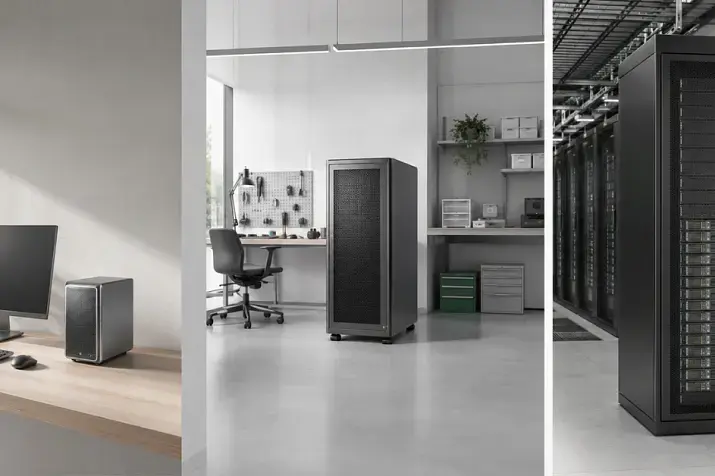
Even an air-cooled HGX server cannot be treated as an ordinary rack node that can be installed in any colocation facility. Rack power, redundancy, inlet-air temperature, and the data centre's cooling capacity must all be assessed.
Economics: Calculate the Cost of the Entire Service
The GPU price is only part of the expense. Total cost includes the server, network, NVMe, external storage, rack space, electricity, cooling, licences, support, redundancy, and engineering labour.
It is more useful to compare platforms using the following metrics:
- cost per million tokens;
- tokens per second per server and per watt;
- cost per user session;
- fine-tuning duration;
- actual GPU utilisation;
- cost of downtime.
An RTX PRO 6000 server running at 70–80% utilisation may be more cost-effective than an HGX B300 running at 10–15%. However, for round-the-clock high-volume inference, the B200 or B300 can reduce the cost per token through higher density and fewer nodes.
A general-purpose PCIe server is easier to expand and reassign to other workloads. HGX is better suited to a standardised cluster with consistently high utilisation and expensive downtime.
When the H100 or H200 Is More Rational Than Blackwell
Hopper remains relevant when the workload fits within its available memory and performance. The H100 should be considered when the model fits into 80 GB, the stack is already proven, and a ready-made server is significantly cheaper or available sooner.
The H200 occupies an intermediate position: 141 GB of HBM3e and 4.8 TB/s of bandwidth make it a strong option for inference that is constrained by memory but does not yet require Blackwell.
PowerEdge XE9680 with H200 may be more rational than the B200 if 141 GB per GPU is sufficient, FP4 is not required, the infrastructure is standardised on Hopper, and the price difference exceeds the benefit of the newer generation.
Moving to Blackwell is justified when it removes a measurable limitation: insufficient memory, low bandwidth, an excessive number of servers, or unacceptable training time.
Blackwell Server Selection Matrix
| Scenario | Rational platform | Rationale |
|---|---|---|
| Private assistant, RAG, 7B–70B models | 1–2 RTX PRO 6000 | Sufficient memory and a lower entry threshold |
| Several independent services | 2–8 RTX PRO 6000 | GPUs are allocated across models and queues |
| LoRA or QLoRA | RTX PRO 6000 | HGX is usually not required |
| One large model across multiple GPUs | B200 | Fast communication within HGX |
| High-volume inference of a large LLM | B200 | HBM3e, NVLink, and high density |
| Long context and a large KV cache | B300 | Up to 288 GB per GPU |
| Reasoning models at high concurrency | B300 | More memory and high attention performance |
| Existing Hopper infrastructure | H100 or H200 | Lower migration risk and potential savings |
| More than 80 GB is required, but the B200 is excessive | H200 | 141 GB HBM3e |
| Pilot without a confirmed workload | RTX PRO 6000 or rental | Avoid locking the budget into an oversized system |
Before choosing a platform, the model should be tested in the same format, engine, and parallelism mode that will be used in production. A test with one short request is not a substitute for load testing: realistic context lengths, user counts, and acceptable latency limits are required.
For most companies, the RTX PRO 6000 remains the most flexible entry point into Blackwell. The B200 is needed when a large model depends on fast communication between GPUs. The B300 is justified when the project uses the additional memory for long context, a large KV cache, and high concurrency. The H100 and H200 should remain in the comparison until a total-cost calculation demonstrates the advantage of the new generation.
Platform specifications and availability were verified as of July 2026. The exact amount of usable memory, supported GPUs, and power and cooling requirements should be confirmed in the documentation for the selected server.
Choosing the Right Equipment
Our specialists will contact you and answer all your questions
Free shipping on orders over 500 € in the EU, £500 in the UK, and $3,000 in the USA
Free shipping on orders over 500 € in the EU, £500 in the UK, and $3,000 in the USA
Free shipping on orders over 500 € in the EU, £500 in the UK, and $3,000 in the USA