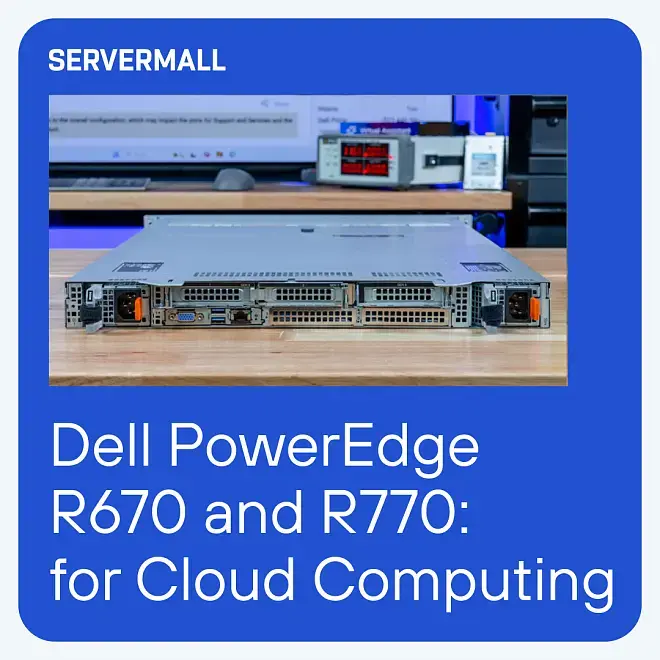
Dell has introducedDell PowerEdge R670 and Dell PowerEdge R770 CSP (Cloud Service Provider) — designed specifically for cloud environments and space-constrained data centers. In this article, we'll take a closer look at the systems, explain what DC-MHS and OpenBMC are, discuss what happened to iDRAC, and explore what these changes mean for system administrators.
Energy Efficiency and Technologies
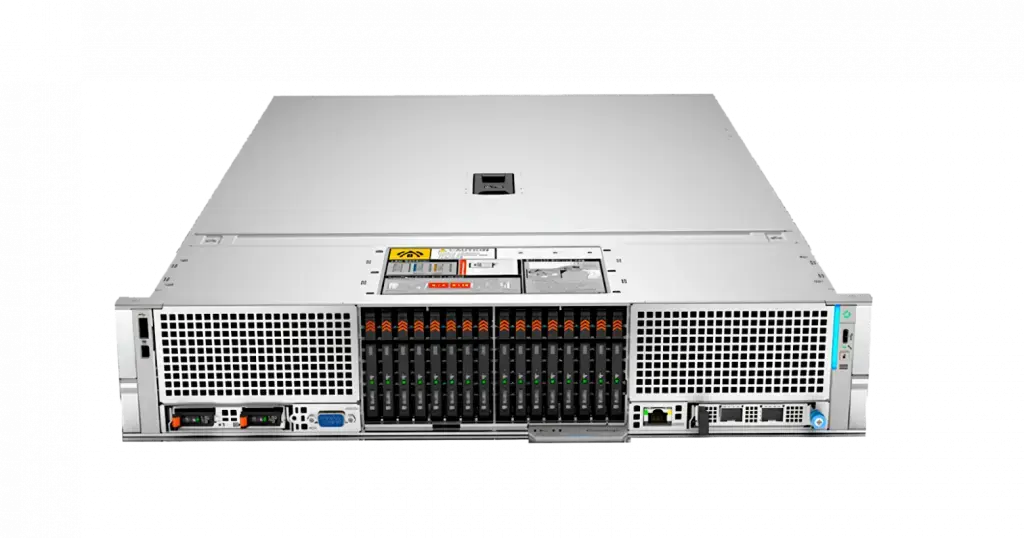
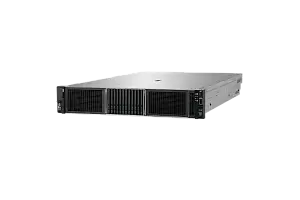
The Dell PowerEdge R770 CSP Edition is a 2U dual-socket rack server designed for installation in standard data center racks. It is optimized for high-performance computing (HPC) workloads while delivering strong power efficiency, helping organizations reduce operational costs without compromising system performance.
The server is powered by the latest Intel Xeon 6 processors (Intel has dropped the "Scalable" branding), supports DDR5 memory, NVMe BOSS boot storage, and features multi-vector cooling designed for cloud-scale deployments. It is also Energy Star certified. The R770 is well suited for dense virtualization, hyperconverged infrastructure, cloud platforms, software-defined storage (SDS), and virtually any traditional server or data center workload.
PowerEdge R770 CSP Edition
|
Feature |
Specifications |
|
Processor |
Two Intel Xeon 6 processors with up to 144 cores per CPU |
|
Memory |
• 32 DDR5 DIMM slots, supporting up to 2 TB RDIMM memory, speeds up to 6400 MT/s• DDR5 ECC RDIMM modules only |
|
Storage Controllers |
Internal boot: Boot Optimized Storage Subsystem (BOSS-N1 Flatbread): HW RAID 1, 2 × M.2 NVMe SSDs or USB |
|
Drive Bays |
Front bays:• Up to 8 × EDSFF E3.S Gen5 NVMe SSDs, up to 122.4 TB• Up to 16 × EDSFF E3.S Gen5 NVMe SSDs, up to 244.8 TB |
|
Hot-Swap Power Supplies |
• 1500 W Titanium, 100–240 VAC or 240 VDC• 1100 W Platinum, 100–240 VAC or 240 VDC• 800 W Platinum, 100–240 VAC or 240 VDC |
|
Cooling Options |
Air cooling |
|
Fans |
• High-Performance Silver (HPR SLVR) or High-Performance Gold (HPR GOLD) fans• Up to 6 hot-swappable fans |
|
Dimensions and Weight |
• Height — 86.8 mm (3.42 in)• Width — 482 mm (18.97 in)• Depth — 802.4 mm (31.59 in) with bezel, 814.52 mm (32.07 in) without bezel• Weight — 28.53 kg (62.89 lb) |
|
Form Factor |
2U rack server |
|
Embedded Management |
• Open Server Manager (OSM), based on OpenBMC, utilizing the new Nuvoton Arbel controller on the DC-SCM (Data Center Secure Control Module)• Dedicated OSM Ethernet port |
|
Security |
• Cryptographically signed firmware• Data-at-rest encryption (SEDs with local or external key management)• Secure Boot• Secure Erase• Secured Component Verification (hardware integrity validation)• Silicon Root of Trust• TPM 2.0 FIPS, CC-TCG certified (optional) |
|
Networking Options |
OCP NIC 3.0 card: 2 front-access slots or 2 rear-access slots |
|
GPU Options |
Up to 4 × 75 W Single-Width GPUs |
|
Ports |
Front ports:• 1 × OSM Direct port (USB 2.0 Type-C)• 1 × USB 2.0 (optional)• 1 × Mini DisplayPort (optional)• 1 × DB9 serial port (with front I/O configuration)• 1 × Dedicated OSM Ethernet port (with front I/O configuration)Rear ports:• 1 × Dedicated OSM Ethernet port• 1 × VGA• 2 × USB 3.1Internal ports:• 1 × USB 3.1 (optional) |
|
PCIe |
Up to 4 PCIe Gen5 x16 slots |
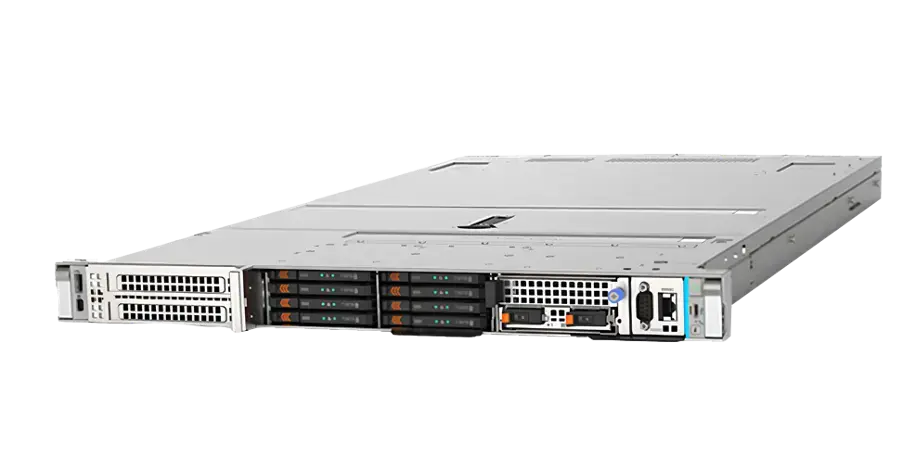
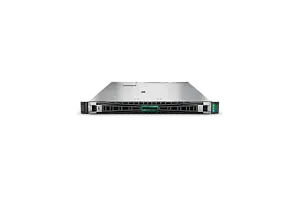
The Dell PowerEdge R670 CSP Edition is a 1U dual-socket rack server designed for standard rack deployment. It shares the same compute platform and many of the same core specifications as the R770, but supports half the maximum storage capacity in its highest-end configurations. It also features a simplified cooling design, offers only two PCIe 5.0 x16 slots, and supports up to two single-width GPUs rated at 75 W each.
PowerEdge R670 CSP Edition
|
Feature |
Specifications |
|
Processor |
Two Intel Xeon 6 processors with up to 144 cores per CPU |
|
Memory |
• 32 DDR5 DIMM slots, supporting up to 2 TB RDIMM memory, speeds up to 6400 MT/s• DDR5 ECC RDIMM modules only |
|
Storage Controllers |
Internal boot: Boot Optimized Storage Subsystem (BOSS-N1 Flatbread): HW RAID 1, 2 × M.2 NVMe SSDs or USB |
|
Drive Bays |
Front bays:• Up to 8 × EDSFF E3.S Gen5 NVMe SSDs, up to 122.4 TB |
|
Hot-Swap Power Supplies |
• 1500 W Titanium, 100–240 VAC or 240 VDC• 1100 W Platinum, 100–240 VAC or 240 VDC• 800 W Platinum, 100–240 VAC or 240 VDC |
|
Cooling Options |
Air cooling |
|
Fans |
• High-Performance Silver (HPR SLVR) fans• Up to 4 hot-swappable fan assemblies (dual-fan modules) |
|
Dimensions and Weight |
• Height — 42.8 mm (1.69 in)• Width — 482 mm (18.98 in)• Depth — 817.94 mm (32.20 in) with bezel, 829.44 mm (32.66 in) without bezel• Weight — 20.24 kg (44.62 lb) |
|
Form Factor |
1U rack server |
|
Embedded Management |
• Open Server Manager (OSM), based on OpenBMC, utilizing the new Nuvoton Arbel controller on the DC-SCM (Data Center Secure Control Module)• Dedicated OSM Ethernet port |
|
Security |
• Cryptographically signed firmware• Data-at-rest encryption (SEDs with local or external key management)• Secure Boot• Secure Erase• Secured Component Verification (hardware integrity validation)• Silicon Root of Trust• TPM 2.0 FIPS, CC-TCG certified (optional) |
|
Networking Options |
OCP NIC 3.0 card: 2 front-access slots or 2 rear-access slots |
|
GPU Options |
Up to 2 × 75 W Single-Width GPUs |
|
Ports |
Front ports:• 1 × OSM Direct port (USB 2.0 Type-C)• 1 × USB 2.0 (optional)• 1 × Mini DisplayPort (optional)• 1 × DB9 serial port (with front I/O configuration)• 1 × Dedicated OSM Ethernet port (with front I/O configuration)Rear ports:• 1 × Dedicated OSM Ethernet port• 1 × VGA• 2 × USB 3.1Internal ports:• 1 × USB 3.1 (optional) |
|
PCIe |
Up to 2 PCIe Gen5 x16 slots |
The R670 occupies a similar position to its predecessors, serving as a more compact alternative to the R770 for organizations seeking maximum compute density in a 1U form factor. It is particularly well suited for dense virtualization, cloud-native applications, database scaling, and software-defined storage deployments.
Top-selling network switches
Free shipping on orders over £500 in the EU, £500 in the UK, and $3,000 in the USA

Free shipping on orders over £500 in the EU, £500 in the UK, and $3,000 in the USA

Free shipping on orders over £500 in the EU, £500 in the UK, and $3,000 in the USA

Free shipping on orders over £500 in the EU, £500 in the UK, and $3,000 in the USA
What Else Is Interesting About the R670 and R770 CSP?
Both solutions run on the same controller and use identical hardware. The choice is entirely yours, but it cannot be changed later, as the selected management platform is factory-configured.
No SAS, No SATA, No Traditional NVMe Drive Options — EDSFF E3.S NVMe Only
The R670 and R770 CSP Edition systems are designed exclusively around EDSFF E3.S NVMe SSDs. The table below lists the internal storage devices currently supported by both platforms. As the 17th-generation portfolio expands, Dell is expected to introduce additional server models supporting the more familiar SAS, SATA, and traditional NVMe drive configurations.
|
Form Factor |
Type |
Interface Speed |
Capacity |
|
EDSFF E3.S |
Data Center NVMe SSD |
Gen5 |
1.6 TB, 1.92 TB, 3.2 TB, 3.84 TB |
|
EDSFF E3.S |
NVMe SSD |
Gen5 |
3.2 TB, 3.84 TB, 6.4 TB, 7.68 TB, 15.36 TB |
Smart Cooling Functionality
Smart Cooling combines hardware and software technologies to optimize thermal management. The system continuously adjusts the speed of individual fans in real time and automatically adapts to changing environmental conditions by analyzing data from onboard thermal sensors.
This approach minimizes power consumption while reducing operating costs across the server lifecycle.

Faster DDR5 Memory
This is already the second generation of Dell servers built around DDR5 memory. With Generation 17 systems, Dell has increased the maximum supported memory speed from 5600 MT/s to 6400 MT/s.
Otherwise, the platform remains largely unchanged, continuing to support ECC (Error-Correcting Code) memory and registered DIMMs with capacities of up to 256 GB per module.
Intel Xeon 6 Server Processors — Goodbye, Scalable
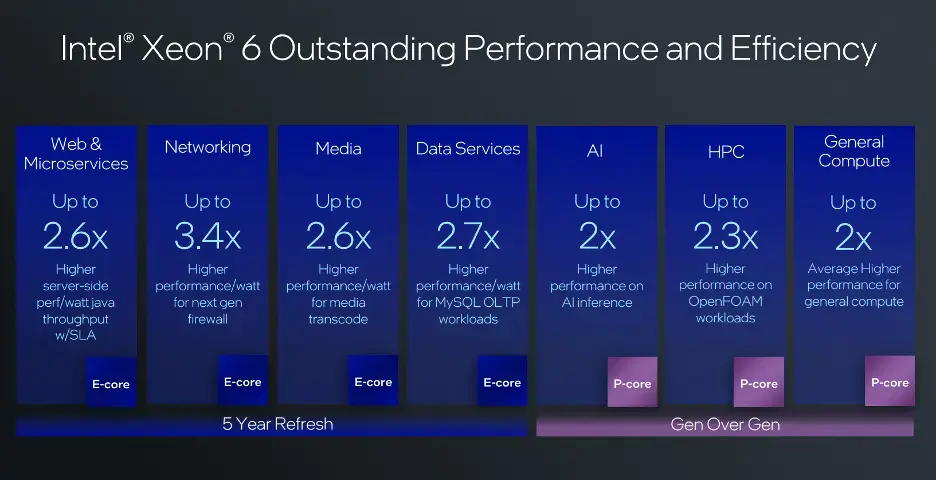
At Computex 2024 in Taipei, Intel unveiled the Intel Xeon 6 processor family, designed for high-performance computing and dense data center deployments. The platform targets AI workloads, compute-intensive applications, scalability-focused environments, and efficiency-driven infrastructure.
One of the most significant changes is the introduction of two core architectures: Performance Cores (P-cores) and Efficient Cores (E-cores). Both share a common software stack and compatible architecture, resembling the approach Intel already uses in its consumer Core processor lineup.
Performance cores are designed for demanding workloads, delivering maximum performance for AI applications and compute-intensive tasks.
Efficient cores prioritize core density and performance per watt, making them particularly attractive for cloud environments that require high throughput and scalable infrastructure.
The first Efficient-core Xeon 6 processors, the Intel Xeon 6700E series, became available in mid-2024 and are the processors initially offered in the Dell PowerEdge R670 and R770 CSP platforms. Intel is expected to expand the lineup later with the Xeon 6700P and Xeon 6900E/6900P families.
|
Processor |
Core Count |
Maximum Frequency |
Base Frequency |
Cache |
|
Intel Xeon 6740E Processor (96M Cache, 2.40 GHz) |
96 |
3.2 GHz |
2.4 GHz |
96 MB |
|
Intel Xeon 6756E Processor (96M Cache, 1.80 GHz) |
128 |
2.6 GHz |
1.8 GHz |
96 MB |
|
Intel Xeon 6780E Processor (108M Cache, 2.20 GHz) |
144 |
3.0 GHz |
2.2 GHz |
108 MB |
|
Intel Xeon 6710E Processor (96M Cache, 2.40 GHz) |
64 |
3.2 GHz |
2.4 GHz |
96 MB |
|
Intel Xeon 6766E Processor (108M Cache, 1.90 GHz) |
144 |
2.7 GHz |
1.9 GHz |
108 MB |
|
Intel Xeon 6731E Processor (96M Cache, 2.20 GHz) |
96 |
3.1 GHz |
2.2 GHz |
96 MB |
|
Intel Xeon 6746E Processor (96M Cache, 2.00 GHz) |
112 |
2.7 GHz |
2.0 GHz |
96 MB |
Choosing the Right Equipment
Our specialists will contact you and answer all your questions
Designed for Modern Data Centers
Dell's CSP Edition servers are built around the DC-MHS (Data Center Modular Hardware System) architecture.
DC-MHS is part of a collaborative initiative within the Open Compute Project involving companies such as Dell Technologies and Intel. The architecture standardizes server design, technologies, and mechanical layouts while improving interoperability across infrastructure components. The goal is to simplify integration into existing data center environments and reduce platform fragmentation.
The core idea behind DC-MHS is interoperability. Systems built around the standard are designed to work consistently across multiple vendors and alongside critical data center infrastructure components, ranging from peripheral devices to storage and networking systems.
Even when deploying servers from different manufacturers, organizations can benefit from compatible interfaces and common modular form factors.
Existing front-node chassis from Dell's 15th- and 16th-generation server platforms are expected to remain reusable. However, backplanes will require redesigns to support DC-MHS specifications.
PERC modules will also be updated to support the DC-MHS backplane architecture. Following this transition, PERC controllers will no longer connect directly to the backplane. Instead, power delivery will be routed through dedicated cabling between the backplane and the PERC module. In future SAS/SATA-enabled Generation 17 systems, the data cabling topology will also change accordingly.
Security for Zero-Trust IT Operations
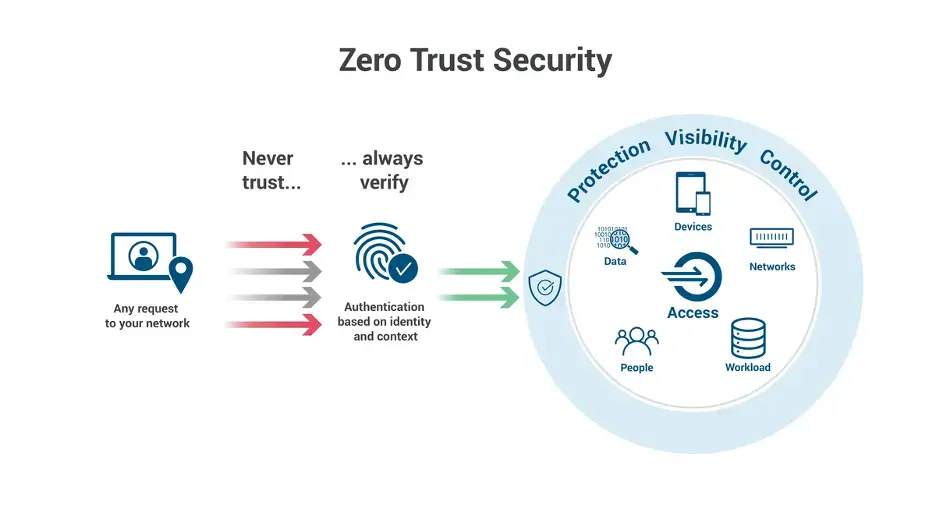
Security is embedded throughout the entire PowerEdge lifecycle, including manufacturing and delivery.
A silicon root of trust ensures secure server boot processes, while multi-factor authentication (MFA) and role-based access control help maintain operational integrity. This layered security model protects systems from deployment through end-of-life, ensuring that Dell PowerEdge R670 and R770 platforms remain secure and manageable throughout their operational lifespan.
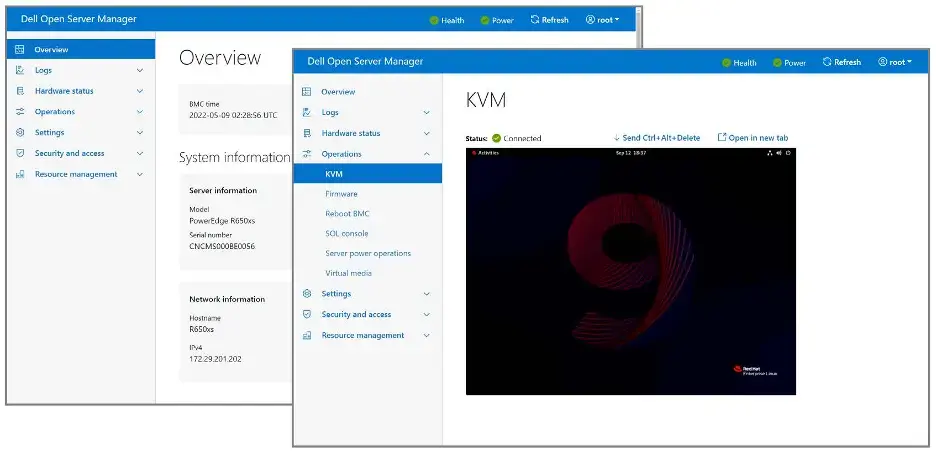
The silicon root of trust also guarantees that Dell's validated OpenBMC implementation — and only Dell's validated implementation — can operate on PowerEdge systems, providing the same level of security, supportability, and manageability customers traditionally expect from iDRAC.
To prevent unauthorized or malicious OpenBMC firmware from being installed, Dell Lifecycle Management supports deployment of digitally signed Dell firmware packages through Dell Open Server Manager. The same update process applies to BIOS firmware, backplane components, power supplies, and Open Server Manager itself.
In addition, OpenBMC log export capabilities allow diagnostic data to be packaged into SupportAssist archives, enabling comprehensive troubleshooting and vendor-assisted support workflows.
Simplified Administration and Automation
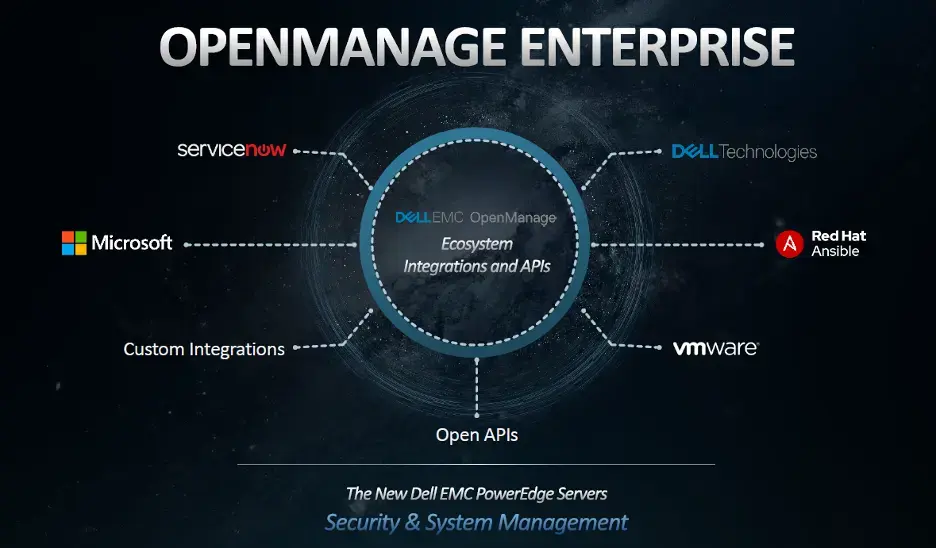
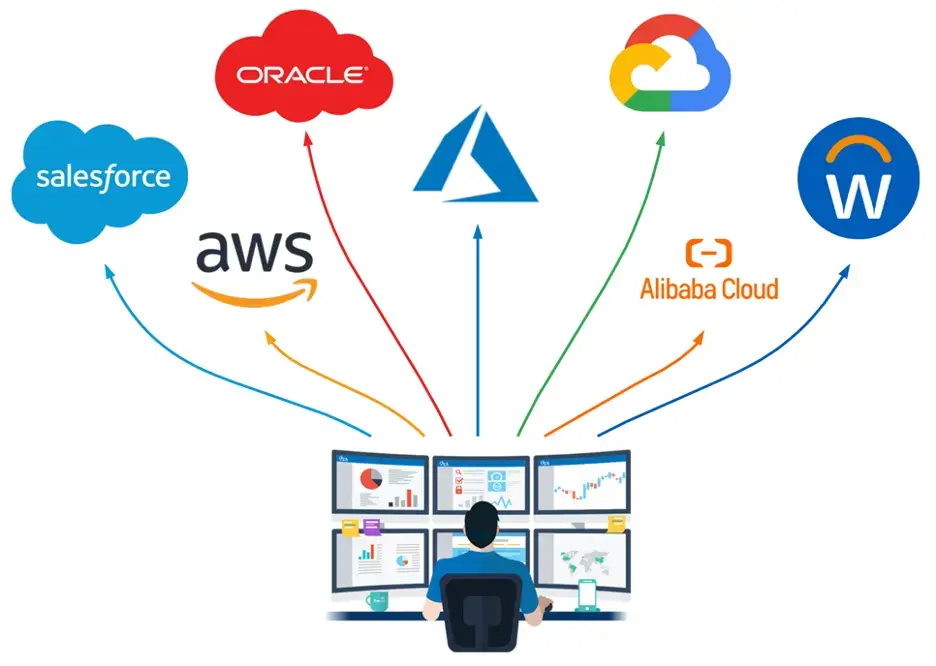
Dell PowerEdge R670 and R770 CSP servers support Dell OpenManage, providing a comprehensive, secure, and efficient management framework for PowerEdge infrastructure.
For organizations preferring open management ecosystems, Dell also offers Open Server Manager, built on the OpenBMC platform.
The OpenManage Enterprise interface consolidates essential management capabilities into a single console, eliminating the need for multiple third-party tools or separate management applications. Routine tasks such as provisioning, monitoring, and firmware updates can be automated, reducing manual intervention and administrative overhead.
Management is centralized through a true one-to-many operating model, allowing administrators to control large-scale deployments from a single interface.
Expert note: Dell R670 and R770 systems are also designed for rapid deployment and simplified maintenance. Front-access I/O configurations and the flexibility of Open Server Manager make physical and remote administration significantly more convenient.
Administrators can access server interfaces directly from the cold aisle of the data center—or, preferably, from anywhere remotely—making day-to-day operations considerably easier.
That’s it. If you enjoyed the article, make sure to follow us on LinkedIn so you don’t miss the release of new materials.
Choosing the Right Equipment
Our specialists will contact you and answer all your questions
Content:

Free shipping on orders over £500 in the EU, £500 in the UK, and $3,000 in the USA

Free shipping on orders over £500 in the EU, £500 in the UK, and $3,000 in the USA
Free shipping on orders over £500 in the EU, £500 in the UK, and $3,000 in the USA
Free shipping on orders over £500 in the EU, £500 in the UK, and $3,000 in the USA


Free shipping on orders over £500 in the EU, £500 in the UK, and $3,000 in the USA