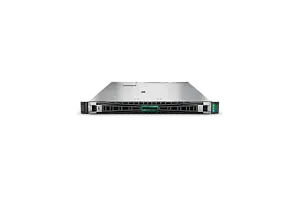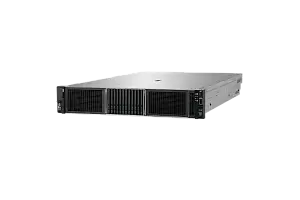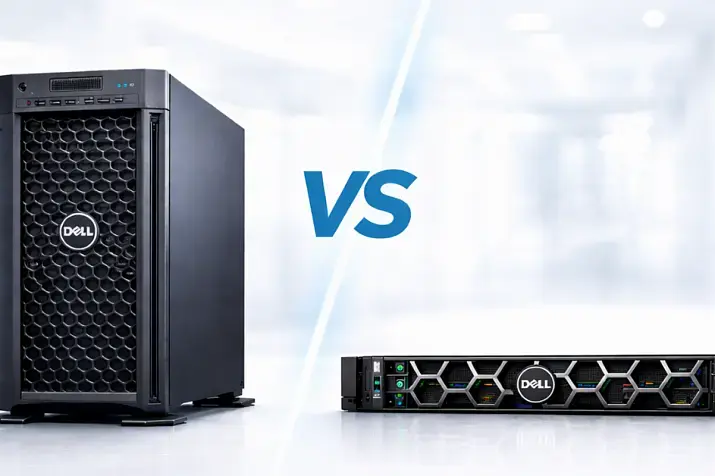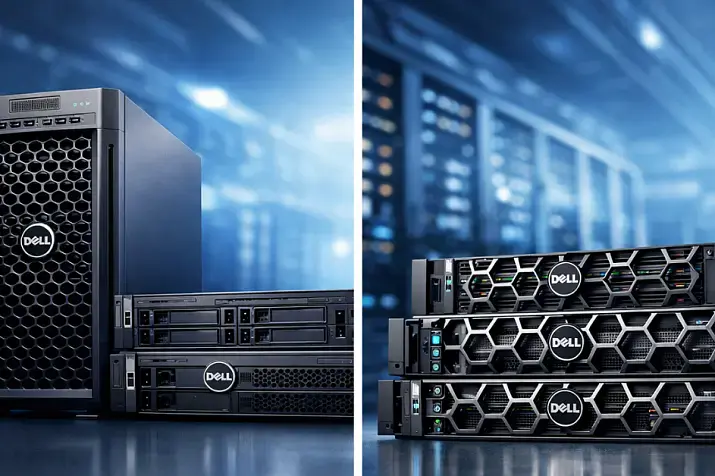
When choosing between the DELL PowerEdge R660 and DELL PowerEdge R660xs, it's essential to understand the key differences between these models. Both platforms are single-processor 1U servers from the 16th generation, but the R660xs offers expanded memory scaling capabilities and more flexible storage options. The primary difference is that the R660xs supports DDR5 memory at speeds up to 4800 MHz and provides more drive bay configurations.
The DELL PowerEdge R660 is a compact single-processor server designed for medium-scale tasks where density and energy efficiency are priorities. The model is ideally suited for virtualization, databases, and web applications in medium and large enterprises. The R660xs, on the other hand, represents an enhanced version with improved specifications for more demanding workloads.
In this article, we'll examine the technical specifications of both models in detail, conduct a comprehensive comparison of their capabilities, and help you determine which server best suits your specific needs. We'll analyze processor performance, memory capacity, storage options, expansion capabilities, and the applicability of each model for various use cases.
DELL R660 vs R660xs Comparison Table
| Specification | DELL PowerEdge R660 | DELL PowerEdge R660xs |
|---|---|---|
| Model | DELL PowerEdge R660 | DELL PowerEdge R660xs |
| Processors | Up to one 4th Gen Intel Xeon Scalable processor, up to 32 cores | Up to one 4th Gen Intel Xeon Scalable processor, up to 32 cores |
| Memory | 16 DDR5 RDIMM slots, up to 1 TB, speeds up to 4800 MHz | 16 DDR5 RDIMM slots, up to 1 TB, speeds up to 4800 MHz |
| Front Drive Bays | Up to 8 x 2.5" SAS/SATA/NVMe (max 122.8 TB) | Up to 10 x 2.5" SAS/SATA/NVMe (max 153 TB) |
| Rear Drive Bays | Up to 2 x 2.5" SAS/SATA/NVMe (max 30.7 TB) | Up to 2 x 2.5" SAS/SATA/NVMe (max 30.7 TB) |
| Storage Controllers | PERC H755, H755N, H345, HBA355i, S150 | PERC H755, H755N, H345, HBA355i, S150 |
| PCIe Expansion Slots | Up to 3 PCIe Gen5 slots | Up to 3 PCIe Gen5 slots |
| Power Supplies | 800W/1100W/1400W Platinum/Titanium | 800W/1100W/1400W Platinum/Titanium |
| Form Factor | 1U rack server | 1U rack server |
| Management | iDRAC9, Quick Sync 2 | iDRAC9, Quick Sync 2 |
| Ideal Use Cases | Virtualization, databases, web applications | High-performance databases, analytics, expanded storage |
DELL PowerEdge R660

The DELL PowerEdge R660 is a single-processor platform in a compact 1U form factor, designed to balance performance and space efficiency. The model is built on 4th Gen Intel Xeon Scalable processors and supports next-generation DDR5 memory, delivering significant performance improvements over previous versions.
DELL PowerEdge R660 Technical Specifications
- Processor: Up to one 4th Gen Intel Xeon Scalable processor supporting up to 32 cores
- Memory: 16 DDR5 RDIMM slots supporting up to 1 TB RAM, speeds up to 4800 MHz
- Front Bays: Up to 8 x 2.5" SAS/SATA/NVMe drives with maximum capacity up to 122.8 TB
- Rear Bays: Up to 2 x 2.5" SAS/SATA/NVMe drives with maximum capacity up to 30.7 TB
- Storage Controllers: PERC H755, H755N, H745, H345, HBA355i, S150, BOSS-S2
- Power Supplies: 800W Platinum, 1100W Titanium, 1400W Platinum (hot-plug, redundant)
- Cooling: Air cooling, optional processor liquid cooling
- Fans: Up to 4 sets of hot-plug fans (dual fan module)
- Expansion Slots: Up to 3 PCIe Gen5 low-profile slots
- Network Adapters: 2 x 1GbE LOM, optional OCP 3.0
- GPU Options: Up to three 75W single-width GPUs
- Management: iDRAC9, Quick Sync 2, OpenManage Enterprise
- Security: TPM 2.0, Secure Boot, Silicon Root of Trust, cryptographically signed firmware
- Dimensions: Height 42.8 mm (1.7"), width 482 mm (18.97"), depth 809 mm (31.85")
- Operating Systems: VMware ESXi, Microsoft Windows Server, Red Hat Enterprise Linux, Ubuntu Server, SUSE Linux Enterprise Server
Who Should Choose DELL PowerEdge R660
The DELL PowerEdge R660 is an excellent choice for organizations requiring a compact and efficient solution for virtualization, medium-sized databases, web applications, and enterprise applications. The server is ideally suited for deployment in rack configurations with limited space where equipment density is important.
The model is optimal for use cases including software-defined storage (SDS), VMware vSphere or Microsoft Hyper-V virtualization platforms, medium-scale SQL and Oracle databases, and Kubernetes container environments. With NVMe drive support, the server delivers high I/O performance critical for modern applications.
DELL PowerEdge R660xs
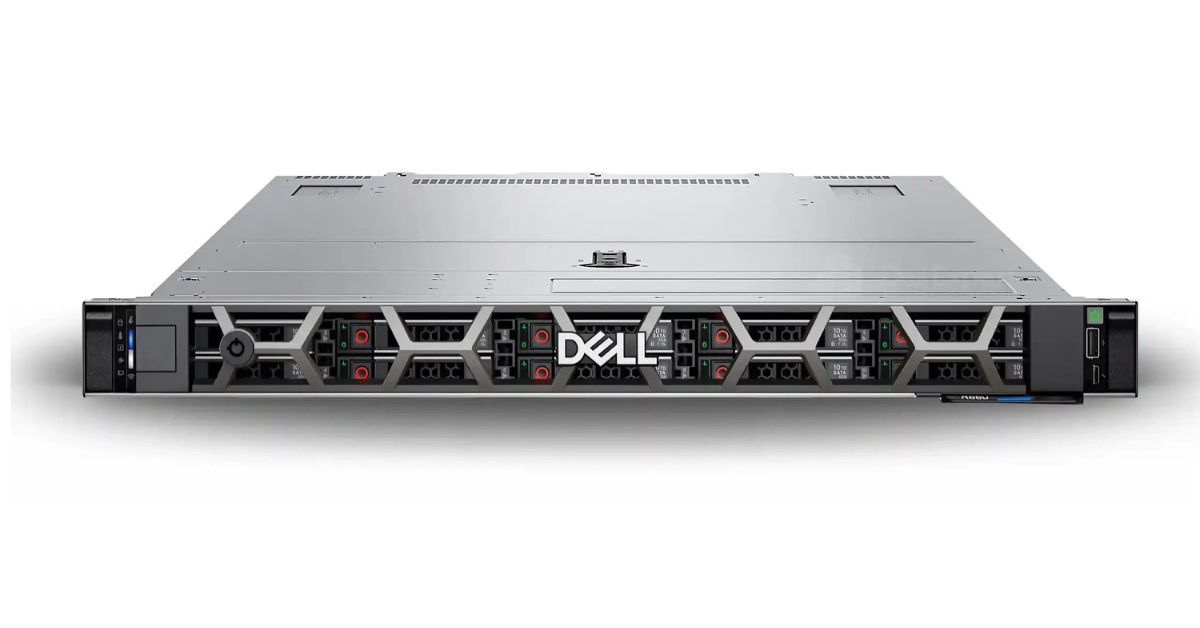
The DELL PowerEdge R660xs is an enhanced version of the R660, offering improved storage and scaling capabilities. The key difference is the increased number of front drive bays — up to 10 versus 8 in the base model, allowing for maximum storage capacity of up to 153 TB.
DELL PowerEdge R660xs Technical Specifications
- Processor: Up to one 4th Gen Intel Xeon Scalable processor supporting up to 32 cores
- Memory: 16 DDR5 RDIMM slots supporting up to 1 TB RAM, speeds up to 4800 MHz
- Front Bays: Up to 10 x 2.5" SAS/SATA/NVMe drives with maximum capacity up to 153 TB
- Rear Bays: Up to 2 x 2.5" SAS/SATA/NVMe drives with maximum capacity up to 30.7 TB
- Storage Controllers: PERC H755, H755N, H745, H345, HBA355i, S150, BOSS-S2
- Power Supplies: 800W Platinum, 1100W Titanium, 1400W Platinum (hot-plug, redundant)
- Cooling: Air cooling, optional processor liquid cooling
- Fans: Up to 4 sets of hot-plug fans (dual fan module)
- Expansion Slots: Up to 3 PCIe Gen5 low-profile slots
- Network Adapters: 2 x 1GbE LOM, optional OCP 3.0
- GPU Options: Up to three 75W single-width GPUs
- Management: iDRAC9, Quick Sync 2, OpenManage Enterprise
- Security: TPM 2.0, Secure Boot, Silicon Root of Trust, cryptographically signed firmware
- Dimensions: Height 42.8 mm (1.7"), width 482 mm (18.97"), depth 809 mm (31.85")
- Operating Systems: VMware ESXi, Microsoft Windows Server, Red Hat Enterprise Linux, Ubuntu Server, SUSE Linux Enterprise Server
Who Should Choose DELL PowerEdge R660xs
The DELL PowerEdge R660xs is designed for more demanding use cases where storage capacity is critical. The two additional drive bays allow for a 25% increase in total storage, making this server an ideal choice for high-performance databases, big data analytics systems, file servers, and content delivery.
The model is optimal for organizations working with large data volumes, including business intelligence systems, real-time data processing platforms, distributed storage systems, media servers, and applications requiring high I/O throughput. The expanded storage capabilities make the R660xs the preferred choice for scenarios requiring maximum storage density in a compact 1U form factor.
Choosing the Right Equipment
Our specialists will contact you and answer all your questions
Key Differences Between DELL R660 and R660xs
Storage Capacity
The primary and most significant difference between the two models is the number of front drive bays. The DELL PowerEdge R660 supports up to 8 x 2.5" drives, while the R660xs can accommodate up to 10 such drives. This translates to an increase in maximum storage capacity from 122.8 TB to 153 TB — a difference of 30.2 TB, representing a 25% increase.
For organizations working with large data volumes, this difference can be critical. The two additional bays allow not only increased total storage but also more flexible RAID configurations, improved performance through load distribution across more drives, and additional levels of data redundancy.
Configuration Flexibility
Having more drive bays in the R660xs opens additional possibilities for storage system configuration. For example, you can create a configuration with dedicated drives for the operating system, database, and backups while maintaining sufficient space for working data. It's also possible to deploy more complex RAID schemes that provide an optimal balance between performance and fault tolerance.
Importantly, both models support NVMe drives, ensuring exceptionally high I/O performance. However, the R660xs can use more NVMe drives simultaneously, which is critical for applications requiring maximum throughput, such as high-frequency transactional systems and real-time analytics platforms.
Identical Characteristics
Aside from the number of drive bays, the two models are virtually identical in their remaining specifications. They use the same 4th Gen Intel Xeon Scalable processors, support the same DDR5 memory capacity (up to 1 TB), have identical power supply options, and the same expansion capabilities through PCIe Gen5 slots.
Both platforms feature the modern iDRAC9 management system, which provides remote monitoring and server management, automatic firmware updates, and comprehensive diagnostic tools. Quick Sync 2 support enables wireless server management through mobile devices, simplifying initial setup and maintenance processes.
Performance Comparison
Processor Power
Both models use 4th Gen Intel Xeon Scalable processors, delivering significant performance improvements over previous generations. The 4th generation architecture offers improved energy efficiency, increased core counts (up to 32 per processor), and an expanded instruction set, including support for Intel Advanced Vector Extensions 512 for accelerating compute-intensive tasks.
Since both models support the same processors, their computational performance is identical when using the same CPU configuration. The choice of a specific processor should be based on workload characteristics: for multi-threaded applications, choose processors with more cores, while for frequency-sensitive applications, models with fewer cores but higher clock speeds are preferable.
Storage Subsystem Performance
While both models use the same storage controllers, including the high-performance PERC H755, the R660xs has a performance advantage due to its ability to install more drives. When using NVMe drives in RAID 0 or RAID 10 configuration, the R660xs can deliver 25% higher aggregate throughput compared to the R660.
For transactional databases where both throughput and input/output operations per second (IOPS) matter, having additional drives in the R660xs allows for more efficient load distribution. This is especially important for applications with high random read and write intensity, such as SQL Server, Oracle Database, or virtualization systems with multiple virtual machines.
Memory Performance
Both platforms support DDR5 memory at speeds up to 4800 MHz, providing significantly higher bandwidth compared to DDR4. DDR5 technology also offers improved energy efficiency and enhanced on-die error correction features, increasing system reliability.
At the maximum configuration of 1 TB RAM, both models can support large numbers of virtual machines or process massive in-memory datasets. For real-time data analytics applications or database caching systems, this memory capacity minimizes disk accesses and maximizes performance.
Use Case Scenarios
Optimal Applications for DELL R660
The DELL PowerEdge R660 is ideally suited for organizations requiring a balanced platform for virtualization and enterprise applications. The 8-drive bay configuration provides sufficient capacity and performance for most standard workloads, including small to medium VMware vSphere or Microsoft Hyper-V virtualization farms.
The server excels at web hosting tasks where serving multiple websites or web applications is required. Thanks to its compact 1U form factor, the R660 maximizes rack space utilization, which is critical for hosting providers and cloud services where rack space cost is a significant factor.
For medium-sized enterprise databases, the R660 provides an optimal combination of processor performance, memory capacity, and storage speed. NVMe drive configurations deliver the necessary performance for OLTP systems, customer relationship management (CRM) systems, and enterprise resource planning (ERP) applications.
Optimal Applications for DELL R660xs
The DELL PowerEdge R660xs is the preferred choice for scenarios requiring maximum storage capacity in a compact form factor. Organizations working with large data volumes gain a significant advantage from the additional 25% storage capacity, which can be critical for analytics systems, data warehouses, and file servers.
The model excels for deploying software-defined storage systems (SDS) such as VMware vSAN or Microsoft Storage Spaces Direct. The additional drive bays enable more efficient configurations with improved redundancy and performance, critical for ensuring high availability of enterprise applications.
For media companies working with high-resolution video content, the R660xs provides the necessary space for storing large files and sufficient bandwidth for simultaneously processing multiple streams. Video surveillance systems requiring storage of large volumes of video recordings also benefit from the increased storage capacity.
Containerization and Orchestration
Both models are excellent for deploying container platforms such as Kubernetes or Docker Swarm. The high performance of 4th Gen Intel Xeon processors and large DDR5 memory capacity enable efficient running of multiple containers simultaneously. The R660 is suitable for medium-sized Kubernetes clusters, while the R660xs better handles scenarios requiring persistent storage of large data volumes for containers.
Storage Configurations
RAID Options for DELL R660
With 8 available drive bays, the DELL PowerEdge R660 supports a wide range of RAID configurations. For maximum performance, RAID 0 with 8 drives can be used, providing the highest throughput but without data redundancy. For a balance between performance and data protection, RAID 10 is optimal, using all 8 drives to create mirrored striped arrays.
RAID 5 configuration with 8 drives provides a good balance between storage capacity, performance, and data protection, allowing recovery from a single drive failure while maintaining 87.5% usable capacity. For mission-critical data, RAID 6 can be used, protecting against simultaneous failure of two drives, though this reduces usable capacity to 75% of total volume.
RAID Options for DELL R660xs
The additional two drive bays in the DELL PowerEdge R660xs open more flexible configuration options. With 10 drives, you can create a more efficient RAID 10 configuration that delivers better performance at the same redundancy level. Hybrid configurations are also possible, where some drives are used for high-performance RAID 0 or RAID 10, and others for less critical data in RAID 5 or RAID 6.
For organizations using tiered storage, the R660xs allows deployment of a combination of NVMe drives for critical data with high performance requirements and SSD or SATA HDDs for less demanding workloads. For example, you could dedicate 4 NVMe drives in RAID 10 for the database, 4 SATA SSDs in RAID 5 for applications, and 2 drives for backups or logs.
RAID Controllers and Capabilities
Both models support the advanced PERC H755 controller, which provides hardware RAID acceleration and has 8 GB of cache memory with battery backup. This is critical for ensuring data integrity during unexpected power outages. The controller supports all standard RAID levels (0, 1, 5, 6, 10, 50, 60) as well as advanced features such as RAID level migration, capacity expansion, and data consistency checking.
For less demanding applications, the S150 software RAID controller is available, requiring no additional cost but providing basic RAID functionality. HBA355i controllers are also supported for non-RAID configurations or for use with software-defined storage systems where RAID functions are implemented at the operating system or hypervisor level.
Our most popular servers

Free shipping on orders over 500 € in the EU, £500 in the UK, and $3,000 in the USA
Free shipping on orders over 500 € in the EU, £500 in the UK, and $3,000 in the USA
Free shipping on orders over 500 € in the EU, £500 in the UK, and $3,000 in the USA

Free shipping on orders over 500 € in the EU, £500 in the UK, and $3,000 in the USA
Power and Cooling
Power Supplies
Both models offer flexible power supply options with hot-swap support and 1+1 redundancy. Available power supplies include 800W with Platinum certification, 1100W with Titanium certification, and 1400W with Platinum certification. Power supply selection should be based on processor configuration, number of drives, and presence of additional devices such as GPUs or high-performance network adapters.
Titanium certification provides up to 96% efficiency at 50% load, significantly reducing power consumption and heat generation compared to less efficient power supplies. For organizations with large server deployments, the difference in energy efficiency can lead to substantial savings in operational costs over the equipment's lifespan.
Cooling System
Both models feature air cooling systems with hot-swap fan support. The standard configuration includes dual-fan modules that provide adequate cooling for most configurations. For more demanding scenarios, such as using high-TDP processors or installing GPUs, high-performance SLVR and GOLD fans are available.
Optional processor liquid cooling allows efficient heat dissipation from the CPU in high-density computing configurations. This is especially useful in data centers with limited air conditioning capabilities or when deploying in regions with high ambient temperatures. Liquid cooling also helps reduce noise levels, which is important for servers deployed in office environments.
Network Capabilities and Expansion
Network Adapters
Both platforms feature an integrated 2 x 1GbE LOM network adapter, providing basic network connectivity and network connection redundancy capability. For higher-performance network requirements, OCP 3.0 adapter support is available, which can provide speeds of 10GbE, 25GbE, or even 100GbE depending on the chosen adapter model.
The OCP 3.0 slot is a standardized form factor developed by the Open Compute Project, ensuring compatibility with a wide range of network adapters from various manufacturers. This allows organizations to choose the optimal solution for their specific network performance requirements without limitations related to proprietary form factors.
PCIe Expansion Slots
Both models support up to 3 PCIe Gen5 slots, providing sufficient flexibility for installing additional network adapters, storage controllers, or specialized accelerators. PCIe Gen5 offers double the bandwidth of PCIe Gen4 — up to 32 GT/s per lane, which is critical for high-performance devices such as NVMe controllers or 100GbE network adapters.
The low-profile slot form factor accommodates 1U chassis limitations while enabling installation of a wide range of adapters. For applications requiring GPU acceleration, both models support up to three single-width 75W GPUs, allowing server use for machine learning, rendering, or scientific computing tasks.
Management and Monitoring
iDRAC9 - Integrated Remote Access Controller
Both models feature the integrated iDRAC9 remote access controller, providing complete server control independent of operating system state. iDRAC9 enables remote server power management, console access via virtual KVM, remote media mounting for operating system installation, and firmware updates without requiring physical presence in the data center.
The Intelligent Provisioning feature simplifies initial server setup, enabling quick operating system deployment, RAID array configuration, and driver installation through a convenient web interface. This is especially useful for mass server deployments as it significantly reduces setup time for each device.
OpenManage Enterprise
For centralized server fleet management, DELL offers the OpenManage Enterprise platform, providing a single management point for hardware health monitoring, firmware update deployment, configuration setup, and report generation. OpenManage Enterprise supports automatic server discovery on the network, simplifying inventory and management of large device quantities.
The automatic firmware update feature allows scheduling updates during low-load periods, minimizing impact on application operations. The monitoring system provides proactive alerts about potential issues such as component overheating, disk performance degradation, or impending fan failure, enabling administrators to take action before serious failures occur.
Quick Sync 2
Quick Sync 2 technology provides wireless server management via smartphone or tablet. This is especially useful during initial server setup in the data center, enabling quick identification of a specific server in the rack, obtaining information about its configuration and status, and performing basic management operations without needing to connect a laptop.
Choosing the Right Equipment
Our specialists will contact you and answer all your questions
Security
Hardware Security Mechanisms
Both models feature comprehensive security mechanisms starting at the hardware level. Silicon Root of Trust provides an immutable foundation for firmware authenticity verification, preventing execution of unauthorized or compromised code at the BIOS level. Cryptographically signed firmware ensures all system software components are verified for authenticity before loading.
Secure Boot ensures that only trusted software executes during system boot, preventing boot process attacks. System Lockdown allows administrators to lock server configuration, preventing unauthorized changes to hardware settings or firmware, which is critical for regulatory compliance requirements.
TPM 2.0 and Data Encryption
Trusted Platform Module 2.0 support provides hardware storage of cryptographic keys and certificates, critical for implementing full-disk encryption and authentication. TPM 2.0 also supports attestation features, enabling remote verification that the server is in a trusted state and has not been compromised.
The Secure Erase feature ensures reliable data deletion from all storage devices when decommissioning or reselling the server. This guarantees that confidential information cannot be recovered even using specialized data recovery equipment.
Selection Recommendations
When to Choose DELL PowerEdge R660
Choose the DELL PowerEdge R660 if you need a compact and efficient server for standard enterprise workloads where storage capacity up to 122.8 TB is sufficient. This model is optimal for medium-scale virtualization, web applications, medium-sized databases, and enterprise applications where the priority is balancing cost and performance.
The R660 is also an excellent choice for organizations seeking to maximize equipment placement density in limited data center space. The compact 1U form factor allows more servers per rack, reducing floor space requirements and potentially lowering total cost of ownership through more efficient space utilization.
The model is ideal for deployment as Kubernetes cluster nodes, application servers in three-tier architecture, or web servers for high-traffic sites. NVMe drive configurations provide sufficient performance for most transactional databases without requiring additional drive bays.
When to Choose DELL PowerEdge R660xs
Prefer the DELL PowerEdge R660xs if your workloads require maximum storage capacity in a compact form factor. The additional 25% storage capacity can be critical for big data analytics systems, data warehouses, file servers, and media applications where data volume continues to grow.
The R660xs is the preferred choice for organizations planning to deploy software-defined storage systems such as VMware vSAN or Ceph. The additional drive bays enable more efficient configurations with improved balance between capacity, performance, and fault tolerance, critical for ensuring high data availability.
The model is optimal for scenarios requiring high storage IOPS density, such as transaction-intensive databases, virtual desktop infrastructure (VDI) systems, or streaming data processing applications. The ability to use 10 NVMe drives simultaneously provides exceptional I/O performance, critical for modern high-performance applications.
Configuration Selection Criteria
When selecting a specific configuration, consider the following factors:
- Processor: Choose core count based on workload characteristics. For multi-threaded applications and virtualization, prefer processors with more cores. For frequency-sensitive applications, choose processors with fewer cores but higher clock speeds.
- Memory: For virtualization, a minimum of 256 GB RAM is recommended. For in-memory databases or analytics systems, maximum configuration of 1 TB may be required.
- Storage: Use NVMe drives for mission-critical data with high performance requirements. SATA SSDs suit less demanding applications, while SATA HDDs are appropriate for archival data and backups.
- Network: For cluster configurations and high-performance applications, 10GbE or higher network adapters are recommended via OCP 3.0 slot.
- Power: Select power supply wattage with 20-30% headroom above calculated maximum power consumption. Always use redundant power supplies for mission-critical applications.
Total Cost of Ownership
Initial Investment
The price difference between DELL PowerEdge R660 and R660xs is relatively modest, primarily due to the additional drive bays and related components. However, total configuration cost will significantly depend on processor choice, memory capacity, and storage device type.
When planning the budget, consider not only the server cost but also necessary drives, additional network adapters, extended warranty, and support services. For mission-critical applications, investing in extended warranty with 24/7 support and next-business-day onsite service is recommended.
Operational Costs
Both models feature high energy efficiency thanks to 4th Gen Intel Xeon processors and high-efficiency power supplies. Using Titanium-certified power supplies can achieve 5-10% energy savings compared to Platinum units, which at scale can lead to substantial savings.
The R660xs may have slightly higher power consumption when all drive bays are fully loaded, especially when using SATA HDDs instead of SSDs. However, when using modern SSDs or NVMe drives, power consumption difference between models is minimal. It's important to consider not only server power consumption but also cooling costs, which can account for up to 40% of total data center energy costs.
Scalability and Future Expansion
When evaluating total cost of ownership, consider future expansion possibilities. The R660xs with its greater storage capacity may delay the need to purchase additional servers or storage systems, which long-term can result in savings. However, if your current storage needs don't require more than 8 drives, investing in the R660xs may be unjustified.
Conclusion
The choice between DELL PowerEdge R660 and R660xs ultimately comes down to your data storage capacity requirements. Both models offer identical capabilities in terms of processor power, memory capacity, network capabilities, and expansion options. The only substantial difference is the number of front drive bays — 8 versus 10.
If your workloads require maximum storage capacity in a compact 1U form factor, or you plan to deploy software-defined storage systems, the DELL PowerEdge R660xs will be the optimal choice. The additional 25% storage capacity can be critical for analytics systems, data warehouses, and media applications.
On the other hand, if your storage needs are satisfied with 8 drives, the DELL PowerEdge R660 offers an excellent price-to-performance ratio for virtualization, enterprise applications, and medium-sized databases. The model provides all necessary capabilities of a modern server platform at an optimal cost of ownership.
Regardless of the chosen model, both platforms represent reliable, high-performance solutions built on advanced 4th Gen Intel Xeon technology and DDR5 memory. They provide an excellent foundation for building modern IT infrastructure with scalability and adaptability to changing business needs.
For detailed consultation and assistance in selecting the optimal server configuration for your specific tasks, visit our server catalog, which features a complete range of DELL server equipment with detailed specifications and configurations.