For real-time transactions, you need one type of system—OLTP (Online Transaction Processing). For analytics, you need another—OLAP (Online Analytical Processing). OLTP is like Sonic the Hedgehog: always in motion, racing forward at full speed, reacting instantly to obstacles and collecting rings along the way. OLTP processes every transaction quickly and predictably. OLAP, on the other hand, is more like Kirby—it inhales everything in its path: piles of objects, enemies, entire worlds. OLAP systems absorb massive volumes of data—millions and billions of rows—so they can later digest them and turn them into something meaningful, like a report.
And since the use cases are so different, it’s only logical that the server architecture, storage systems, and even database engines are different as well.
That’s where we get to the actual subject. In this long read, we’ll talk about OLAP, OLTP, and the hardware behind them.
OLAP and OLTP: What They Are and Why They Exist
Let’s dig a bit deeper into the technology.
OLAP and OLTP have completely different goals and architectures. That’s why, for most businesses, the real question isn’t choosing between them, but figuring out how to combine them properly within a single infrastructure.
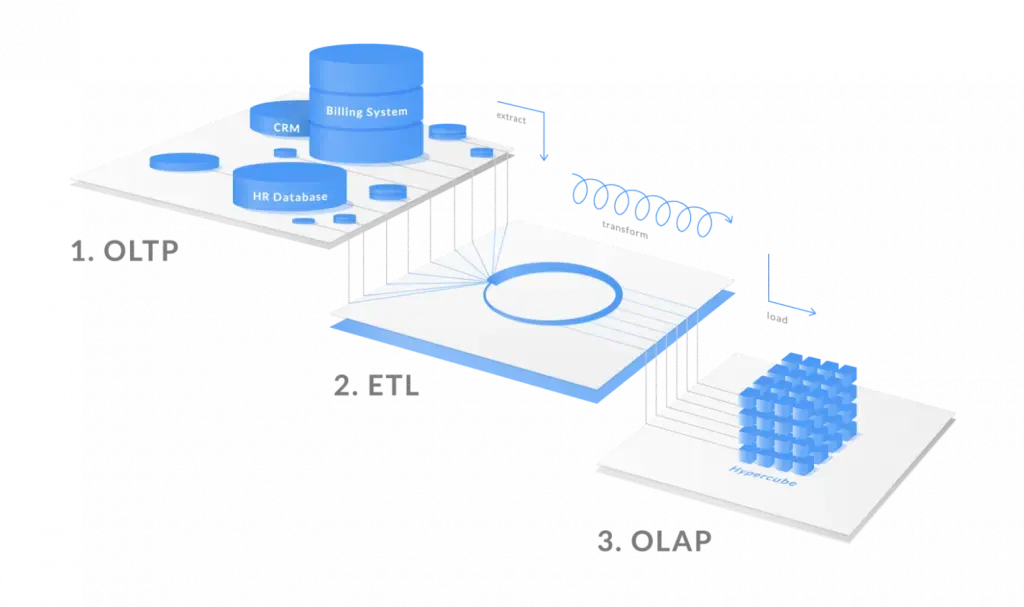
OLAP is a tool for complex analysis of large data volumes. It’s how businesses get meaningful analytical insights. Take grocery retail as an example: the analytics team collects all sales data for a given period from multiple sources—operational databases, external services, and other systems. All of this data is then loaded into a specialized storage system—a data warehouse—optimized for multidimensional analysis.
Next, the analysts run a query:
“How much butter and bread were sold in June 2024 across all stores in a given region, how did those numbers change in June 2025, and what’s the relationship between these products?”
Answering a question like this requires aggregating millions of rows, filtering data by regions, categories, and dates, and then calculating correlations, changes, and forecasts. Such queries can take a long time—within reason—and that’s perfectly normal, because the results are used to make business decisions and define long-term strategy.
In OLAP, completeness and accuracy matter more than instant response time. That’s why strategic analytics—annual reports or long-term forecasts—may run for one or two hours. It’s a different story when operational analytics for daily decisions, like pricing changes, take hours to complete—that’s usually a sign of unsuitable infrastructure.
Expert note. Analysts typically work through BI systems (Business Intelligence—not to be confused with BIM), such as Power BI, Tableau, Qlik, Looker, or Apache Superset, where visual interfaces allow them to build queries, dashboards, and reports without deep SQL knowledge.
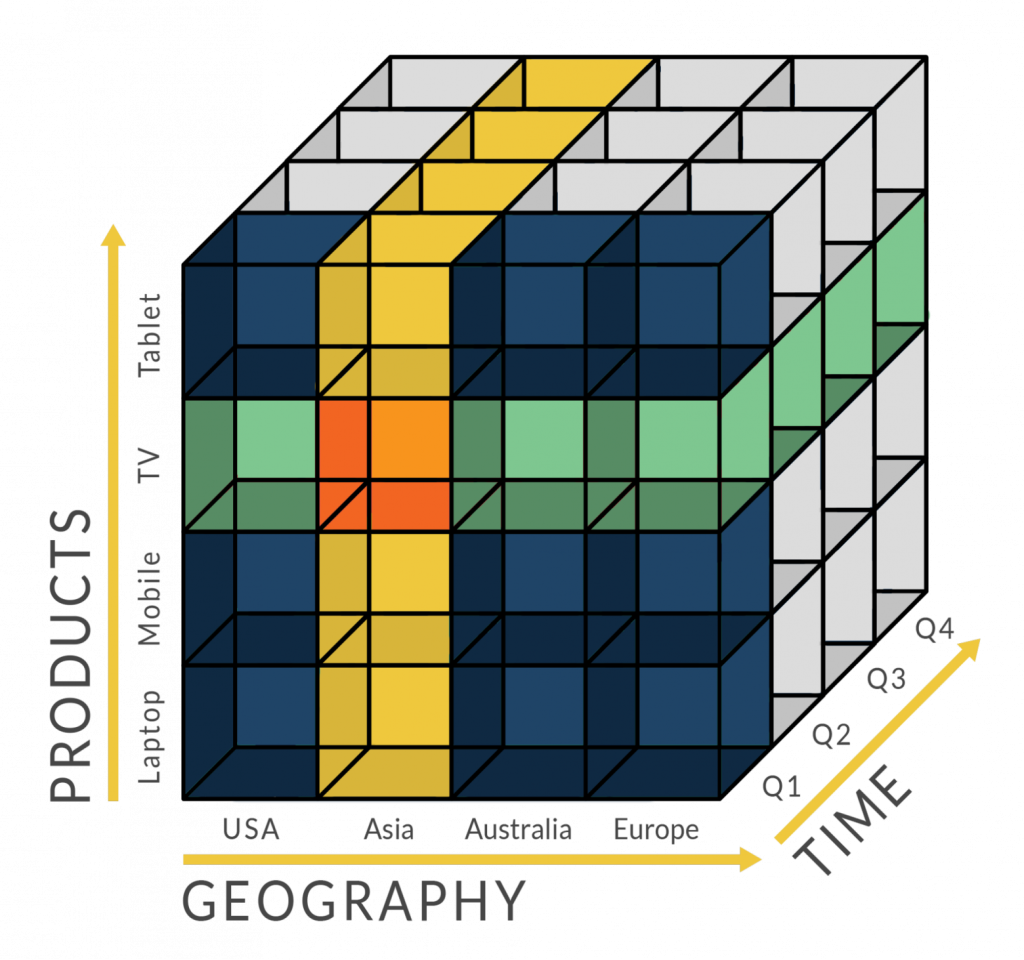
At the core of OLAP are multidimensional data structures (cubes), which allow data to be viewed from different angles—by time, region, product, customer, and dozens of other dimensions. This makes OLAP an ideal tool for strategic analytics. Unlike, for example, CRM systems, where the main goal is operational customer and transaction management, not complex queries over terabytes of historical sales data.
Classic OLAP tools include ClickHouse, Greenplum, Hadoop/Spark, and Amazon Redshift. They are designed for large-scale processing and parallelism.
OLTP, by contrast, is designed for speed when processing individual operations. At a supermarket checkout, every transaction—scanning an item, taking payment, writing the record—must happen instantly. Any delay means queues grow and customers leave. No one is going to wait three minutes per item just to buy butter and bread.
OLTP systems are optimized specifically for these fast, frequent, real-time operations. But using them for strategic analytics is almost pointless—complex queries over massive datasets are simply not what they’re built for.
Typical OLTP databases include PostgreSQL, MySQL/InnoDB, Oracle Database, and Microsoft SQL Server.
There are also hybrid solutions—HTAP (Hybrid Transactional/Analytical Processing)—which try to combine transactions and analytics within a single system, such as TiDB, SAP HANA, or YugabyteDB. In practice, however, most companies still separate workloads: one database handles fast operations, another handles analytics. The convenience of hybrid systems comes at the cost of increased infrastructure complexity and higher hardware requirements.
And this is where IT architects, administrators, or anyone else responsible start asking questions. Which server should be used for OLAP, and which for OLTP? Should these be separate servers? Virtual machines? A cluster? Maybe compute nodes combined with separate storage? How many storage systems are needed? If there are several, should they be active-active or active-standby? And that’s just the beginning—there are dozens, if not hundreds, of similar details.
And those details directly affect the business.
I won’t be able to answer every possible question—everyone’s workloads are different—but I’ll try to give you useful reference points. And, as always, the comments are open.
Most popular refurbished servers

Free shipping on orders over £500 in the EU, £500 in the UK, and $3,000 in the USA

Free shipping on orders over £500 in the EU, £500 in the UK, and $3,000 in the USA

Free shipping on orders over £500 in the EU, £500 in the UK, and $3,000 in the USA

Free shipping on orders over £500 in the EU, £500 in the UK, and $3,000 in the USA
Choosing the Right Equipment
Our specialists will contact you and answer all your questions
How to Choose Servers and Storage for OLTP and OLAP
Selecting servers for OLTP and OLAP are two very different tasks, and mistakes here are expensive. Put slow storage under OLTP, and you’ll get request queues and unhappy customers. Try running OLAP on unsuitable servers, and you’ll be watching queries execute for weeks. Save on redundancy for data and components… well, you already know how that ends.
In high-load database systems, performance and reliability depend directly on architecture and hardware. But before buying equipment, architectural decisions come first. Let’s start with OLTP.
OLTP Architecture: Speed and Predictability
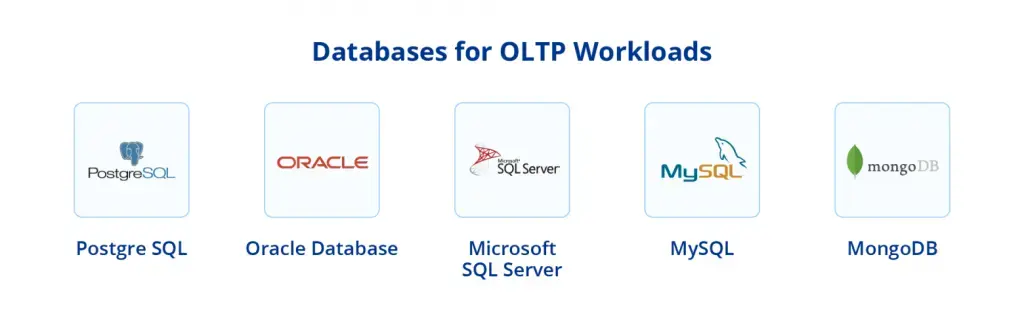
OLTP systems are the frontline of the business. Online banking, payment gateways, and e-commerce platforms all run on them. These systems have clear requirements: tens or hundreds of thousands of transactions per second, strict latency SLAs measured in milliseconds, and data integrity—losing a single transaction record is equivalent to losing money.
Every transactional system is built around ACID requirements (Atomicity, Consistency, Isolation, Durability). In simple terms:
-
A transaction is executed fully or not at all (Atomicity)
-
Data remains in a consistent state (Consistency)
-
Parallel operations do not interfere with each other (Isolation)
-
Data is not lost even in case of failure (Durability)
When looking at such a system, an IT architect doesn’t start by thinking about hardware. The primary concerns are how to normalize data so transactions remain fast and consistent; how to distribute load across clusters using sharding and replication; and how to design fault tolerance so the failure of one—or even several—nodes doesn’t bring the entire system down.
So what’s the takeaway?
Expert note. If simplicity matters and the expected load is moderate, the optimal choice is a combination of replication and caching—for example, PostgreSQL or MySQL with Redis. When data volume grows and load increases linearly, and strict global consistency isn’t critical, shared-nothing architectures with sharding make more sense. If strict consistency is the top priority—and the budget allows for it—shared-disk solutions like Oracle RAC are the better choice. For systems requiring extreme processing speed or real-time analytics, in-memory databases are worth considering.
In the table below, I’ve summarized the main architectural approaches used when designing OLTP systems.
OLTP Architecture Patterns at a Glance
|
Technology / Approach |
How it Works |
Pros |
Cons |
When to Use |
|
Shared-Disk |
All nodes access shared storage (SAN/NAS). Coordination handled by DB engine (e.g. Oracle RAC). |
Single logical DB, no manual sharding, automatic load balancing |
Very expensive, specialized hardware, storage bottlenecks |
Banking, telecom billing, strict consistency |
|
Shared-Nothing / Sharding |
Each node owns its data slice. Nodes communicate over network (e.g. Cassandra, CockroachDB). |
Near-linear scaling, no single storage bottleneck |
Complex sharding logic, difficult joins |
Social networks, marketplaces, gaming |
|
Replication / Clustering |
Data replicated across nodes for HA and read scaling |
High availability, failover |
Writes don’t scale, replication lag |
Read-heavy workloads |
|
Caching |
Hot data stored in memory (Redis, Memcached) |
Offloads 70–80% of DB load, extremely fast |
Cache invalidation complexity |
APIs, e-commerce, recommendation engines |
|
In-Memory Databases |
Data stored primarily in RAM |
Maximum speed, real-time analytics |
Expensive, RAM-hungry |
HFT, telecom, IoT |
|
Microservices Architecture |
Business logic split into independent services (often Kubernetes) |
Scalability, team autonomy |
Operational overhead |
Large, fast-moving systems |
|
Message Brokers |
Asynchronous communication (Kafka, RabbitMQ) |
Decoupling, resilience |
Debugging complexity, latency |
Peak loads, complex integrations |
The takeaway is simple. If you optimize OLTP like it’s OLAP, you’ll kill latency. If you run OLAP on OLTP-grade infrastructure, your analysts will be watching progress bars instead of dashboards. Architecture mistakes here don’t show up in benchmarks — they show up in lost revenue, broken SLAs, and very uncomfortable meetings.
Choosing the Right Equipment
Our specialists will contact you and answer all your questions
Content:

Free shipping on orders over £500 in the EU, £500 in the UK, and $3,000 in the USA

Free shipping on orders over £500 in the EU, £500 in the UK, and $3,000 in the USA
Free shipping on orders over £500 in the EU, £500 in the UK, and $3,000 in the USA
Free shipping on orders over £500 in the EU, £500 in the UK, and $3,000 in the USA


Free shipping on orders over £500 in the EU, £500 in the UK, and $3,000 in the USA