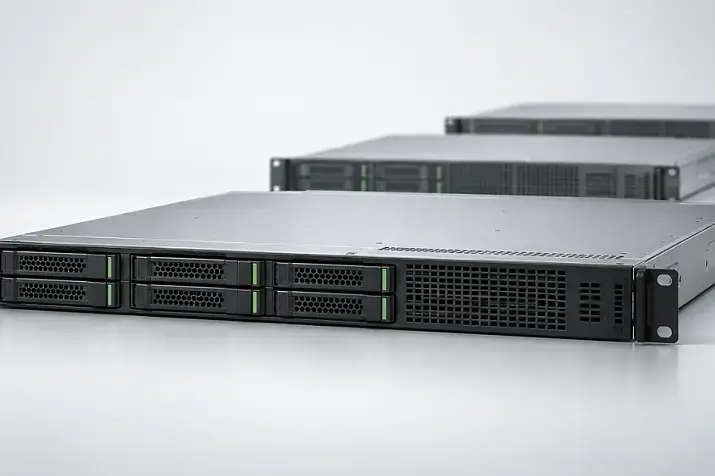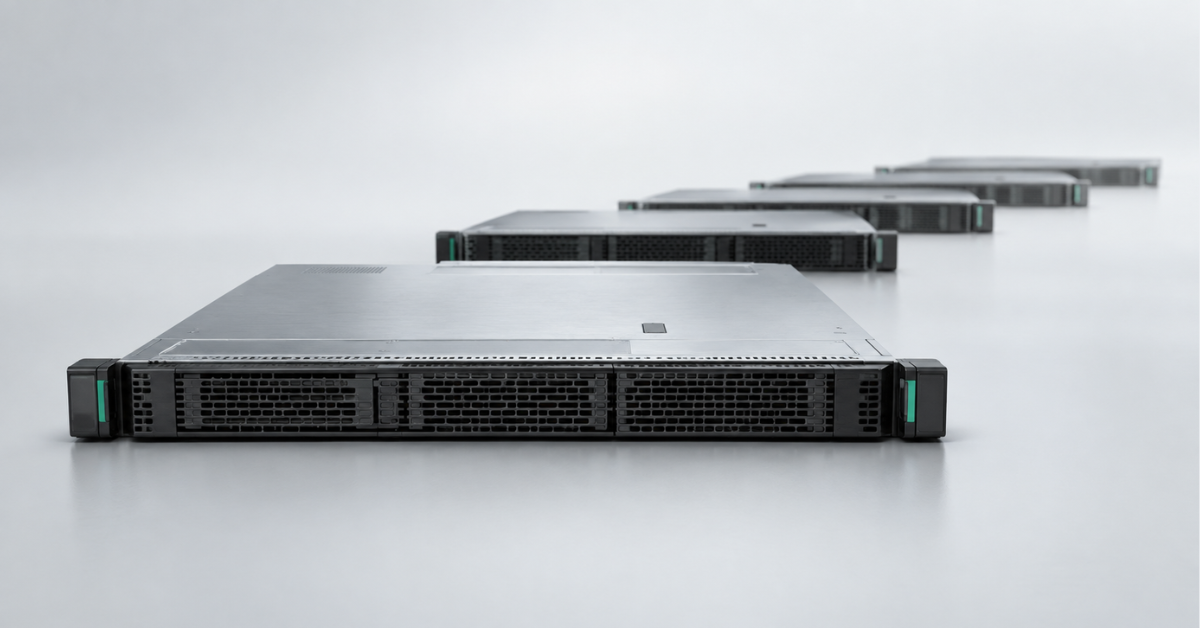
HPE ProLiant DL325 is a single-socket 1U rack server based on AMD EPYC processors, designed for high compute density, virtualisation and data-intensive workloads. For a new general-purpose node, the DL325 Gen11 is usually the most sensible choice: it supports DDR5, PCIe 5.0 and modern drives while costing less than top-end Gen12 configurations. Gen10 Plus and Gen10 Plus v2 remain relevant when budgets are limited, while Gen12 is primarily needed where up to 192 cores, up to 6 TB of memory, iLO 7 and more flexible drive layouts provide a real benefit. The decision should consider not only the generation but also the exact chassis, controller, memory configuration, network adapters, power supplies and cooling.
What is the HPE ProLiant DL325?
HPE ProLiant DL325 belongs to HPE's enterprise 300 series. The DL designation indicates a rack-mounted system, while the final digit 5 denotes an AMD platform. Every generation covered here is a single-socket 1U server. There was no DL325 Gen9: the model's history began with Gen10.
A single AMD EPYC processor provides many cores, memory channels and PCIe lanes, enabling the DL325 to handle workloads that previously required a dual-socket server. A single-socket design offers several advantages:
- there is no need to purchase a second processor and memory for its channels;
- there is no data exchange between two physical processors, although the chiplet architecture must still be considered;
- when software is licensed per socket, a single-socket system has a lower total cost of ownership;
- some EPYC processors with the P suffix are intended specifically for single-socket systems and offer attractive cost per core.
However, one processor does not mean a single memory node. NPS settings in the BIOS can present an EPYC processor as one, two or four NUMA nodes. A virtual machine or process that crosses the boundaries of such a node may access memory with additional latency.
Related models in the HPE range
The HPE ProLiant DL family includes several models with similar purposes:
- DL325 — one AMD EPYC processor in a 1U chassis, providing maximum compute density per socket;
- DL345 — one AMD EPYC processor in a 2U chassis, with more room for drives and expansion cards;
- DL365 — two AMD EPYC processors in a 1U chassis when one socket is not enough;
- DL385 — two AMD EPYC processors in a 2U chassis with broader expansion capabilities.
If an Intel platform is required, the closest model by form factor is the dual-socket 1U DL360. Its evolution is covered in the article “HPE ProLiant DL360 Gen9–Gen12: Comparison and Selection”. The 2U DL380 chassis provides more room for drives, controllers, network cards and accelerators; its generations are examined in “HPE ProLiant DL380: Comparing Gen10 Plus, Gen11 and Gen12”.
How the HPE ProLiant DL325 generations evolved
The range has had five main variants: Gen10, Gen10 Plus, Gen10 Plus v2, Gen11 and Gen12. Plus and Plus v2 denote separate platforms rather than configurations of the same server. Their processors, system boards, drive cages and controllers differ.
| Generation | Processors | Memory | Drives in maximum alternative configurations | Interfaces and management |
|---|---|---|---|---|
| DL325 Gen10 | AMD EPYC 7001; 7002 in later revisions, up to 64 cores | 16 DDR4 slots, up to 2 TB | Up to 10 SFF or 4 LFF; separate NVMe variants | PCIe 3.0, iLO 5; integrated networking depends on the system board revision |
| DL325 Gen10 Plus | AMD EPYC 7002, up to 64 cores | 16 DDR4 slots, up to 2 TB | Up to 10 SFF or 4 LFF in the standard chassis; up to 24 SFF or 12 LFF in the extended chassis | PCIe 4.0, OCP 3.0, iLO 5 |
| DL325 Gen10 Plus v2 | AMD EPYC 7003, up to 64 cores; selected 7002 processors are supported | 16 DDR4 slots, up to 4 TB | Up to 10 SFF or 4 LFF | PCIe 4.0, OCP 3.0, iLO 5, tri-mode controllers |
| DL325 Gen11 | AMD EPYC 9004 and 9005, up to 160 cores | 12 DDR5 slots, up to 3 TB | Up to 10 SFF, 4 LFF or 20 EDSFF E3.S | PCIe 5.0, OCP 3.0, iLO 6 |
| DL325 Gen12 | AMD EPYC 9005, up to 192 cores and 500 W | 24 DDR5 slots, up to 6 TB | Up to 10 SFF, 4 LFF or 20 EDSFF E3.S; mixed SFF and EDSFF layouts are possible | PCIe 5.0, rear and front OCP 3.0, iLO 7 |
The table shows platform limits rather than the specifications of every system offered for sale. SFF, LFF and EDSFF options belong to different chassis configurations, so their drive-bay counts cannot be added together. Maximum memory capacity is also achieved only with a specific module type and population order, while a high-TDP processor can limit the choice of cards, drives and accelerators.
Choosing the Right Equipment
Our specialists will contact you and answer all your questions
HPE ProLiant DL325 Gen10
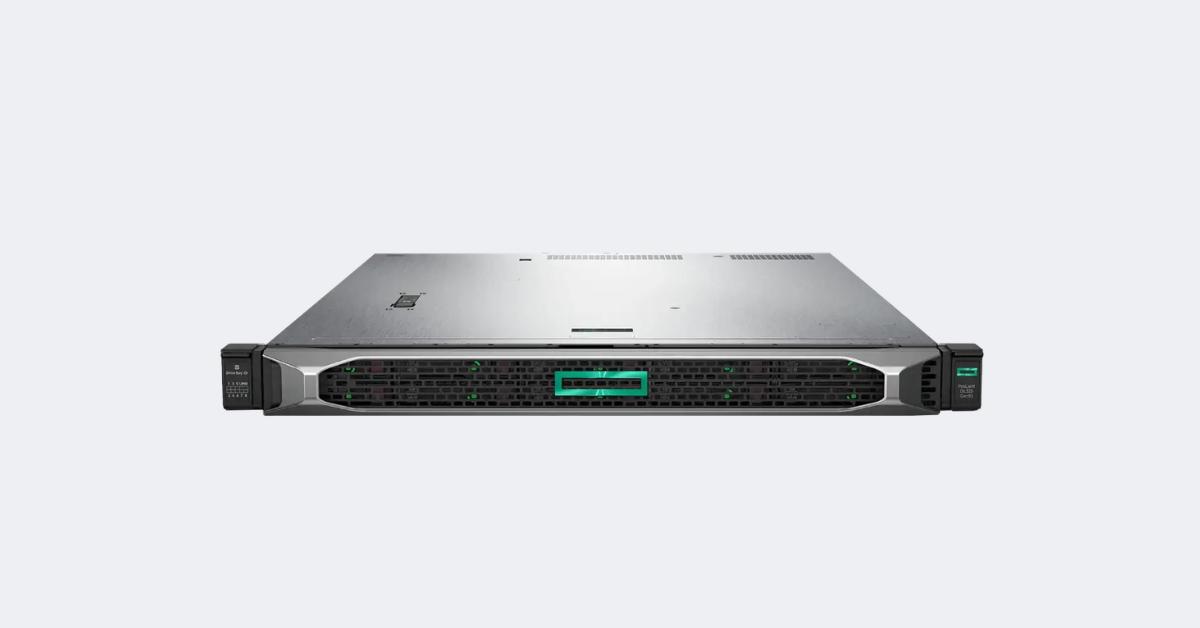
Image source: Servermall
Model configurations: HPE ProLiant DL325 Gen10.
The DL325 Gen10 appeared in 2018 and was the first server in the range. Initial configurations used AMD EPYC 7001 processors, while later versions adopted EPYC 7002 with up to 64 cores. The platform has 16 DDR4 slots, eight memory channels, PCIe 3.0 and iLO 5.
Three main drive layouts were offered:
- eight SFF bays with the option to add two SAS/SATA or two NVMe drives;
- eight NVMe drives with two additional bays;
- four LFF bays for hard drives or SATA/SAS solid-state drives.
The memory limit is 2 TB. Installing two DIMMs per channel reduces frequency, so both capacity and slot population matter. Early system boards could include four integrated 1 Gbit/s ports, while revisions for EPYC 7002 were supplied without them. Upgrading to EPYC 7002 also depends on the system board, ROM version and supported processor list despite the common socket.
Today, Gen10 is suitable for laboratory infrastructure, a backup node, moderate virtualisation and services for which PCIe 3.0 is sufficient. Its limitations are already noticeable in a new high-load system: the platform has been discontinued, and support for current hypervisor, operating-system and driver versions must be checked separately.
HPE ProLiant DL325 Gen10 Plus and Gen10 Plus v2
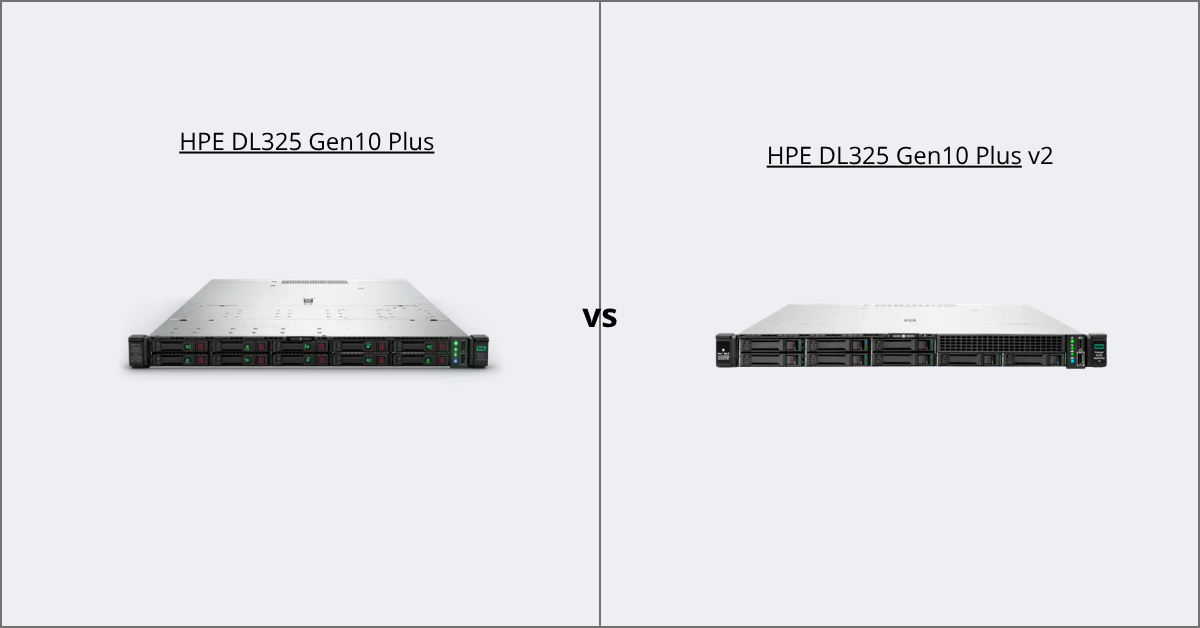
Image source: Servermall
Model configurations: DL325 Gen10 Plus and DL325 Gen10 Plus v2.
These servers are often grouped together, although there is a fundamental difference between them. The standard Gen10 Plus is notable for its advanced storage subsystem, while v2 offers a newer processor generation and a more compact chassis.
What changed in the DL325 Gen10 Plus?
Gen10 Plus moved to AMD EPYC 7002, DDR4-3200 and PCIe 4.0, increasing the bandwidth available to NVMe drives and network adapters. A replaceable OCP 3.0 module was introduced for network cards.
The generation's most unusual feature was its range of chassis options:
- up to 24 SFF SAS/SATA drives;
- up to 24 NVMe U.3 drives in the corresponding version;
- up to 12 LFF drives;
- simpler configurations with 8 or 16 SFF bays and 4 or 8 LFF bays.
For a 1U system, this is a high density achieved through multiple rows of drive cages, a deep chassis and more difficult access to internal drives. Installing the cages affects cabling, cooling and the availability of other options, and also requires a higher-performance cooling system. This version is relevant to software-defined storage, but it requires a rack of suitable depth and is closer to an experimental design because the layout was later discontinued.
How does Gen10 Plus v2 differ from Gen10 Plus?
The v2 version adopted AMD EPYC 7003, including high-frequency F models and 7003X processors with larger caches. Maximum memory increased to 4 TB, while the chassis became shorter than one metre, which is useful for shallow racks.
Tri-mode controllers work with SAS, SATA and NVMe, but compatibility is still determined by the drive cage, backplane, cables and available PCIe lanes.
The shorter chassis required a compromise. The Gen10 Plus v2 supports a maximum of 10 SFF or 4 LFF drives, whereas the preceding generation could accommodate 24 SFF or 12 LFF drives. Consequently, v2 is usually preferable as a compute node, while the standard Gen10 Plus may be more useful when dense local storage is the priority.
HPE ProLiant DL325 Gen11

Image source: Servermall
Model configurations: HPE ProLiant DL325 Gen11.
Gen11 was a complete platform change. The server moved to the SP5 socket, AMD EPYC 9004 processors, DDR5 memory and PCIe 5.0. Current HPE documentation also lists selected EPYC 9005 processors, so the claim that Gen11 works only with the 9004 series is now outdated.
The supported range extends to 160 cores, a 400 W thermal design power and 3 TB of memory. The processor has 12 DDR5 channels and one slot per channel. Speeds of up to 4800 MT/s are specified for EPYC 9004 and up to 6400 MT/s for compatible EPYC 9005 processors. Maximum capacity is achieved with twelve 256 GB modules; using only a few modules leaves some channels idle.
Storage options include:
- up to 10 SFF SAS, SATA or NVMe U.3 drives;
- 4 LFF drives;
- up to 20 NVMe EDSFF E3.S drives in a separate chassis;
- a dedicated NS204i-u boot module with two M.2 NVMe drives in RAID 1.
EDSFF E3.S is designed for dense NVMe deployment and effective drive cooling. E3.S cages, SFF cages and GPU chassis are alternative configurations rather than parts of one maximum system.
Gen11 introduced iLO 6, two OCP 3.0 connectors and a front-mounted accelerator configuration: up to four single-slot or two double-slot GPUs when suitable risers, power and cooling are installed. The server is suitable for moderate inference, video processing and virtual desktop infrastructure, but it does not replace a specialised GPU platform.
When upgrading Gen11 to EPYC 9005, the processor part number, ROM version, system board revision, thermal design power and cooling must be checked.
Gen12
Current generation models: HPE ProLiant Gen12 servers.
In Gen12, HPE added the word Compute to the product name, but the DL325 retained its basic concept: one AMD EPYC processor in a 1U chassis. The platform uses 9005-series processors with 8 to 192 cores and a thermal design power of up to 500 W in supported configurations.
Some EPYC 9005 processors are already supported by Gen11, so Gen12 differs in more than the processor series alone:
- up to 192 cores instead of 160 in the DL325 Gen11;
- 24 DDR5 slots and up to 6 TB of memory;
- up to two modules on each of the 12 memory channels;
- iLO 7 management controller;
- additional front and rear OCP 3.0 connectors;
- more flexible SFF and EDSFF drive-cage layouts;
- air, closed-loop liquid or direct liquid cooling.
Even with DDR5-6400 modules, the platform limits memory speed to 5200 MT/s with one DIMM per channel and reduces it further with two. The operating frequency of a completed server is not determined by the memory label alone.
Storage options include 4 LFF, up to 10 SFF or up to 20 EDSFF E3.S drives. SFF and EDSFF can be combined in a modular chassis, but the layout depends on the front sections, controllers, cables and supported-drive list.
The GPU configuration accommodates up to four single-slot or two double-slot accelerators. A 500 W processor, GPUs and a dense NVMe configuration require appropriate fans, heat sinks or liquid cooling and correctly sized power supplies. The platform's headline maximum values usually cannot all be combined in one chassis.
How components affect the actual configuration
The generation sets the limits, but the combination of components determines performance and cost. Two DL325 servers from the same generation can differ considerably.
Processor: cores, frequency and cache
A high core count is useful for virtual machines and parallel computing. For databases and software licensed per core, a higher frequency with fewer cores is often more cost-effective.
EPYC model names may include additional suffixes:
- P — a model for single-socket systems, often with an attractive cost per core;
- F — a processor with higher clock speeds for workloads sensitive to individual-core performance;
- X in the 7003X and 9004X series — a larger cache that can accelerate certain databases, computational workloads and analytics applications.
The effect of frequency and cache depends on the application, so processors should be compared under similar workloads and settings. Windows Server, hypervisors and database systems may be licensed by physical core: a more expensive 16- or 32-core model can sometimes reduce total project cost compared with a 96- or 192-core processor.
Memory: capacity does not replace bandwidth
Modules should be installed symmetrically to use all memory channels:
- Gen10, Gen10 Plus and Gen10 Plus v2 — eight channels, with up to two modules per channel;
- Gen11 — 12 channels and one module per channel;
- Gen12 — 12 channels and up to two modules per channel.
Two high-capacity modules may provide the required total memory but leave most channels unused. A second module in a channel increases capacity but usually reduces frequency.
NPS2 and NPS4 modes divide the processor into NUMA nodes and can improve locality for properly configured virtual machines; NPS1 presents a larger domain. The best option depends on virtual-machine size and the hypervisor scheduler.
Drives: identical bays do not guarantee identical interfaces
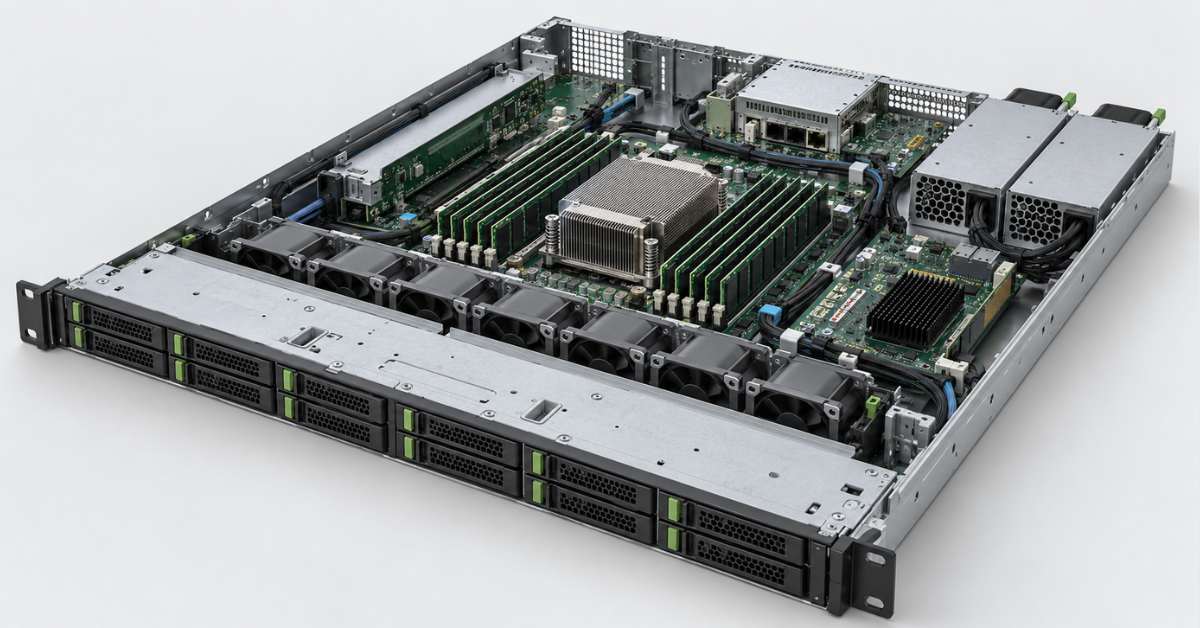
SAS and SATA use a storage controller, while NVMe uses PCIe lanes directly or through a tri-mode controller. Externally similar U.2 and U.3 drives are not always interchangeable: their capabilities depend on the backplane and cabling. The EDSFF E3.S format is intended for dense NVMe configurations in Gen11 and Gen12.
When selecting a storage subsystem, the following elements are interdependent:
- the type and number of front drive cages;
- the backplane;
- a hardware RAID controller or direct NVMe connection;
- the cable kit;
- fan requirements.
Consequently, “10 SFF bays” does not yet answer which drives will work. An NS204i boot module with two mirrored M.2 NVMe drives frees the main bays but requires compatible mounts and cables.
Networking, power and cooling
Gen11 and Gen12 can be supplied without a network adapter: OCP 3.0 or PCIe cards must be included in the specification in advance.
Two power supplies provide redundancy only when connected to independent power feeds. Their capacity must be calculated together with the processor, drives, networking and GPUs; hot components require appropriate heat sinks and fans.
The 1U chassis is designed for an equipment room: under load, its small fans are unsuitable for a quiet office.
Choosing the Right Equipment
Our specialists will contact you and answer all your questions
Which workloads suit the DL325?
Virtualisation and containers
Many cores and memory channels make the DL325 a convenient virtualisation node. Sizing should account for virtual-machine dimensions and NUMA placement, memory headroom, networking and storage.
Databases and analytics
For transactional databases, frequency, memory latency and NVMe performance are often more important than maximum core count. Analytics can benefit from many-core EPYC processors and the larger cache of X-series models. Database licensing must also be considered.
Software-defined storage
The DL325 is suitable for hyperconverged systems and distributed storage. Gen10 Plus stands out with up to 24 SFF or 12 LFF drives, while newer generations offer EDSFF and PCIe 5.0.
Web services, CDN and edge sites
The 1U chassis saves space, while the short Gen10 Plus v2 is convenient for shallow racks. At an edge site, temperature, dust and acoustics must also be considered.
GPU and artificial intelligence
Gen11 and Gen12 are suitable for inference, video processing and virtual desktops with one or two accelerators. A specialised GPU platform is a better choice for training large models.
Which HPE ProLiant DL325 generation should you choose?
| Workload | Suitable generation | What to consider |
|---|---|---|
| Laboratory, backup services, budget infrastructure | Gen10 | Age, PCIe 3.0 and compatibility with current software |
| Maximum local SFF or LFF capacity while retaining DDR4 | Gen10 Plus | Greater depth and complex layout of dense drive chassis |
| EPYC 7003, high frequency or larger cache with DDR4 | Gen10 Plus v2 | No more than 10 SFF or 4 LFF drives |
| New general-purpose virtualisation node | Gen11 | Up to 12 modules and 3 TB of memory; compatibility of the specific EPYC 9005 processor |
| Up to 192 cores, 6 TB of memory, iLO 7 or a flexible EDSFF layout | Gen12 | Price, power, cooling and actual option compatibility |
Gen10 is chosen for the lowest budget when software compatibility has been confirmed. Among DDR4 platforms, Gen10 Plus v2 is better suited to compute workloads, while the standard Plus is preferable for dense local storage. Gen11 is the optimal choice for a new general-purpose node. Moving to Gen12 is justified by a requirement for more than 160 cores, more than 3 TB of memory, iLO 7, front OCP connectors or a new drive-cage layout.
Total cost should include the processor, memory-channel population, drives, controllers, cables, networking, power, licences and maintenance. An entry-level Gen12 can be less capable than a well-equipped Gen11, while an inexpensive many-core processor can become more costly because of software licensing.
New or refurbished equipment
Gen10, Gen10 Plus and Gen10 Plus v2 have been discontinued and are usually sold as refurbished equipment or old stock. Gen11 is available both new and refurbished, while Gen12 is predominantly new.
For a refurbished server, check the exact chassis configuration, backplanes, controller, cables, risers, fans, power supplies, drive carriers and iLO licence. Missing proprietary parts for NVMe can make an upgrade considerably more expensive. For drives, endurance, error logs and extended testing matter; for the complete system, consider the supplier's warranty, spare-parts availability and replacement time. Such a warranty is not the same as manufacturer support.
Frequently asked questions
Which DL325 generation is current?
The current model is the HPE ProLiant Compute DL325 Gen12. Gen11 remains a modern platform, supports EPYC 9004 and selected 9005 processors, and is often more cost-effective for a new general-purpose node.
How does Gen10 Plus v2 differ from Gen10 Plus?
Gen10 Plus v2 uses EPYC 7003, supports up to 4 TB of DDR4 and has a short chassis. The standard Plus uses EPYC 7002 but can accommodate up to 24 SFF or 12 LFF drives when the special platform is used.
Can Gen10 Plus be converted into v2 or Gen11 by replacing the processor?
No. The v2 uses a different system board, while Gen11 has a new socket, DDR5 and PCIe 5.0. A processor can be replaced only within the supported list for the specific revision.
Is one processor sufficient for virtualisation?
Yes, provided that memory, networking and storage performance are sufficient. Especially large virtual machines or a greater number of expansion cards require a dual-socket or 2U system.
Is the DL325 suitable for artificial intelligence workloads?
Gen11 and Gen12 support up to two double-slot accelerators and are suitable for moderate inference or video processing. Training large models requires a specialised server.
Which should you choose: DL325, DL345, DL365 or DL385?
The DL325 has one processor in 1U; the DL345 has one processor in a roomier 2U chassis; the DL365 has two processors in 1U; and the DL385 has two processors in an expandable 2U chassis.
Conclusion
The HPE ProLiant DL325 has evolved from a 1U server based on EPYC 7001/7002 to a platform with 192 cores, 6 TB of DDR5, PCIe 5.0 and iLO 7. Gen10 suits budget workloads, Gen10 Plus is intended for dense storage, Gen10 Plus v2 is a mature DDR4 option, and Gen11 is appropriate for most new projects. Gen12 should be selected when its additional cores, memory and interfaces provide measurable value. The final decision depends on compatibility across the entire system, not just the generation number.
Choosing the Right Equipment
Our specialists will contact you and answer all your questions