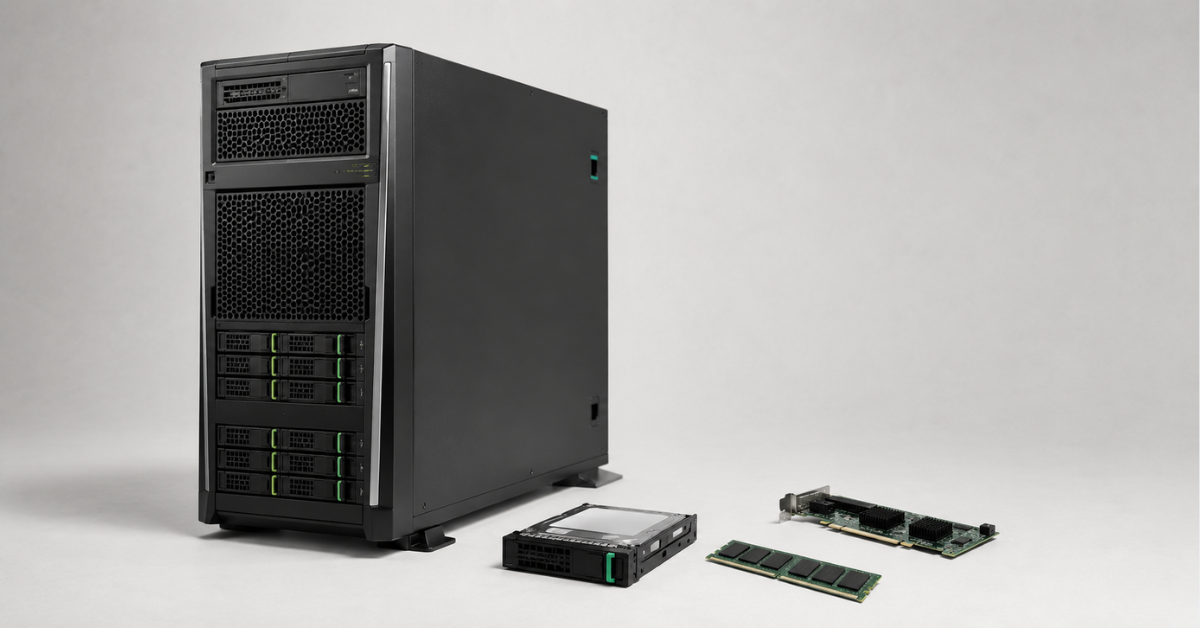
The HPE ProLiant ML350 is an enterprise-class dual-socket tower server with extensive capacity for memory, storage and expansion cards. The ML350 Gen11 is the optimal choice for most new projects; on a limited budget, a refurbished Gen10 is worth considering, while Gen12 is justified for systems with a long service life that already require the latest Intel Xeon 6 processors and fast NVMe drives. Gen9 is primarily suitable for non-critical tasks or expanding an existing fleet.
The generation number is no substitute for properly sizing the configuration. Two ML350 servers of the same age can differ significantly: one may have an entry-level processor and software RAID, while another has two high-performance processors, balanced memory, a hardware controller with protected cache and redundant power supplies.
What is the HPE ProLiant ML350?
The ML350 is the flagship general-purpose model in the HPE ProLiant ML tower server family. It is designed for companies that have outgrown a compact single-socket server but do not necessarily need to place their equipment in a full-scale data centre.
The large chassis can accommodate:
- one or two processors;
- a substantial amount of error-correcting memory;
- multiple drive cages;
- RAID controllers and network adapters;
- compute accelerators;
- an internal tape drive;
- redundant power supplies and fans.
The letters ML identify the tower product line. The number 350 denotes a high-performance Intel-based model in the 300 series. The number following Gen indicates the platform generation. Starting with Gen12, the full official name is HPE ProLiant Compute ML350 Gen12, but it remains a continuation of the same product line.
ML350, ML110 or DL380
The ML110 is more compact, uses one processor and is designed for moderate workloads. The ML350 supports two processors and provides more memory slots, drive bays and expansion slots.
HPE ProLiant DL servers are designed for rack installation from the outset. The similarly positioned DL380 is more convenient for dense deployment in a data centre. The ML350 can operate as a standalone tower and can be converted for rack installation if required, although it usually occupies 5U. The rack platform is covered in more detail in the article “HPE ProLiant DL380 Gen12 vs Gen11 vs Gen10 Plus: which server should you buy in 2026?”.
How the ML350 product line evolved
The table lists the maximum platform capabilities, not the specifications of every ready-made configuration. Maximum values depend on the processors, memory, chassis, drive cages, controllers, risers and cooling. SFF, LFF and EDSFF options are mutually exclusive and cannot be combined.
| Generation | Processors | Memory | Storage | Expansion and management |
|---|---|---|---|---|
| ML350 Gen9 | Up to two Intel Xeon E5-2600 v3/v4 processors, up to 22 cores per processor | 24 DDR4 slots; up to 3 TB | Up to 48 SFF or 24 LFF drives | PCIe 3.0, up to 9 slots, iLO 4 |
| ML350 Gen10 | Up to two 1st- or 2nd-generation Intel Xeon Scalable processors, up to 28 cores | 24 DDR4 slots; up to 3 TB | Up to 24 SFF or 12 LFF drives; up to 8 NVMe drives | PCIe 3.0, up to 8 slots, iLO 5 |
| ML350 Gen11 | Up to two 4th- or 5th-generation Intel Xeon Scalable processors, up to 64 cores | 32 DDR5 slots; up to 8 TB | Up to 24 SFF, 12 LFF or 12 EDSFF E3.S drives | PCIe 5.0, up to 10 slots, OCP 3.0, iLO 6 |
| ML350 Gen12 | Up to two Intel Xeon 6700P/6500P processors, up to 86 performance cores per processor | 32 DDR5 slots; up to 8 TB | Up to 24 SFF, 12 LFF or 12 EDSFF drives; up to 24 NVMe drives | PCIe 5.0, up to 10 slots, OCP 3.0, iLO 7 |
Maximum storage capacity is better assessed by the number of bays rather than terabytes alone, as HPE gradually certifies higher-capacity drives. “Up to ten PCIe slots” also does not mean ten identical full-speed connectors. Some are linked to the second processor, electrical width differs from physical size, and the final layout depends on the risers.
HPE ProLiant ML350 Gen8: two platforms with similar names
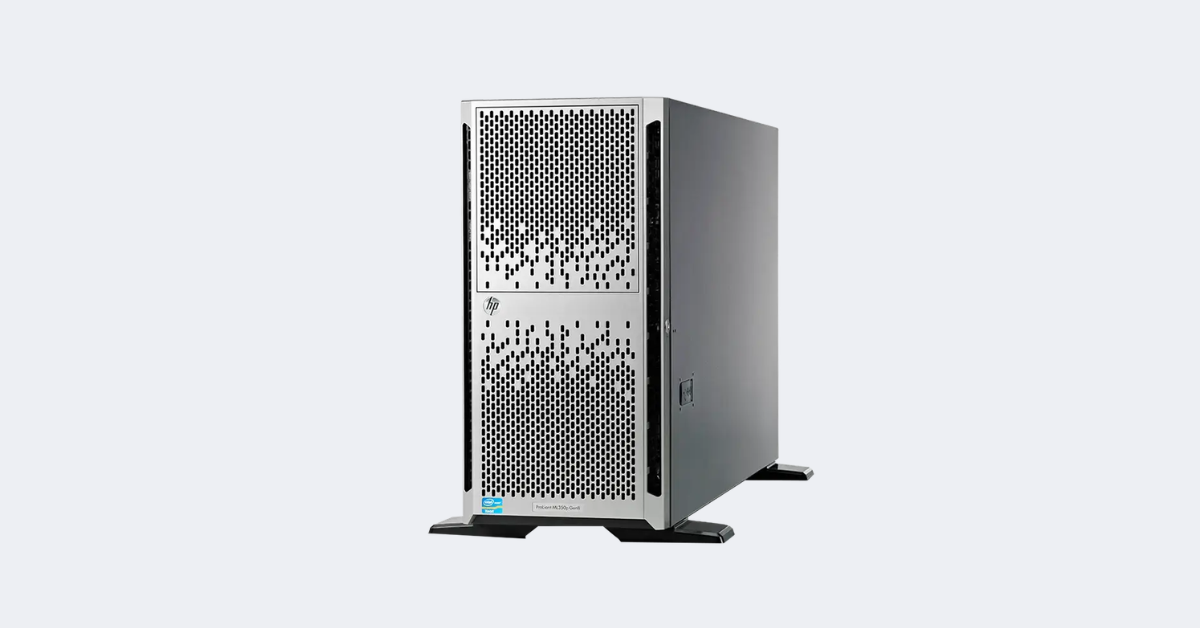
HPE ProLiant ML350P Gen8.
Image source: Servermall
Gen8 included the ML350e and ML350p. These were not two configurations of the same server: they differed in their processors, memory and expansion capabilities. Their specifications must not be combined.
Both versions use DDR3 and are now primarily of interest for labs, legacy software or repairs to existing infrastructure. For a new production system, the age of the components, power consumption, availability of working spare parts and limited support for modern hypervisors usually outweigh the low price.
Choosing the Right Equipment
Our specialists will contact you and answer all your questions
HPE ProLiant ML350 Gen9: DDR4 and high storage capacity
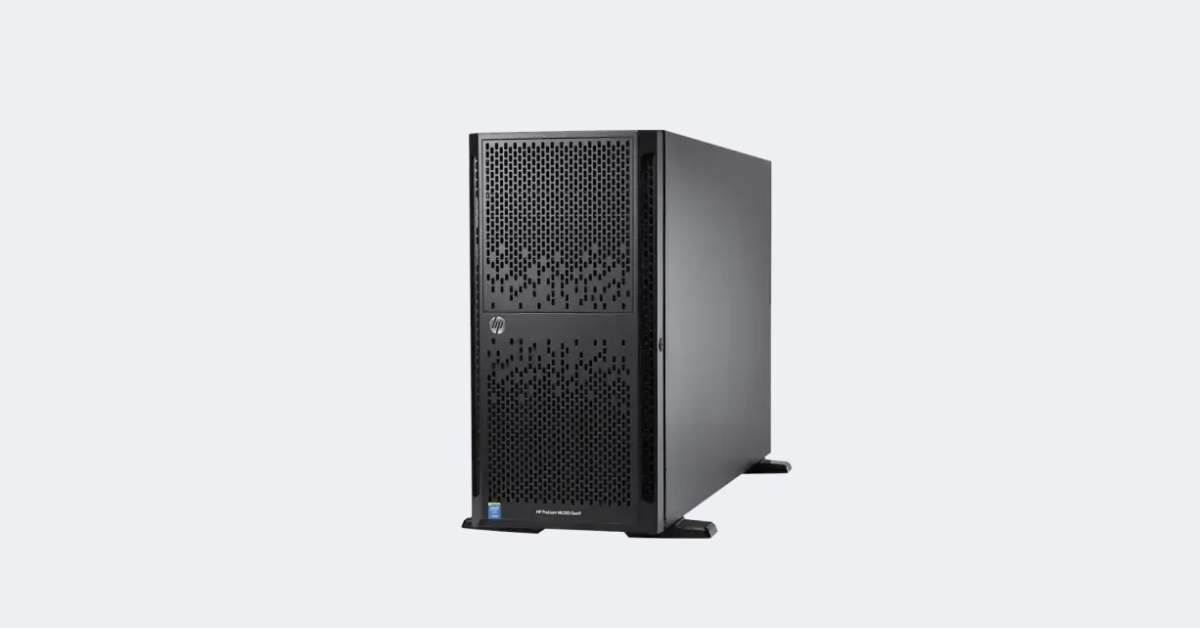
HPE ProLiant ML350 Gen9.
Image source: Servermall
The ML350 Gen9 supports one or two Intel Xeon E5-2600 v3/v4 processors, up to 22 cores per processor and 24 DDR4 slots. The official HPE specification gives a maximum of 3 TB with compatible v4 processors and 128 GB LRDIMMs. The limit is lower with v3 processors and other memory modules.
The generation's strength is local storage: a maximum configuration supports up to 48 2.5-inch SFF drives or 24 3.5-inch LFF drives. Specific chassis options differ. Configurations available in the Servermall catalogue have 8 or 12 LFF bays or 8 SFF bays; further expansion requires cages, cables and a suitable controller.
Other features include:
- up to nine PCIe 3.0 slots;
- iLO 4 remote management;
- HPE Smart Array controllers;
- redundant power in applicable configurations.
Gen9 is suitable for file services, backup, labs and moderate virtualisation. Before purchasing, it is important to confirm support for the required OS, hypervisor, network adapter and RAID controller. This generation is already becoming a limitation for new NVMe drives, modern GPUs and heavily loaded databases.
HPE ProLiant ML350 Gen10: a sensible balance on the refurbished market
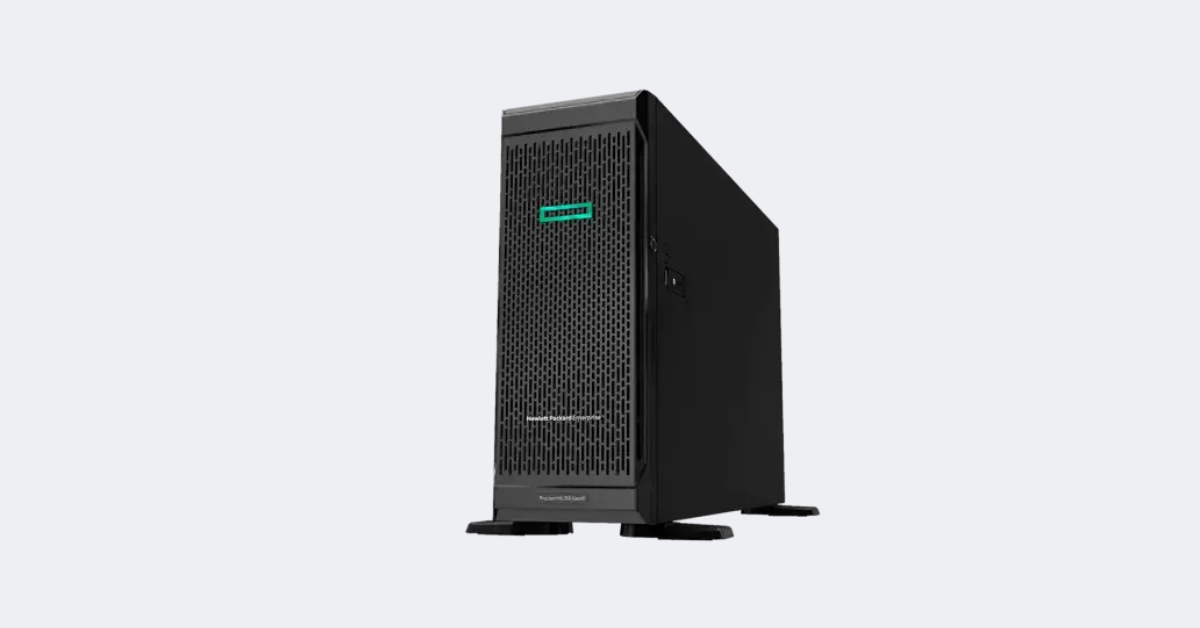
HPE ProLiant ML350 Gen10.
Image source: Servermall
Gen10 introduced 1st- and 2nd-generation Intel Xeon Scalable processors, with up to two CPUs and up to 28 cores per socket. The number of memory slots remained unchanged: 24 DDR4 sockets and up to 3 TB of conventional RAM.
According to the HPE QuickSpecs, the server gained iLO 5, up to eight PCIe 3.0 slots and a chassis with three zones for drive cages. It supports up to 24 SFF or 12 LFF drives and, in a separate configuration, up to eight NVMe drives. Mixed SFF and LFF cages are supported, but their combination depends on the original chassis, cables and controller.
iLO 5 added hardware-based firmware verification and more modern management tools. The remote console and some features depend on the licence. For more context on out-of-band server management, see the article on practical differences between a server and a PC.
The ML350 Gen10 is suitable for medium-density virtualisation, 1C, ERP, file services, backup and databases for which DDR4 and PCIe 3.0 are sufficient. The platform can be expanded conveniently using components available on the refurbished market. Installing a second processor, all drive cages, NVMe or a GPU may nevertheless require additional fans, risers and more powerful power supplies.
Why there is no ML350 Gen10 Plus
HPE offers Gen10 Plus servers in many product lines, including the DL360 and DL380, but there is no separate production ML350 Gen10 Plus model. This is also clear from the HPE ProLiant Gen10 Plus catalogue: the ML350 is not among the platforms listed.
This designation is sometimes used by third-party sellers because of confusion with other models or later ML350 Gen10 configurations. Support for 2nd-generation Intel Xeon Scalable processors does not turn the ML350 Gen10 into a Gen10 Plus: the next official platform is the ML350 Gen11.
HPE ProLiant ML350 Gen11: DDR5, PCIe 5.0 and new drive form factors
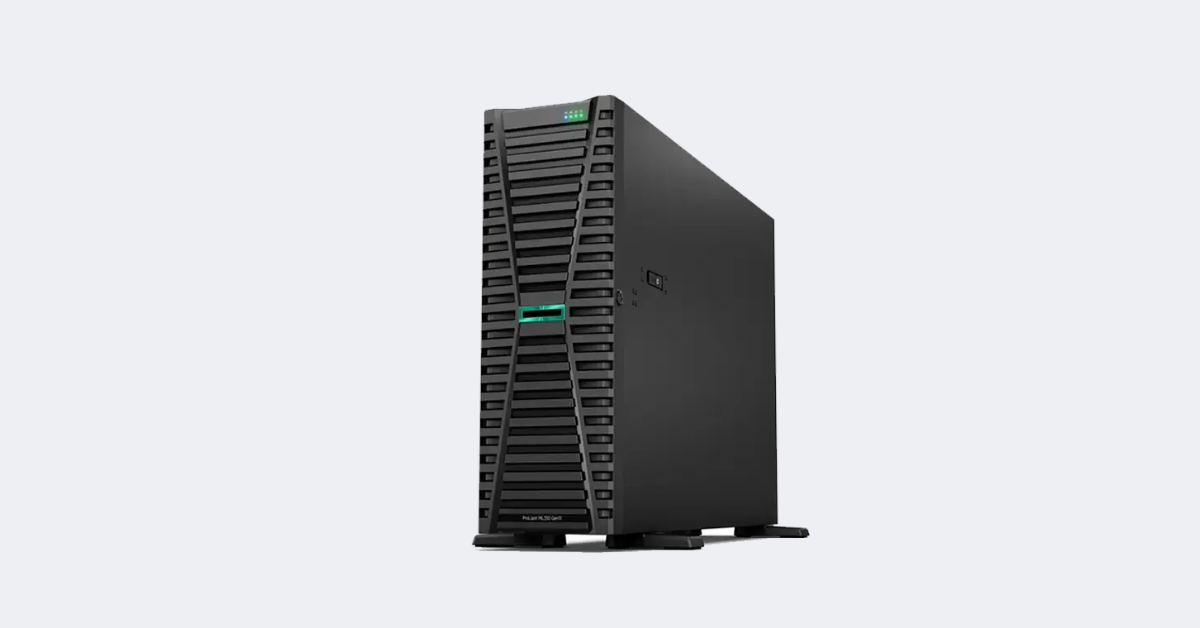
HPE ProLiant ML350 Gen11.
Image source: Servermall
Gen11 was a complete platform refresh. It supports 4th- and 5th-generation Intel Xeon Scalable processors, up to 64 cores per processor, 32 DDR5 slots and up to 8 TB of memory. Each processor has eight channels and 16 DIMM sockets.
The HPE specification for the ML350 Gen11 notes that replacing a 4th-generation processor with a 5th-generation model is not supported as a standard field upgrade. When buying, you need to know which processor revision a particular unit was built for rather than relying solely on the Gen11 label.
PCIe 5.0 increases bandwidth for networking, controllers and storage. Depending on the risers, up to ten slots are available. OCP 3.0 connectors allow a compatible network card or RAID controller to be installed without occupying a standard PCIe slot.
Storage options include:
- up to 24 SFF drives for SAS, SATA and compatible NVMe;
- up to 12 LFF drives;
- an 8-drive U.3 NVMe cage with four lanes per drive;
- up to 12 EDSFF E3.S drives;
- an NS204i-u boot device with two M.2 NVMe drives in RAID 1;
- an internal tape drive with a compatible layout.
These options cannot be combined arbitrarily. The EDSFF cage limits other front bays, while direct NVMe connectivity, operation through a tri-mode controller and VROC require different cables and settings.
Gen11 is suitable for new virtualisation systems, VDI, ERP, heavily loaded databases and applications requiring fast networking or the highest-speed NVMe storage. It is the most balanced choice when the benefits of DDR5 and PCIe 5.0 are already needed but the maximum core density of Gen12 does not yet justify the additional cost.
HPE ProLiant Compute ML350 Gen12: Intel Xeon 6 and iLO 7
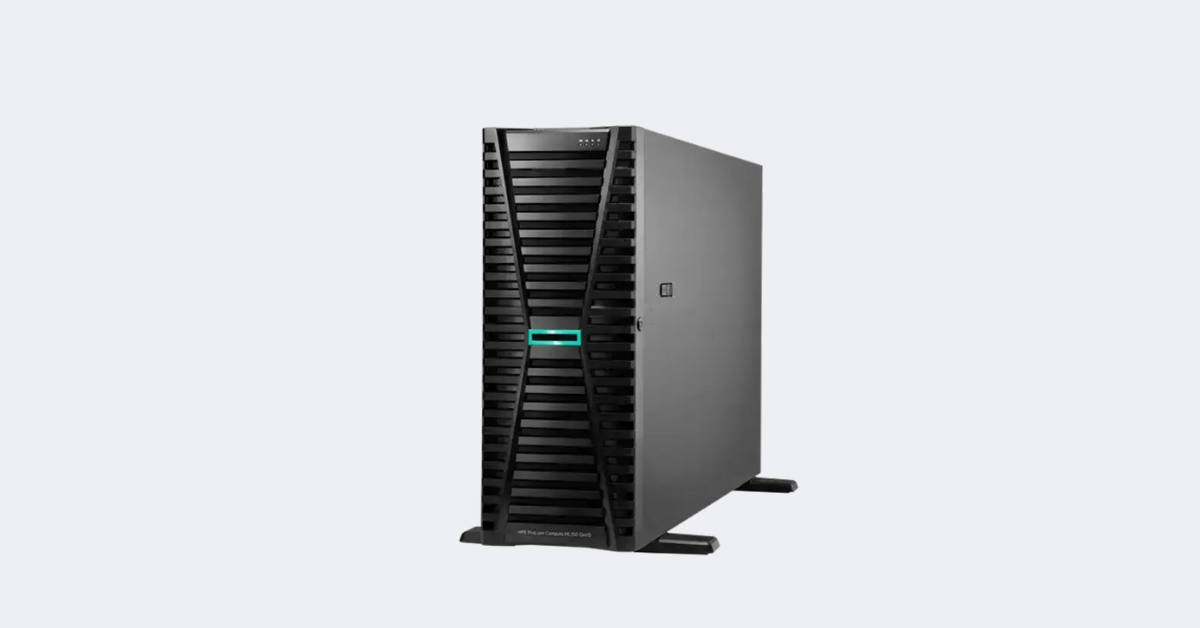
HPE ProLiant Compute ML350 Gen12.
Image source: Servermall
The ML350 Gen12 uses Intel Xeon 6700P and 6500P processors with performance cores. The top models contain up to 86 cores, or up to 172 in a dual-socket system. Information about Xeon 6 processors with efficient cores from the specifications of other HPE Gen12 systems must not be applied here: the ML350 is designed for the P-series.
According to the HPE QuickSpecs, each processor provides up to 88 PCIe 5.0 lanes. The server retains 32 DDR5 slots and an 8 TB limit, while the maximum memory speed has increased to 6400 MT/s. Actual speed depends on the processor model, DIMM type and number of modules per channel.
Three chassis zones support cages for 4 LFF drives, 8 SFF drives, 8 NVMe drives with four lanes per drive, or 12 EDSFF E3.S drives. A configuration with up to 24 NVMe drives using two lanes per drive is possible. The NS204i-u V2 with a mirrored pair of M.2 drives is available for booting.
Intel VROC is used for directly connected NVMe drives, with the available RAID levels depending on the licence. Compatible HPE hardware controllers are used for SAS, SATA and mixed arrays. Consequently, the figure “24 NVMe” says nothing about a ready-made configuration without the cage type, connection width and controller.
Management is handled by iLO 7. High-performance heatsinks, additional fans and power supplies of up to 2200 W are available for top-end processors, multiple GPUs and a fully populated chassis. Gen12 is the right choice for a long-term project, high virtual-machine density, demanding databases or an advanced NVMe system. For a conventional file server, a well-equipped Gen10 or Gen11 is often more economical.
How the ML350 storage subsystem works
An empty bay does not by itself mean the server is ready for another drive. Expansion may require a cage with a backplane, power and data cables, a RAID controller, cache protection, available PCIe lanes and additional fans.
3.5-inch LFF is usually chosen for high-capacity HDDs in file servers, archives and backup systems. 2.5-inch SFF makes it possible to install more drives and is suitable for SAS and SATA SSDs and, in newer generations, NVMe. The same physical size does not mean the same interface.
EDSFF E3.S is a separate server NVMe form factor in Gen11 and Gen12. Such a drive cannot be installed in a conventional SFF cage: it requires the appropriate backplane, which affects the layout of the other bays.
SAS and SATA are usually connected through a hardware RAID controller. NVMe can operate directly from processor lanes or through a tri-mode controller. A direct connection uses PCIe lanes and may require VROC for RAID. A controller simplifies array management but has its own bandwidth limit.
A mirrored pair of M.2 drives for booting leaves the front bays available for data. In virtualisation, this makes it possible to separate the hypervisor from the working array and service the primary storage independently.
A second processor changes more than just the core count
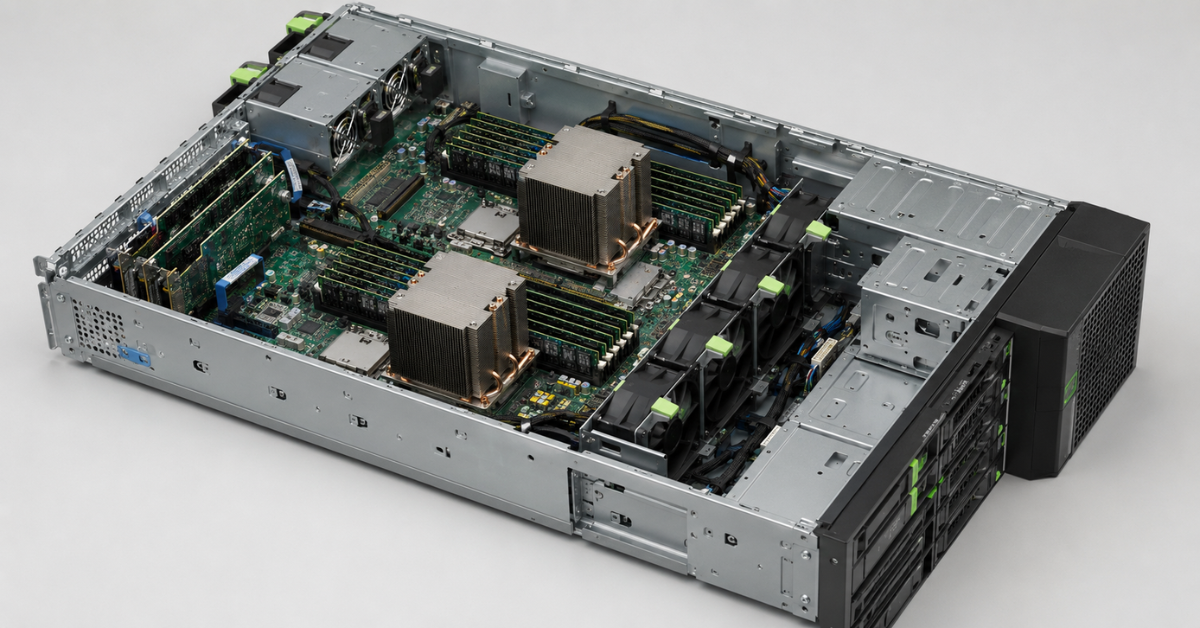
In a dual-socket ML350, half of the memory channels and some of the expansion lanes belong to the second processor. Until it is installed, the associated memory and PCIe slots do not work.
An upgrade requires a second processor of the same model, a compatible heatsink, fans and the correct memory distribution. The riser and power-supply capacity must also be checked. Different processors cannot be mixed.
Virtualisation must account for NUMA, the division of memory between processor nodes. If a virtual machine regularly accesses memory attached to the other processor, latency increases. VM sizing and hypervisor settings should therefore match the server topology.
A high core count also affects software costs. Windows Server, database management systems and other products may be licensed by core or socket. A newer processor can reduce the number of physical servers but increase licence costs.
Choosing the Right Equipment
Our specialists will contact you and answer all your questions
Cooling, noise and power
A tower chassis does not make the ML350 a quiet workstation. Noise depends on the processors, drives, controllers, GPUs, temperature and cooling profile. The fans briefly run at high speed during startup, and a powerful dual-processor configuration under load may be too loud for a normal office.
A separate room with properly designed airflow is preferable. A closed furniture cabinet without a supply of cool air is unsuitable. The equipment must not be placed near heating, moisture or construction dust.
Additional fans may be required when installing a second processor, all drive cages, NVMe, a high-performance controller, high-speed networking or a GPU, or when mounting the server in a rack.
Two power supplies provide redundancy but do not protect against an external power failure. For resilience, connect them to independent circuits or separate UPS units. Capacity should be selected for the peak configuration. Higher-output Gen11 and Gen12 power supplies may require 200–240 V input.
Management and software compatibility
The remote-management controller version changed with each platform:
- Gen9 — iLO 4;
- Gen10 — iLO 5;
- Gen11 — iLO 6;
- Gen12 — iLO 7.
iLO can monitor temperatures, fans, power and memory, read hardware logs, control power and install firmware independently of the main OS. The remote graphical console and some automation features depend on the licence.
The iLO version does not determine software compatibility. Each controller, network adapter, GPU and boot device must be matched to the selected OS or hypervisor. This is especially important for Gen9: the server may handle the workload, but newer software versions may no longer officially support it.
The management interface should be placed in a separate network segment with access limited to administrative addresses, and firmware should be updated regularly. Hardware security in newer generations strengthens the platform but does not replace a secure network and regular updates.
Which HPE ProLiant ML350 generation should you choose?
| Scenario | Generation | Why |
|---|---|---|
| Lab and non-critical services | Gen9 | Low cost when compatibility has been confirmed in advance |
| File storage and backup | Gen10 or Gen11 | Gen10 is more affordable; Gen11 is more modern |
| Moderate virtualisation | Gen10 or Gen11 | A sufficient choice of processors and memory without necessarily paying extra for Gen12 |
| Large-scale virtualisation and VDI | Gen11 or Gen12 | DDR5, PCIe 5.0, more cores and faster networking |
| Databases and analytics | Gen11 or Gen12 | High memory and NVMe bandwidth |
| Multiple GPUs | Gen11 or Gen12 | Modern slots, power delivery and supported accelerators |
| A new server for long-term use | Gen12 | A current platform with room for future growth |
| Expanding an existing fleet | The same generation | Standardised spare parts and firmware |
Gen9 is a reasonable choice for labs and for continuing to operate a uniform fleet. Gen10 offers a strong price-to-capability ratio on the refurbished market. If an application does not require DDR5 and PCIe 5.0, a well-equipped Gen10 can offer better value than a basic Gen11.
Gen11 is a general-purpose platform for most new enterprise systems. Gen12 is intended for projects with high compute density and a long planning horizon. The decision should account for the cost of the complete configuration, cooling, power and licences, not just the core count.
New or refurbished ML350
Gen9 and Gen10 are discontinued and are more commonly sold as refurbished equipment. Such a server can provide more memory, storage and redundant components for the same budget if the workload does not require DDR5 and PCIe 5.0.
Quality depends on diagnostics of the processors, memory, drives, controller and its battery, fans and power supplies, as well as the condition of the iLO logs and firmware. Cages, cables, blanks and rails are important for expansion: an uncommon upgrade kit can significantly increase the final price.
A critical system needs a warranty, available spare parts and a clear replacement time frame. Gen11 and Gen12 provide a more modern lifecycle, but a newer generation does not correct a weak configuration: one entry-level processor, minimal memory and a single power supply may matter more than the difference between Gen11 and Gen12.
Frequently asked questions about the HPE ProLiant ML350
Can the ML350 be installed in a rack?
Yes, with a compatible conversion kit and rails. Gen10–Gen12 occupy 5U in rack form, although the tower chassis is described as 4U.
Can a second processor be added later?
Yes, provided a complete compatible kit is selected. In addition to a processor of the same model, a heatsink, fans, correct memory distribution and a power check will be required.
Is the ML350 suitable for an office?
Yes, provided there is a location with proper cooling and an acceptable noise level. A server with two powerful processors, NVMe or a GPU is better placed in a separate room. The general requirements are covered in the article “How to choose an office server”.
Which ML350 is best for virtualisation?
Gen10 is often sufficient for a moderate number of VMs. Gen11 is preferable when memory, network or NVMe workloads are high. Gen12 is needed for high compute density or a long service life. One server model alone is not enough for high availability: multiple nodes, a redundant network, storage and tested recovery are required.
Conclusion
In terms of capabilities, the HPE ProLiant ML350 is close to a full-featured dual-socket rack platform while retaining the convenience of a tower chassis. Gen10 offers good value on a limited budget, Gen11 suits most new enterprise systems, and Gen12 provides the greatest headroom for cores and modern NVMe. Gen9 is justified where its limitations are understood in advance.
The selection process should begin with the workload: number of users and
virtual machines, processor and memory requirements, usable array capacity,
networking and acceptable downtime. Servermall specialists will help select
compatible processors, memory, drive cages, a RAID controller, network adapters,
cooling and power for a specific project.
Choosing the Right Equipment
Our specialists will contact you and answer all your questions