HPE ProLiant DL365 is a dual-socket 1U rack server based on AMD EPYC, designed primarily for dense virtualisation, databases and compute clusters. The modern model has only two generations: Gen10 Plus with DDR4 and PCIe 4.0, and Gen11 with DDR5 and PCIe 5.0. Gen11 is usually the more sensible choice for a new project, while Gen10 Plus is worth considering for its lower price, compatibility with an existing DDR4 fleet or an attractively priced refurbished configuration. There is no separate DL365 Gen12 as of the article update date.
What is the HPE ProLiant DL365?
All HPE ProLiant DL365 generations and configurations are available here.
The letters DL identify the HPE ProLiant rack server range. The 365 designation refers to a 1U platform with two AMD processor sockets. The model's main value is its high core count and memory bandwidth per rack unit.
Density inevitably creates limitations. A 1U chassis has less room for drive cages, expansion cards and large accelerators, while cooling two powerful processors is more difficult than in a 2U system. The DL365 should therefore be considered a compute node rather than a universal server with maximum local storage capacity.
The model occupies a clear position in the HPE ProLiant DL rack server range: the DL325 provides one AMD EPYC processor in 1U, the DL345 places one AMD EPYC in a roomier 2U chassis, and the DL385 combines two AMD sockets with a 2U chassis.
Why does the DL365 have an unusual generation history?
The DL365 name did not originate with EPYC. In the late 2000s, HP produced the ProLiant DL365 G5, a dual-socket 1U server based on AMD Opteron. The designation then disappeared from the current product range for many years and returned only with the DL365 Gen10 Plus.
It is therefore impossible to build the familiar continuous sequence of Gen9, Gen10, Gen10 Plus, Gen11 and Gen12 for this model. There was no DL365 Gen9 or standard DL365 Gen10. The modern comparison begins with Gen10 Plus, followed by Gen11.
The old G5 is now relevant only from a historical perspective. Its architecture, memory, interfaces, power consumption and management tools are too far removed from current requirements to include it in the same comparison table as EPYC-based servers. It has no practical value for a modern production environment unless there is a need to run very old legacy systems; otherwise, it is of historical or museum interest only.
HPE ProLiant DL365 Gen10 Plus
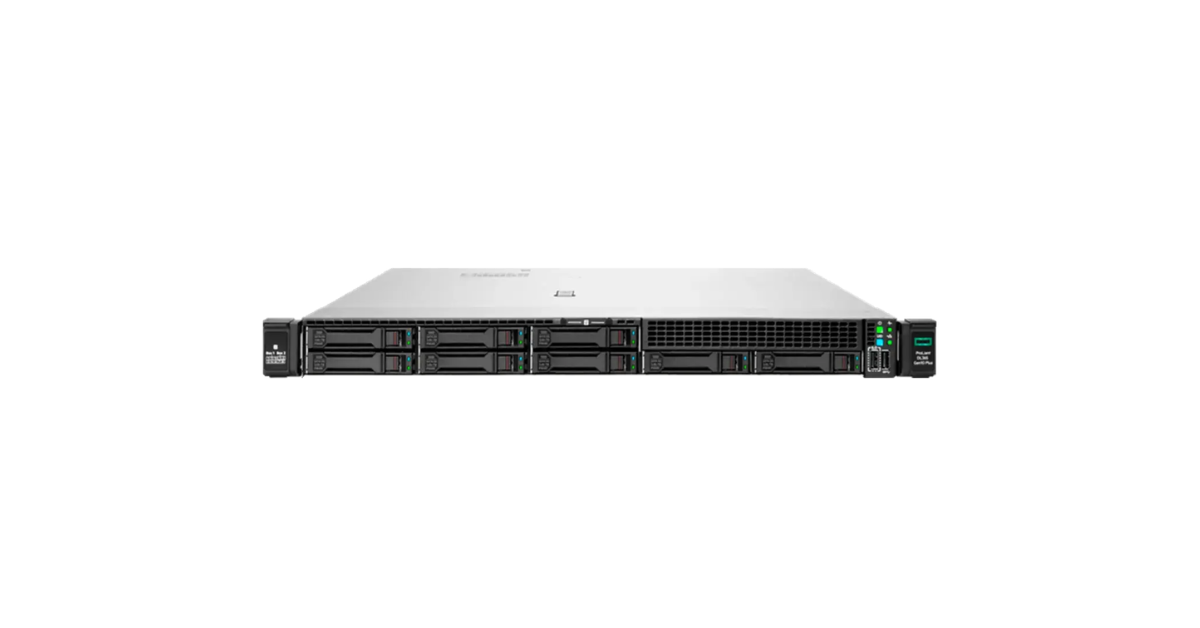
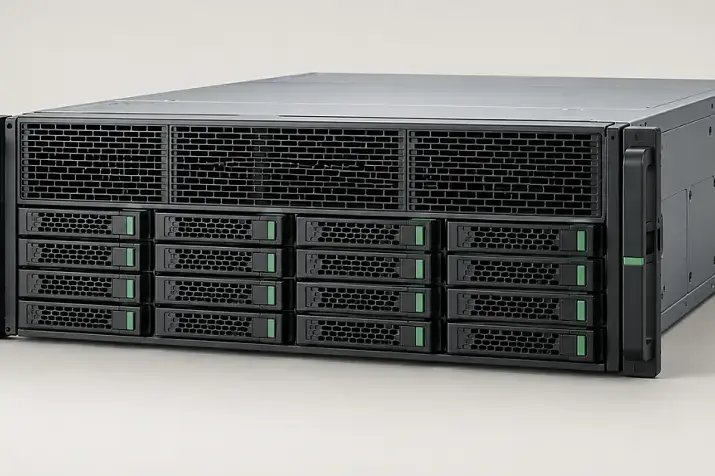
HPE ProLiant DL365 Gen10 Plus: models and configurations are available here.
Image source: Servermall
The DL365 Gen10 Plus brought the model designation back as a modern dual-socket AMD platform. The server supports EPYC 7002 and 7003 processors with up to 64 cores per CPU. A fully populated system therefore provides up to 128 physical cores, but core count is not the only important factor when choosing processors: clock speed, cache size, thermal design power and licensing costs can have a greater effect on the outcome.
The server has 32 DDR4 memory slots, with 16 per processor. Each EPYC processor has eight memory channels, and two modules per channel allow capacity to be increased. Speeds reach 3200 MT/s, while the maximum stated capacity is up to 8 TB with supported high-capacity modules. The actual limit depends on the processors, module type and population rules.
The platform introduced PCIe 4.0 and OCP 3.0 network adapters. Depending on the risers, up to three PCIe slots are available, with the third connected to the second processor. Installing only one CPU does not simply halve the core count: some memory slots and I/O lanes will remain unavailable.
A typical front panel accommodates eight 2.5-inch drives. An optional expansion adds two NVMe bays, increasing the maximum to ten SFF drives. However, the SAS/SATA/NVMe designation in the specifications does not make every bay universal. The appropriate cage, cables, controller and connection layout are required.
Gen10 Plus uses iLO 5 and redundant HPE Flexible Slot power supplies. Storage options include software RAID, hardware Smart Array controllers, HBAs and tri-mode controllers. An important and easily overlooked detail is that the official HPE QuickSpecs identify restrictions affecting EPYC 7002 processors when used with tri-mode controllers. The processor, controller and drive cage therefore cannot be selected independently.
Gen10 Plus is suitable for mature DDR4 infrastructure where component availability and predictable operation are priorities. It is particularly attractive on the secondary market when moving to more expensive DDR5 is not yet necessary: PCIe 4.0 is already sufficient for fast NVMe drives and modern network cards.
Choosing the Right Equipment
Our specialists will contact you and answer all your questions
HPE ProLiant DL365 Gen11
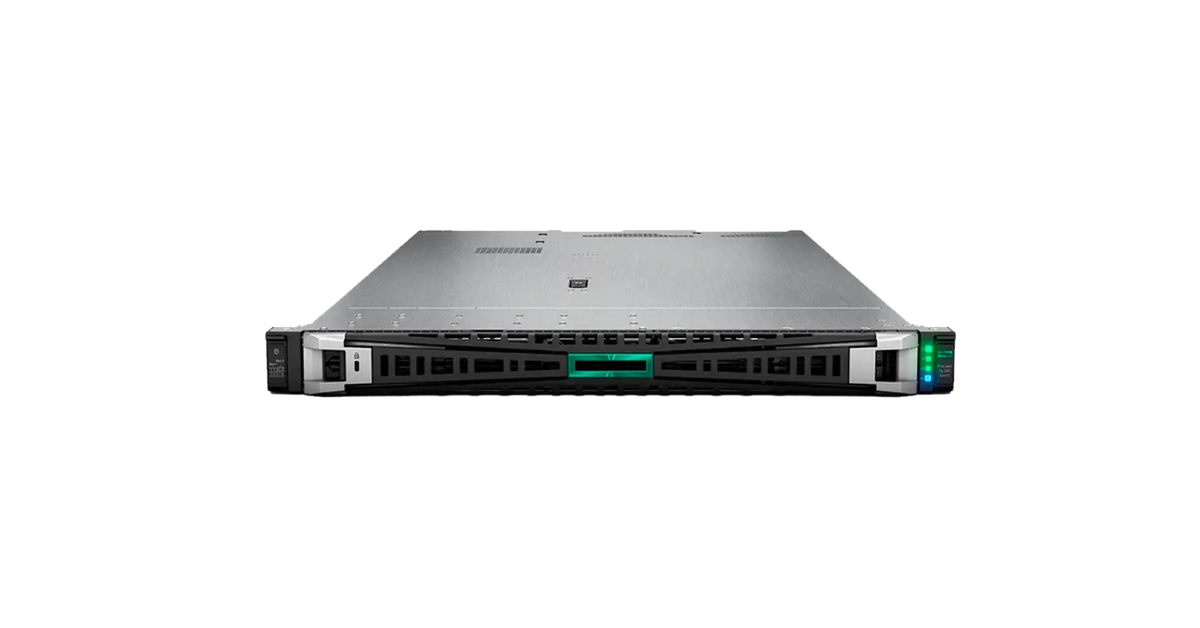
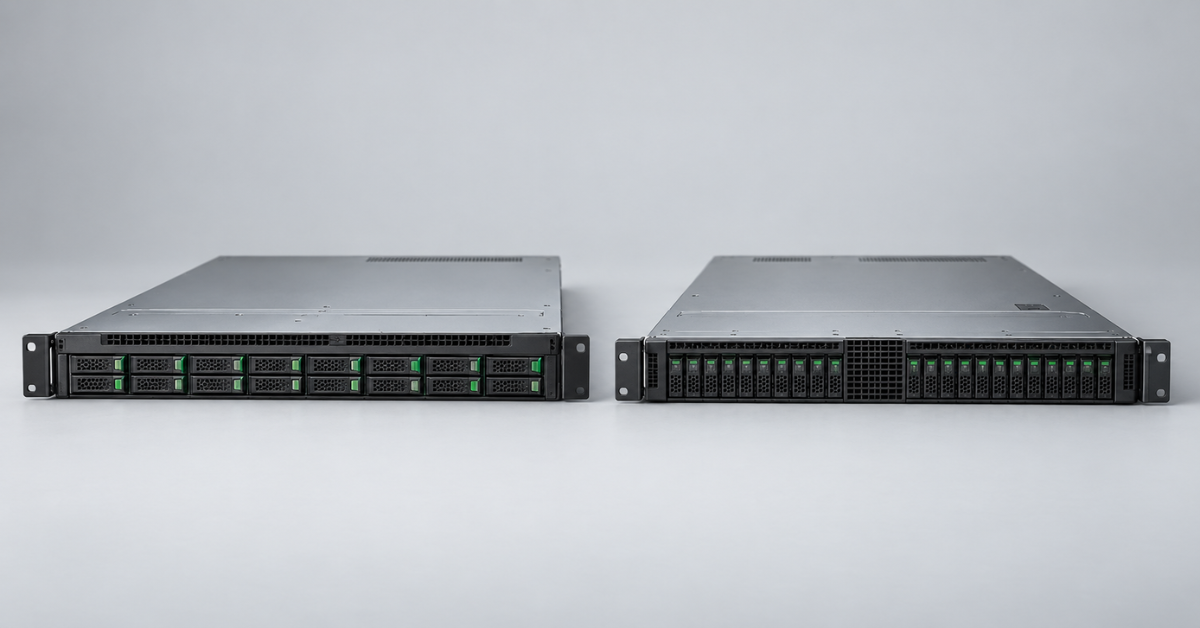
HPE ProLiant DL365 Gen11: models and configurations are available here.
Image source: Servermall
Gen11 is not a cosmetic update but a move to a new platform. The server supports AMD EPYC 9004 and, following a product-range update, EPYC 9005 processors. The current HPE DL365 Gen11 page specifies support for up to 160 cores per processor. This is the limit for compatible DL365 configurations, not the maximum core count across the entire EPYC 9005 family.
The number of memory slots decreased from 32 to 24, but the architecture became wider: each socket has 12 DDR5 channels with one slot per channel. Total capacity reaches 6 TB. With EPYC 9004, memory operates at up to 4800 MT/s, while compatible EPYC 9005 configurations support up to 6400 MT/s. The final speed is determined by the slowest element: the processor, modules, population scheme or firmware version.
I/O moved to PCIe 5.0. The platform provides two main PCIe slots and two OCP 3.0 network connectors. It formally has fewer slots than Gen10 Plus, but each connection offers greater bandwidth. OCP cards allow network interfaces to be installed without occupying a standard expansion slot.
Several front-panel storage configurations are available: up to 10 SFF drives or up to 20 EDSFF E3.S drives. The second option is intended for dense, high-performance NVMe configurations. These use different chassis and component sets, so converting a basic 8SFF system into a 20 EDSFF system by simply replacing the drive cage is generally not possible.
iLO 6 provides OOB (out-of-band) management. In addition to local console access and health monitoring, the server can connect to HPE OneView and HPE Compute Ops Management for centralised fleet management. Protection is built around HPE's silicon root of trust and AMD Secure Processor features, but security also depends on timely firmware updates, access settings and management-network isolation.
Gen11 supports air and direct liquid cooling. Special configurations can accommodate up to two single-slot or dual-slot GPUs. Such a configuration requires compatible risers, higher-capacity power supplies and the correct fan kit, while some front bays are allocated to the accelerators. The DL365 is suitable for selected accelerated-computing and model-inference workloads, but it does not replace a specialised multi-GPU server.
DL365 Gen10 Plus vs Gen11
| Parameter | DL365 Gen10 Plus | DL365 Gen11 |
|---|---|---|
| Processors | Up to 2 × AMD EPYC 7002/7003, up to 64 cores per CPU | Up to 2 × AMD EPYC 9004/9005, up to 160 supported cores per CPU |
| Memory | 32 DDR4 slots, 8 channels per CPU, up to 3200 MT/s and 8 TB | 24 DDR5 slots, 12 channels per CPU, up to 4800/6400 MT/s and 6 TB |
| I/O | PCIe 4.0, OCP 3.0, up to 3 slots | PCIe 5.0, 2 × OCP 3.0, up to 2 main slots |
| Drives | Typically 8 SFF, up to 10 SFF with NVMe expansion | Up to 10 SFF or up to 20 EDSFF E3.S |
| Management | iLO 5 | iLO 6 with enhanced integration into HPE cloud management |
| Cooling | Air cooling; the fan kit depends on the CPU and installed devices | Air or direct liquid cooling |
| Typical choice | Cost-effective DDR4 platform or expansion of an existing fleet | New infrastructure, high core density and fast I/O |
Gen11 is faster because several elements change at once, not because of a single specification. It introduces a new processor architecture, memory platform and I/O generation. The benefits therefore appear in applications that can use more memory channels, fast NVMe drives, modern networking or a large number of cores.
Gen10 Plus has more physical DIMM slots and a higher stated maximum memory capacity, while Gen11 provides more channels per socket and greater bandwidth. Similarly, the 20 EDSFF drives in Gen11 cannot be compared directly with the 10 SFF drives in Gen10 Plus without considering the drive type, controller and required capacity.
One or two processors: memory, NUMA and licensing
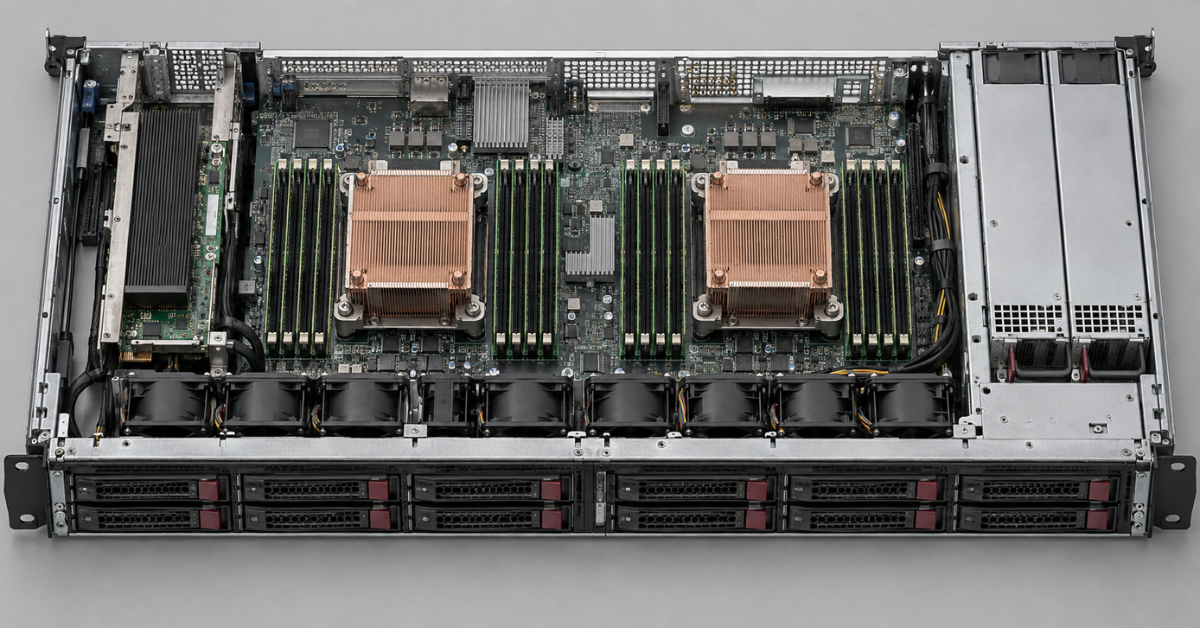
The DL365 is sometimes available with one processor, although its architecture is designed for two. Each CPU controls its own memory channels and some PCIe lanes. If the second socket is empty, the associated DIMM slots, riser or devices will not operate.
In a dual-socket system, memory forms two NUMA nodes. A processor accesses its local memory faster than the memory attached to the other CPU. A hypervisor usually accounts for this topology, but a large virtual machine, database or compute job can cross a NUMA boundary and incur additional latency.
Several principles help maintain consistent performance:
- distribute memory symmetrically between the processors and channels;
- align large virtual machines with the size of a NUMA node;
- place network cards, NVMe drives and accelerators according to their CPU affinity;
- configure power-saving modes and the performance profile for the actual workload.
Doubling the number of cores is not always economically beneficial. Windows Server, SQL Server, hypervisors, databases and application software may be licensed by physical core, socket or allocated resources. A server with fewer, faster cores can cost less over its entire service life than a maximum-core configuration.
If a second processor is unnecessary now and is unlikely to be required in the foreseeable future, compare the DL365 with the single-socket DL325. One EPYC processor can provide many cores, all memory channels on its socket and numerous PCIe lanes without the cost and power consumption of a second CPU.
Drives, RAID and dedicated boot storage
In server descriptions, the number of bays often appears to be the main parameter, but the data path from the drive to the processor matters more when building a system. The same external SFF form factor may conceal SATA, SAS or NVMe connectivity. Each option requires a compatible backplane, cables and controller.
The main storage layouts serve different purposes:
- hardware RAID is suitable for SAS and SATA when conventional RAID levels, cache and centralised array management are required;
- a tri-mode controller works with SAS, SATA and NVMe, but only in supported combinations of processor, firmware and drive cage;
- an HBA exposes drives to the operating system or software-defined storage with minimal intervention;
- a direct NVMe connection provides a short data path and low latency, but redundancy is then often implemented by the software layer.
A dedicated module with two M.2 NVMe drives can be used for booting. It frees the front bays for application data and allows the system volume to be mirrored. However, the module, its mounting hardware and cables must be included in the configuration; the presence of a connector alone is not sufficient.
Virtualisation requires low latency and predictable performance under mixed workloads. A database requires write endurance, cache protection and a correct write-acknowledgement policy. Software-defined storage requires direct drive access and HBA compatibility. Local RAID protects against some hardware failures but does not replace backups, replication or clustered high availability.
Networking, accelerators, power and cooling
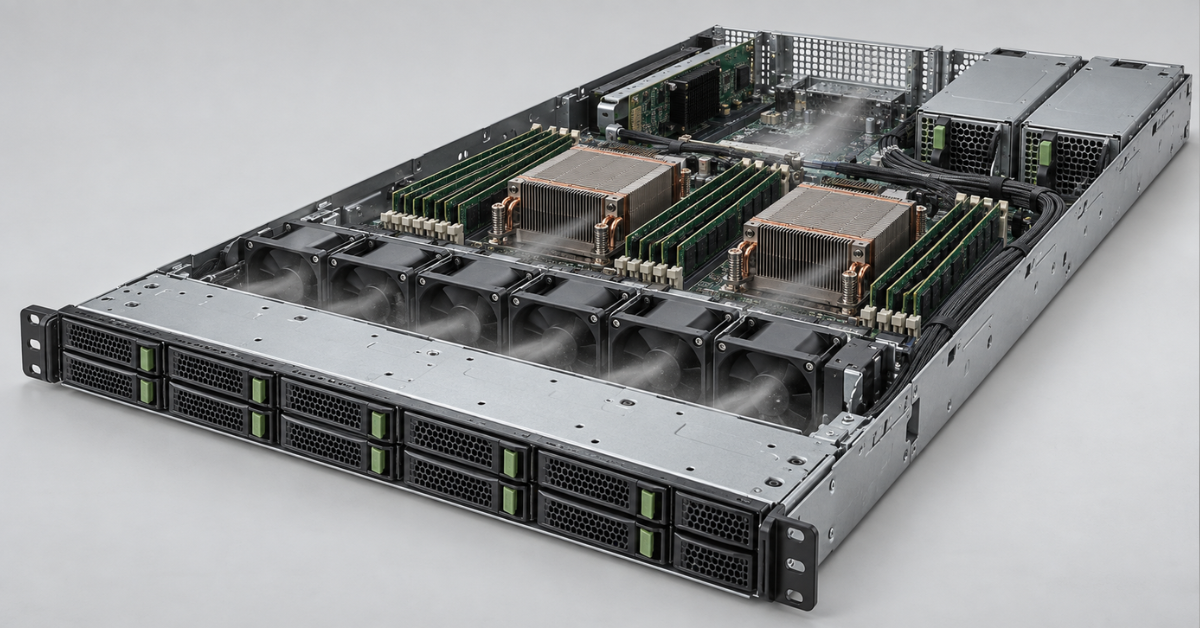
The OCP 3.0 network connector is useful for more than convenient adapter replacement. It leaves standard PCIe slots available for an HBA, controller, additional network card or accelerator. On a virtualisation node, it is generally sensible to separate management traffic, storage and virtual-machine networks logically or physically.
Configurations with NVMe drives, 100 Gbit/s adapters, high-end EPYC processors and GPUs produce more heat. For Gen10 Plus, the official matrix requires high-performance fans with certain CPU thermal design powers and high-speed devices. Gen11 has even stricter requirements, while direct liquid cooling is available for the densest configurations.
The power supply should be selected after calculating the requirements of the complete system. Its rating must account for two processors, memory, drives, cards and peak load. In a 1+1 arrangement, each power supply must be able to support the server by itself after the other unit fails; two 1600 W supplies do not mean that 3200 W is always available to the system in a redundant configuration.
A 1U chassis requires rapid airflow and is therefore generally louder than a 2U system. The DL365 is designed for a rack with controlled inlet-air temperature, sufficient power and organised hot and cold aisles. This model may not be the best choice for an ordinary office without a dedicated server room.
Choosing the Right Equipment
Our specialists will contact you and answer all your questions
Which workloads suit the DL365?
The server's strength is compute and memory capacity per rack unit. Typical use cases include:
- dense virtualisation and private-cloud clusters;
- virtual desktop infrastructure (VDI);
- Kubernetes nodes and other container platforms;
- databases, analytics and caching of large datasets;
- engineering calculations, design automation and high-performance computing;
- application servers that require many cores and fast networking;
- compute nodes using external storage systems or distributed storage.
The processor should be selected according to the workload profile. Many-core models are beneficial for large numbers of virtual machines and parallel tasks. Higher-frequency CPUs with fewer cores are better suited to applications with limited parallelism and may reduce licensing costs.
The DL365 is less suitable when a project requires dozens of 3.5-inch drives, numerous expansion cards, more than two powerful GPUs or ample room for future reconfiguration. In such cases, a 2U chassis is often more economical despite occupying twice as much rack space.
DL365 or another HPE model?
The closest alternatives differ in more than their processors; their layouts also vary.
DL325
A single-socket 1U server based on AMD EPYC. It is suitable when one modern CPU provides enough cores, memory and PCIe lanes. It reduces power consumption, architectural complexity and potential licensing costs. The model's development is covered in “HPE ProLiant DL325: Generation Overview”.
DL345
A single-socket 2U server based on AMD EPYC. The chassis provides more room for drives, cards and accelerators, making the DL345 more convenient for mixed workloads and local storage. For more information, see “HPE ProLiant DL345: Generation Overview”.
DL360
A dual-socket 1U Intel Xeon server and the direct equivalent in density and form factor. The choice between it and the DL365 depends on application requirements, certification, core count, memory, licensing costs and, of course, fleet compatibility and organisational preferences. The versions are compared in “HPE ProLiant DL360 Gen9–Gen12: Comparison and Selection”.
DL380
Two Intel Xeon processors and a 2U chassis provide more drive bays and expansion options. The DL380 is more convenient as a universal host or a server with extensive local storage. Its generations are covered in “HPE ProLiant DL380: Comparing Gen9–Gen12”.
DL385
HPE ProLiant DL385 retains two AMD sockets but places them in a 2U chassis. It is preferable when additional drives, PCIe cards or more generous cooling are required. The DL365 offers greater density, while the DL385 provides more configuration flexibility.
Does the HPE ProLiant DL365 Gen12 exist?
HPE has not introduced a DL365 Gen12 as of the article update date. In the current AMD range, the DL325 Gen12 serves as the dense single-socket 1U model, while the DL345 Gen12 is the more expandable 2U option. The dual-socket DL365 continues to be sold as Gen11 with support for EPYC 9004 and 9005 processors.
This distinction between processor generation and server generation is important. EPYC 9005 is the fifth generation of AMD EPYC processors, but installing it in a DL365 does not turn the server into Gen12. The chassis remains a DL365 Gen11, and its management platform remains iLO 6.
If an infrastructure standard specifically requires HPE Gen12 and iLO 7, select a model from the current HPE ProLiant Gen12 range rather than looking for a DL365 Gen12 configuration that does not exist.
Which DL365 generation should you choose?
| Project requirements | Suitable option | Why | What to consider |
|---|---|---|---|
| Expansion of an existing DDR4 fleet | Gen10 Plus | Common components and processes, PCIe 4.0 and an accessible price | Platform age, support period and EPYC 7002 restrictions |
| New project without extreme core density | Gen11 with EPYC 9004 | DDR5, PCIe 5.0, 12 memory channels per CPU and EDSFF | Memory cost, power and cooling |
| Maximum performance per 1U | Gen11 with EPYC 9005 | Up to 160 supported cores per CPU and DDR5 at up to 6400 MT/s | Per-core licensing and firmware compatibility |
| One processor is sufficient | DL325 or DL345 | Lower cost and power consumption, with no unused second socket | DL325 is denser; DL345 offers better expansion |
| Large drive capacity and expansion cards are required | DL385 | Two EPYC processors in a 2U chassis | Occupies more rack space |
Fully configured servers, rather than bare chassis, must be compared. The calculation should include processors, memory, drive cages, controllers, networking, risers, the boot module, power supplies, the iLO licence, rails and software licences. The difference in platform price may be small compared with licensing hundreds of cores or purchasing a large amount of memory.
For a three-to-five-year horizon, Gen11 usually provides more headroom. Gen10 Plus is justified when EPYC 7003 and PCIe 4.0 are sufficient for the workload and the savings on the server and DDR4 are real. Moving to Gen11 solely for the higher generation number makes little sense: an upgrade should remove a measurable CPU, memory, network or storage bottleneck.
New or refurbished DL365
A new Gen11 is a logical choice for a project with a long service life, requirements for EPYC 9005 and DDR5, or a need to procure identical nodes in batches. A refurbished Gen10 Plus can provide a strong price-to-performance ratio, particularly when expanding an existing cluster.
A server's condition cannot be assessed from its processors and RAM capacity alone. Suitability also depends on the system-board revision, firmware, riser completeness, drive-cage type, cables, carriers, blanks and the iLO Advanced licence. A seemingly inexpensive missing component can sometimes prevent installation of the required controller or drives.
Operating-system, hypervisor, driver and firmware compatibility should be checked for the exact configuration in the HPE Support Center. This is particularly important when installing EPYC 9005 in Gen11, as current system firmware, iLO and a support pack may be required.
Warranty terms and the availability of identical replacement components are important for refurbished equipment. A cluster benefits more from several standardised nodes with identical networking, controllers and firmware than from a collection of nominally more powerful but inconsistent configurations.
Conclusion
The HPE ProLiant DL365 should be selected as a dense dual-socket AMD server rather than a universal platform with the maximum possible number of drives and cards. Gen10 Plus remains a strong DDR4 option for cost-effective upgrades and existing fleets. Gen11 is preferable for new projects thanks to EPYC 9004/9005, DDR5, PCIe 5.0, EDSFF and iLO 6.
If one CPU is sufficient, consider the DL325 or DL345; if local storage and expansion are priorities, consider the DL385. There is no DL365 Gen12 as of the article update date, so the current choice within this model is between the mature Gen10 Plus and the more modern Gen11.
Choosing the Right Equipment
Our specialists will contact you and answer all your questions