
Small businesses don’t need the biggest or most expensive hardware — they need the right server for their workloads and budget. File sharing, accounting and ERP, CRM, internal web apps and a few virtual machines: this is where DELL PowerEdge servers shine.
If you need a quick answer, the most practical choices for companies up to ~50–100 employees are:
- DELL PowerEdge T150 — your first office server for files, accounting and light applications.
- DELL PowerEdge T350 — a more expandable tower when data volumes and user count grow.
- DELL PowerEdge R250 — a compact 1U rack server for a small server room or colocation.
- DELL PowerEdge R450 — a 1U workhorse for virtualization and business-critical services.
- DELL PowerEdge R550 — a 2U system with plenty of drive bays for storage-heavy workloads.
In the rest of this guide we’ll compare these servers side by side, look at real-world use cases and help you pick the right configuration for your business.
Why small businesses outgrow PCs and NAS boxes
Many companies start with a powerful desktop PC or a simple NAS as a “server”. It works for a while — until you add more users, more files and more applications. Then the typical problems appear:
- unpredictable performance and slowdowns during peak hours;
- no proper RAID and limited options for redundancy;
- no enterprise-grade remote management;
- difficult to scale without downtime or data migration headaches.
DELL PowerEdge servers solve these issues with ECC memory support, hardware RAID controllers, the iDRAC9 remote management controller and flexible storage options. At the same time, they can be tailored to your environment: a quiet tower in the office or a dense 1U/2U rack server in a cabinet or data centre.
Comparison: best DELL servers for small business
| Model | CPU | RAM | Storage | Price level | Typical use cases |
|---|---|---|---|---|---|
| DELL PowerEdge T150 | Intel Xeon E-2300 (up to 8 cores) | Up to 128 GB DDR4 UDIMM | Up to 4 × 3.5" SAS/SATA | Entry-level | First office server for file sharing, accounting and light apps. See configs on DELL PowerEdge T150. |
| DELL PowerEdge T350 | Intel Xeon E-2300 (up to 8 cores) | Up to 128 GB DDR4 UDIMM | Up to 8 × 3.5" SAS/SATA | Affordable mid-range | Growing companies with more data and users. Details on DELL PowerEdge T350. |
| DELL PowerEdge R250 | Intel Xeon E-2300 (up to 8 cores) | Up to 128 GB DDR4 UDIMM | Up to 4 × 3.5" SAS/SATA | Budget 1U rack | Compact 1U for colocation, web apps and basic virtualization. See DELL PowerEdge R250. |
| DELL PowerEdge R450 | Up to 2 × Intel Xeon Silver, up to 24 cores/CPU | Up to 1 TB DDR4 RDIMM | Up to 8 × 2.5" or 4 × 3.5" | Mid-range | Virtualization hosts, databases and business-critical services. More info on DELL PowerEdge R450. |
| DELL PowerEdge R550 | Up to 2 × Intel Xeon Silver, up to 24 cores/CPU | Up to 1 TB DDR4 RDIMM | Up to 16 × 2.5" or 8 × 3.5" | Upper mid-range | Storage-heavy workloads, backups and mixed virtualization. See DELL PowerEdge R550. |
DELL PowerEdge T150: ideal first server for a small office

The DELL PowerEdge T150 is a natural starting point when you outgrow ad-hoc solutions and want a real on-premises server. It consolidates shared folders, accounting/ERP, a small database or an internal web app in a single, manageable system.
Key specs of DELL PowerEdge T150
- CPU: Intel Xeon E-2300 family (up to 8 cores), or Intel Pentium in entry configs.
- Memory: up to 128 GB DDR4 UDIMM with ECC protection.
- Drives: up to 4 × 3.5" SAS/SATA HDD/SSD.
- RAID: PERC hardware RAID for RAID 1/5/10 and basic redundancy.
- Form factor: compact 4U tower that can live in an office corner.
- Management: iDRAC9 for remote access, power control and monitoring.
Who should choose DELL PowerEdge T150
- Small offices with up to ~20–30 employees and a single main server.
- Accounting, legal, service or small manufacturing businesses.
- Workloads: file server, accounting/ERP, small database, intranet, light virtualization.
If you are buying your very first server and want something reliable, easy to manage and affordable, T150 is a very safe and future-proof starting point.
DELL PowerEdge T350: more disks and room to grow

The DELL PowerEdge T350 keeps the familiar Xeon E-2300 platform but adds significantly more storage capacity and power headroom. It’s the right choice when you expect your data footprint and the number of services to grow steadily.
Key features of DELL PowerEdge T350
- CPU: Intel Xeon E-2300, up to 8 cores.
- RAM: up to 128 GB DDR4 UDIMM with ECC — enough for several apps and a small virtualization cluster.
- Storage: up to 8 × 3.5" SAS/SATA HDD/SSD, ideal for gradual capacity expansion.
- Power: PSUs up to 600 W, with redundancy options.
- Form factor: larger 4.5U tower with more internal space and airflow.
When DELL PowerEdge T350 makes sense
- You know that file storage, backups and databases will grow for the next 3–5 years.
- You run multiple systems side by side (ERP, CRM, reporting, internal tools).
- You prefer to keep the server in the office instead of a rack cabinet.
Compared to T150, T350 gives you more breathing room in terms of drive bays and power budget, which often means lower total cost of ownership in the long run.
DELL PowerEdge R250: compact 1U server for racks and colocation

The DELL PowerEdge R250 is the logical step when you move from office hardware to a proper rack in a server room or hosting provider. It’s a 1U rack server that combines the Xeon E-2300 platform with a form factor optimised for data centre environments.
Key specs of DELL PowerEdge R250
- CPU: one Intel Xeon E-2300 (up to 8 cores) or entry-level Intel Pentium.
- RAM: up to 128 GB DDR4 UDIMM with ECC.
- Drives: up to 4 × 3.5" SAS/SATA HDD/SSD.
- RAID: PERC H345, H755, HBA355i or S150, depending on configuration.
- Network: 2 × 1 GbE LOM with optional additional NICs.
- Management: iDRAC9, REST API, integration with System Center, vCenter, Ansible and more.
Typical workloads for DELL PowerEdge R250
- Hosting your own services in a colocation rack.
- Web applications, portals, small SaaS products.
- Light virtualization (a handful of VMs), dev/test environments.
- Secondary or backup server next to a more powerful primary node.
If space in the rack is expensive or limited, R250 gives you a neat 1U footprint while keeping the platform simple and cost-effective.
DELL PowerEdge R450: 1U virtualization and application workhorse

The DELL PowerEdge R450 moves you into the dual-socket Intel Xeon Scalable world. With up to two CPUs and up to 1 TB of RAM it can host dozens of virtual machines and several critical applications on a single 1U chassis.
Key specs of DELL PowerEdge R450
- CPUs: up to 2 × 3rd Gen Intel Xeon Scalable (up to 24 cores each).
- RAM: up to 16 DDR4 RDIMM slots, up to 1 TB total.
- Storage: up to 8 × 2.5" or 4 × 3.5" SAS/SATA HDD/SSD.
- RAID: rich PERC portfolio (H345, H355, H745, H755 and others).
- Network: 2 × 1 GbE LOM plus an OCP 3.0 slot for faster NICs.
- Management: iDRAC9, OpenManage ecosystem, automation and integration options.
When to consider DELL PowerEdge R450
- You plan to run a hypervisor (VMware, Hyper-V, Proxmox, KVM) with many VMs.
- You host business-critical SQL databases, CRM/ERP or line-of-business apps.
- You want to build a small HA cluster out of two or more identical servers.
For many small companies, one or two R450 servers become the core of their private cloud: dense, powerful and still reasonably priced compared to high-end enterprise gear.
DELL PowerEdge R550: 2U capacity for storage-heavy and mixed workloads
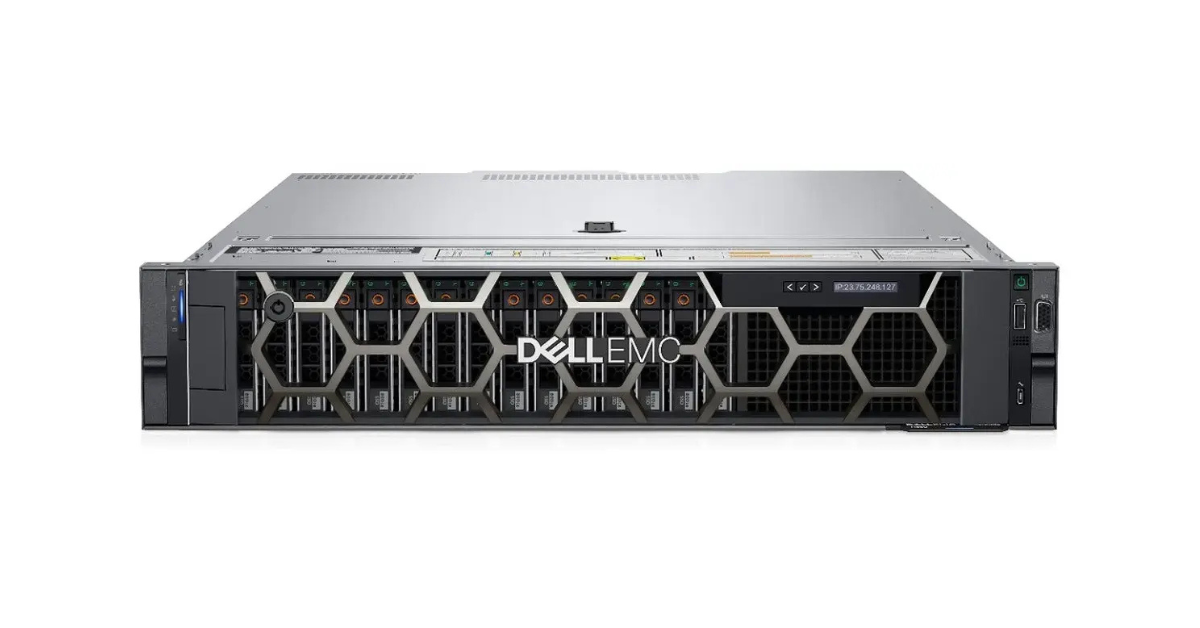
When storage becomes the main bottleneck — archives, media files, backups — it’s time to look at the DELL PowerEdge R550. It offers a 2U form factor with significantly more drive bays while keeping the same Xeon Scalable platform.
Key specs of DELL PowerEdge R550
- CPUs: up to 2 × 3rd Gen Intel Xeon Scalable (up to 24 cores).
- Memory: up to 1 TB DDR4 RDIMM.
- Storage: up to 16 × 2.5" or 8 × 3.5" SAS/SATA HDD/SSD.
- RAID: full PERC controller range, identical to R450.
- Form factor: 2U rack, easier cooling and more space for drives.
Best use cases for DELL PowerEdge R550
- File server and on-prem backup repository.
- Virtualization host plus local storage for VMs.
- Combined role: application server + database + storage in one box.
- Part of a pair: R450 as a CPU-heavy node, R550 as a storage-oriented node.
If your main worry is “where to put all this data” rather than CPU horsepower, R550 is usually a better long-term investment than multiple smaller boxes.
How to choose the right DELL server for your small business
To avoid overspending and still leave room for growth, focus on a few simple questions.
1. Tower vs rack
- Tower (T150, T350) — no rack cabinet yet, the server will live in the office, noise and simplicity matter.
- Rack (R250, R450, R550) — you already have a rack, a small server room or plan to colocate in a data centre.
2. Workload profile
- Files, light apps, accounting/ERP — DELL PowerEdge T150 or R250 are usually enough.
- Growing data footprint and several apps — consider T350 or R550.
- Virtualization, CRM/ERP, databases — start with R450 or a pair of R450/R550.
3. Growth horizon
Servers are typically bought for at least 3–5 years. Think about:
- expected headcount growth and the number of new systems;
- planned projects that may stress CPU, RAM or storage;
- whether you’ll need a second server for redundancy or off-site backup.
4. Availability and resilience
- At minimum: proper RAID and decent PSUs.
- Better: redundant PSUs (R450/R550) and role separation between servers.
- Mandatory: iDRAC9 configured with alerts, monitoring and secure remote access.
Conclusion: a simple upgrade path with DELL PowerEdge
DELL PowerEdge servers give small businesses a clear, predictable upgrade path: start with a single tower or 1U box, then add more powerful rack servers as you grow — without changing your tools, management approach or vendor ecosystem.
As a starting point, you can look at:
- DELL PowerEdge T150 — first office server.
- DELL PowerEdge T350 — more disks and expansion room.
- DELL PowerEdge R250 — compact 1U for racks and colocation.
- DELL PowerEdge R450 — main virtualization and application node.
- DELL PowerEdge R550 — storage-oriented 2U server for mixed workloads.
Explore available configurations on the product pages for DELL PowerEdge T150, DELL PowerEdge T350, DELL PowerEdge R250, DELL PowerEdge R450 and DELL PowerEdge R550 and align them with your current and future workloads.