For a modern small business, a server is no longer “just a PC in the corner”. You need a reliable platform for file sharing, accounting, CRM, small databases, backups and light virtualisation. HPE ProLiant servers are designed exactly for that balance of reliability, scalability and reasonable cost.
If we get straight to the point, the best HPE servers for small businesses in 2025 are HPE ProLiant MicroServer Gen10 Plus, HPE ProLiant ML30 Gen11, HPE ProLiant ML110 Gen11, compact rack server HPE ProLiant DL20 Gen11 and the more powerful yet still SMB-friendly HPE ProLiant ML350 Gen11. Together they cover scenarios from a 10-person office to a growing company with dozens of users and multiple critical services.
In this guide, we will compare these models, explain which workloads they suit best, provide a quick comparison table and give practical tips on how to choose the right configuration for your use case: file server, light virtualisation, branch office, accounting workloads and more.
What small businesses really need from a server
Even with 10–30 employees it quickly becomes clear that a single powerful laptop or a random desktop is not enough. Typical requirements appear:
- centralised file storage with access control and auditability;
- fast and stable work of accounting or ERP systems with several concurrent users;
- internal services like CRM, intranet, ticketing or simple web applications;
- reliable backups of workstations and critical databases;
- light virtualisation — several virtual machines for separate services and test environments;
- secure remote access for employees working from home or branch offices.
HPE ProLiant Gen10, Gen10 Plus and Gen11 servers meet these needs with ECC memory, robust storage controllers, remote management via iLO and flexible drive configurations. At the same time many models remain compact and power-efficient enough to run in a small office without a dedicated server room.
Comparison of the best HPE servers for small business
The table below summarises the key specs of five HPE servers that are most relevant for SMB scenarios. It helps you quickly see which model fits your performance, scalability and budget requirements.
| Model | CPU | RAM | Storage | Price level | Typical use case |
|---|---|---|---|---|---|
| HPE ProLiant MicroServer Gen10 Plus | Intel Xeon E-2300, up to 4 cores | Up to 64 GB DDR4 ECC | Up to 4 LFF SATA HDD/SSD | Entry-level | Very small office, file server, backup target |
| HPE ProLiant ML30 Gen11 | Intel Xeon E-2400, 4–8 cores | Up to 128 GB DDR5 ECC | Up to 4 LFF or 8 SFF SAS/SATA HDD/SSD | Lower mid-range | Accounting, databases, light virtualisation |
| HPE ProLiant ML110 Gen11 | 4th/5th Gen Intel Xeon Scalable, up to 32 cores | Up to 1.5 TB DDR5 | Up to 8 LFF or 16 SFF SAS/SATA HDD/SSD | Mid to upper mid-range | Service consolidation, growth, virtualisation |
| HPE ProLiant DL20 Gen11 | Intel Xeon E-2400, 4–8 cores | Up to 128 GB DDR5 ECC | 2 LFF or up to 4+2 SFF | Affordable | Compact rack server for branches and racks |
| HPE ProLiant ML350 Gen11 | 4th/5th Gen Intel Xeon Scalable, up to 64 cores | Up to 8 TB DDR5 | Up to 12 LFF or 24 SFF SAS/SATA/NVMe | Upper mid-range | Heavier virtualisation and fast-growing SMBs |
Overview of HPE small business server models
HPE ProLiant MicroServer Gen10 Plus: the perfect first server

HPE ProLiant MicroServer Gen10 Plus is a compact ultra-micro tower that easily fits on a desk or shelf and looks more like a small NAS than a traditional server. Inside, however, you get a true server-grade platform with ECC memory and remote management capabilities.
- CPU: Intel Xeon E-2300 or Intel Pentium Gold (2–4 cores, up to 4.1 GHz turbo, depending on model).
- Memory: up to 64 GB HPE DDR4 Standard Memory with ECC, 2 DIMM slots.
- Drives: up to 4 LFF SATA HDD or SSD — perfect for a simple file server and backups.
- Network: embedded 4-port 1 GbE Intel i350-AM4 adapter.
- Form factor: ultra micro tower, around 4.2 kg, very compact footprint.
- RAID: Intel VROC SATA software RAID for SATA drives.
Best for: very small businesses, home offices and teams of 5–15 people that need their first “real” server for shared folders, accounting, light database workloads and local backups without the complexity of a full-size rack system.
HPE ProLiant ML30 Gen11: versatile office server for accounting and files

HPE ProLiant ML30 Gen11 is the natural next step once a simple microserver becomes limiting. It is a full 4U tower server with more CPU, memory and drive options, ideal for a growing small business running databases, accounting and several services at the same time.
- CPU: Intel Xeon E-2400 (4–8 cores, higher clocks and more cache than E-2300 family).
- Memory: up to 128 GB HPE DDR5 Standard Memory with ECC, 4 DIMM slots.
- Drives: up to 4 LFF SATA/SAS or up to 8 SFF SAS/SATA HDD/SSD, depending on chassis.
- Networking: embedded 4-port 1 GbE adapter.
- Management: HPE iLO with Intelligent Provisioning, optional iLO Advanced licence.
- Form factor: 4U tower, can also be rack-mounted using an optional kit.
Best for: companies with 10–40 employees running accounting systems, line-of-business applications, small SQL databases and light virtualisation. ML30 Gen11 offers a comfortable balance of price, performance and expansion options.
HPE ProLiant ML110 Gen11: room to grow and consolidate services
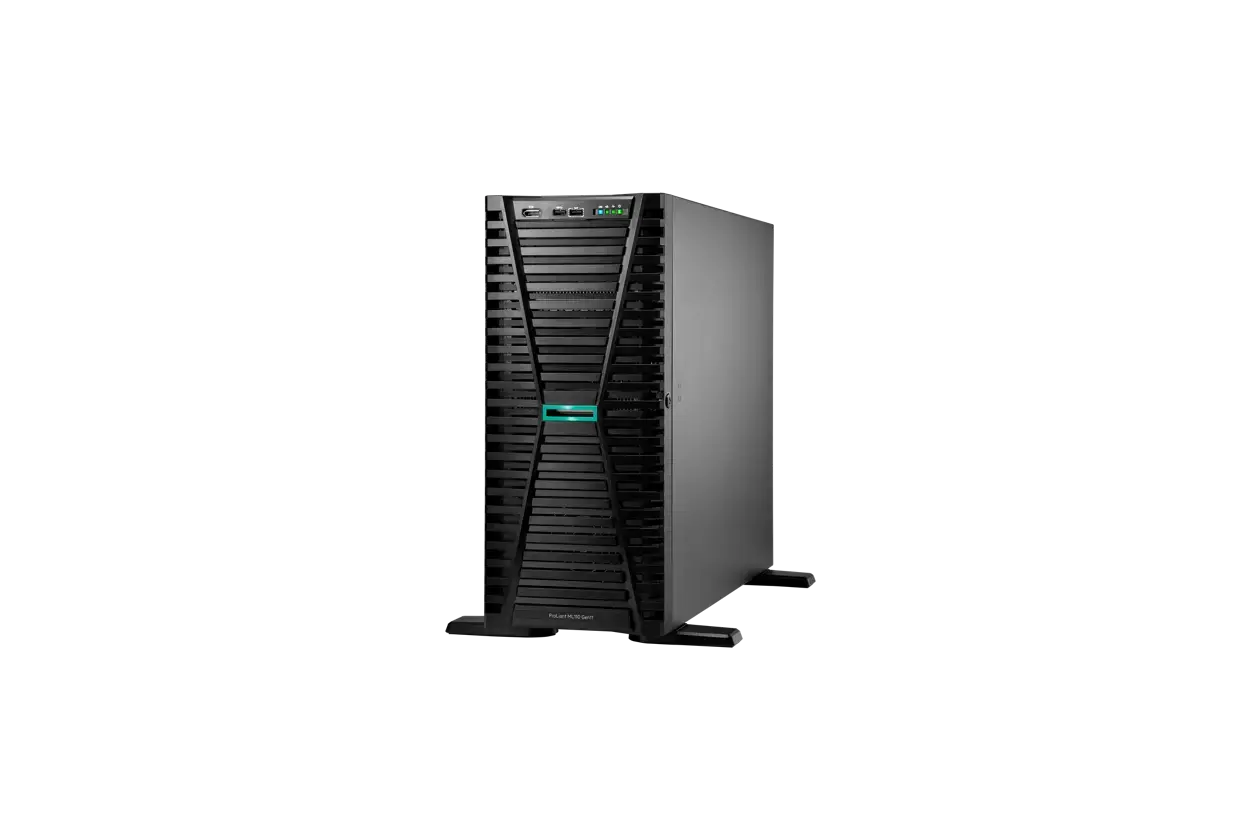
HPE ProLiant ML110 Gen11 is a single-socket tower based on 4th and 5th Gen Intel Xeon Scalable CPUs. It delivers a big step up in compute power and memory capacity compared to Xeon E platforms, while still keeping the simplicity of a single-socket design.
- CPU: 1× Intel Xeon Scalable Gen4/Gen5 (8–32 cores, depending on the SKU).
- Memory: up to 1.5 TB HPE DDR5 Smart Memory, 16 DIMM slots.
- Drives: 4–8 LFF or up to 16 SFF SAS/SATA HDD/SSD.
- Reliability: Advanced ECC, Online Spare and Lockstep modes for better memory protection.
- Management: HPE iLO Standard/Advanced, HPE OneView integration.
- Form factor: 4.5U tower with rack conversion options.
Best for: small businesses that have outgrown entry-level towers and want to consolidate multiple services onto a single, more powerful host: several VMs, heavier databases, application servers and remote access services with headroom for future growth.
HPE ProLiant DL20 Gen11: compact 1U rack server for branches and racks

HPE ProLiant DL20 Gen11 is a dense 1U rack server ideal for small racks and colocation environments. It keeps the familiar Xeon E-2400 platform, but in a format optimised for data centres and branch offices with existing racks.
- CPU: Intel Xeon E-2400 (4–8 cores, up to 5.8 GHz turbo depending on SKU).
- Memory: up to 128 GB DDR5 ECC, 4 DIMM slots.
- Drives: 2 LFF or 4+2 SFF SAS/SATA HDD/SSD.
- Network: embedded 4-port 1 GbE network adapter.
- Management: HPE iLO6, HPE OneView Standard/Advanced.
- Form factor: 1U rack, low power and cooling requirements.
Best for: branch offices, small racks and hosting providers where space is limited. Typical roles include domain controller, file and print server, local application server, small virtualisation host or VPN gateway for a remote site.
HPE ProLiant ML350 Gen11: a platform for growing and virtualised environments

HPE ProLiant ML350 Gen11 is a flagship tower server that can smoothly evolve from a single-server SMB setup to a mini data centre platform. It supports up to two 4th/5th Gen Intel Xeon Scalable CPUs, huge memory capacity and flexible storage options, making it a strong choice for heavier virtualisation.
- CPU: up to 2× Intel Xeon Scalable (8–64 cores per processor).
- Memory: up to 8 TB HPE DDR5 Smart Memory, 32 DIMM slots.
- Drives: 4–12 LFF or up to 24 SFF SAS/SATA/x1 NVMe HDD/SSD; EDSFF and NVMe-centric configs are available.
- Management: HPE iLO, HPE OneView and Compute Ops Management.
- Form factor: 4U tower with optional rack conversion kit.
- Security: UEFI Secure Boot, Immutable Silicon Root of Trust, TPM 2.0 and advanced memory protection modes.
Best for: fast-growing SMBs and organisations that want to run many VMs on a single host: application servers, databases, test environments, remote desktop sessions and backup infrastructure — with enough headroom to scale for several years.
How to choose the right HPE server for your small business
To make a good choice, start from your workloads and a realistic growth horizon of at least 2–3 years. Below are common scenarios and recommended models.
1. Very small office with up to 10–15 employees
Core needs: shared files, simple database or accounting system, local backups, maybe a small in-house application.
- Recommended: HPE ProLiant MicroServer Gen10 Plus or HPE ProLiant ML30 Gen11 in an entry configuration.
- Memory: 16–32 GB RAM to keep some headroom for future services.
- Storage: RAID1 for OS and data, plus a separate volume or external device for backups.
2. Classic small business with 20–50 users
Here you usually have an accounting/ERP system, SQL database, file server, perhaps an internal CRM and intranet, all serving dozens of users.
- Recommended: HPE ProLiant ML30 Gen11 or HPE ProLiant ML110 Gen11.
- Memory: 32–64 GB RAM for comfortable multi-service workloads and light virtualisation.
- Storage: RAID10 (4 disks) for databases and “hot” files, with a separate backup target.
3. Branch office or multiple locations
You run several sites, use VPNs, and place your server in a rack (on-prem or in colocation). The server hosts directory services, local apps and some VMs.
- Recommended: HPE ProLiant DL20 Gen11 as a compact rack server, or HPE ProLiant ML110 Gen11 / ML350 Gen11 where more headroom is required.
- Memory: 64 GB RAM and more if you plan to run several VMs.
- Storage: a mix of SSD for performance-critical workloads and HDD for archives and backups.
4. Fast-growing company and virtualisation-first strategy
If you expect your infrastructure to grow quickly and want to host many workloads on a small number of physical machines, planning for virtualisation from day one makes sense.
- Recommended: HPE ProLiant ML350 Gen11 with the option to add a second CPU and expand memory later.
- Memory: start with 64–128 GB RAM and plan to upgrade as you add more VMs.
- Storage: fast SSD pool for virtual machines and logs, capacity-oriented HDD pool for backups and cold data.
Key decision criteria
- Resource headroom: avoid sizing “to the last megabyte” — plan for growth in load and data volume.
- Resilience and backup: think in terms of RAID and independent backups, not one or the other.
- Remote management: iLO licences can significantly reduce on-site interventions and downtime.
- Form factor: tower servers are convenient for offices without racks; rack servers are better if you already have a dedicated server room or colocation.
Conclusion
The HPE ProLiant portfolio covers almost every small business scenario — from a first microserver in a 10-person office to a powerful virtualisation host that can serve multiple locations. For entry-level workloads, HPE ProLiant MicroServer Gen10 Plus and HPE ProLiant ML30 Gen11 are great starting points. If you expect rapid growth or want to consolidate more services, HPE ProLiant ML110 Gen11 and HPE ProLiant ML350 Gen11 give you plenty of headroom, while HPE ProLiant DL20 Gen11 is ideal where rack space is the main constraint.
Define your key workloads (file server, databases, virtualisation, backups), estimate how they will grow in the next few years and then choose a model with a sensible reserve of CPU, memory and storage. You can explore current configurations and pricing on the model pages in the ServerMall catalogue — for example, start with HPE ProLiant ML30 Gen11 and related solutions in the same family.