Choosing the right rack server for a home lab requires balancing performance, energy efficiency, and budget. In 2025, DELL servers from Gen14, Gen15, and Gen16 series represent optimal solutions for enthusiasts, IT professionals, and developers who want to create professional infrastructure at home. Rack servers in 1U and 2U form factors provide compact placement in standard 19-inch racks, offering enterprise-level capabilities in home environments.
A home lab based on rack servers opens up wide possibilities: from learning virtualization and containerization to testing distributed systems and deploying private cloud solutions. A properly selected server allows running dozens of virtual machines simultaneously, experimenting with Kubernetes, deploying your own data storage, or creating environments for development and testing. Modern DELL rack servers feature relatively low noise levels and power consumption, which is critical for home use.
In this article, we'll review five best rack servers for home labs: DELL PowerEdge R640 8SFF, HPE DL360 Gen10 8SFF, DELL PowerEdge R340 8SFF, DELL PowerEdge R540 8LFF, and HPE DL380 Gen10 24SFF. Each model has its advantages and optimal use cases.
Rack Servers Comparison Table for Home Lab
| Model | Processor | Memory (RAM) | Storage | Form Factor | Use Cases |
|---|---|---|---|---|---|
| DELL R640 8SFF | Up to 2x Intel Xeon Scalable (up to 28 cores) | Up to 3 TB DDR4 | Up to 8x 2.5" + 2 rear | 1U Rack | Virtualization, containers, dense computing |
| HPE DL360 Gen10 8SFF | Up to 2x Intel Xeon Scalable (up to 28 cores) | Up to 3 TB DDR4 | Up to 8x 2.5" + 2 rear | 1U Rack | Virtualization, containers, enterprise workloads |
| DELL R340 8SFF | Intel Xeon E-2200 (up to 8 cores) | Up to 64 GB DDR4 | Up to 8x 2.5" | 1U Rack | Light virtualization, file server, testing |
| DELL R540 8LFF | Up to 2x Intel Xeon Scalable (up to 20 cores) | Up to 1 TB DDR4 | Up to 12x 3.5" + 2 rear | 2U Rack | Data storage, media server, backups, NAS |
| HPE DL380 Gen10 24SFF | Up to 2x Intel Xeon Scalable (up to 28 cores) | Up to 3 TB DDR4 | Up to 24x 2.5" | 2U Rack | Virtualization, databases, high-density storage |
DELL PowerEdge R640 8SFF — Power in Compact Form

The DELL PowerEdge R640 8SFF server is a flagship 14th generation solution in 1U form factor, ideally suited for serious home labs. This model supports up to two second-generation Intel Xeon Scalable processors with a maximum of 28 cores per processor, providing exceptional computing power for virtualization and containerization.
Technical Specifications
- Processor: Up to 2x Intel Xeon Scalable 2nd generation, up to 28 cores per processor
- Memory: 24 DDR4 DIMM slots, up to 3 TB maximum, speeds up to 2933 MT/s
- Storage: Up to 8x 2.5" SAS/SATA (HDD/SSD) with support for up to 8 NVMe SSDs, maximum 76.8 TB
- Additional Storage: Up to 2x 2.5" SAS/SATA/NVMe rear bays, maximum 15.36 TB
- RAID Controllers: PERC H330, H730P, H740P, H750, HBA330
- Network Adapters: 4x 1GbE, 2x 10GbE + 2x 1GbE, 4x 10GbE, or 2x 25GbE
- Expansion Slots: 3x PCIe Gen3 slots (all x16)
- Power Supplies: Redundant hot-plug PSU from 495W to 1600W Platinum
- Management: iDRAC9, iDRAC Direct, Quick Sync 2
- Dimensions: 42.8mm (1.69") x 482mm (18.98") x 808.5mm (31.8")
- Weight: Up to 21.9 kg (48.3 lbs)
Who It's For
DELL PowerEdge R640 8SFF is ideal for advanced enthusiasts and IT professionals who require maximum computing density. The server excels at running multiple virtual machines (VMware ESXi, Proxmox, Hyper-V), container platforms (Docker, Kubernetes), and high-performance computing tasks. NVMe drive support makes it perfect for databases and applications requiring low-latency data access. The compact 1U form factor allows placing multiple servers in a small home rack, creating a full-fledged cluster.
HPE DL360 Gen10 8SFF — Reliability and Performance from HPE
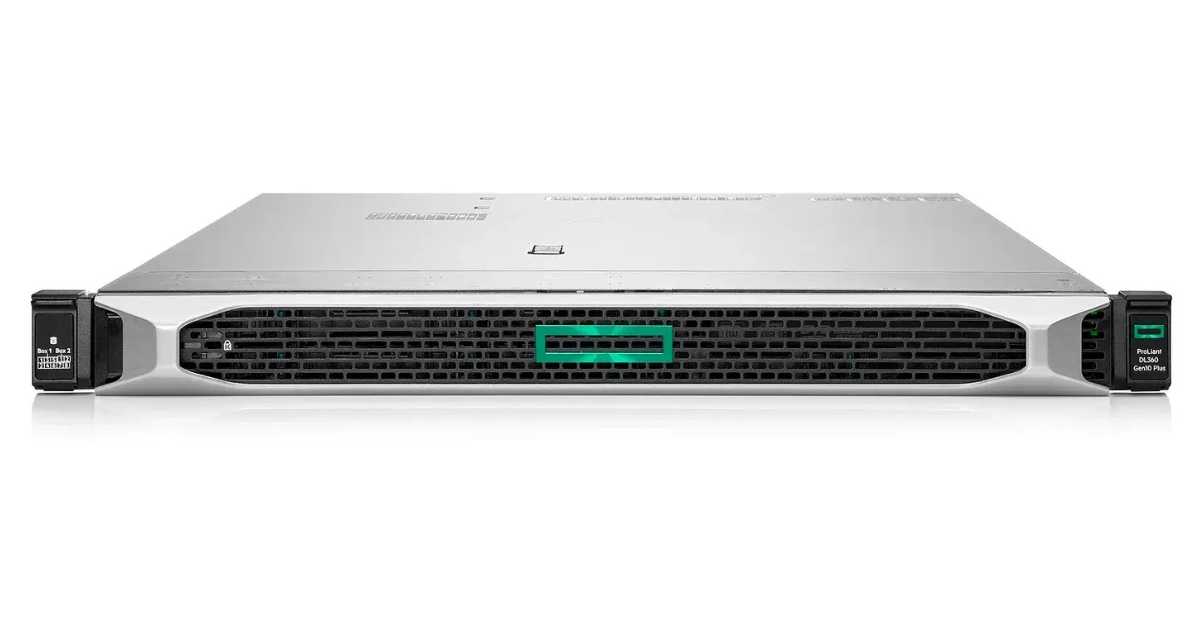
The HPE DL360 Gen10 8SFF server is a time-tested solution from Hewlett Packard Enterprise that combines reliability, performance, and configuration flexibility. This dual-processor server in 1U form factor supports first and second-generation Intel Xeon Scalable processors, offering excellent balance between computing power and energy efficiency.
Technical Specifications
- Processor: Up to 2x Intel Xeon Scalable (8100/8200, 6100/6200, 5100/5200, 4100/4200, 3100/3200 series), up to 28 cores per processor
- Memory: 24 DDR4 DIMM slots, up to 3 TB with 128 GB DDR4, speeds up to 2933 MT/s
- Intel Optane Support: Up to 6 TB with HPE 512GB 2666 Persistent Memory Kit
- NVDIMM: HPE NVDIMM-N (only available on 1st Generation Intel Xeon Scalable Processors), single rank, 16 GB
- Front Storage: 4 LFF SAS/SATA, 8 SFF SAS/SATA + 2 NVMe, 10 SFF SAS/SATA, or 10 SFF NVMe
- Additional Storage: 1 SFF or 1 Dual UFF rear drive optional
- RAID Controllers: HPE Smart Array S100i and/or HPE Essential or Performance RAID controllers
- Management: HPE iLO Standard with Intelligent Provisioning (embedded), HPE OneView Standard
- Network Adapters: Embedded 4x 1GbE Ethernet Adapter (select models) or HPE FlexibleLOM and optional PCIe stand-up cards
- Expansion Slots: 3 slots, for detailed descriptions refer to the QuickSpecs
- Cooling: Hot-plug redundant standard fans
- Security: Optional locking Bezel Kit, Intrusion Detection Kit, HPE TPM 2.0
- Dimensions: SFF Chassis: 1.69 x 17.11 x 27.83 in (4.29 x 43.46 x 70.7 cm), LFF Chassis: 1.69 x 17.11 x 29.5 in (4.29 x 43.46 x 74.98 cm)
- Weight: Minimum 28.74 lb (13.04 kg), maximum 37 lb (16.78 kg)
- Form Factor: 1U Rack
Who It's For
HPE DL360 Gen10 8SFF is an excellent choice for those who prefer the HPE ecosystem or have experience working with this manufacturer's servers. The server is ideal for virtualization (VMware ESXi, Hyper-V, Citrix Hypervisor), container platforms, and enterprise applications. Integration with HPE OneView simplifies multi-server management, which is especially useful when building cluster configurations. Intel Optane Persistent Memory support opens possibilities for working with in-memory databases and applications requiring ultra-fast data access. HPE iLO (Integrated Lights-Out) provides powerful remote management capabilities, including virtual KVM and remote media. For home labs focused on learning HPE enterprise technologies, this server provides an authentic experience with industrial solutions.
DELL PowerEdge R340 8SFF — Compact Entry-Level Server
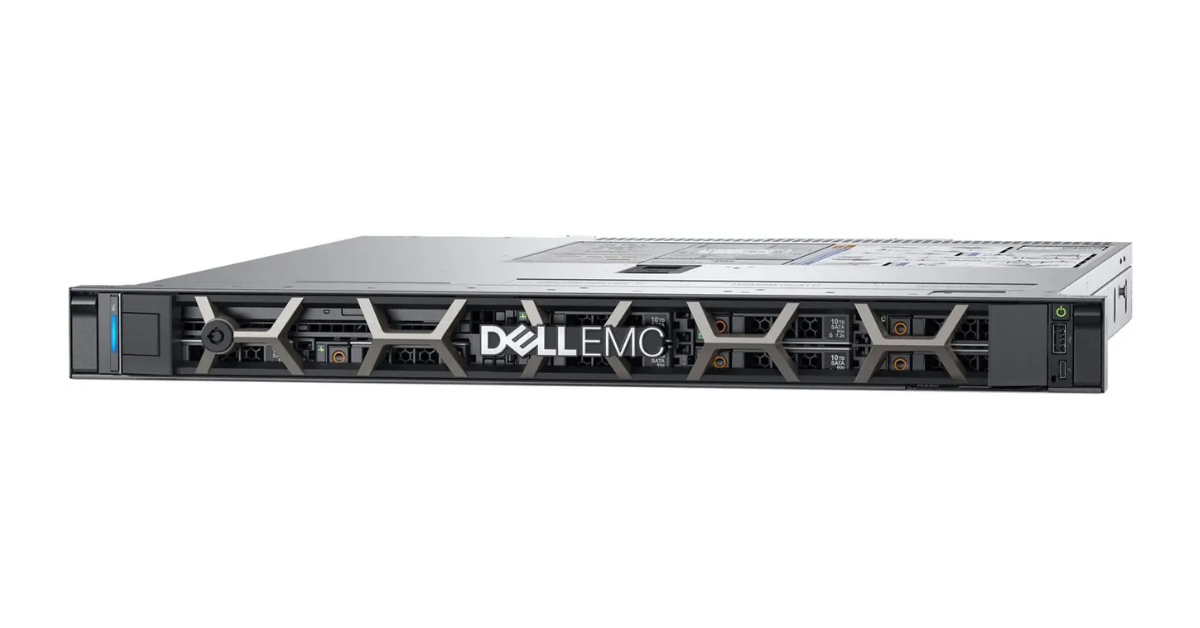
For those taking first steps in building a home lab or having a limited budget, the DELL PowerEdge R340 8SFF represents an affordable and functional solution. This single-processor 14th generation server in 1U form factor offers enterprise features at an attractive price.
Technical Specifications
- Processor: One Intel Xeon E-2200 series processor (up to 8 cores) or Intel Pentium (up to 2 cores)
- Memory: 4 DDR4 DIMM slots, UDIMM support up to 64 GB maximum, speeds up to 2666 MT/s
- Storage: Up to 8x 2.5" hot-plug SAS/SATA (HDD/SSD), maximum 128 TB
- RAID Controllers: PERC H730P, H330, HBA330 (non-RAID), Software RAID PERC S140
- Boot: Boot Optimized Storage Subsystem (BOSS) 2x M.2 240GB (RAID 1 or No RAID) or Internal Dual SD Module
- Network Adapters: 2x 1GbE LOM integrated
- Expansion Slots: 2x PCIe Gen 3.0 slots (one x8 low-profile half-length, one x16 low-profile/full-height half-length)
- Power Supplies: Single or dual 350W (Platinum) or 550W (Platinum) hot-plug redundant
- Management: iDRAC9, iDRAC Direct, OpenManage Software
- Dimensions: 42.8mm (1.68") height x 434mm (17.08") width x 595.63mm (23.45") depth
- Weight: Up to 13.6 kg (29.98 lbs)
- Form Factor: 1U Rack
Who It's For
DELL PowerEdge R340 8SFF is the ideal starter server for home lab newcomers or for specific tasks not requiring extreme computing power. It's perfect for learning virtualization basics (running 5-10 virtual machines), deploying file servers, organizing home NAS, development test environments. Xeon E-2200 processors provide sufficient performance for most home scenarios with minimal power consumption. The server can also serve as an edge node in a home cluster, performing monitoring server, proxy, or gateway roles.
DELL PowerEdge R540 8LFF — Data Storage for Home

When storage capacity is the priority, DELL PowerEdge R540 8LFF becomes the obvious choice. This dual-processor 14th generation server in 2U form factor is specifically designed for working with large data volumes, supporting 3.5" LFF (Large Form Factor) bays.
Technical Specifications
- Processor: Up to two Intel Xeon Scalable 2nd generation processors, up to 20 cores per processor
- Memory: 16 DDR4 DIMM slots, RDIMM/LRDIMM support, speeds up to 2666 MT/s, maximum 1 TB
- Front Storage: Up to 12x 3.5" SAS/SATA HDD, maximum 192 TB
- Rear Storage: Up to 2x 3.5" SAS/SATA HDD, maximum 32 TB
- RAID Controllers: Internal: PERC H750, H350, H740P, H730P, H330; External: HBA355e, H840, 12Gb/s External SAS HBA
- Software RAID: S140
- HBA Adapters: HBA350i, HBA330
- Boot: BOSS (Boot Optimized Storage Subsystem) HWRAID 2x M.2 SSDs 240GB or 480GB, Internal Dual SD Module
- Optical Drive: Optional DVD-ROM, DVD+RW
- Network Adapters: 2x 1GbE LOM + optionally 2x 1GbE, 2x 10GbE SFP+, or 2x 10GbE BaseT
- Expansion Slots: With optional riser: Non-rear storage or Rear storage configurations
- Power Supplies: Platinum 495W, 750W, 750W 240V HVDC, 1100W, 1100W 380V HVDC, hot plug with full redundancy
- Cooling: Up to six fans
- Management: iDRAC9, iDRAC Direct, iDRAC RESTful API with Redfish, Quick Sync 2
- Dimensions: 86.8mm (3.41") x 434mm (17.08") x 703.76mm (27.71")
- Weight: Up to 29.68 kg (65.43 lbs)
- Form Factor: 2U Rack
Who It's For
DELL PowerEdge R540 8LFF is the optimal choice for home labs where data storage volume is critical. Support for up to 12 drives in 3.5" format (expandable with rear bays to 14 drives) allows creating massive storage of several hundred terabytes. The server is ideal for media servers (Plex, Jellyfin), backup systems (Veeam, BackupPC), personal cloud storage (Nextcloud, ownCloud), distributed file systems. Two Intel Xeon Scalable processors provide sufficient computing power for simultaneously performing storage and virtualization tasks, making R540 a universal solution for complex home infrastructures.
HPE DL380 Gen10 24SFF — Maximum Storage Density from HPE
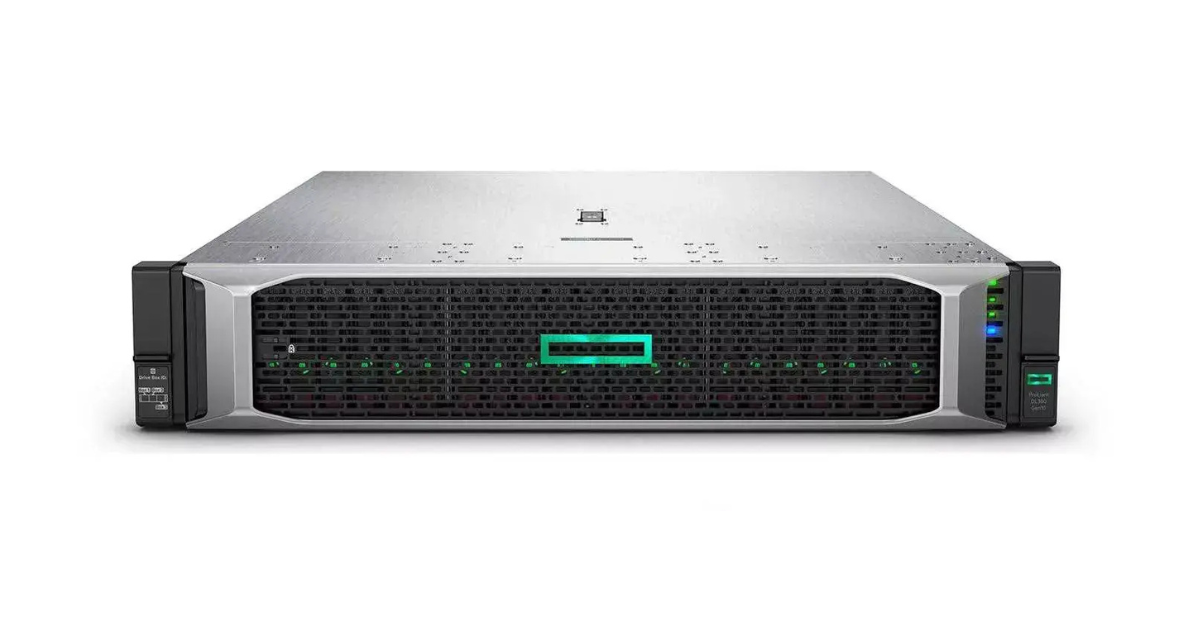
The HPE DL380 Gen10 24SFF server is HPE's flagship solution in 2U form factor, providing impressive storage density combined with high computing performance. Support for up to 24 drives in 2.5" format makes this server ideal for scenarios requiring large numbers of drives while maintaining compact form factor.
Technical Specifications
- Processor: Up to 2x Intel Xeon Scalable (8100/8200, 6100/6200, 5100/5200, 4100/4200, 3100/3200 series), up to 28 cores per processor
- Memory: 24 DDR4 DIMM slots, up to 3 TB with 128 GB DDR4, speeds up to 2933 MT/s, up to 6 TB with HPE 512GB 2666 Persistent Memory Kit
- NVDIMM: HPE NVDIMM-N (only available on 1st Generation Intel Xeon Scalable Processors), single rank, 16 GB
- Front Storage: 8 or 12 LFF SAS/SATA/SSD, 8, 10, 16, 18, or 24 SFF SAS/SATA/SSD
- Boot: 2x M.2 SATA SSD standard on primary riser
- Additional Storage: 6 SFF rear drive optional or 3 LFF rear drive optional, 2 SFF or 2 Dual UFF rear drive optional, 20 SFF NVMe optional
- RAID Controllers: HPE Smart Array S100i and/or HPE Essential or Performance RAID controllers
- Management: HPE iLO Standard with Intelligent Provisioning (embedded), HPE OneView Standard (requires download); optional HPE iLO Advanced and HPE OneView Advanced (require licenses)
- Cooling: Hot-plug redundant fans, standard
- Network Adapters: HPE 1 Gb 331i Ethernet adapter 4-ports per controller and/or optional HPE FlexibleLOM
- Expansion Slots: 8 slots, for detailed descriptions reference the QuickSpecs
- Power Supplies: Dual hot-plug redundant 1+1 HPE Flexible Slot Power Supplies (2.6")
- Security: Optional locking Bezel Kit, Intrusion Detection Kit, HPE TPM 2.0
- Dimensions: 17.54 x 28.75 x 3.44 in (44.55 x 73.03 x 8.74 cm)
- Weight: 32.6 lb (14.76 kg)
- Form Factor: 2U Rack
Who It's For
HPE DL380 Gen10 24SFF is the optimal choice for advanced home labs where a combination of high computing power and large number of drive bays is required. Support for 24 drives in 2.5" format allows creating complex storage configurations with separation into different performance tiers (hot/warm/cold), organizing RAID arrays with high fault tolerance, or deploying distributed storage solutions. The server is ideal for virtualization platforms with multiple virtual machines each requiring its own storage, for database clusters with replication, for backup and data deduplication systems. Two Intel Xeon Scalable processors and up to 6 TB of memory (with Intel Optane) provide resources for the most demanding applications. HPE DL380 Gen10 also features excellent expandability — 8 PCIe slots allow adding specialized adapters, GPUs, or high-speed network cards for 25/40/100 GbE connections.
Rack Server Selection Recommendations for Home Lab
Selection Criteria
When choosing a rack server for a home lab, several key factors must be considered:
- Usage Goals: Determine primary tasks — virtualization, data storage, containerization, development, testing, or a combination of these scenarios.
- Budget: Gen14 (14th generation DELL) servers offer excellent price/performance ratio on the secondary market, while new Gen15-16 models provide maximum performance and energy efficiency.
- Power Consumption: For home use, it's critical to account for electricity costs — newer processor generations are significantly more efficient.
- Noise Level: Rack servers can be noisy — consider placement in a separate room or choose models with configurable fan profiles.
- Space: 1U form factor takes less space, but 2U offers better cooling and more expansion options.
- Scalability: Think about future growth — the ability to add processors, memory, and drives is critical for long-term use.
- Compatibility: Ensure the selected server supports necessary operating systems and hypervisors (ESXi, Proxmox, Hyper-V).
Use Cases and Recommended Models
For Beginners and Limited Budgets
Recommendation: DELL PowerEdge R340 8SFF
If you're just starting to explore server technologies or have a limited budget, R340 is the ideal choice. It offers sufficient performance for learning virtualization basics, running small test environments, deploying home services (VPN, DNS, DHCP). Low power consumption of Xeon E-2200 series processors and compact 1U form factor make it an economical solution for 24/7 operation.
For Intensive Virtualization and Containerization
Recommendation: DELL PowerEdge R640 8SFF or HPE DL360 Gen10 8SFF
When the goal is running multiple virtual machines or large-scale container clusters, both servers with two processors and up to 3 TB of memory provide necessary resources. DELL R640 features support for up to 10 drive bays (including rear), which is preferable for scenarios with high storage performance requirements. HPE DL360 Gen10 offers superior integration with the HPE ecosystem and Intel Optane Persistent Memory support for applications requiring ultra-fast data access. NVMe drive support in both models is critical for applications requiring minimal latency.
For Large Data Storage
Recommendation: DELL PowerEdge R540 8LFF
If storage capacity is the priority, R540 with support for up to 14 drives in 3.5" format (12 front + 2 rear) allows creating an array of several hundred terabytes. This is the ideal solution for media servers with collections in tens of terabytes, backup systems for entire home infrastructure, personal cloud storage. The 2U form factor provides better cooling when working with multiple drives, which is critical for drive reliability and longevity.
For Universal Tasks and Balanced Workload
Recommendation: HPE DL380 Gen10 24SFF
When a server is needed that handles a wide range of tasks well and provides maximum storage flexibility, HPE DL380 Gen10 with 24 SFF bays represents the ideal solution. It's suitable for complex scenarios: virtualization + databases + file storage, or containers + distributed storage + monitoring services. Two Intel Xeon Scalable processors and up to 6 TB of memory (with Intel Optane) provide sufficient power, while 24 drive bays in 2.5" format allow creating the most flexible storage configuration with separation into fast NVMe for applications, SSDs for hot data, and HDDs for archives. The 2U form factor provides excellent cooling when working with multiple drives.
For Creating Clusters and High Availability
Recommendation: Multiple DELL PowerEdge R640 8SFF
For advanced users who want to study cluster technologies, high availability, and distributed systems, the optimal solution is purchasing several identical R640 servers. The compact 1U form factor allows placing 3-5 servers in a small home rack, creating a full-fledged cluster for experimenting with Proxmox Cluster, VMware vSAN, Kubernetes HA, Ceph, or other distributed systems. This configuration brings the home lab as close as possible to production environments.
Configuration Optimization
After choosing the appropriate model, it's important to configure it correctly:
- Memory: For virtualization, you can never have too much memory — start with at least 64-128 GB with expandability to 256-512 GB as needs grow.
- Processors: For most home scenarios, mid-range processors (Intel Xeon Silver or Gold) are sufficient — they provide balance between performance and cost.
- Storage: A hybrid configuration is recommended — SSDs for system drives and hot data, HDDs for storing archives and rarely used information.
- RAID: For critical data, use RAID 10 (performance + fault tolerance) or RAID 6 (maximum data protection for large arrays).
- Network: For serious labs, consider upgrading network adapters to 10GbE — this is critical for virtualization with shared storage and cluster configurations.
- Management: Use iDRAC for remote management — this allows controlling the server without physical access, including remote console connection and power management.
Power Saving
Rack servers can consume significant amounts of electricity. Here are some optimization tips:
- Use processor power-saving modes (C-states, P-states) through BIOS
- Configure fan profiles to reduce RPMs at low load
- Disable unused ports and devices
- Consider using schedules to turn off servers at night if 24/7 operation isn't critical
- Choose power supplies with high efficiency (Platinum, Titanium)
- For servers with multiple processors, assess whether both are needed — often one powerful processor is more efficient than two weaker ones
Conclusion
Choosing a rack server for a home lab depends on specific goals, budget, and future plans. DELL PowerEdge and HPE ProLiant Gen10, Gen14, Gen15, and Gen16 series offer a wide range of solutions for any use case — from entry-level to enterprise-class.
For beginners and limited budgets, DELL PowerEdge R340 8SFF provides the ideal entry point into the world of server technologies. If maximum computing power in compact form factor is the priority, DELL PowerEdge R640 8SFF or HPE DL360 Gen10 8SFF represent flagship solutions. For tasks related to storing large data volumes, DELL PowerEdge R540 8LFF has no competition thanks to support for up to 14 drives in 3.5" format. Finally, HPE DL380 Gen10 24SFF offers unmatched flexibility with support for 24 drives in 2.5" format for the most complex storage and virtualization scenarios.
Regardless of choice, all reviewed servers support modern virtualization, containerization, and data storage technologies, providing professional-level capabilities at home. A properly selected and configured rack server will become a reliable foundation for learning new technologies, experimenting, and developing professional skills for many years.
Explore the complete catalog of DELL servers at ServerMall and choose the optimal configuration for your home lab. Our specialists will help you select the perfect solution for your tasks and budget.