Finding the best server for small business operations is a critical decision that impacts productivity, data security, and long-term operational costs. Small businesses need reliable, cost-effective server solutions that can handle daily workloads without requiring a dedicated IT department or breaking the budget.
Whether you're managing file sharing for a ten-person team, running business applications, hosting a customer database, or establishing your first on-premises infrastructure, choosing the right server determines whether your technology supports growth or becomes a bottleneck.
The modern small business server market offers exceptional options ranging from compact tower servers to powerful rack-mount solutions. Models like the Dell PowerEdge R650, Dell PowerEdge R540, and HPE ProLiant ML30 Gen11 deliver enterprise reliability at small business prices, providing capabilities that support business growth for years to come.
This comprehensive guide examines the top server options for small businesses in 2025, comparing specifications, performance characteristics, and real-world applications to help you make an informed investment decision.
Best Server Options for Small Business
We evaluated leading server platforms based on price-performance ratio, reliability, expandability, and support for common small business applications. Here's how the top contenders compare:
Dell PowerEdge R650

Dell PowerEdge R650 is a high-performance 1U rack server designed for demanding workloads, virtualization, and data-intensive applications. Powered by up to two 3rd Gen Intel Xeon Scalable processors with up to 40 cores per CPU, it delivers exceptional compute density and scalability in a compact chassis.
It supports a wide range of internal and external storage controllers, including PERC H745, H755, and H840, as well as BOSS-S1/S2 with M.2 SSD boot drives. The flexible drive configuration allows up to 10× 2.5" or 4× 3.5" front bays, plus 2× 2.5" rear drives, offering a maximum storage capacity of 153TB. Power options range from 800W to 1400W with Platinum and Titanium efficiency ratings, ensuring stable operation and energy savings. Cooling is handled by high-efficiency air or optional liquid cooling modules.
With its robust performance, flexibility, and enterprise-grade manageability, the PowerEdge R650 is ideal for virtualization, database processing, and high-density data center environments.
| Processor | Up to two 3rd Gen Intel Xeon Scalable processors with up to 40 cores per processor |
|---|---|
| Storage controllers | Internal: PERC H745, HBA355I, S150, H355, H345, H755, H755N; BOSS-S1/S2 (2× M.2 SSD 240GB or 480GB); External: PERC H840, HBA355E |
| Drive bays | Front: Up to 10× 2.5" SAS/SATA/NVMe (HDD/SSD) max 153TB; Up to 4× 3.5" SAS/SATA max 64TB; Rear: Up to 2× 2.5" SAS/SATA/NVMe max 30.7TB |
| Power supplies | 800W Platinum AC/240 Mixed Mode, 1100W Titanium AC/240 Mixed Mode, 1400W Platinum AC/240 Mixed Mode, 1100W DC -48–60V |
| Cooling | Air cooling or optional CPU liquid cooling; up to four dual-fan hot-plug modules |
| Size | Height: 42.8mm (1.7"), Width: 482mm (18.97"), Depth: 822.84mm (32.39") |
Dell PowerEdge R540

Dell PowerEdge R540 is a versatile 2U rack server that offers balanced performance, scalability, and value for a wide range of workloads. Equipped with up to two 2nd Gen Intel Xeon Scalable processors and up to 20 cores per CPU, it provides reliable performance for both compute and storage-intensive operations.
This model supports 16 DDR4 DIMM slots for up to 1TB of memory and includes flexible storage configurations with up to 12× 3.5" front bays and 2× 3.5" rear bays for a maximum of 224TB. Storage management is enabled through a variety of RAID controllers, including PERC H750 and H840. Power supplies range from 495W to 1100W with hot-plug redundancy, ensuring continuous uptime. The server is engineered for efficiency, easy maintenance, and scalability.
The PowerEdge R540 is an excellent choice for organizations seeking a dependable mid-range platform for virtualization, backup, or business-critical applications.
| Processor | Up to two 2nd Gen Intel Xeon Scalable processors, up to 20 cores per processor |
|---|---|
| Memory | 16 DDR4 DIMM slots, supports RDIMM/LRDIMM up to 1TB, 2666MT/s |
| Storage controllers | Internal: PERC H750, H350, H740P, H730P, H330; External: HBA355e, H840; Software RAID: S140; Boot: BOSS (2× M.2 SSD 240/480GB) |
| Drive bays | Front: Up to 12× 3.5" SAS/SATA HDD max 192TB; Rear: Up to 2× 3.5" SAS/SATA HDD max 32TB |
| Power supplies | 495W, 750W, 1100W Platinum hot-plug PSUs, full redundancy available |
| Size | Height: 86.8mm (3.41"), Width: 434mm (17.08"), Depth: 703.76mm (27.71") |
Dell PowerEdge R340
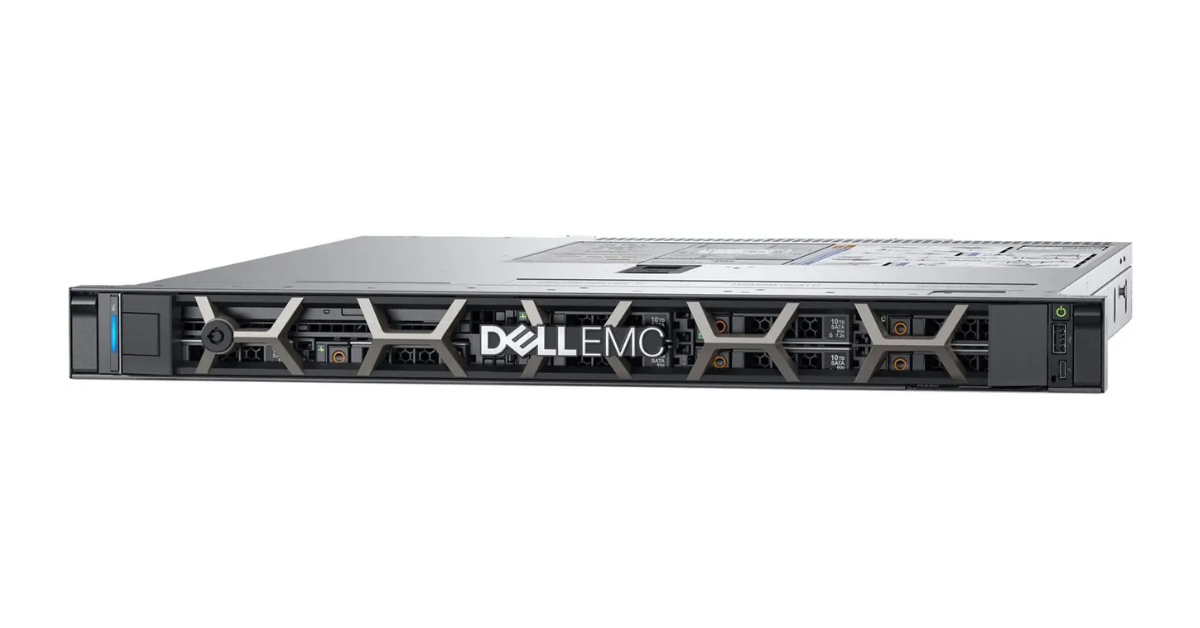
Dell PowerEdge R340 is a compact and affordable 1U rack server designed for small businesses, branch offices, and remote deployments. It supports a single Intel Xeon E-2200 processor or compatible Pentium, Core i3, or Celeron CPUs, delivering dependable performance for everyday workloads.
With 4 DDR4 DIMM slots supporting up to 64GB ECC memory, it ensures data integrity and stability. Storage flexibility includes up to 8× 2.5" or 4× 3.5" SATA/SAS drives and multiple RAID options via PERC and HBA controllers. Power redundancy is available through 350W or 550W Platinum-rated PSUs, enhancing reliability in critical environments.
Compact yet powerful, the PowerEdge R340 is ideal for web hosting, file storage, and small-scale virtualization, combining Dell’s enterprise reliability with an entry-level footprint.
| Processor | 1× Intel Xeon E-2200 / Pentium / Core i3 / Celeron |
|---|---|
| Memory | 4× DDR4 DIMM, up to 64GB, 2666MT/s, ECC supported |
| Storage controllers | Internal: PERC H730P, H330, HBA330; Software RAID: S140; External: 12Gbps SAS HBA; Boot: BOSS 2× M.2 240GB (RAID1 or no RAID) |
| Drive bays | Up to 8× 2.5" or 4× 3.5" SATA/SAS (HDD/SSD) hot-plug |
| Power supplies | 350W or 550W Platinum, single or redundant |
| Dimensions | Height: 1U; Width: 434mm; Depth: 595.63mm; Weight: 13.6kg |
HPE ProLiant ML30 Gen11

HPE ProLiant ML30 Gen11 is a powerful and expandable tower server designed for growing businesses that need enterprise-class performance in an affordable, easy-to-manage solution. It supports Intel Xeon E-2400 series processors with up to 8 cores and 16MB cache, delivering responsive performance for file sharing, collaboration, and light virtualization.
With support for up to 128GB DDR5 ECC memory and multiple drive configurations (4× LFF or 8× SFF), the ML30 Gen11 provides flexible scalability to meet evolving storage and performance needs. Integrated 1Gb 4-port networking and Intel VROC SATA storage management ensure seamless data access and transfer. Power options include efficient 500W, 800W, or 1000W units.
Ideal for small offices and remote locations, the ProLiant ML30 Gen11 combines performance, expandability, and security in a 4U tower form factor.
| Processor | 1× Intel Xeon E-2400 series, 4–8 cores, up to 3.6GHz, 16MB cache |
|---|---|
| Memory | Up to 128GB DDR5 ECC, 4 DIMM slots |
| Drive bays | 4× LFF SATA/SAS or 8× SFF SAS/SATA HDD/SSD |
| Controllers | Network: HPE embedded 1Gb 4-port BCM5719; Storage: Intel VROC SATA |
| Power supplies | HPE 500W, 800W, or 1000W units |
| Form factor | 4U Tower Server |
Dell PowerEdge R750xs

Dell PowerEdge R750xs is a performance-optimized 2U rack server built for modern workloads that require high compute density and flexible storage options. It features up to two 3rd Gen Intel Xeon Scalable processors with up to 32 cores each, making it ideal for virtualization, data analytics, and high-performance computing.
The R750xs supports up to 1TB of DDR4 memory at 3200MT/s and offers versatile storage configurations with up to 16× 2.5" or 12× 3.5" SAS/SATA/NVMe drives. Supported by advanced RAID controllers like PERC H755 and H840, it ensures fast and reliable data access. Power supplies range from 600W to 1400W, with hot-swap redundancy for uninterrupted operation. Efficient cooling is maintained by up to six hot-swap fan modules.
Delivering a balance of performance, flexibility, and energy efficiency, the PowerEdge R750xs is engineered for dynamic data center environments and scalable enterprise workloads.
| Processors | Up to two 3rd Gen Intel Xeon Scalable processors with up to 32 cores |
|---|---|
| Memory | 16 DDR4 DIMM slots, up to 1TB, 3200MT/s, ECC supported |
| Storage controllers | Internal: PERC H345, H355, H745, H755, H755N, HBA355i; External: PERC H840, HBA355E; Boot: BOSS-S2 (2× M.2 SSDs) |
| Drive bays | Front: Up to 12× 3.5" or 16× 2.5" SAS/SATA/NVMe; Rear: Up to 2× 2.5" SAS/SATA/NVMe |
| Power supplies | 600W–1400W hot-swap redundant Platinum/Titanium Mixed Mode |
| Cooling | Standard/High performance fans (Silver/Gold), up to 6 hot-swap modules |
| Dimensions | Height: 86.8mm (3.41"), Width: 482mm (18.97"), Depth: 721.62mm (28.4") |
Recommendations by Business Type and Size
Professional Services: Law Firms, Accounting, Consulting (5–10 employees)
Recommended: Dell PowerEdge R340 or HPE ProLiant ML30 Gen11
Professional services firms need reliable document storage, email hosting, and practice management software. The R340 provides enterprise reliability in rack format while the ML30 Gen11 offers tower convenience with the latest technology. Both handle typical workloads (file sharing, QuickBooks, document management) efficiently. ECC memory protects against data corruption in legal documents or financial records. Budget 64GB RAM and 2–4TB storage in RAID 5 configuration.
Creative Agencies: Design, Video, Photography (10–20 employees)
Recommended: Dell PowerEdge R540
Creative businesses generate enormous file volumes requiring substantial storage capacity. The R540's twelve 3.5-inch bays accommodate 10–20TB of project files, raw footage, and archived campaigns cost-effectively. Configure with large-capacity HDDs (8–12TB each) for bulk storage, and use SSDs for caching active projects. Dual Xeon processors and up to 1TB RAM ensure smooth performance for rendering, asset management, and file server operations.
IT Startups and SaaS Developers (10–50 employees)
Recommended: Dell PowerEdge R650
For companies running virtual machines, CI/CD pipelines, or in-house development environments, the R650 offers top performance and scalability. Support for NVMe drives and 40-core Xeon processors enables quick compilation, testing, and hosting of multiple virtual environments. It’s an excellent choice for growing IT teams that need flexibility and reliability. Opt for 128–256GB RAM and SSD-based RAID 10 arrays to balance speed and redundancy.
Manufacturing and Engineering Companies (20–100 employees)
Recommended: Dell PowerEdge R750xs
Industrial and engineering businesses depend on compute-heavy applications—CAD, CAM, ERP, and analytics systems. The R750xs provides dual 3rd Gen Xeon CPUs and exceptional storage bandwidth, perfect for hosting production databases, simulations, or 3D design projects. Configurable up to 184TB storage and 1TB memory, it suits both on-premise workloads and hybrid cloud setups. Pair it with high-speed networking and redundant PSUs for maximum uptime.
Small Retail, Hospitality, and Local Services (up to 10 employees)
Recommended: HPE ProLiant ML30 Gen11
For small businesses that need a quiet, compact, and affordable system, the ML30 Gen11 delivers exceptional reliability. Ideal for POS systems, booking software, or light database hosting, this tower server fits easily into back-office environments. Low power consumption and optional iLO remote management make it perfect for non-technical users. Start with 32–64GB memory and a simple mirrored SSD array for safety.
Key Selection Criteria for Small Business Servers
Processing Power Requirements
Small businesses rarely need maximum processor configurations. A single mid-range Intel Xeon E-2300 processor handles file serving for fifteen users comfortably. The R340 and ML30 Gen11 with single processors suffice for basic operations. Consider dual processors (R540, R650, R750xs) when running virtualization with multiple VMs, hosting databases with high transaction volumes, or supporting thirty-plus concurrent users. Focus budget on sufficient cores (6–8 for basic, 12–16 for advanced workloads) rather than maximum clock speed.
Memory Considerations
Start with 32GB–64GB RAM for general file serving and single-application hosting. The R340 and ML30 Gen11 support up to 128GB, adequate for most small business scenarios. Plan 8GB per virtual machine if implementing virtualization—a server running four VMs needs a minimum of 32GB plus hypervisor overhead. ECC memory is non-negotiable for business-critical data, preventing corruption from memory errors. The R540, R650, and R750xs supporting 3–4TB enable extensive virtualization or memory-intensive applications like databases and analytics platforms.
Storage Strategy
Calculate current storage needs and multiply by three for a three-year planning horizon. Implement RAID 5 or RAID 6 for data protection—single drives are unacceptable for business data. The R340 and ML30 Gen11 with four bays suit businesses under 2TB total needs. The R540's twelve 3.5-inch bays provide cost-effective capacity for data-heavy operations. Consider NVMe drives in R650 or R750xs for database servers or applications requiring sub-millisecond latency. Hybrid configurations work well: SSDs for operating systems and active data, HDDs for archives and backups.
Rack vs. Tower Form Factor
Tower servers (ML30 Gen11) work well for businesses without rack infrastructure, offering quiet operation suitable for office environments and easy physical access for maintenance. Rack-mount servers (R340, R540, R650, R750xs) provide better density for growth, superior cable management, and a professional appearance in dedicated server rooms. Consider current infrastructure and three-year growth plans. Starting with a tower and converting later costs more than beginning with rack-mount if expansion is likely.
Management and Monitoring
Remote management interfaces (Dell iDRAC9, HPE iLO) prove invaluable for small businesses without full-time IT staff. These tools enable remote power cycling, BIOS configuration, hardware health monitoring, and operating system deployment without physical server access. Entry-level management (iDRAC9 Basic on R340) provides essentials. Advanced tiers (iDRAC9 Enterprise on R650/R750xs) add automation and detailed diagnostics. For businesses relying on external IT support, comprehensive remote management reduces service calls and associated costs.
Power and Cooling Requirements
Calculate total power consumption including monitors and networking equipment. The R340 and ML30 Gen11 draw 200–350 watts, manageable on standard office circuits. Larger servers (R540, R650, R750xs) consume 400–800 watts under load—verify electrical infrastructure capacity. Redundant power supplies prevent downtime from PSU failures but double power connection requirements. Ensure adequate cooling: rack servers need proper airflow in enclosed cabinets, while tower servers require climate-controlled rooms when running continuously.
Final Thoughts
Choosing the right server depends on workload, growth expectations, and IT expertise. Small firms should prioritize reliability and ease of management, while mid-sized teams benefit from scalability and virtualization options. Dell’s PowerEdge line provides a solid backbone for businesses of all sizes, and HPE’s ProLiant ML30 Gen11 remains one of the best entry-level towers available in 2025.
Before purchasing, assess future expansion plans—whether you’ll add users, storage, or applications—and ensure your server chassis and power configuration can support it. For most SMBs, investing in slightly higher specifications today saves time and cost in future upgrades.
Explore the full range of business servers at Servermall — with expert configuration support and free delivery across EU.