Selecting server hardware for medium-sized businesses is a strategic decision that directly impacts company performance, IT infrastructure scalability, and operational costs. Medium businesses with 50 to 500 employees require reliable server solutions capable of handling corporate applications, databases, virtualization systems, and ensuring uninterrupted operation of mission-critical services.
In 2025, the optimal servers for medium business are DELL PowerEdge 15th and 16th generation models, as well as HPE ProLiant Gen11 platforms. These systems offer the ideal balance between performance, reliability, and total cost of ownership. They support modern Intel Xeon Scalable processors, provide sufficient memory capacity for virtualization, and feature flexible storage scalability options.
Key requirements for medium business server equipment include virtualization support based on VMware ESXi or Microsoft Hyper-V, capability to deploy enterprise resource planning systems (ERP, CRM), medium-load database processing, file services, and backup systems. Modern servers must also provide remote management through iDRAC or iLO, hardware RAID controllers for data protection, and hot-swap component capability to minimize downtime.
Server Comparison Table for Medium Business
| Model | Processor | RAM | Storage | Use Cases |
|---|---|---|---|---|
| DELL PowerEdge R450 | Up to 2x Intel Xeon Scalable 3rd Gen (up to 24 cores) | Up to 1 TB DDR4 | Up to 8x 2.5" SAS/SATA | Virtualization, web applications, databases |
| DELL PowerEdge R550 | Up to 2x Intel Xeon Scalable 3rd Gen (up to 24 cores) | Up to 1 TB DDR4 | Up to 16x 2.5" or 8x 3.5" | Enterprise applications, file services |
| DELL PowerEdge R750 | Up to 2x Intel Xeon Scalable 3rd Gen (up to 40 cores) | Up to 4 TB DDR4 | Up to 24x 2.5" or 12x 3.5" | High-performance virtualization, ERP/CRM |
| HPE ProLiant DL360 Gen11 | Up to 2x Intel Xeon Scalable 4th/5th Gen (up to 64 cores) | Up to 4 TB DDR5 | Up to 10x 2.5" or 20x EDSFF | Modern virtualization, containers, databases |
| HPE ProLiant DL380 Gen11 | Up to 2x Intel Xeon Scalable 4th/5th Gen (up to 60 cores) | Up to 8 TB DDR5 | Up to 24x 2.5" or 12x 3.5" | Mission-critical applications, large-scale virtualization |
DELL PowerEdge R450 — Compact Virtualization Solution

The DELL PowerEdge R450 server represents a versatile 1U form factor platform for small and medium enterprises requiring reliable and performant solutions with minimal rack space requirements. This server is optimized for entry and mid-level virtualization tasks, web hosting, corporate applications, and databases with moderate workloads.
Technical Specifications
- Processors: up to two Intel Xeon Scalable 3rd Generation supporting up to 24 cores per processor
- Memory: 16 DDR4 DIMM slots, maximum capacity 1 TB, speeds up to 2933 MHz
- Storage: up to 8x 2.5" SAS/SATA (HDD/SSD) with maximum capacity 61.4 TB
- RAID controllers: PERC H345, H355, HBA355i, H745, H755, S150
- Network adapters: embedded 2x 1GbE LOM, optional OCP 3.0
- Remote management: iDRAC9 with Redfish API support
- Power supplies: hot-swap 600W Platinum or 800W Platinum with redundancy
- Form factor: 1U rack server (42.8 mm height)
Who Should Choose This
The DELL PowerEdge R450 is ideal for medium companies deploying virtualization infrastructure based on VMware vSphere, Microsoft Hyper-V, or Citrix Hypervisor. The server efficiently handles 10-20 virtual machines under average load, providing sufficient compute power for typical corporate services — domain controllers, file servers, email systems, and business applications.
Thanks to its compact 1U form factor, this server saves valuable space in server racks, which is especially important for companies with limited data center facilities. Hot-swap support for drives and power supplies minimizes downtime risks, while the embedded iDRAC9 controller allows administrators to manage the server remotely, even when the operating system is offline.
DELL PowerEdge R550 — Universal 2U Platform
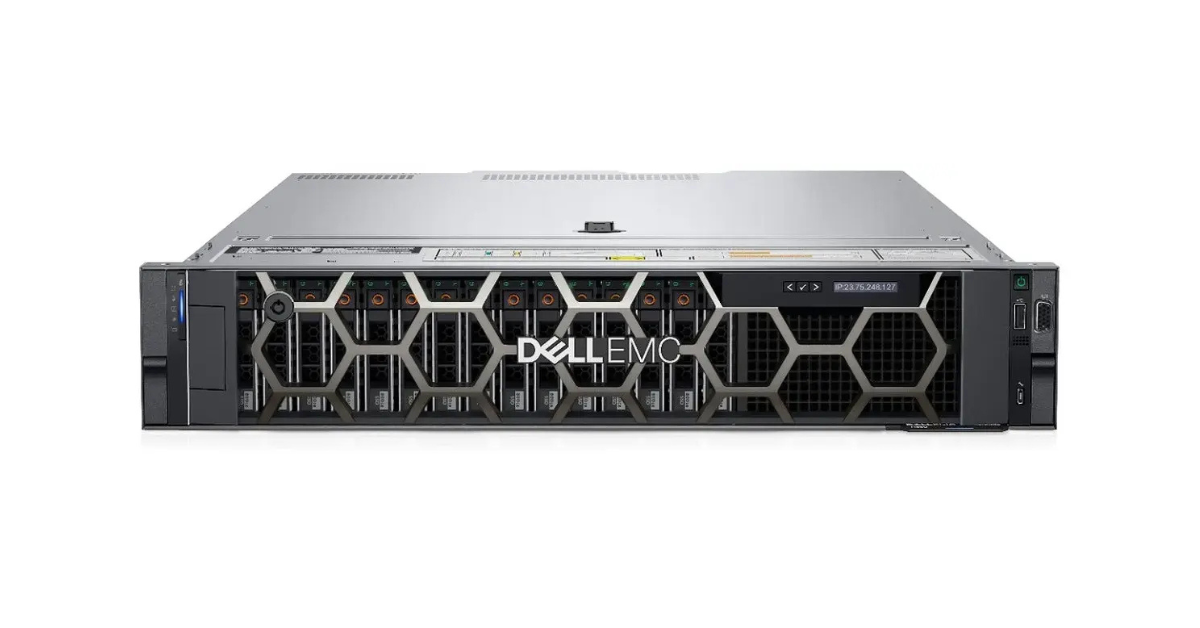
The DELL PowerEdge R550 is a classic dual-processor 2U form factor server designed for a wide range of medium business tasks. The increased form factor compared to R450 provides greater flexibility in storage configuration and expansion, making this model the preferred choice for companies with growing data storage needs.
Technical Specifications
- Processors: up to two Intel Xeon Scalable 3rd Generation supporting up to 24 cores per processor
- Memory: 16 DDR4 DIMM slots, maximum capacity 1 TB, speeds up to 2933 MHz, registered ECC support
- Storage: up to 16x 2.5" SAS/SATA (maximum 122.88 TB) or up to 8x 3.5" SAS/SATA (maximum 128 TB)
- RAID controllers: PERC H345, H355, HBA355i, H745, H755, S150
- Boot devices: Boot Optimized Storage Subsystem (BOSS-S2) with 2x M.2 SSD support
- Network adapters: embedded 2x 1GbE LOM, optional OCP 3.0 for 10GbE/25GbE
- Expansion slots: up to 4 PCIe Gen4 (3x16 + 1x8)
- Power supplies: 600W, 800W or 1100W Platinum/Titanium with hot swap
- Form factor: 2U rack server (86.8 mm height)
Who Should Choose This
The DELL PowerEdge R550 is the optimal solution for medium businesses requiring balance between performance, storage capacity, and scalability. This server excels as a platform for enterprise resource planning systems (ERP), customer relationship management systems (CRM), document management systems, and business intelligence.
With the ability to install up to 16x 2.5" or 8x 3.5" drives, the R550 is ideal for deploying file servers with substantial data volumes, backup servers, and corporate database storage systems. NVMe drive support through BOSS provides high-speed operating system and hypervisor boot, while the main drive array can be configured for optimal balance of performance and capacity.
DELL PowerEdge R750 — Flagship Power for Demanding Tasks

The DELL PowerEdge R750 server represents a high-performance 2U form factor solution for medium and large enterprises with demanding workloads. This model provides maximum compute power, memory capacity, and configuration flexibility among all servers in the PowerEdge 15th generation lineup.
Technical Specifications
- Processors: up to two Intel Xeon Scalable 3rd Generation supporting up to 40 cores per processor
- Memory: 32 DDR4 DIMM slots, maximum 4 TB (LRDIMM) or 2 TB (RDIMM), speeds up to 3200 MHz
- Intel Optane Persistent Memory support: up to 16 modules (8 TB maximum)
- Storage: flexible configuration — up to 24x 2.5" SAS/SATA/NVMe (368.84 TB), up to 16x 2.5" (245.76 TB), up to 12x 3.5" (192 TB), or up to 8x 2.5" NVMe (122.88 TB)
- Rear bays: additionally up to 4x 2.5" (61.44 TB)
- RAID controllers: PERC H745, HBA355i, S150, H345, H755, H755N
- Network adapters: embedded 2x 1GbE LOM, OCP 3.0 for 10GbE/25GbE/100GbE
- Expansion slots: up to 8 PCIe Gen4 (up to 6x16), SNAP I/O module support
- GPU: support for up to two dual-slot 300W, four single-slot 150W or six 75W accelerators
- Power supplies: 800W, 1100W, 1400W Platinum/Titanium or 1100W DC
- Cooling system: air or optional processor liquid cooling
Who Should Choose This
The DELL PowerEdge R750 is the choice for medium businesses with mission-critical applications and high performance requirements. The server is ideal for deploying large-scale virtualization infrastructures with 50+ virtual machines, high-load databases (Microsoft SQL Server, Oracle Database, PostgreSQL), business intelligence systems, and big data processing.
The ability to install up to 4 TB of RAM makes the R750 an optimal choice for in-memory computing platforms such as SAP HANA, as well as for deploying large virtualization clusters VMware vSAN or Microsoft Storage Spaces Direct. Intel Optane Persistent Memory support opens new possibilities for database acceleration and data caching with persistence across reboots.
For companies using specialized GPU-accelerated applications, the R750 offers the ability to install professional NVIDIA graphics accelerators for artificial intelligence tasks, machine learning, rendering, or video processing. Eight PCIe Gen4 slots provide exceptional flexibility in connecting high-speed network adapters, storage controllers, and specialized accelerators.
HPE ProLiant DL360 Gen11 — Next-Generation Modern Platform
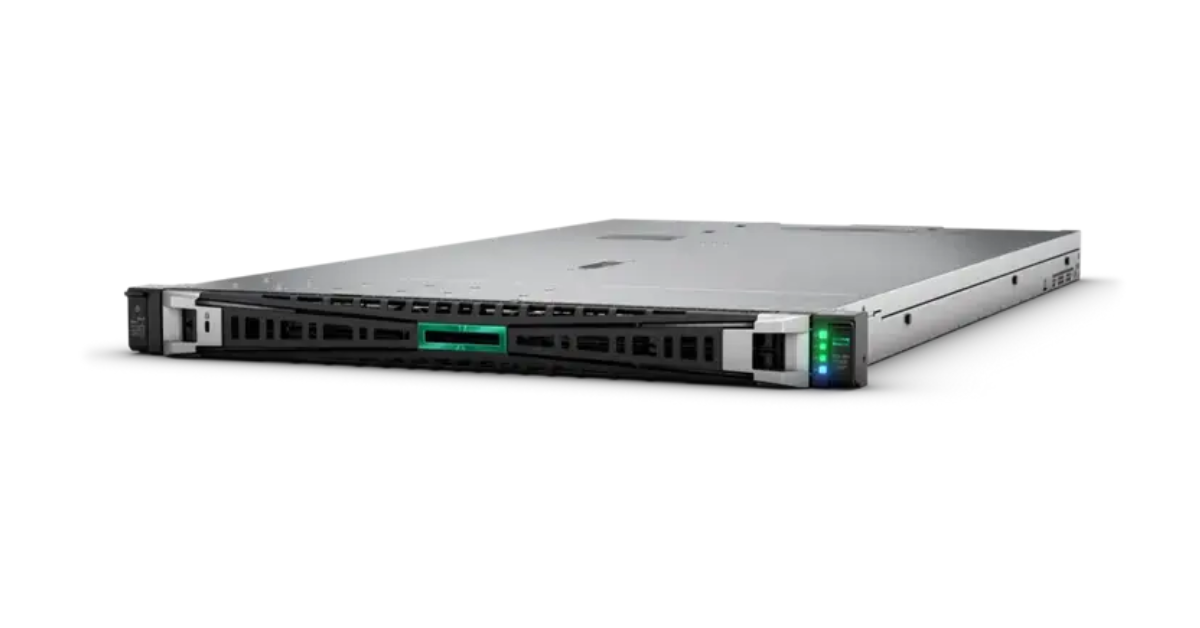
The HPE ProLiant DL360 Gen11 server represents the latest generation of HPE server platforms built on Intel Xeon Scalable 4th and 5th generation processors. This 1U server combines cutting-edge technologies, including DDR5 memory, PCIe Gen5, and modern accelerator support, delivering significant performance gains over previous generations.
Technical Specifications
- Processors: up to two Intel Xeon Scalable 4th or 5th Generation supporting up to 64 cores per processor
- Memory: 16 DDR5 slots per processor, maximum 4 TB with 256 GB modules, speeds up to 5600 MHz
- Advanced memory features: HPE Fast Fault Tolerant Memory, Advanced ECC, Online Spare, Mirroring
- Storage: flexible configuration — up to 10x 2.5" SAS/SATA/NVMe (including 8+2), up to 4x 3.5" LFF, or up to 20x EDSFF E3.s 1T NVMe
- Boot devices: 2x M.2 NVMe in RAID1 (internal module or external access)
- RAID controllers: embedded Intel VROC SATA/NVMe controller, optional HPE Smart Array Gen11
- Network adapters: wide selection from 1GbE to 200GbE in PCIe and OCP 3.0 formats
- Expansion slots: up to 3 PCIe Gen5 + up to 2 OCP 3.0 PCIe5
- Power supplies: 500W, 800W, 1000W, 1600W, 1800W-2200W Platinum/Titanium
- Management: HPE iLO 6 with Intelligent Provisioning, compatible with HPE OneView and Compute Ops Management
Who Should Choose This
HPE ProLiant DL360 Gen11 is the choice for medium businesses striving for modern technologies and maximum performance in a compact form factor. The latest Intel Xeon 5th generation processors provide substantial per-core compute power improvement compared to previous generations, particularly noticeable in workloads optimized for new processor instructions, such as Intel AMX for AI and machine learning acceleration.
DDR5 memory with doubled bandwidth compared to DDR4 is critical for memory-intensive applications — databases, analytics systems, Kubernetes container platforms, and virtualization with high virtual machine density. Support for up to 4 TB of RAM in a 1U form factor makes the DL360 Gen11 ideal for deploying in-memory databases and caching systems.
Particularly noteworthy is support for next-generation EDSFF (E3.S) drives, which provide placement density of up to 20 NVMe drives in a 1U chassis with improved cooling. This makes the DL360 Gen11 an excellent choice for software-defined storage (VMware vSAN, Ceph, Storage Spaces Direct) and hyperconverged infrastructures.
HPE ProLiant DL380 Gen11 — Flagship for Mission-Critical Applications
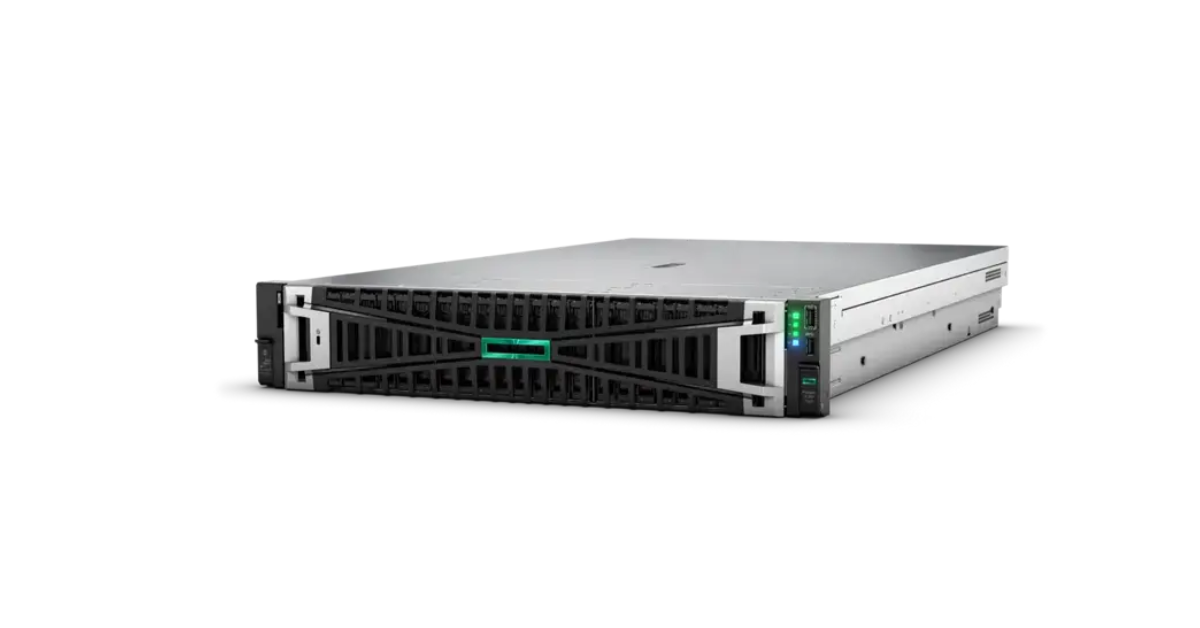
The HPE ProLiant DL380 Gen11 server is the flagship model in the HPE ProLiant 2U form factor lineup, offering maximum performance, scalability, and reliability for mission-critical business applications. This platform is built on the latest Intel Xeon Scalable 4th and 5th generation technologies and represents the ideal solution for medium enterprises with the most demanding workloads.
Technical Specifications
- Processors: up to two Intel Xeon Scalable 4th or 5th Generation supporting up to 60 cores per processor
- Memory: 32 DDR5 DIMM slots, maximum capacity 8 TB with 256 GB modules, speeds up to 5600 MHz
- Advanced memory features: Advanced ECC, Online Spare, Mirroring, Lock Step, HPE Fast Fault Tolerant Memory (ADDDC)
- Intel Optane Persistent Memory support for hybrid memory configurations
- Storage: maximum configuration flexibility — up to 24x 2.5" SAS/SATA/SSD, up to 12x 3.5" LFF, optionally 20x SFF NVMe, 6 or 2 SFF rear bays
- RAID controllers: wide selection of HPE Smart Array Gen11 — SR932i-p, MR216i-o/p, MR416i-o/p, MR408i-o
- Network adapters: from 1GbE to 200GbE in PCIe adapter and OCP 3.0 formats
- Expansion slots: up to 8 PCIe Gen5 + 2 OCP 3.0 for maximum connection flexibility
- Power supplies: 800W, 1000W, 1600W Platinum/Titanium with hot swap and 1+1 redundancy
- Form factor: 2U rack server (8.75 cm height)
- Management: HPE iLO 6 Standard/Advanced with Intelligent Provisioning, integration with HPE OneView and HPE GreenLake
Who Should Choose This
HPE ProLiant DL380 Gen11 is a premium solution for medium businesses deploying mission-critical applications requiring maximum reliability, performance, and scalability. This server is ideal for infrastructure consolidation, allowing multiple workloads to be unified on a single high-performance platform.
The ability to install up to 8 TB of DDR5 memory makes the DL380 Gen11 an ideal choice for the most memory-demanding applications — large virtualization clusters with hundreds of virtual machines, large-scale in-memory databases (SAP HANA, Oracle Database In-Memory), Redis or Memcached caching systems, and container platforms with high placement density.
For companies implementing Software-Defined Infrastructure, the DL380 Gen11 offers an optimal combination of compute power and storage capacity. Support for up to 24x 2.5" drives or 20 NVMe drives enables deploying hyperconverged solutions based on VMware vSAN, Nutanix, Microsoft Storage Spaces Direct, or open-source Ceph platforms.
Eight PCIe Gen5 slots provide unprecedented bandwidth for connecting high-speed 100GbE/200GbE network adapters, NVMe-over-Fabric controllers, GPU accelerators for AI/ML tasks, and specialized FPGA adapters. This makes the DL380 Gen11 a universal platform for any current and future medium business tasks.
Server Selection Recommendations for Medium Business
Configuration Selection Criteria
Company size and user count: For companies with 50-100 employees, a single DELL PowerEdge R450 or R550 is sufficient. With 100-250 people, two servers are recommended for fault tolerance — for example, R550 for production applications and R450 for file services. Companies with 250-500 employees should consider DELL R750 or HPE DL380 Gen11 as the primary virtualization platform.
Virtualization tasks: For basic virtualization with 10-20 virtual machines, DELL R450 with 128-256 GB RAM is suitable. Medium virtualization density (20-40 VMs) requires DELL R550 or HPE DL360 Gen11 with 256-512 GB memory. High density (50+ VMs) or critical applications are best served by DELL R750 or HPE DL380 Gen11 with 512 GB - 1 TB RAM.
Storage requirements: If total data volume doesn't exceed 10-20 TB, DELL R450 with 8x 2.5" drives is sufficient. For volumes of 20-50 TB, DELL R550 with 8x 3.5" LFF configuration is recommended. When storing 50-100 TB, DELL R750 with 12x 3.5" or 24x 2.5" configuration is optimal. For high-performance tasks with IOPS requirements, choose models with NVMe support — HPE DL360/DL380 Gen11 or DELL R750.
Application criticality and fault tolerance requirements: For non-critical applications, basic configurations with a single server are acceptable. Important business applications require redundant components (power supplies, network adapters) and hot-swap drive capability — all reviewed models support these features. Mission-critical applications should be deployed on clusters of two or more servers using High Availability technologies (VMware HA, Microsoft Failover Clustering).
Recommendations for Specific Use Cases
File server and document management systems: DELL PowerEdge R550 with 8x 3.5" drives in RAID 6 provides optimal balance of capacity, performance, and reliability. Configuration: 2x Intel Xeon Silver 4310 (12 cores), 128 GB RAM, 8x 8 TB SATA, PERC H755.
Department virtualization platform (10-20 VMs): DELL PowerEdge R450 — compact and cost-effective solution. Configuration: 2x Intel Xeon Silver 4314 (16 cores), 256 GB RAM, 4x 1.92 TB SSD in RAID 10, PERC H745, 2x 10GbE network adapters.
Enterprise ERP system (SAP, Microsoft Dynamics, 1C): DELL PowerEdge R750 for production database and application server. Configuration: 2x Intel Xeon Gold 6338 (32 cores), 512 GB RAM, 4x 1.92 TB NVMe in RAID 10 for DB, 4x 3.84 TB SSD for storage, PERC H755, 2x 25GbE.
High-performance database: HPE ProLiant DL380 Gen11 with 5th generation processors and DDR5 memory. Configuration: 2x Intel Xeon Gold 6530 (32 cores), 768 GB DDR5, 8x 3.84 TB NVMe in software RAID or Database RAID, 2x 25GbE, HPE SR932i-p controller.
Hyperconverged infrastructure (HCI): Three HPE ProLiant DL360 Gen11 or DELL PowerEdge R650 nodes. Configuration per node: 2x Intel Xeon Gold 6430 (32 cores), 512 GB RAM, 8x 3.84 TB NVMe for vSAN/S2D, 2x M.2 240 GB for boot, 2x 25GbE for production, 2x 25GbE for vSAN/S2D.
Backup server: DELL PowerEdge R550 with maximum storage capacity. Configuration: 1x Intel Xeon Silver 4310, 64 GB RAM, 16x 8 TB SATA in RAID 6 (2.5" configuration), PERC H355, 2x 10GbE.
Scalability Planning
When selecting a server platform, it's important to consider business growth prospects for the next 3-5 years. We recommend initially purchasing servers with expansion headroom:
- Leave 30-50% of memory slots free for future RAM increases
- Choose models with more drive bays than currently needed
- Provide spare PCIe slots for adding network adapters or accelerators
- Install power supplies with 20-30% power headroom for future components
- Plan network infrastructure with 25GbE/100GbE migration in mind
For mission-critical systems, we recommend the following infrastructure development strategy: start with two servers in a high-availability cluster, add a third server for maintenance fault tolerance, then scale the cluster horizontally as load grows. This ensures seamless scaling without downtime and business risks.
Conclusion
Choosing the optimal server for medium business depends on multiple factors — company scale, workload types, performance and reliability requirements, and budget constraints. All reviewed models — DELL PowerEdge R450, R550, R750 and HPE ProLiant DL360/DL380 Gen11 — represent proven and reliable platforms capable of effectively addressing modern medium business needs.
For companies beginning digital transformation or modernizing legacy infrastructure, DELL PowerEdge R450 or R550 offer optimal price-performance ratios. These servers provide sufficient compute power for typical corporate applications, entry-level virtualization, and file services while remaining cost-effective solutions.
Medium enterprises with high performance, scalability, and reliability requirements should consider DELL PowerEdge R750 or HPE ProLiant DL380 Gen11. These flagship platforms provide maximum compute power, latest technology support (DDR5, PCIe Gen5, NVMe), and exceptional configuration flexibility, making them ideal choices for mission-critical applications and long-term IT infrastructure investments.
Regardless of chosen model, proper configuration planning considering current needs and growth prospects, critical component redundancy, and reliable backup system implementation are essential. Professional consultation from ServerMall specialists will help select the optimal solution for your business.
Explore the complete catalog of server equipment on the ServerMall website and receive personalized consultation on choosing a server for your medium business.