
MongoDB is one of the world's most popular NoSQL databases, requiring carefully selected server hardware to ensure high performance and reliability. The choice of server for MongoDB directly impacts query processing speed, system scalability, and overall application stability.
The optimal MongoDB server should feature a powerful multi-core processor for parallel query processing, sufficient RAM to cache working data sets, and fast NVMe SSD storage to minimize read-write latency. Component reliability and hot-swap capabilities are also crucial for ensuring continuous operation.
In this article, we'll examine five best-in-class server solutions from Dell and HPE that are ideal for deploying MongoDB across various use cases—from small projects to large high-load systems processing millions of queries per second.
MongoDB Server Comparison Table
| Model | Processor | RAM | Storage | Use Case |
|---|---|---|---|---|
| DELL PowerEdge R650 | Up to 2x Intel Xeon Scalable (40 cores) | Up to 1 TB DDR4 | Up to 10x 2.5" NVMe/SAS/SATA | Medium to large databases, production environments |
| DELL PowerEdge R750 | Up to 2x Intel Xeon Scalable (40 cores) | Up to 4 TB DDR4 | Up to 24x 2.5" NVMe/SAS/SATA | Large databases, heavy workloads, replication |
| DELL PowerEdge R450 | Up to 2x Intel Xeon Scalable (24 cores) | Up to 1 TB DDR4 | Up to 8x 2.5" SAS/SATA | Small to medium databases, dev/test environments |
| HPE ProLiant DL360 Gen11 | Up to 2x Intel Xeon Scalable (64 cores) | Up to 4 TB DDR5 | Up to 10x 2.5" NVMe/SAS/SATA | High-performance databases, mission-critical systems |
| HPE ProLiant DL380 Gen11 | Up to 2x Intel Xeon Scalable (60 cores) | Up to 8 TB DDR5 | Up to 24x 2.5" NVMe/SAS/SATA | Scalable solutions, sharded clusters |
DELL PowerEdge R650

The compact 1U DELL PowerEdge R650 server represents a balanced solution for deploying MongoDB in data centers with limited space. This server is optimally suited for medium-sized MongoDB replica sets and production environments with moderate workloads.
Technical Specifications:
- Processors: Up to 2x 3rd Gen Intel Xeon Scalable (up to 40 cores per processor)
- Memory: 16 DDR4 slots, up to 1 TB with 64 GB modules, speeds up to 3200 MT/s
- Storage: Up to 10x 2.5" drives with NVMe, SAS, and SATA support, maximum capacity up to 153 TB
- Additional bays: Up to 2x 2.5" rear drives for system partitions or logs
- Storage controllers: PERC H745, H755, H755N, HBA355I for flexible RAID configuration
- Network adapters: 2x 1GbE embedded, optional OCP 3.0 for 10/25/100 GbE connectivity
- Power supplies: Platinum 800W or Titanium 1100W with full redundancy
- Management: iDRAC9 for remote monitoring and management
- Form factor: 1U rack server (height 42.8 mm)
Who It's For:
The DELL PowerEdge R650 is ideal for companies deploying MongoDB as part of a 3-5 node replica set. The server provides sufficient computational power to handle hundreds of thousands of operations per second with proper indexing and query optimization. NVMe drive support achieves minimal latency when working with data sets, which is critical for MongoDB.
This server is recommended for medium-scale production environments, web applications with active databases, real-time analytics systems, and microservice architectures. The compact 1U form factor allows for maximum rack space efficiency in data centers.
DELL PowerEdge R750

The flagship 2U DELL PowerEdge R750 server is a powerful platform for deploying large-scale MongoDB clusters with extreme performance and storage capacity requirements. The server is designed for operation in the most demanding environments with millions of daily transactions.
Technical Specifications:
- Processors: Up to 2x 3rd Gen Intel Xeon Scalable (up to 40 cores per processor, 80 cores per server)
- Memory: 32 DDR4 DIMM slots, up to 4 TB with LRDIMM modules, speeds up to 3200 MT/s
- Intel Persistent Memory support: Up to 16 Intel Optane PMem 200 series slots to increase memory to 8 TB
- Front bays: Up to 24x 2.5" drives with NVMe/SAS/SATA support, maximum 368.84 TB
- Rear bays: Up to 4x 2.5" additional drives for OS and logs
- RAID controllers: PERC H745, H755, H755N with cache and BBU for data protection
- Network interfaces: 2x 1GbE embedded + OCP 3.0 slot for adapters up to 100 GbE
- Expansion slots: Up to 8 PCIe Gen4 slots for GPU, network, or specialized cards
- Power supplies: From 800W Platinum to 1400W Platinum with hot swap
- Cooling: Hot-swappable fans with optional liquid cooling for processors
- Form factor: 2U rack server
Who It's For:
The DELL PowerEdge R750 is built for organizations working with large data volumes and high transactional loads. This server excels as a primary node in large MongoDB replica sets, processing millions of read and write operations daily.
Especially recommended for: fintech companies with high-frequency transactions, social networks with millions of users, IoT platforms with streaming data processing, e-commerce systems with high query concurrency. Support for up to 24 NVMe drives provides exceptional I/O performance for parallel operations, critical for MongoDB aggregation queries and sharding operations.
DELL PowerEdge R450

The compact and economical DELL PowerEdge R450 is an excellent solution for small to medium MongoDB projects and dev/test environments. This 1U server provides a balance between performance and total cost of ownership.
Technical Specifications:
- Processors: Up to 2x 3rd Gen Intel Xeon Scalable (up to 24 cores per processor)
- Memory: 16 DDR4 RDIMM slots, up to 1 TB, speeds up to 2933 MT/s
- Storage: Up to 8x 2.5" SAS/SATA drives, maximum capacity 61.4 TB
- Controllers: PERC H345, H355, H745, H755, HBA355i for various configurations
- Boot devices: BOSS-S1 with 2x M.2 SSDs in RAID 1 or Internal Dual SD Module
- Network interfaces: 2x 1GbE embedded + optional OCP 3.0
- Expansion slots: 2 PCIe Gen4 low-profile slots for additional adapters
- Power supplies: 600W or 800W Platinum with hot swap and redundancy
- Form factor: 1U rack server
Who It's For:
The DELL PowerEdge R450 is ideal for startups and small to medium businesses needing a reliable MongoDB platform without excessive investment. The server handles medium-sized databases (up to several terabytes) and provides sufficient performance for tens of thousands of operations per second.
Recommended for: MongoDB application development and testing, web projects with moderate traffic, secondary nodes in replica sets, monitoring and logging systems, small-scale CRM and ERP systems. Thanks to its compact size and energy efficiency, the R450 is also suitable for remote offices and edge locations.
HPE ProLiant DL360 Gen11
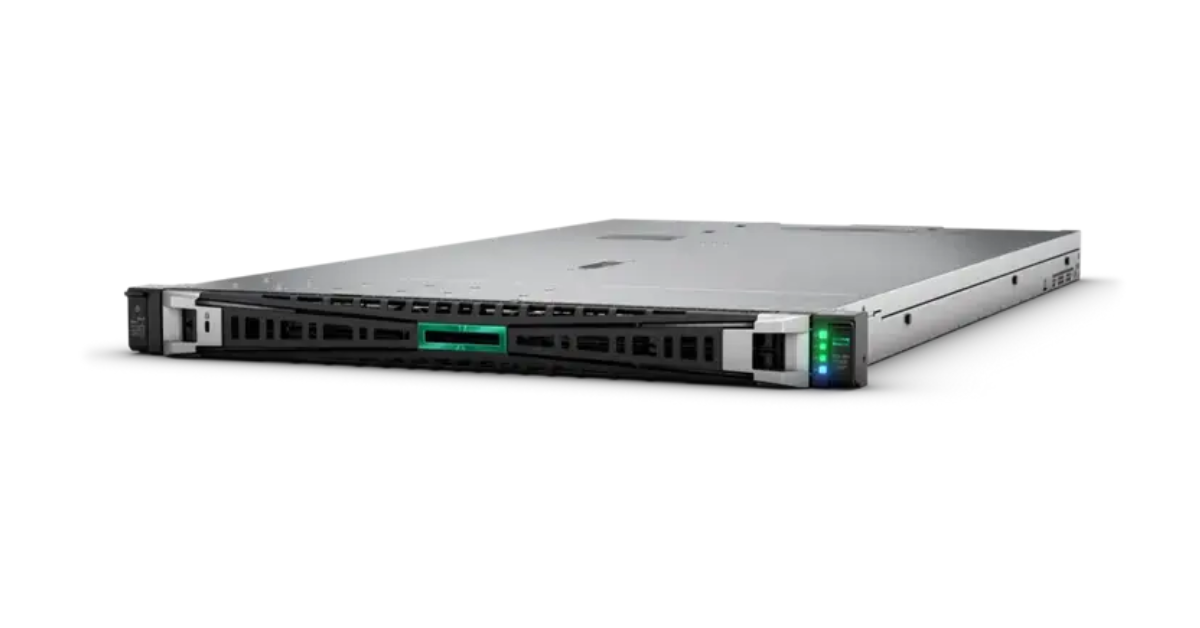
The latest-generation HPE ProLiant DL360 Gen11 server represents a technological breakthrough with support for 4th and 5th Gen Intel Xeon Scalable processors and DDR5 memory. This is one of the most powerful 1U solutions on the market for MongoDB.
Technical Specifications:
- Processors: Up to 2x 4th or 5th Gen Intel Xeon Scalable (up to 64 cores per processor)
- Memory: 16 DDR5 slots per socket (32 total), up to 4 TB per socket with 256 GB modules
- Maximum memory: Up to 8 TB DDR5 SmartMemory with speeds up to 5600 MT/s
- Storage: Up to 10x 2.5" NVMe/SAS/SATA (8+2 configuration) or 20x EDSFF E3.s NVMe
- Boot devices: 2x NVMe M.2 in RAID 1 (internal module or rear access)
- Controllers: HPE Smart Array Gen11 with NVMe support, various configuration options
- Network adapters: Wide selection from 1 GbE to 200 GbE in PCIe and OCP 3.0 formats
- Expansion slots: Up to 3 PCIe Gen5 slots + 2 OCP 3.0 PCIe5 slots
- Power supplies: From 500W to 2200W Titanium with hot swap
- Management: HPE iLO 6 with advanced automation capabilities
- Form factor: 1U rack server
Who It's For:
The HPE ProLiant DL360 Gen11 is the choice for organizations requiring maximum MongoDB performance in a compact form factor. 5th Gen Intel Xeon processors and DDR5 memory provide significant performance gains over previous generations, especially for highly parallelized workloads.
Ideal for: mission-critical production systems with maximum availability requirements, high-load API services with MongoDB backends, real-time analytics systems, financial applications with strict SLAs, containerized MongoDB deployments in Kubernetes. DDR5 memory support with increased bandwidth is particularly important for MongoDB workloads with large in-memory working data sets.
HPE ProLiant DL380 Gen11
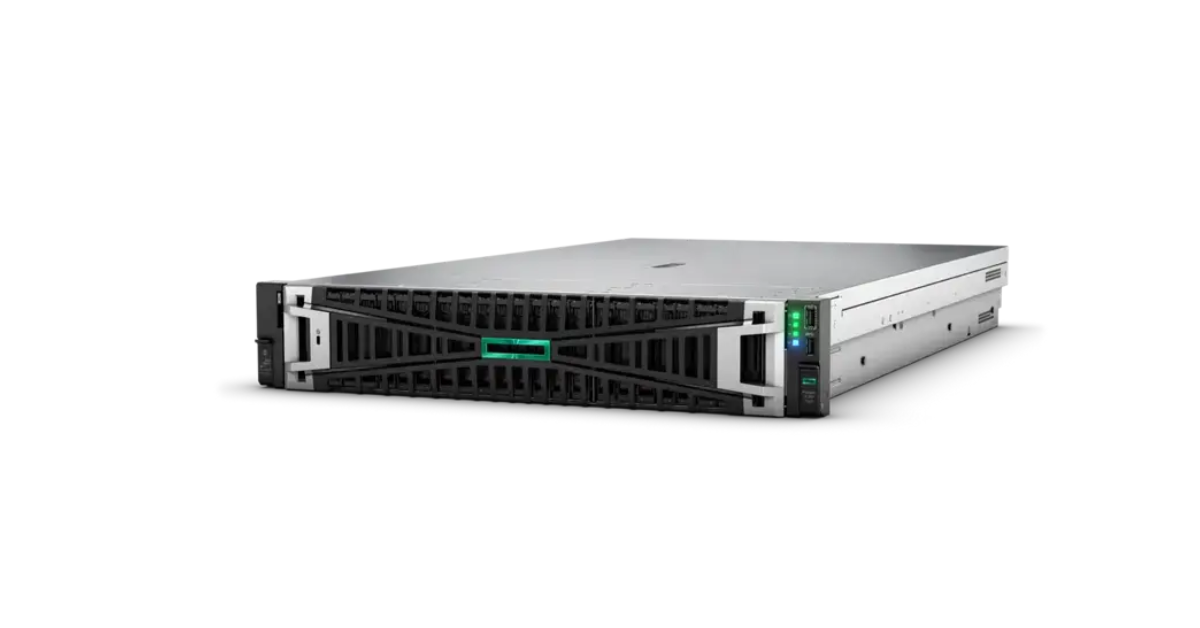
The flagship 2U HPE ProLiant DL380 Gen11 server represents the pinnacle of server technology for the most demanding MongoDB clusters. The server provides an unprecedented combination of computing power, memory capacity, and configuration flexibility.
Technical Specifications:
- Processors: Up to 2x 4th or 5th Gen Intel Xeon Scalable (up to 60 cores per processor, 120 cores per system)
- Memory: 32 DDR5 SmartMemory slots, up to 8 TB with 256 GB modules
- Memory speed: Up to 5600 MT/s DDR5 for maximum bandwidth
- Front bays: Up to 24x 2.5" SAS/SATA/SSD drives or 20x NVMe SSDs
- Optional configurations: 8 or 12 LFF drives for large capacity arrays
- Rear bays: Up to 6x 2.5" SFF drives for system partitions, logs, and replication
- Controllers: HPE Smart Array SR932i-p, MR216i-o, MR416i-o with hardware RAID and cache
- Network interfaces: From 1 GbE to 200 GbE with RDMA support for minimum latency
- Expansion slots: Up to 8 PCIe Gen5 slots + 2 OCP 3.0 slots for maximum flexibility
- Power supplies: From 800W to 1600W Titanium with full 1+1 redundancy
- Management: HPE iLO 6 Standard with optional Advanced for extended capabilities
- Form factor: 2U rack server
Who It's For:
The HPE ProLiant DL380 Gen11 is built for enterprise organizations with large-scale MongoDB deployments. This server can serve as a primary node in distributed sharded MongoDB clusters, handling petabytes of data and billions of documents.
Recommended for: large e-commerce platforms with global presence, telecom operators with MongoDB billing systems, SaaS providers with multi-tenant databases, Big Data analytics and Data Lakes, artificial intelligence systems requiring fast access to training data. The ability to install up to 24 NVMe drives provides exceptional I/O performance, critical for MongoDB aggregation pipelines and MapReduce operations. Support for 8 TB of DDR5 memory allows placing working data sets of several terabytes in RAM, minimizing disk access.
MongoDB Server Selection Recommendations
Hardware Selection Criteria
When choosing a server for MongoDB, several key parameters must be considered that directly impact database performance:
1. Processor Computing Power
MongoDB effectively utilizes multi-core processors for parallel query processing. Servers with processors having high per-core frequencies (2.5 GHz and above) and large core counts (16 or more) are recommended. Intel Xeon Scalable processors with 24-40 cores per socket are optimal for production systems.
2. RAM Volume and Speed
Memory is a critically important resource for MongoDB. The database uses the WiredTiger storage engine, which actively caches working data sets in RAM. Minimum recommended volume is 64 GB for small databases, 128-256 GB for medium systems, and from 512 GB to several terabytes for large production clusters. DDR5 memory with 4800-5600 MT/s speeds provides substantial performance advantages.
3. Data Storage System
Low I/O latency is critically important for MongoDB. NVMe SSD drives are strongly recommended, providing latencies under 100 microseconds and hundreds of thousands of IOPS. For production systems, a RAID 10 configuration of 4-8 NVMe drives is optimal. SATA SSDs are acceptable only for dev/test environments or secondary nodes with low loads.
4. Network Infrastructure
For MongoDB replica sets, 10 GbE or faster network adapters are recommended to minimize data replication latency between nodes. In sharded clusters, 25 GbE or 100 GbE adapters with RDMA support are preferable for maximum throughput.
Use Cases and Recommended Configurations
Small Business and Startups (up to 1 TB data)
Recommendation: DELL PowerEdge R450
- Configuration: 1x Intel Xeon Silver 4310 (12 cores), 64 GB RAM, 4x 960 GB SATA SSD in RAID 10
- Use case: web applications with moderate traffic, content management systems, internal business applications
- Advantages: optimal price/performance ratio, low power consumption
Medium Business (1-10 TB data)
Recommendation: DELL PowerEdge R650 or HPE ProLiant DL360 Gen11
- Configuration: 2x Intel Xeon Gold 6330 (56 cores total), 256-512 GB RAM, 6-8x 1.92 TB NVMe SSD in RAID 10
- Use case: e-commerce platforms, SaaS applications, enterprise systems with high concurrency
- Advantages: compact 1U form factor, excellent NVMe performance
Large Business and Enterprise (10+ TB data)
Recommendation: DELL PowerEdge R750 or HPE ProLiant DL380 Gen11
- Configuration: 2x Intel Xeon Platinum 8352Y (64 cores total), 1-2 TB RAM, 12-16x 3.84 TB NVMe SSD in RAID 10
- Use case: fintech, telecom, social networks, IoT platforms, Big Data analytics
- Advantages: maximum memory and storage capacity, support for advanced configurations
Sharded MongoDB Clusters
For sharded clusters, the following architecture is recommended:
- Config servers: 3x small servers (e.g., DELL R450) with 32-64 GB RAM
- Query routers (mongos): 2+ servers emphasizing processor power
- Shard servers: From 2 to dozens of shards, each as a 3-node replica set based on R650/R750 or DL360/DL380 Gen11
Replica Sets for High Availability
Typical MongoDB replica set configuration:
- Primary: Powerful server with maximum memory and NVMe drives (R750 or DL380 Gen11)
- Secondary 1: Identical or similar configuration to Primary for fast failover
- Secondary 2 (or Arbiter): Less powerful server for ensuring voting quorum
Configuration Optimization
Resource Balancing
It's important to properly allocate budget between server components. For MongoDB, the priority is:
- NVMe SSD drives (greatest impact on performance)
- RAM (must accommodate working data set)
- Processor (24-40 cores sufficient for most tasks)
- Network adapters (10 GbE minimum for replication)
RAID Configurations
The following RAID levels are recommended for MongoDB:
- RAID 10: Optimal choice for production systems, provides best write performance
- RAID 5/6: Acceptable for secondary nodes and archival data, but not for primary
- JBOD: Possible when using built-in MongoDB replication, but increases risks
Conclusion
Choosing a server for MongoDB is an investment in your application's performance and reliability. Properly selected hardware ensures fast query processing, minimal latency, and high system availability.
For small projects and dev/test environments, the optimal choice is the DELL PowerEdge R450, which provides sufficient performance at a reasonable cost. Medium-scale companies will get maximum value from the DELL PowerEdge R650 or HPE ProLiant DL360 Gen11, which combine compactness and power.
For enterprise solutions with extreme workloads, the best choice is the DELL PowerEdge R750 or HPE ProLiant DL380 Gen11. These servers provide maximum performance, capacity, and configuration flexibility for the most demanding MongoDB clusters.
The ServerMall team is ready to help select the optimal server configuration for your MongoDB tasks. Browse our complete catalog of server equipment on our website and get expert consultation to make the right decision.