Introduction
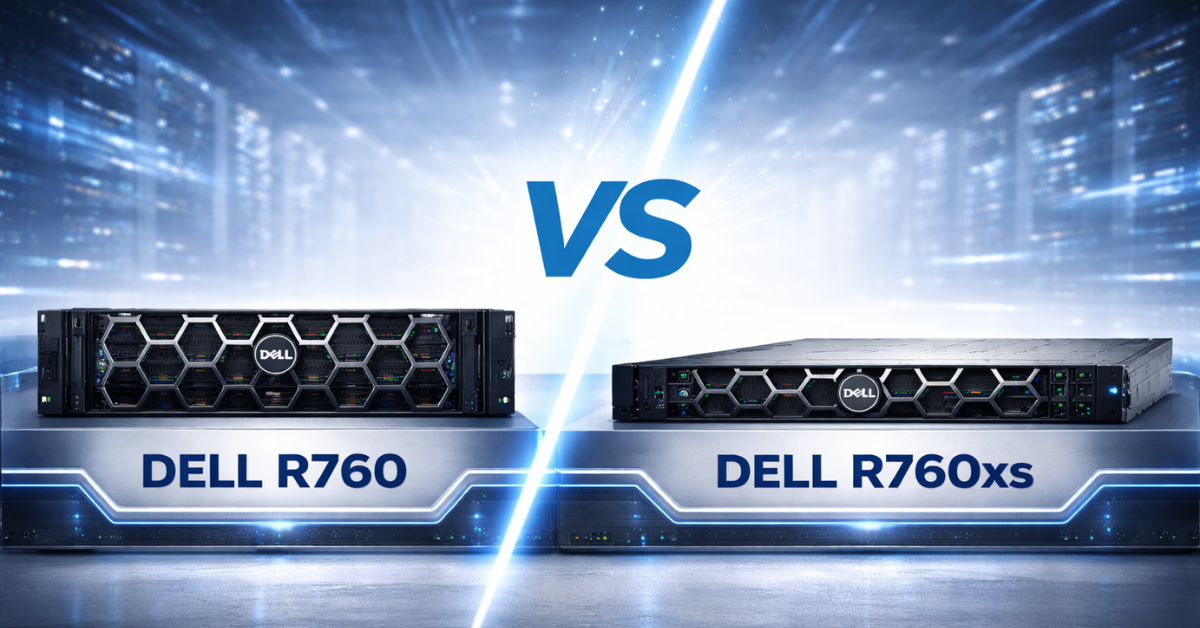
The DELL PowerEdge R760 and R760XS are two 16th generation servers that often cause confusion due to their similar naming. Both belong to the dual-processor server lineup in rack form factors, but they have fundamental differences in architecture, expansion capabilities, and target use cases. The R760 represents a universal platform for a wide range of tasks, while the R760XS is optimized for specific workloads requiring maximum computational power with limited local storage requirements.
The key distinction between these models lies in the balance between computational resources and data storage capabilities. The R760 offers up to 32 DDR5 memory slots and flexible drive bay configurations, making it ideal for virtualization, databases, and tasks requiring substantial storage capacity. The R760XS, in contrast, provides up to 16 memory slots and limited drive bay options but compensates with enhanced capabilities for accelerators and network adapters, which is critical for high-performance computing and AI/ML applications.
In this article, we'll examine the technical specifications of both models in detail, conduct a direct comparison of their capabilities, and help determine which server best suits your business needs. We'll analyze processor capabilities, memory configurations, storage options, expandability, and typical usage scenarios for each platform.
DELL R760 vs R760XS Comparison Table
| Feature | DELL PowerEdge R760 | DELL PowerEdge R760XS |
|---|---|---|
| Form Factor | 2U rack server | 1U rack server |
| Processors | Up to two 4th Gen Intel Xeon Scalable, up to 60 cores per processor | Up to two 4th Gen Intel Xeon Scalable, up to 60 cores per processor |
| Memory | 32 DDR5 slots, up to 8 TB (LRDIMM), speeds up to 4800 MHz | 16 DDR5 slots, up to 2 TB, speeds up to 4800 MHz |
| Drive Bays (Front) | Up to 24 x 2.5" SAS/SATA/NVMe or up to 12 x 3.5" SAS/SATA | Up to 10 x 2.5" SAS/SATA/NVMe or up to 4 x 3.5" SAS/SATA |
| Drive Bays (Rear) | Up to 4 x 2.5" SAS/SATA/NVMe | Up to 2 x 2.5" SAS/SATA/NVMe |
| PCIe Slots | Up to 8 PCIe Gen5 slots | Up to 3 PCIe Gen4 slots |
| GPU Support | Up to two dual-width 300W or up to six single-width 75W | Not supported |
| Power Supplies | 700W-2800W Titanium/Platinum | 600W-1400W Titanium/Platinum |
| Management | iDRAC9 | iDRAC9 |
| Primary Use Cases | Virtualization, databases, general workloads | HPC, compute clusters, high-performance networking |
DELL PowerEdge R760: Universal Business Platform

The DELL PowerEdge R760 represents the flagship model in DELL's 16th generation rack server lineup. This 2U form factor platform is designed to deliver maximum flexibility and performance across a broad spectrum of enterprise applications. The R760 excels with superior balance between computational power, storage capabilities, and expandability, making it an ideal choice for organizations requiring a versatile solution.
Key Technical Specifications
- Processors: Up to two 4th Gen Intel Xeon Scalable processors supporting up to 60 cores per processor, delivering high performance for multi-threaded applications
- Memory: 32 DDR5 DIMM slots supporting RDIMM up to 2 TB or LRDIMM up to 8 TB, data transfer speeds up to 4800 MHz, critical for memory-intensive applications
- Storage: Flexible drive bay configurations — up to 12 x 3.5" or up to 24 x 2.5" drives with SAS, SATA, and NVMe support, maximum capacity up to 368.84 TB
- Rear Drives: Additional options up to 4 x 2.5" drives for operating system or caching, maximum 61.44 TB
- Storage Controllers: PERC H755, H755N, H745, HBA355I, S150 for various performance levels and data protection
- Expandability: Up to 8 PCIe Gen5 slots with SNAP I/O module support for maximum flexibility in network adapter and accelerator configuration
- GPU Support: Up to two dual-width GPUs at 300W each or up to six single-width 75W accelerators for AI/ML tasks
- Network Adapters: Embedded 2-port 1GbE LOM with expansion options up to 25GbE/100GbE via OCP 3.0 and PCIe cards
- Power Supplies: Wide range from 700W to 2800W with Titanium and Platinum certification for optimal energy efficiency
- Cooling: Air cooling with optional processor liquid cooling for dense data centers
- Management: iDRAC9 with Quick Sync 2 for remote management and monitoring
- Dimensions: Height 86.8 mm, width 482 mm, depth 758.3 mm (without bezel) / 772.14 mm (with bezel)
Who Should Choose DELL R760
The DELL PowerEdge R760 is optimally suited for organizations requiring a universal server platform with maximum configuration flexibility. This server is ideal for virtualization environments including VMware vSphere, Microsoft Hyper-V, or Red Hat Virtualization, where high virtual machine density is critical. The large memory capacity and numerous drive bays make the R760 an excellent choice for database management systems like Oracle, Microsoft SQL Server, PostgreSQL, or MySQL that demand both high performance and storage capacity.
With GPU support and extensive PCIe capabilities, the server suits machine learning, artificial intelligence, and big data analytics tasks. The ability to install multiple NVMe drives makes it effective for Software-Defined Storage and hyperconverged infrastructures. Companies working with SAP ERP systems, customer relationship management applications, or enterprise resource planning systems will find a reliable and performant platform in the R760.
DELL PowerEdge R760XS: Compact Power for Specialized Tasks
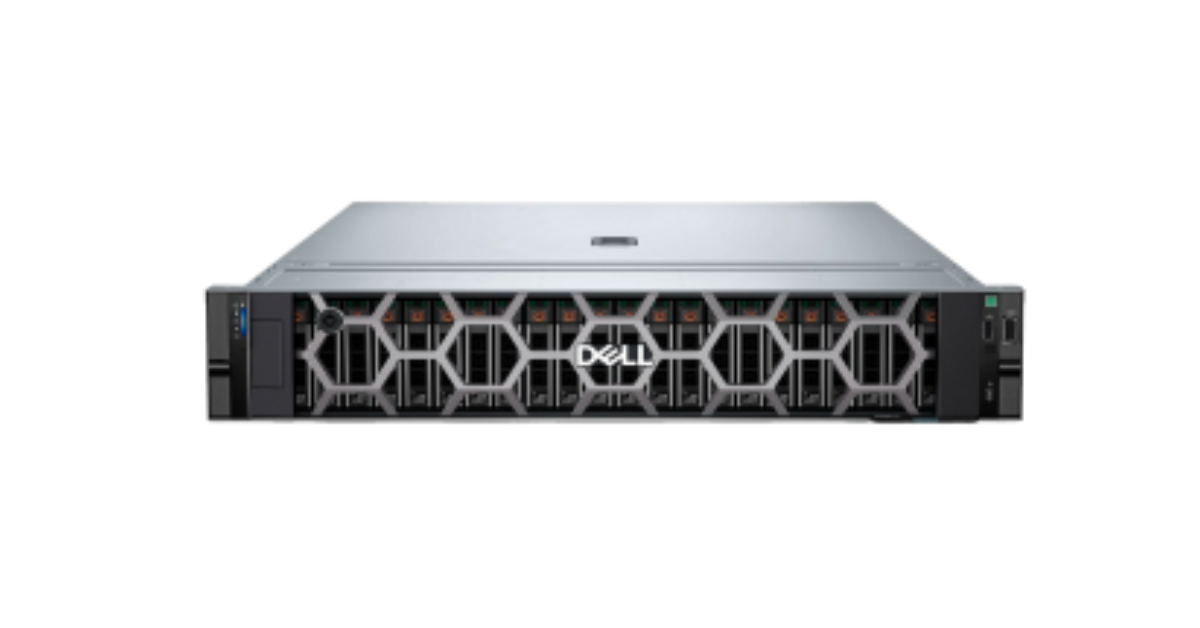
The DELL PowerEdge R760XS is designed for organizations requiring maximum compute density in a compact 1U form factor. This model represents a specialized platform optimized for high-performance computing, compute clusters, and scenarios where processor power and network performance are priorities over local storage capacity. The R760XS sacrifices some storage and expansion capabilities in favor of compactness and efficient rack space utilization.
Key Technical Specifications
- Processors: Up to two 4th Gen Intel Xeon Scalable processors supporting up to 60 cores per processor, identical to R760 in computational power
- Memory: 16 DDR5 DIMM slots supporting RDIMM up to 2 TB, speeds up to 4800 MHz — half of R760's capabilities
- Storage: Limited options — up to 10 x 2.5" or up to 4 x 3.5" drives with SAS, SATA, and NVMe support, maximum front drive capacity up to 76.8 TB
- Rear Drives: Up to 2 x 2.5" SAS/SATA/NVMe drives, maximum 15.36 TB for operating system
- Storage Controllers: PERC H755, H755N, H745, H355, H345, HBA355i, S150
- Expandability: Up to 3 PCIe Gen4 slots — significantly less than R760, but sufficient for specialized network adapters
- GPU Support: Not available due to 1U form factor limitations
- Network Adapters: Embedded 2-port 1GbE LOM with OCP 3.0 option for high-speed network connections
- Power Supplies: Range from 600W to 1400W Platinum and Titanium with hot-swap and redundancy
- Cooling: Standard air cooling with High Performance Silver or Gold fans
- Management: iDRAC9 with Quick Sync 2 for remote management
- Dimensions: Height 42.8 mm (1U), width 482 mm, depth 734.95 mm (without bezel) / 748.79 mm (with bezel)
Who Should Choose DELL R760XS
The DELL PowerEdge R760XS is ideally suited for organizations deploying large-scale compute clusters where server density per rack unit is critical. This server is optimal for high-performance computing (HPC) in scientific research, simulation, and engineering calculations where data is stored on separate storage systems while compute nodes process tasks in parallel.
The compact 1U form factor makes the R760XS an excellent choice for edge computing and distributed infrastructures where space is limited but high computational performance is required. The server suits rendering farms, financial modeling, real-time data processing, and analytical tasks using external storage systems like NetApp, Dell EMC, or Pure Storage.
With enhanced networking capabilities through OCP 3.0, the R760XS is effective for software-defined networking (SDN), virtual network functions (VNF), and telecommunications applications. Organizations building private clouds or Infrastructure as a Service (IaaS) where computational resources are separated from storage will find this model an optimal solution for compute nodes.
Detailed Capability Comparison
Processor Performance
Both models support identical 4th Gen Intel Xeon Scalable processors with Sapphire Rapids architecture, offering up to 60 cores per processor and built-in accelerators for AI and cryptography. Maximum clock frequency reaches 4.0 GHz in turbo mode for top models. Processors support Intel Turbo Boost Max 3.0, Intel Speed Select Technology, and Intel Advanced Vector Extensions 512 (AVX-512) for optimizing specialized workload performance.
In terms of computational power, the R760 and R760XS are absolutely equal. Both can be equipped with Platinum, Gold, Silver, and Bronze processor lines depending on performance requirements and budget. The difference begins in the memory subsystem and expansion capabilities, which affect the systems' ability to effectively utilize processor power in different scenarios.
Memory Subsystem
The key difference between models lies in supported memory capacity. The R760 with 32 DDR5 slots can be equipped with up to 8 TB of RAM when using 256 GB LRDIMM modules. This is critical for memory-intensive applications — high-density VM virtualization, in-memory databases like SAP HANA, Redis, or large caches for analytics systems.
The R760XS with 16 slots is limited to 2 TB maximum capacity, which is sufficient for most computational tasks but may be inadequate for consolidated virtualization environments or databases with large in-memory datasets. Both models support DDR5-4800 with registered ECC memory for data integrity.
Data Storage
In this area, the differences between models are most substantial. The R760 offers maximum flexibility with configurations up to 24 x 2.5" drives or 12 x 3.5" drives in front bays, plus up to 4 additional 2.5" rear drives. NVMe drive support enables extreme IOPS performance for high-performance databases and virtualization applications.
The R760XS is more compact and offers up to 10 x 2.5" or 4 x 3.5" front drives and 2 x 2.5" rear drives. This limitation is compensated by the ability to use external storage systems via HBA controllers or high-speed network connections to SAN/NAS. For compute clusters where storage is centralized, this is not a disadvantage.
Expandability and Accelerators
The R760 dominates in the expandability category with up to 8 PCIe Gen5 slots, allowing installation of multiple accelerators, network adapters, or specialized cards. Support for up to two dual-slot NVIDIA A100, A40 GPUs or up to six single T4 makes this server a universal platform for AI inference, machine learning model training, and graphics computing.
The R760XS is limited to 3 PCIe Gen4 slots and doesn't support GPUs due to power and cooling limitations of the 1U form factor. However, these slots can be used for high-performance 100GbE or 200GbE network adapters, InfiniBand, or specialized FPGA accelerators for financial computing or streaming data processing.
Power Consumption and Cooling
The R760 requires higher wattage power supplies — up to 2800W Titanium for configurations with multiple GPUs and drives. The 2U form factor provides superior air cooling with optional processor liquid cooling for dense data centers. This maintains stable temperatures even under maximum load.
The R760XS is more energy-efficient with power supplies up to 1400W, reflecting lower power requirements due to absent GPUs and fewer drives. Cooling in a 1U chassis is more aggressive, which can lead to increased noise levels, but modern High Performance Gold fans minimize this issue.
Choosing Between R760 and R760XS
Choose DELL PowerEdge R760 if you need:
- Maximum RAM capacity up to 8 TB for high-density virtualization or in-memory databases
- Large local storage up to 368 TB for databases, file servers, or virtual machine storage systems
- GPU support for machine learning, AI inference, graphics computing, or CUDA applications
- Multiple PCIe Gen5 slots for network adapters, accelerators, and specialized cards
- Universal platform for consolidating various workloads — databases, virtualization, applications
- Flexibility in storage configuration choice — SAS, SATA, or NVMe in various combinations
- Optional liquid cooling for dense data centers with elevated thermal management requirements
Choose DELL PowerEdge R760XS if you need:
- Maximum compute node density per rack unit in 1U format
- Compute cluster for HPC tasks with centralized storage on SAN/NAS
- Edge computing solutions with limited physical space but high performance requirements
- Specialized network functions with high-performance 100GbE/200GbE network adapters
- Financial modeling, rendering, scientific computing where data arrives over the network
- Reduced power consumption compared to larger form factors
- Distributed infrastructures with multiple small locations requiring compact servers
General Selection Criteria
When choosing between R760 and R760XS, the key factor is the balance between local storage and compute density. If your infrastructure assumes storage-compute disaggregation and you have centralized storage systems, the R760XS will provide greater compute density with lower costs for rack space and cooling.
If you require consolidation — combining compute, memory, and storage in one system — the R760 is the obvious choice. Its versatility enables deploying hyperconverged infrastructures where each node contains a complete resource set. This is especially relevant for medium organizations without separate SANs or for branch offices with autonomous infrastructure.
Budget considerations also play a role. The R760XS is often cheaper in base configuration due to fewer components, but final cost depends on specific processor, memory, and network adapter requirements. It's important to evaluate total cost of ownership, including power consumption, cooling, and rack space over a 3-5 year server lifecycle.
Conclusion
The DELL PowerEdge R760 and R760XS represent two different approaches to server architecture within the same generation. The R760 is a universal workhorse for a broad spectrum of enterprise applications, offering maximum flexibility in memory, storage, and expansion configuration. Its 2U form factor and support for up to 8 TB of memory make it ideal for virtualization, databases, and storage-intensive tasks.
The R760XS, in contrast, is optimized for specialized scenarios where compute density is the priority and storage is centralized on external systems. Its compact 1U form factor is ideal for HPC compute clusters, edge computing, and situations where maximizing compute nodes per rack is important with limited budget for space and cooling.
The choice between these models should be based on careful analysis of your current and future needs. Evaluate local storage requirements, GPU accelerator necessity, RAM volume for your applications, and your infrastructure architecture. Both models offer superior Intel Xeon 4th Gen processor performance, but their different architectures make them optimal for different tasks.
For detailed configuration and pricing consultation, contact ServerMall specialists. We'll help select the optimal server configuration for your specific business tasks and budget, ensuring maximum efficiency of your server infrastructure investment.