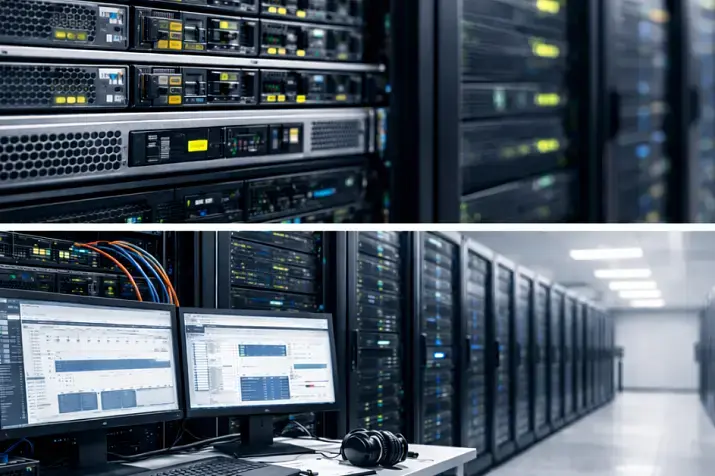
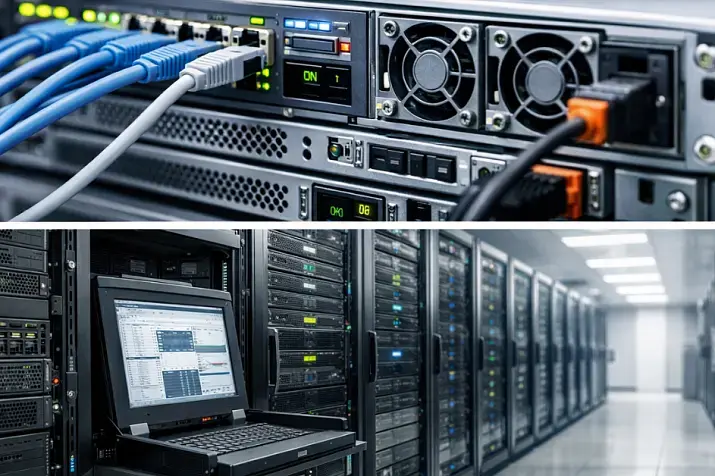
The DELL PowerEdge R420 and R620 Gen 14 servers represent two popular models that continue to see active deployment in corporate infrastructure. The primary difference between them lies in form factor and scalability: the R420 is a compact 1U server supporting up to two processors and 12 memory slots, while the R620 is also a 1U solution but with extended capabilities up to 24 memory slots and more flexible storage configuration. Both servers are built on Intel Xeon E5-2400 v2 series processors, but the R620 supports more powerful E5-2600 v2 series processors.
Choosing between DELL R420 and R620 largely depends on the specific requirements of your IT infrastructure. The R420 is ideally suited for small to medium businesses requiring a reliable server for entry-level virtualization, web hosting, or file services. This model offers more affordable pricing while maintaining sufficient performance for most typical business tasks. The R620, in turn, is oriented towards more demanding workloads: extended virtualization with a large number of virtual machines, database servers with intensive memory operations, and enterprise applications requiring high compute density.
In this comprehensive comparison, we'll examine the technical specifications of both models, their advantages and disadvantages, optimal use scenarios, and help you make an informed decision about choosing a server for your business. The analysis covers processor capabilities, memory configurations, storage options, energy efficiency, and total cost of ownership for these servers.
DELL R420 vs R620 Comparison Table
| Feature | DELL PowerEdge R420 | DELL PowerEdge R620 |
|---|---|---|
| Form Factor | 1U Rack | 1U Rack |
| Processors | Up to 2x Intel Xeon E5-2400 v2 (up to 10 cores) | Up to 2x Intel Xeon E5-2600 v2 (up to 12 cores) |
| Memory Slots | 12 DIMM slots | 24 DIMM slots |
| Maximum Memory | 384 GB (12 x 32 GB) | 768 GB (24 x 32 GB) |
| Memory Type | DDR3 up to 1866 MHz | DDR3 up to 1866 MHz |
| Drive Bays | Up to 4x 3.5" or 8x 2.5" | Up to 4x 3.5" or 10x 2.5" |
| Storage Controllers | PERC H310, H710, H710P | PERC H310, H710, H710P, H810 |
| PCIe Slots | 2 PCIe 3.0 slots | 2 PCIe 3.0 slots |
| Network Ports | 4x 1GbE (integrated) | 4x 1GbE (integrated) |
| Power Supplies | 350W, 550W (Hot-plug) | 495W, 750W (Hot-plug) |
| Management | iDRAC7 Express/Enterprise | iDRAC7 Express/Enterprise |
| Depth | ~660 mm | ~724 mm |
| Optimal Use Cases | Small to medium business, web hosting, file services, entry-level virtualization | Virtualization, databases, enterprise applications, VDI, high-performance computing |
DELL PowerEdge R420: Overview and Specifications
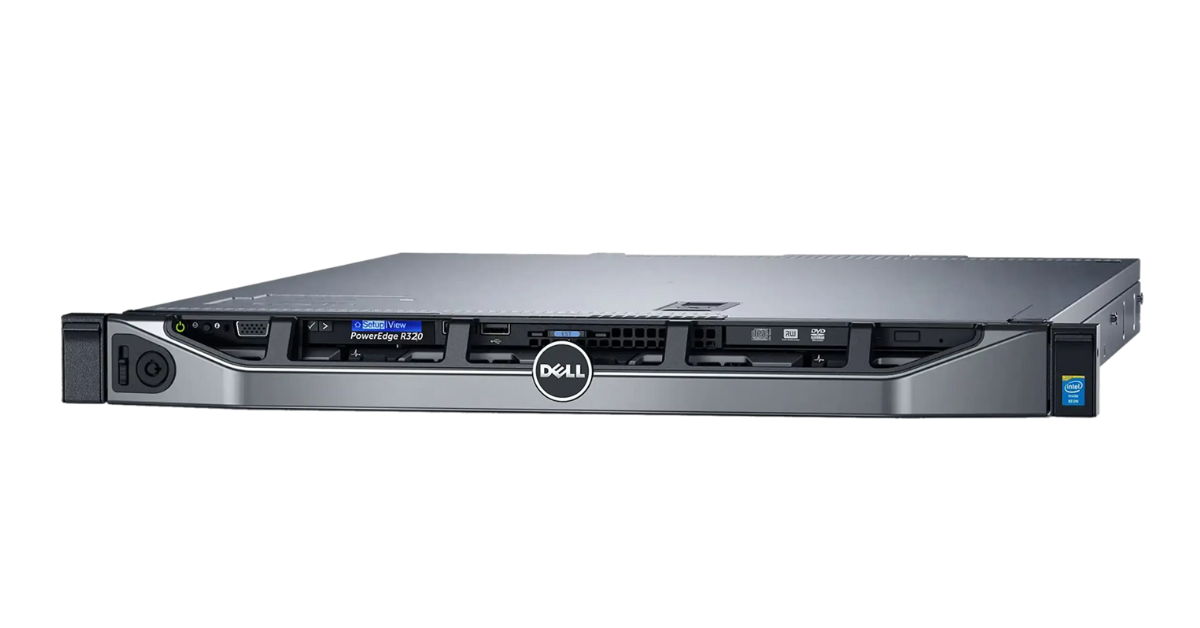
The DELL PowerEdge R420 is a compact single or dual-processor 1U rack server designed for small to medium businesses. The model is built on Intel Xeon E5-2400 v2 series processors, providing an excellent balance between performance and energy efficiency. The server supports up to 12 DDR3 memory modules, allowing a maximum memory capacity of 384 GB using 32 GB modules each.
DELL R420 Technical Specifications
- Processor: Up to 2x Intel Xeon E5-2400 v2 (6-10 cores per processor, frequency up to 3.0 GHz)
- Memory: 12 DIMM slots, DDR3 RDIMM/LRDIMM support up to 1866 MHz, maximum 384 GB
- Storage: Up to 4x 3.5" SAS/SATA or up to 8x 2.5" SAS/SATA (HDD/SSD)
- RAID Controllers: PERC H310, H710, H710P (512 MB - 1 GB cache)
- Network: Integrated 4-port 1GbE Broadcom 5720 controller
- Expansion Slots: 2x PCIe 3.0 (1x8 and 1x16 slots)
- Power: Single or redundant 350W/550W Hot-plug PSU
- Management: iDRAC7 Express or Enterprise with Lifecycle Controller
- Dimensions: 43.4 x 43.4 x 66.0 cm (W x H x D)
- Weight: Approximately 15-18 kg (depending on configuration)
Who Should Choose DELL R420
The DELL PowerEdge R420 is an optimal choice for organizations with limited budgets requiring a reliable server solution for basic tasks. The server excels in roles such as domain controller, file server, email server for small companies (up to 50-100 users), web server for sites with moderate traffic, and application server for internal business systems.
The model is also suitable for entry-level virtualization using VMware ESXi, Microsoft Hyper-V, or Citrix XenServer, enabling the operation of 10-15 virtual machines depending on configuration. The R420 is particularly popular among small to medium enterprises, educational institutions, small data centers, and IT companies providing basic hosting services.
DELL PowerEdge R620: Overview and Specifications

The DELL PowerEdge R620 represents a more powerful solution in the Gen 14 1U server lineup. Built on Intel Xeon E5-2600 v2 series processors, this server offers significantly higher performance and scalability compared to the R420. The key advantage of the R620 lies in its support for up to 24 DDR3 memory modules, allowing a maximum memory capacity of 768 GB—double that of the junior model.
DELL R620 Technical Specifications
- Processor: Up to 2x Intel Xeon E5-2600 v2 (6-12 cores per processor, frequency up to 3.5 GHz)
- Memory: 24 DIMM slots, DDR3 RDIMM/LRDIMM support up to 1866 MHz, maximum 768 GB
- Storage: Up to 4x 3.5" SAS/SATA or up to 10x 2.5" SAS/SATA (HDD/SSD)
- RAID Controllers: PERC H310, H710, H710P, H810 (512 MB - 2 GB cache)
- Network: Integrated 4-port 1GbE Broadcom 5720 controller with optional 10GbE adapters
- Expansion Slots: 2x PCIe 3.0 (configuration depends on drive bay model)
- Power: Redundant 495W/750W Hot-plug PSU with Titanium efficiency option
- Management: iDRAC7 Express or Enterprise with advanced monitoring features
- Dimensions: 43.4 x 43.4 x 72.4 cm (W x H x D)
- Weight: Approximately 18-22 kg (depending on configuration)
Who Should Choose DELL R620
The DELL PowerEdge R620 is oriented towards organizations with higher performance and scalability requirements. The server is ideally suited for large-scale virtualization, enabling 30-50 and more virtual machines thanks to increased memory capacity and more powerful processors. The R620 excellently handles database server roles (Microsoft SQL Server, Oracle Database, MySQL, PostgreSQL) with medium to high loads, where large memory capacity is critical for data caching.
The model is also popular for deploying VDI (Virtual Desktop Infrastructure) solutions based on VMware Horizon or Citrix Virtual Apps and Desktops, serving up to 100-150 virtual desktops. The R620 is suitable for Enterprise-class corporate applications (ERP, CRM systems), data processing and analytics servers, and as nodes in high-performance clusters. This server is chosen by medium to large enterprises, financial organizations, medical institutions with demanding applications, and cloud service providers.
Detailed Comparison of DELL R420 and R620
Processor Architecture and Performance
One of the key differences between DELL R420 and R620 lies in the supported processors. The R420 uses Intel Xeon E5-2400 v2 series processors, which represent entry to mid-level solutions with core counts from 4 to 10 and base frequencies from 1.8 to 3.0 GHz. These processors use the LGA 1356 socket and have a single-channel DDR3 memory controller.
The R620, on the other hand, is equipped with more powerful Intel Xeon E5-2600 v2 series processors using the LGA 2011 socket. These CPUs offer 6 to 12 cores per processor with base frequencies up to 3.5 GHz and support Intel Turbo Boost 2.0, Hyper-Threading, and a wider instruction set. E5-2600 v2 processors have a quad-channel memory controller, providing significantly higher memory bandwidth—a critically important factor for applications working with large data volumes.
In practice, the performance difference between top configurations of R420 and R620 can reach 40-60% in multi-threaded tasks, making the R620 substantially more powerful for virtualization and database servers.
Memory Subsystem
Memory architecture is another area where the R620 has a significant advantage. Thanks to the quad-channel memory controller of E5-2600 v2 processors and 24 DIMM slots (12 per processor), the R620 can achieve a maximum memory capacity of 768 GB using 32 GB modules. Moreover, the four-channel architecture per processor provides memory bandwidth up to 59.7 GB/s per processor when using DDR3-1866 modules.
The DELL R420 with its 12 memory slots and single-channel controller is limited to a maximum capacity of 384 GB and lower memory bandwidth. For most basic tasks, this is quite sufficient, but when working with memory-intensive applications—such as large databases, big data processing systems, or massive virtualization—the advantage of the R620 becomes apparent.
It's important to note that both servers support Advanced ECC, memory sparing, and memory mirroring technologies, ensuring high reliability for critical applications.
Storage Configurations
In the storage area, both servers offer flexible options with slight differences. The R420 supports up to 4 drives in 3.5" format or up to 8 drives in 2.5" format in the front panel. This allows creating storage up to 32 TB (4x8 TB HDD) or a more compact but performant configuration with SSD drives.
The R620 offers a similar configuration with 3.5" drives (up to 4), but in the 2.5" drive variant supports up to 10 devices instead of 8. These additional two slots can be critically important when building RAID arrays with enhanced performance or when needing to separate data across different disk sets. Additionally, the R620 supports the more advanced PERC H810 RAID controller with 2 GB cache memory and external disk array support.
Both servers support RAID levels 0, 1, 5, 6, 10, 50, and 60, providing flexibility in configuring storage performance and fault tolerance. Hot-swap drive options and additional internal boot drives are also available.
Network Capabilities and Expandability
Both servers are equipped with an integrated 4-port Broadcom 5720 network adapter with 1 Gigabit Ethernet ports, providing reliable network connectivity and channel aggregation capabilities for increased throughput or fault tolerance organization. However, in both cases, additional network adapters can be added through PCIe slots, including 10 Gigabit Ethernet adapters for high-speed network connections.
In terms of expansion slots, the servers are roughly equal—both offer 2 PCIe 3.0 slots, but the specific configuration (slot size and bandwidth) may vary depending on the chosen drive bay. This allows adding various adapters: additional network cards, HBA adapters for connecting external storage systems, GPUs for specialized tasks, or other PCI expansion cards.
Management and Monitoring
Both servers are equipped with iDRAC7 (integrated Dell Remote Access Controller) remote management technology, available in two versions: Express (basic) and Enterprise (advanced). iDRAC7 Enterprise provides full-featured remote server access, including virtual console, virtual media devices, power management capabilities, and detailed monitoring of all server components.
Lifecycle Controller—an integrated server lifecycle management system—is present in both models and provides ease of deployment, updates, and maintenance without needing to boot the operating system. This significantly simplifies server infrastructure administration and reduces downtime during maintenance.
Power Consumption and Efficiency
The R420 offers power supplies of 350W or 550W with efficiency certification up to Platinum (up to 94% efficiency). This makes the server relatively economical to operate, especially in basic configurations with one processor and minimal drives.
The R620 uses more powerful power supplies—495W or 750W, also with certification up to Platinum and even Titanium (up to 96% efficiency) in some models. Despite higher nominal power, modern power management technologies allow the server to consume energy efficiently, scaling consumption according to actual load.
It's important to consider that in fully loaded configurations (two processors, maximum memory, all drive slots filled), the R620 will consume more energy than the R420, but the performance difference justifies this increased consumption for demanding tasks.
Physical Dimensions and Installation
Both servers have a 1U rack-mount form factor, allowing efficient use of space in the server rack. However, the R620 is slightly deeper—approximately 724 mm versus 660 mm for the R420. This difference is due to more complex internal architecture, additional memory slots, and more advanced cooling systems.
When planning installation, it's important to consider not only the server height (1U) but also its depth to ensure compatibility with standard or shortened server cabinets. Server weights also differ—the R620 is typically 3-4 kg heavier in similar configurations, which should be considered during mounting.
Price and Total Cost of Ownership
In terms of initial cost, the DELL R420 is traditionally more affordable, especially on the secondary market. The price of a refurbished R420 is typically 20-30% lower than a similarly equipped R620. This makes the R420 an attractive choice for organizations with limited budgets or for projects where maximum performance isn't required.
However, when evaluating total cost of ownership (TCO), it's important to consider not only initial price but also operating costs. The R620 with its higher performance per watt may prove more economical in the long term for demanding tasks where multiple R420 servers would be needed to achieve similar performance.
Recommendations for Choosing Between DELL R420 and R620
Choose DELL R420 if:
- You have a limited budget and need the most cost-effective price/performance solution
- Planned use includes basic tasks: file server, domain controller, email server for small organization
- A server is needed for web hosting sites with moderate traffic
- Entry-level virtualization with 10-15 virtual machines is required
- Memory capacity up to 384 GB is sufficient for your tasks
- The company is developing a small IT infrastructure or this is the first server in the organization
- There are no critical requirements for maximum processor performance
- Planned use in educational institutions or for laboratory purposes
Choose DELL R620 if:
- High performance is required for virtualizing 30-50+ virtual machines
- Planned use as a database server with medium to high load
- Large memory capacity is necessary (more than 384 GB, up to 768 GB)
- The server will be used for VDI solutions with a large number of virtual desktops
- More powerful processors are required for resource-intensive applications
- Planned deployment of Enterprise-class corporate applications (SAP, Oracle E-Business Suite, etc.)
- Higher memory bandwidth is needed for big data processing tasks
- Additional disk space is required (10 drives instead of 8 in 2.5" configuration)
- The server will be used in critical systems where maximum performance and reliability are important
- Long-term operation with gradual resource scaling is planned
Selection Criteria Based on Use Scenarios
For Small Business (up to 50 employees)
Recommendation: DELL R420 — optimal choice for companies needing their first or only server. A single R420 with 1-2 processors, 64-128 GB memory, and 4-8 drives is sufficient for Active Directory, file services, Exchange Server for a small organization, simple virtualization (3-5 VMs), and internal business applications.
For Medium Business (50-250 employees)
Recommendation: DELL R620 — more suitable solution, as medium businesses typically have more complex IT infrastructure with multiple virtual machines, more demanding applications, and databases. An R620 with 256-512 GB memory will provide comfortable operation of 20-40 virtual machines and handle more intensive database loads.
For Virtualization
DELL R420: Suitable for entry-level virtualization (VMware vSphere Essentials, Microsoft Hyper-V Server) with 10-15 small virtual machines. Ideal for test environments, development environments, or small production environments with moderate load.
DELL R620: Optimal for serious virtualization (VMware vSphere Enterprise Plus, Microsoft Hyper-V with advanced features) with 30-50 virtual machines of varying load. Suitable for production environments, critical applications, and dense server consolidation.
For Databases
DELL R420: Will handle small to medium databases (up to 200-300 GB), small number of concurrent connections (up to 100-200 sessions), and moderate transaction load. Suitable for MySQL, PostgreSQL, MS SQL Server Express/Standard for small applications.
DELL R620: Optimal for medium to large databases (500 GB - 2 TB+), large number of concurrent connections (500+ sessions), high transaction load. Ideal for MS SQL Server Enterprise, Oracle Database, large PostgreSQL databases, MySQL with intensive read/write operations.
For Web Hosting and Cloud Services
DELL R420: Good choice for shared hosting, hosting small to medium web applications, entry-level VPS hosting (20-30 VPS containers), and small cloud services.
DELL R620: Suitable for resource-intensive web applications, medium-scale VPS/VDS hosting (50-100 containers), private cloud solutions, and SaaS platforms with multiple clients.
For Remote Desktop Services (RDS) / VDI
DELL R420: Can serve 20-40 remote desktops depending on configuration and user workload type (light office work). Suitable for small RDS deployments or basic VDI solutions.
DELL R620: Capable of serving 80-150 remote desktops with comfortable performance. Optimal for full VDI deployments based on VMware Horizon, Citrix Virtual Apps and Desktops, or Microsoft Azure Virtual Desktop.
Real-World Performance
Test Configurations
For more objective comparison, let's consider typical configurations of both servers:
DELL R420 (Typical Configuration):
- 2x Intel Xeon E5-2450 v2 (8 cores, 2.5 GHz, 20 MB cache)
- 128 GB RAM (8x 16 GB DDR3-1600 RDIMM)
- 4x 2 TB 7.2K SAS HDD in RAID 10
- PERC H710 512 MB controller
- Dual Hot-plug PSU 550W
DELL R620 (Typical Configuration):
- 2x Intel Xeon E5-2680 v2 (10 cores, 2.8 GHz, 25 MB cache)
- 256 GB RAM (16x 16 GB DDR3-1866 RDIMM)
- 6x 900 GB 10K SAS HDD in RAID 10
- PERC H710P 1 GB controller
- Dual Hot-plug PSU 750W
Performance Results
In synthetic processor performance benchmarks (PassMark, Geekbench), the R620 with E5-2680 v2 processors shows results approximately 50% higher than the R420 with E5-2450 v2. In multi-threaded tasks, the advantage is even more pronounced due to higher core count (20 cores / 40 threads versus 16 cores / 32 threads).
In memory performance tests, the R620 demonstrates bandwidth of about 50-55 GB/s per processor using DDR3-1866, while the R420 achieves 25-30 GB/s. This difference is critically important for applications working with large data volumes in memory, such as in-memory databases, analytics systems, and high-density VM virtualization.
In disk subsystem performance tests, results depend on RAID configuration and disk types. Using similar disks and RAID controllers, the difference is minimal, however the R620 with H710P controller (1 GB cache) shows better results in random read/write operations compared to the R420 with H710 (512 MB cache).
Virtualization — Practical Tests
In virtualization tests using VMware vSphere:
- R420: Comfortably handles 12-15 Windows Server 2019 virtual machines (8 GB RAM each) with moderate CPU load around 30-40%. When increasing VM count to 20, noticeable performance degradation and increased latency are observed.
- R620: Confidently processes 35-40 Windows Server 2019 virtual machines (8 GB RAM each) with CPU load of 50-60%. Thanks to larger memory capacity, up to 50 VMs can be run under lighter load or a larger number of Linux containers.
Database — Real Performance
In tests with Microsoft SQL Server 2019:
- R420: Successfully handles a 150 GB database with loads up to 100-150 transactions per second. Allocating 64 GB memory to SQL Server achieves good query caching levels. Complex report execution time is 10-15 seconds.
- R620: Processes a 500 GB database with loads of 300-400 transactions per second. Allocating 192 GB memory to SQL Server allows most active data to be stored in memory, significantly accelerating query execution. Similar complex reports execute in 4-6 seconds.
Upgrade Capabilities and Compatibility
Component Upgrades
Both servers allow gradual modernization, which is important for organizations planning to start with basic configurations and expand capabilities as requirements grow.
Processors: In the R420, you can start with a single E5-2430 v2 processor and later add a second processor or replace with a more powerful E5-2470 v2. In the R620, you can similarly start with E5-2620 v2 and upgrade to E5-2690 v2 or E5-2697 v2 for maximum performance.
Memory: Both servers allow gradual addition of memory modules. The R420 can start with 32-64 GB and expand to 384 GB, while the R620 can start with 64-128 GB and expand to 768 GB.
Storage: Drive bays in both servers support hot-swap, allowing drives to be added or replaced without system shutdown. HDD to SSD replacement for performance improvement is also possible.
Network Equipment: Through PCIe slots, 10GbE, 25GbE, or even 40GbE network adapters can be added for high-speed connectivity to storage networks or increased network throughput.
Operating System Compatibility
Both servers support a wide range of operating systems:
- Windows: Windows Server 2012/2012 R2, 2016, 2019, 2022
- Linux: Red Hat Enterprise Linux 6.x-9.x, SUSE Linux Enterprise Server 11-15, Ubuntu Server 14.04-22.04, CentOS 6-8, Debian 8-11
- Virtualization: VMware vSphere/ESXi 5.5-8.0, Microsoft Hyper-V Server 2012-2022, Citrix XenServer 7.x-8.x, Proxmox VE
- Unix: FreeBSD, Oracle Solaris (some versions)
It's important to check specific driver versions and compatibility with RAID controllers before deployment. DELL provides regular driver and firmware updates through their support portal.
Maintenance and Technical Support
Ease of Maintenance
Both servers are designed with serviceability in mind. All major components—drives, power supplies, fans—support hot-swap and are easily accessible. Memory modules and PCIe cards are also easily installed and removed without special tools.
Diagnostic LED indicators on front and rear panels help quickly identify component issues. The integrated iDRAC7 system provides detailed information about all server component states and can proactively alert about potential problems before they occur.
Spare Parts Availability
Given that both models belong to DELL's Gen 14 servers (released in 2012-2014), they are in End of Life (EOL) status, and DELL no longer provides official technical support. However, on the secondary market and with specialized refurbished equipment suppliers (such as ServerMall), a wide selection of spare parts and components for both models is available.
The most frequently replaced components—power supplies, fans, hard drives—are readily available and relatively inexpensive. More specific components such as system boards or processors can also be found, though with less availability.
Third-Party Support
Many companies specializing in server equipment maintenance offer support contracts for Gen 14 DELL servers. These contracts can include defective component replacement, preventive maintenance, and technical support. The cost of such contracts is typically significantly lower than official DELL support for new models, making server operation more economical.
Security and Compliance Standards
Built-in Security Features
Both servers include multiple levels of protection:
- TPM (Trusted Platform Module) 1.2: Hardware module for secure storage of cryptographic keys and system integrity assurance
- Secure Boot: Technology ensuring only signed and verified operating system components boot
- iDRAC7 Security: Encrypted connection for remote management, multi-level access rights, logging of all administrator actions
- Lockdown Mode: Lock mode prevents unauthorized BIOS and firmware configuration changes
Standards Compliance
DELL PowerEdge Gen 14 servers are certified to multiple international standards:
- FCC Class A, CE Mark, VCCI, C-Tick (electromagnetic compatibility)
- UL, CSA, EN 60950, IEC 60950 (equipment safety)
- Energy Star (energy efficiency)
- FIPS 140-2 Level 2 (cryptographic module)
- Common Criteria EAL2+ (information security)
These certifications ensure compliance with various industry regulations and security standards.
Conclusion
DELL PowerEdge R420 and R620 are proven Gen 14 server solutions, each with its own strengths and optimal application scenarios. The choice between them should be based on your business's specific requirements, budget, and future IT infrastructure development plans.
DELL R420 represents an excellent solution for organizations with limited budgets requiring a reliable server for basic tasks. Its total cost of ownership is lower, power consumption is less, and performance is sufficient for most typical small to medium business tasks. If your company is just starting to build IT infrastructure or needs a server for non-critical applications, the R420 is a reasonable choice.
DELL R620 is a more powerful and scalable platform that justifies its higher cost with improved performance and extended capabilities. For organizations working with resource-intensive applications, large databases, or requiring high-density virtualization, the R620 will provide comfortable operation and performance headroom for years to come.
It's important to remember that both models are from 2012-2014 equipment and are in End of Life status. Nevertheless, due to quality construction, component reliability, and spare parts availability on the secondary market, these servers continue to successfully operate in thousands of organizations worldwide. When purchasing refurbished equipment from reliable suppliers, you get a tested and verified solution at an attractive price.
Ready to choose the right server for your business? Explore our catalog of DELL PowerEdge R420 and DELL PowerEdge R620 refurbished servers with quality guarantees and technical support. Our specialists will help you select the optimal configuration for your tasks and budget.