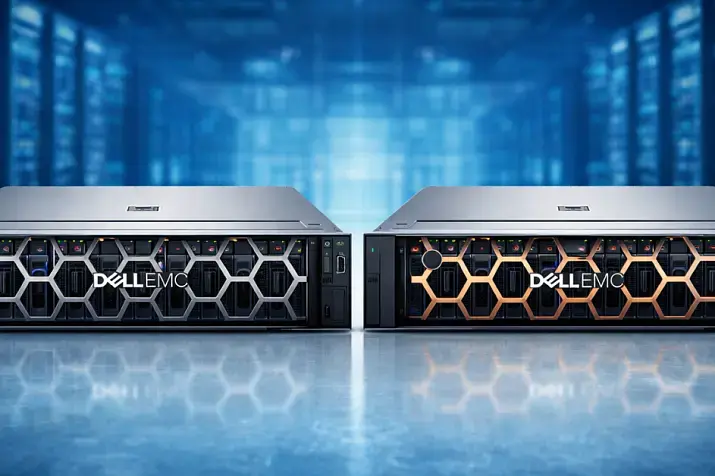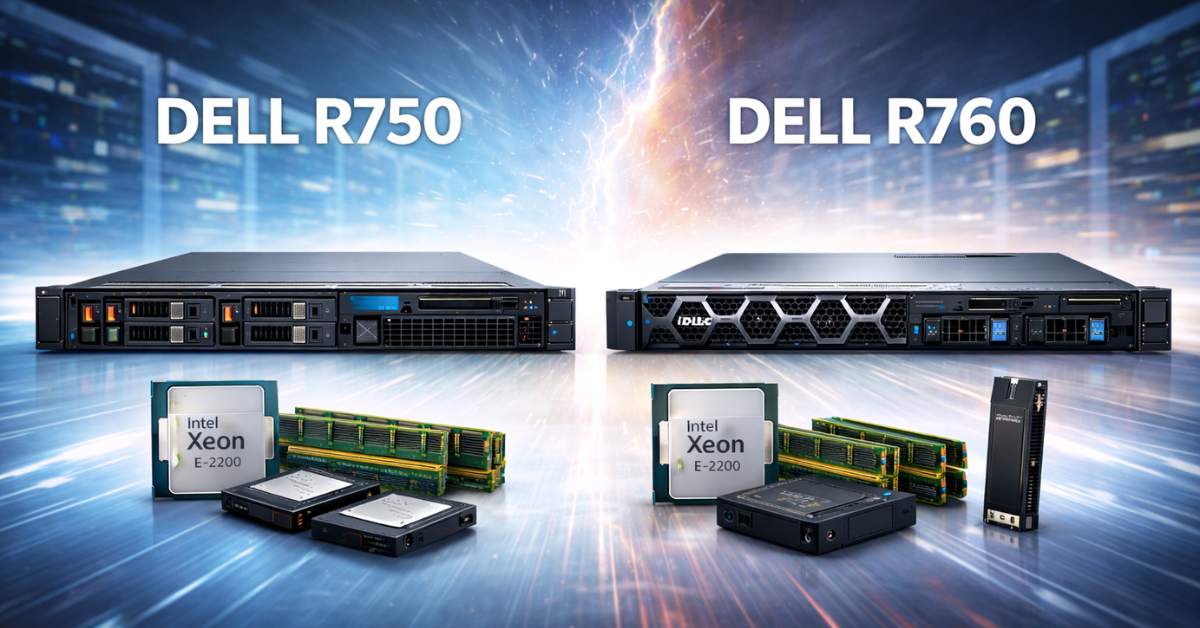
When choosing between DELL PowerEdge R750 and R760, organizations face a critical decision: invest in the proven 15th generation solution or embrace the cutting-edge technologies of the 16th generation. The fundamental difference between these models lies in processor support and memory type: R750 operates with 3rd Gen Intel Xeon Scalable processors and DDR4 memory, while R760 supports 4th and 5th Gen Intel Xeon Scalable processors with DDR5 memory.
Both servers utilize a 2U form factor and are designed for medium to high-intensity enterprise workloads. DELL PowerEdge R750 has established itself as a reliable workhorse for virtualization, databases, and web applications. DELL PowerEdge R760 represents the next evolutionary step, offering improved performance per watt and faster memory support, which is critical for modern high-load applications.
In this comprehensive guide, we'll analyze the technical specifications of both models in detail, examine their applicability for various use cases, and help you make an informed decision based on your specific business requirements and budget constraints.
Server Comparison Table
| Model | Processor | Memory | Storage | Use Cases |
|---|---|---|---|---|
| DELL PowerEdge R750 | Up to 2x Intel Xeon Scalable 3rd Gen (up to 40 cores) | DDR4: up to 2TB RDIMM / 4TB LRDIMM, 3200 MT/s | Up to 24x 2.5" or 12x 3.5" (max 368TB) | Virtualization, databases, VDI, web applications |
| DELL PowerEdge R760 | Up to 2x Intel Xeon Scalable 4th/5th Gen (up to 40 cores) | DDR5: up to 8TB, 4800 MT/s | Up to 24x 2.5" or 12x 3.5" (max 368TB) | AI/ML, HPC, modern virtualization |
DELL PowerEdge R750

The DELL PowerEdge R750 server represents a versatile solution for enterprise data centers, built on Intel Xeon Scalable third-generation processors. This 2U rack server delivers an optimal balance between computing power, expandability, and total cost of ownership.
Technical Specifications
- Processors: Up to two Intel Xeon Scalable 3rd Gen with maximum 40 cores per processor
- Memory: 32 DDR4 DIMM slots, RDIMM support up to 2TB or LRDIMM up to 4TB, speeds up to 3200 MT/s; up to 16 Intel Persistent Memory 200 series slots (8TB max)
- Storage Controllers: PERC H745, H755, H755N, HBA355I, S150, H345; BOSS-S1/S2 for boot
- Drive Bays: Front: up to 12x 3.5", up to 8x 2.5" NVMe, up to 16x 2.5" SAS/SATA/NVMe, up to 24x 2.5" SAS/SATA/NVMe; Rear: up to 2x or 4x 2.5"
- Power Supplies: 800W Platinum, 1100W Titanium, 1400W Platinum, 1100W DC (-48 to -60V)
- Cooling System: Air cooling, optional processor liquid cooling; up to 6 hot-plug fans
- Expansion Slots: Up to 8x PCIe Gen4 (up to 6x x16) with SNAP I/O module support
- Network Adapters: 2x 1GbE LOM, optional OCP 3.0 (x8 PCIe lanes)
- GPU: Up to two dual-width 300W, or four single-width 150W, or six single-width 75W accelerators
- Management: iDRAC9 with Lifecycle Controller, Quick Sync 2
- Dimensions: 86.8mm (H) x 482mm (W) x 758.3mm (D) without bezel
Ideal For
DELL PowerEdge R750 is perfect for organizations requiring:
- Reliable platform for VMware, Hyper-V, or KVM virtualization supporting hundreds of virtual machines
- High-performance solution for relational databases (Oracle, SQL Server, PostgreSQL)
- Application server for ERP systems (SAP, Microsoft Dynamics) and business applications
- VDI infrastructure for hundreds of concurrent users
- Containerization platform (Kubernetes, Docker Swarm)
DELL PowerEdge R760

The DELL PowerEdge R760 model marks a new era in DELL server technology, integrating fourth and fifth-generation Intel processors with DDR5 memory. This solution targets organizations requiring maximum performance and ready to invest in cutting-edge technologies.
Technical Specifications
- Processors: Up to two Intel Xeon Scalable 4th/5th Gen with maximum 40 cores per processor
- Memory: 32 DDR5 DIMM slots, support up to 8TB maximum, speeds up to 4800 MT/s; supports registered ECC DDR5 DIMMs only
- Storage Controllers: PERC H745, H755, H755N, HBA355I, S150, H345; BOSS-S2 (2x M.2 SSD 240GB or 480GB); external PERC H840, HBA355E
- Drive Bays: Identical to R750 - up to 24x 2.5" or 12x 3.5" front, up to 4x 2.5" rear
- Power Supplies: 700W Titanium HLAC, 800W Platinum, 1100W Titanium, 1400W Platinum, 1800W Titanium HLAC, 2400W Platinum, 2800W Titanium HLAC
- Cooling System: Air cooling, optional liquid cooling; standard/high-performance SLVR/GOLD fans; up to 6 hot-plug fans
- Expansion Slots: Similar to R750 - up to 8x PCIe Gen4
- Network Adapters: 2x 1GbE integrated
- GPU: Support similar to R750
- Management: iDRAC9, iDRAC Service Module, Quick Sync 2
- Dimensions: 86.8mm (H) x 482mm (W) x 758.3mm (D) without bezel
Ideal For
DELL PowerEdge R760 is designed for organizations with requirements for:
- Big data processing and real-time analytics
- Machine learning and artificial intelligence (TensorFlow, PyTorch)
- High-performance computing (HPC) and scientific calculations
- Modern cloud infrastructure with energy efficiency requirements
- Performance-critical in-memory databases (SAP HANA)
Key Differences Between R750 and R760
Processor Generation and Performance
The primary distinction lies in supported processors. R750 utilizes 3rd Gen Intel Xeon processors (Ice Lake), while R760 supports 4th (Sapphire Rapids) and 5th generation. The newer processors in R760 offer:
- 15-20% performance improvement in multi-threaded workloads
- Up to 30% better performance per watt
- Built-in Intel accelerators (Intel QAT, Intel DLB, Intel DSA)
- Extended instruction sets for AI and cryptography
Memory Type and Capacity
The transition from DDR4 to DDR5 represents a revolutionary change:
- Bandwidth: DDR4 3200 MT/s in R750 versus DDR5 4800 MT/s in R760 (50% increase)
- Maximum Capacity: 4TB in R750 versus 8TB in R760
- Energy Efficiency: DDR5 consumes 20% less power at the same performance level
- Cost: As of 2026, DDR5 memory costs 30-40% more than DDR4
Power Supplies
R760 offers an extended power range - up to 2800W Titanium, necessary for configurations with multiple powerful GPUs and maximum memory population. R750 is limited to 1400W Platinum.
Pricing and Availability
R750, as a previous-generation model, is significantly more affordable:
- Base R750 configuration costs 25-35% less than comparable R760
- DDR4 memory for R750 is substantially cheaper than DDR5
- R750 is available including refurbished options
Performance Comparison
Computing Power
In synthetic processor benchmarks (Geekbench, SPEC CPU), R760 with 5th generation processors demonstrates an 18-22% advantage in multi-threaded operations and up to 15% in single-threaded compared to R750 with 3rd generation processors in similar configurations.
Memory Bandwidth
DDR5 in R760 provides significant advantages in memory-dependent applications:
- In-memory databases: performance gain up to 35%
- High-density virtualization: response improvement of 20-25%
- Big data tasks (Apache Spark): acceleration of 25-30%
Energy Efficiency
R760 consumes 15-20% less power under similar loads thanks to more efficient processors and DDR5 memory. Over a year of operation, this can result in savings of several hundred dollars in electricity costs per server.
Use Case Scenarios
When to Choose DELL R750
- Limited Budget: Maximum performance needed with minimal investment
- Standard Virtualization: Typical workloads without extreme memory requirements
- Proven Platform: Mature solution required with extensive deployment history
- Existing Infrastructure: Data center already deployed with 14th-15th gen DELL servers
- Short Planning Horizon: Upgrade planned in 2-3 years, maximum longevity not required
When to Choose DELL R760
- AI/ML Workloads: Model training and inference requiring maximum memory bandwidth
- In-Memory Databases: SAP HANA, Redis, Memcached with volumes exceeding 2TB
- High-Performance Virtualization: VMware vSphere 8, Microsoft Hyper-V with hundreds of dense VMs
- 5-7 Year Perspective: Future investment with latest technology support
- Energy Efficiency: Power savings critical (large data centers, edge locations)
Configuration Examples
Virtualization Configuration (R750)
- Processors: 2x Intel Xeon Silver 4310 (12 cores, 2.1 GHz)
- Memory: 512GB DDR4 RDIMM (16x 32GB) 3200 MT/s
- Storage: 8x 1.92TB SATA SSD (RAID 10)
- Controller: PERC H755
- Network: 2x 10GbE
- Application: Up to 60-80 medium-load virtual machines
AI/ML Configuration (R760)
- Processors: 2x Intel Xeon Gold 6548Y+ (32 cores, 2.5 GHz) 5th Gen
- Memory: 2TB DDR5 RDIMM (16x 128GB) 4800 MT/s
- Storage: 4x 7.68TB NVMe SSD (RAID 10), 2x 960GB SSD for OS
- GPU: 2x NVIDIA A100 80GB
- Controller: PERC H755N
- Network: 2x 25GbE
- Application: Deep learning model training, large language models
Migration and Compatibility
When planning migration from R750 to R760, consider:
Software
- All major operating systems (Windows Server 2019/2022, RHEL 8/9, Ubuntu 20.04/22.04) fully support both platforms
- Drivers and firmware update through iDRAC and OpenManage without downtime
- Hypervisors (VMware vSphere 7/8, Hyper-V) operate identically on both platforms
Infrastructure Requirements
- Chassis dimensions identical - standard 19" rack, 2U
- R760 power consumption may be lower under equal load
- Cooling requirements similar
Migration Cost
- DDR4 memory not compatible with R760 - complete replacement to DDR5 required
- SAS/SATA drives migrate without issues
- Software licenses transfer according to vendor policy
Selection Recommendations
Server Selection Criteria
Choose R750 if:
- Project budget is limited and every dollar counts
- Quick deployment on proven platform required
- Workloads don't require more than 2TB memory per server
- Infrastructure upgrade planned in 2-3 years
- No critical energy efficiency requirements
- No plans for AI/ML or in-memory databases
Choose R760 if:
- Platform needed for AI, machine learning, or big data analytics
- Memory capacity of 4-8TB or maximum memory speed required
- Energy efficiency important (edge, remote locations, large data centers)
- Long-term operation planned (5-7 years) with growing workloads
- Modern technologies used (containers, microservices, service mesh)
- Organization ready to pay premium for latest technologies
Hybrid Approach
For many organizations, the optimal solution may be a hybrid strategy:
- R750 for typical workloads (web servers, file storage, basic virtualization)
- R760 for critical applications (databases, analytics, AI/ML)
This approach optimizes budget while ensuring high performance where truly necessary.
Total Cost of Ownership (TCO)
When analyzing TCO over a 5-year horizon, consider:
Capital Expenditures (CapEx)
- R750: Base configuration from $8,500, production-ready from $15,000
- R760: Base configuration from $11,500, production-ready from $20,000
- Initial investment difference: 30-35%
Operational Expenses (OpEx)
- Electricity: R760 saves $200-400/year per server
- Cooling: Proportional heat reduction - additional $100-200/year
- Administration: iDRAC9 identical, no difference
- Support: ProSupport contract costs comparable
Payback Period
Additional R760 investment pays back through electricity savings in 4-5 years with continuous operation. However, for tasks requiring maximum memory performance, performance gains can recoup the difference significantly faster through accelerated business processes.
Conclusion
The choice between DELL PowerEdge R750 and R760 depends on balancing current requirements, budget, and development perspective. R750 remains an excellent solution for companies with typical virtualization, database, and application tasks who value a proven platform and optimal total cost of ownership.
R760 represents an investment in the future - the choice for organizations working with AI/ML, big data, requiring maximum memory performance, or planning long-term operation without near-term upgrade needs. Performance gains of 15-30% in memory-dependent tasks and improved energy efficiency make it attractive for modern data centers.
For most application scenarios, both servers will deliver excellent performance and reliability. The right choice depends on your specific business case, planning horizon, and budget capabilities. ServerMall specialists are ready to help select the optimal configuration for your needs.
Explore current offers and order DELL servers from the ServerMall catalog.