When choosing between the HPE ProLiant DL360 Gen11 and HPE ProLiant DL380 Gen11, understanding the key differences is essential. Both solutions represent cutting-edge platforms based on 4th and 5th Generation Intel Xeon Scalable processors, but they differ in form factor, scalability, and application areas.
The HPE ProLiant DL360 Gen11 is a compact 1U rack server optimized for high-density deployment and efficient rack space utilization. In contrast, the HPE ProLiant DL380 Gen11 is a 2U platform with enhanced scalability capabilities, particularly in memory and storage capacity.
The primary difference lies in expansion capabilities: the DL360 supports up to 4 TB of memory (16 slots per processor), while the DL380 can be equipped with up to 8 TB of memory (32 DIMM slots). Regarding storage, the DL360 offers up to 20 EDSFF drives or 10 SFF drives, whereas the DL380 supports configurations up to 24 SFF drives with additional rear bay options. For virtualization, databases, and memory-intensive applications, the DL380 is the better choice, while the DL360 excels for web servers, containerized platforms, and space-constrained deployments.
Comparison Table: HPE ProLiant DL360 Gen11 vs DL380 Gen11
| Feature | HPE ProLiant DL360 Gen11 | HPE ProLiant DL380 Gen11 |
|---|---|---|
| Form Factor | 1U Rack | 2U Rack |
| Processors | 1-2 x Intel Xeon Scalable (4th/5th Gen), up to 64 cores | 1-2 x Intel Xeon Scalable (4th/5th Gen), up to 60 cores |
| Maximum Memory | 4 TB (256 GB DDR5 per slot) | 8 TB (256 GB DDR5 per slot) |
| Memory Slots | 16 slots per processor (32 total) | 32 DIMM slots |
| Storage (max) | Up to 20 EDSFF E3.s 1T NVMe / 8+2 SFF SAS/SATA/NVMe | Up to 24 SFF SAS/SATA/SSD / 12 LFF SAS/SATA |
| PCIe Expansion Slots | Up to 3 PCIe Gen5 + 2 OCP 3.0 | Up to 8 PCIe Gen5 + 2 OCP 3.0 |
| Power Supplies | 500-2200W | 800-1600W |
| Dimensions (HxWxD) | 4.29 x 43.46 x 75.31 cm | 8.75 x 44.8 x 72.7 cm |
| Weight | 14.56 - 21.58 kg | 16 - 37 kg |
| Use Cases | Web servers, containerization, HPC, Edge computing | Virtualization, databases, enterprise applications, storage |
| Link | Learn more about DL360 Gen11 | Learn more about DL380 Gen11 |
HPE ProLiant DL360 Gen11 — Compactness and Performance
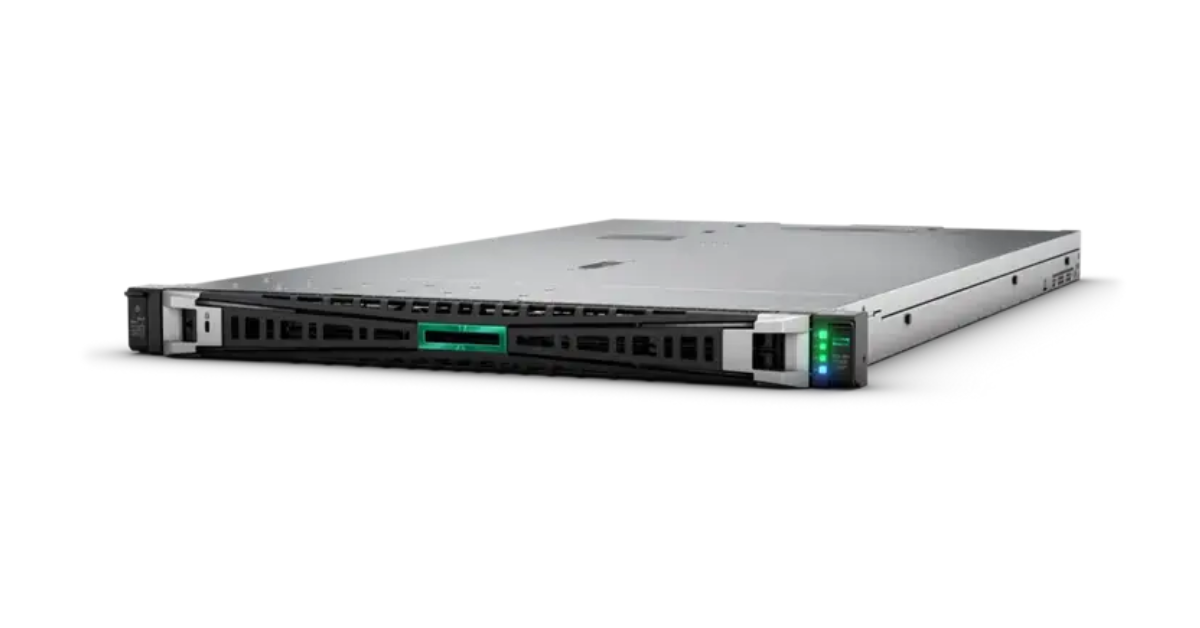
The HPE ProLiant DL360 Gen11 server is a flagship 1U solution designed for organizations requiring maximum compute density in limited rack space. This server is ideal for modern data centers where every rack unit counts.
Technical Specifications of HPE ProLiant DL360 Gen11:
- Processors: 1-2 Intel Xeon Scalable 4th or 5th Generation processors, up to 64 cores per processor, frequencies up to 3.9 GHz
- Processor Cache: 12 to 320 MB L3 (depending on processor model)
- Memory: Up to 4 TB HPE DDR5 Smart Memory, 16 DIMM slots per processor
- Memory Protection: HPE Fast Fault Tolerant Memory, Advanced ECC, Online Spare Memory, Mirrored Memory
- Storage: Up to 4 LFF SAS/SATA, up to 8+2 SFF SAS/SATA/NVMe U.3, up to 20 EDSFF E3.s 1T NVMe, up to 2 M.2 NVMe RAID1 boot devices
- Storage Controllers: Embedded SATA controller (AHCI/Intel RAID), optional HPE Smart Array Gen11 with NVMe support
- Expansion Slots: Up to 3 PCIe Gen5 slots, up to 2 OCP 3.0 PCIe5 slots
- Network Adapters: Wide range from 1GbE to 200GbE in PCIe and OCP 3.0 form factors
- Power Supplies: 500W/800W/1000W/1600W/1800-2200W Flex Slot with hot-swap capability
- Management: HPE iLO6 Standard with Intelligent Provisioning (embedded), HPE OneView Standard
- Form Factor: 1U Rack Server
- Dimensions: 4.29 x 43.46 x 75.31 cm (SFF configuration)
- Weight: 14.56 to 21.58 kg
Who Should Choose HPE ProLiant DL360 Gen11:
The DL360 Gen11 is the optimal choice for workloads requiring high compute density with limited space. The server excels at web hosting, container platforms (Kubernetes, Docker), Edge computing, HPC clusters, CDN servers, and applications requiring fast data access thanks to support for up to 20 EDSFF NVMe drives.
With its compact dimensions and powerful configuration, this server allows for more compute nodes per rack, which is critical for cloud providers and large data centers. Support for up to 64-core processors and 4 TB of memory provides sufficient performance for most enterprise applications.
HPE ProLiant DL380 Gen11 — Versatility and Scalability
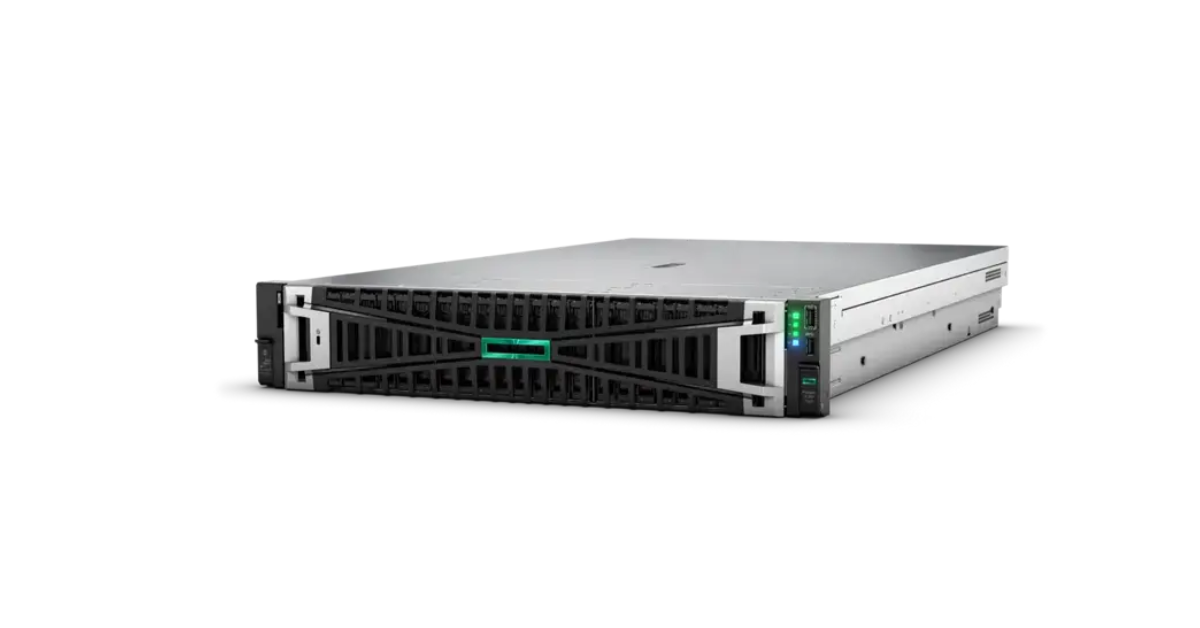
The HPE ProLiant DL380 Gen11 server is a time-tested 2U platform that has remained one of the world's most popular servers for years due to its versatility, reliability, and extensive customization options for diverse workloads.
Technical Specifications of HPE ProLiant DL380 Gen11:
- Processors: 1-2 Intel Xeon Scalable 4th or 5th Generation processors, 16 to 60 cores per processor, frequencies up to 5.8 GHz
- Processor Cache: Up to 16 MB Intel Smart Cache (depending on processor model)
- Memory: Up to 8 TB HPE DDR5 Smart Memory (256 GB per slot), 32 DIMM slots
- Memory Protection: RAS — Advanced ECC, Online Spare, Mirroring, Combined Channel (Lockstep), HPE Fast Fault Tolerant Memory (ADDDC), Intel Optane Persistent Memory support
- Storage: 8 or 12 LFF SAS/SATA/SSD, 8/16/24 SFF SAS/SATA/SSD, optional 6 SFF rear drives or 2 SFF rear drives, 20 SFF NVMe (optional)
- Storage Controllers: HPE SR932i-p, HPE MR216i-o, HPE MR416i-o, HPE MR216i-p, HPE MR416i-p, HPE MR408i-o
- Expansion Slots: Up to 8 PCIe Gen5 slots, 2 OCP 3.0 slots
- Network Adapters: 1GbE to 200GbE in PCIe and OCP 3.0 form factors
- Power Supplies: 800W/1000W/1600W with dual hot-swap redundant 1+1 HPE Flexible Slot option
- Management: HPE iLO Standard with Intelligent Provisioning (embedded), HPE OneView Standard, optional HPE iLO Advanced and HPE GreenLake COM
- Form Factor: 2U Rack Server
- Dimensions: 8.75 x 44.8 x 72.7 cm (SFF configuration), 8.75 x 44.8 x 73.25 cm (LFF configuration)
- Weight: 16 to 37 kg (depending on configuration)
Who Should Choose HPE ProLiant DL380 Gen11:
The DL380 Gen11 is the universal workhorse of enterprise data centers. The server is ideal for virtualization (VMware vSphere, Microsoft Hyper-V, KVM), database management systems (Oracle, Microsoft SQL Server, SAP HANA), enterprise applications (ERP, CRM), private cloud platforms, storage systems, and file servers.
The twofold advantage in memory capacity compared to the DL360 (8 TB vs 4 TB) makes the DL380 the preferred choice for memory-intensive applications. Additional PCIe slots allow for more network adapters, storage controllers, or GPU accelerators. The ability to install up to 24 SFF drives or 12 LFF disks provides flexibility in building storage systems for various purposes.
Detailed Comparison of Key Features
Processor Performance
Both models support 4th and 5th Generation Intel Xeon Scalable processors, providing modern performance levels for enterprise workloads. The DL360 Gen11 can be equipped with processors up to 64 cores, making it excellent for parallel computing and container platforms. The DL380 Gen11 supports processors up to 60 cores with maximum frequencies up to 5.8 GHz, which is particularly important for single-threaded applications and databases.
The 5th Generation Intel Xeon processor architecture includes enhanced Intel Advanced Matrix Extensions (AMX) instructions for accelerating AI and machine learning tasks, built-in Intel Data Streaming Accelerator (DSA) and Intel In-Memory Analytics Accelerator (IAA), and support for DDR5 memory at speeds up to 5600 MT/s.
Memory Subsystem
The primary difference between the models is the supported memory capacity. The DL360 Gen11 with 32 DIMM slots (16 per processor) can be expanded to 4 TB using 256 GB modules. The DL380 Gen11 doubles this capacity with 32 slots, supporting up to 8 TB of memory.
For virtualization workloads, this is a critical difference: when consolidating multiple virtual machines, memory often becomes the limiting factor. The DL380 allows running twice as many virtual machines or containers with the same memory allocation per VM. For in-memory databases (SAP HANA, Redis, Memcached), the additional capacity of the DL380 can be a decisive factor.
Both models support HPE memory protection technologies: Advanced ECC for error detection and correction, Online Spare for automatic replacement of failed modules with spares, Mirrored Memory for complete memory content duplication, and HPE Fast Fault Tolerant Memory (ADDDC) for protection against complete DIMM module failure without system downtime.
Storage System
The storage subsystems of both models offer flexible configurations but have different orientations. The DL360 Gen11 focuses on performance with support for up to 20 EDSFF (Enterprise and Data Center SSD Form Factor) E3.S drives with NVMe interface. This new form factor provides higher SSD density and improved cooling compared to traditional SFF (2.5") drives.
The DL380 Gen11 offers greater configuration diversity: from 8 to 24 SFF drives or from 8 to 12 LFF (3.5") drives in front bays. Additionally, 6 SFF or 2 SFF drives can be installed in rear bays. This makes the DL380 more versatile for various storage scenarios — from fast NVMe arrays to high-capacity HDD storage.
Support for HPE Smart Array Gen11 controllers with Tri-Mode (SAS/SATA/NVMe) technologies allows using mixed drive configurations, optimizing the balance of performance, capacity, and cost. For example, OS and critical databases can be placed on NVMe SSDs, while archival data resides on high-capacity HDDs.
Expansion Capabilities
In terms of PCIe expansion slots, the difference is substantial: the DL360 Gen11 offers up to 3 PCIe Gen5 slots and 2 OCP 3.0 slots, while the DL380 Gen11 provides up to 8 PCIe Gen5 slots and 2 OCP 3.0 slots. This means the DL380 can simultaneously accommodate more expansion cards: multiple high-speed network adapters, GPU accelerators for AI/ML tasks, additional storage controllers, or specialized accelerators (FPGA, cryptographic processors).
PCIe Gen5 doubles the bandwidth compared to Gen4, providing up to 32 GT/s (gigatransfers per second) per lane, which is critical for high-performance 100GbE and 200GbE network adapters, as well as for latest-generation GPUs and NVMe drives.
Power Consumption and Cooling
Both models are equipped with HPE Flexible Slot power supplies of various capacities. The DL360 Gen11 supports PSUs from 500W to 2200W, while the DL380 Gen11 supports 800W to 1600W. It's important to note that actual power consumption depends on the installed configuration: number and type of processors, memory capacity, type and number of drives, and installed expansion cards.
The DL360 Gen11 cooling system includes hot-swappable fans with full redundancy, optimized for the 1U form factor. The DL380 Gen11, thanks to its 2U design, has a more efficient air cooling system that better handles high thermal loads with full configuration including two powerful processors and multiple drives.
Application Scenarios
HPE ProLiant DL360 Gen11 — Best Choice For:
- Web Hosting and Frontend Servers: Compact form factor allows more web servers per rack, important for cloud providers and hosting companies
- Container Platforms: Kubernetes worker nodes, Docker Swarm nodes — high density of compute resources per unit of space
- Edge Computing: Edge data centers with limited space where compactness is critical
- HPC and High-Performance Computing: Cluster compute nodes for scientific calculations, rendering, simulations
- CDN and Caching Servers: Content delivery servers with fast NVMe drives
- VDI Infrastructure: Virtual desktop infrastructure nodes where high density is important
- Microservices Architectures: Platforms for running large numbers of small services
HPE ProLiant DL380 Gen11 — Best Choice For:
- Virtualization Platforms: VMware vSphere, Microsoft Hyper-V, Red Hat Virtualization — hosts for consolidating multiple virtual machines
- Database Management Systems: Oracle Database, Microsoft SQL Server, PostgreSQL, MySQL — database servers with high memory requirements
- SAP HANA and In-Memory Databases: Applications running entirely in memory
- Enterprise Applications: ERP systems (SAP, Oracle E-Business Suite), CRM (Salesforce, Microsoft Dynamics)
- Private Cloud Platforms: OpenStack, VMware Cloud Foundation, Microsoft Azure Stack HCI
- File Servers and NAS: Centralized data storage with large numbers of disks
- Mid-Tier Application Servers: Application servers, middleware, integration buses
- Backup Systems: Backup servers with high-capacity HDD arrays
- AI/ML Infrastructure: Machine learning model training using GPU accelerators (thanks to more PCIe slots)
Recommendations for Choosing Between HPE DL360 Gen11 and DL380 Gen11
Choose HPE ProLiant DL360 Gen11 If:
- Rack space is limited and maximum deployment density is important
- High compute performance is required, but memory capacity up to 4 TB is sufficient for your workloads
- Planning to use large numbers of fast NVMe drives in EDSFF format
- Budget is limited — compact servers typically have lower starting prices
- Need to build a scalable cluster of many identical nodes
- Priority is energy efficiency and minimizing cooling costs (smaller server volume = lower cooling power consumption)
Choose HPE ProLiant DL380 Gen11 If:
- Maximum memory capacity is required — up to 8 TB for virtualization or in-memory databases
- Large number of PCIe expansion slots needed for network adapters, GPUs, or specialized cards
- Planning to use diverse storage configurations — from NVMe to high-capacity HDD arrays
- Maximum configuration flexibility and future upgrade capabilities are required
- Server will be used as a universal platform for various workloads
- Time-tested platform with extensive support ecosystem and compatible solutions is important
- Intel Optane Persistent Memory support is needed for specific applications
Selection Criteria by Workload Type:
| Workload Type | Recommendation | Rationale |
|---|---|---|
| Web Servers, Frontend | DL360 Gen11 | High density, sufficient memory, fast NVMe for caching |
| Virtualization (>50 VMs) | DL380 Gen11 | More memory for greater number of virtual machines |
| OLTP Databases | DL380 Gen11 | More memory for database cache, storage configuration flexibility |
| SAP HANA, In-Memory DB | DL380 Gen11 | Maximum memory capacity is critical factor |
| Containers, Kubernetes | DL360 Gen11 | High density worker nodes, efficient rack utilization |
| HPC Computing | DL360 Gen11 | Compact compute nodes with powerful CPUs |
| File Servers | DL380 Gen11 | More drive bays, LFF HDD support |
| AI/ML with GPUs | DL380 Gen11 | More PCIe slots for GPU accelerators |
| Edge Computing | DL360 Gen11 | Compactness for limited space at the edge |
| Private Cloud | DL380 Gen11 | Versatility, scalability, configuration flexibility |
Management and Security
Both models are equipped with the modern HPE iLO 6 (Integrated Lights-Out) management controller, which provides remote server management independent of operating system status. iLO 6 offers a web interface for hardware health monitoring, remote power management, virtual KVM (keyboard, video, mouse), and virtual media devices for remote OS installation.
HPE iLO 6 includes advanced security capabilities:
- Silicon Root of Trust: Immutable trust anchor built into silicon protects against firmware-level attacks
- Secure Boot: Digital signature verification of bootloader and OS components before loading
- Runtime Firmware Verification: Continuous firmware integrity checking during operation
- System Lockdown: Configuration change lock mode
- Workload Performance Advisor: Performance analysis and optimization recommendations
- iLO Amplifier Pack: Centralized management of multiple servers
Integration with HPE OneView enables automation of server infrastructure deployment, monitoring, and management through a single console. HPE InfoSight provides predictive analytics based on machine learning to prevent failures and optimize performance.
Optional TPM 2.0 (Trusted Platform Module) provides hardware encryption and secure cryptographic key storage, necessary for compliance with security standards in regulated industries.
Total Cost of Ownership (TCO)
When evaluating server ownership costs, it's important to consider not only the initial purchase price but also operational expenses throughout the entire lifecycle.
Factors Affecting TCO:
- Acquisition Cost: DL360 typically has a lower starting price due to compact form factor and fewer components
- Data Center Space Cost: DL360 (1U) occupies half the space of DL380 (2U), important in expensive data centers
- Power Consumption: With similar configurations, DL360 consumes less power, reducing electricity and cooling costs
- Scalability: DL380 allows starting with minimal configuration and gradually scaling resources without platform replacement
- Consolidation: One DL380 with 8 TB memory can replace two DL360s with 4 TB, saving on software licenses, management, and maintenance
- Service Life: Both platforms are designed for 5-7 years of operation with component upgrade capability
For small to medium deployments (up to 10-20 servers), the DL360 typically provides lower total cost of ownership due to lower initial price and operational expenses. For large infrastructures (>50 servers) and high-consolidation workloads, the DL380 may be more economical due to greater capacity and reduced total number of physical servers.
Migration and Compatibility
When planning migration from previous HPE server generations to Gen11, compatibility aspects are important to consider:
Backward Compatibility:
- Operating Systems: Support for wide range of OSes — Microsoft Windows Server, Red Hat Enterprise Linux, SUSE Linux Enterprise Server, Ubuntu Server, VMware ESXi, Oracle Linux
- Hypervisors: Certification for VMware vSphere, Microsoft Hyper-V, Citrix Hypervisor, Red Hat Virtualization, Nutanix AHV
- Management: Integration with existing management systems via HPE OneView, Microsoft System Center, VMware vCenter
- Storage: Support for various drive types allows reusing existing SAS/SATA drives
Migration Path from Previous Generations:
Migration from HPE ProLiant Gen10 or Gen10 Plus to Gen11 typically proceeds smoothly due to similar architecture and HPE tools for configuration transfer. HPE OneView allows creating server profiles that can be applied to new systems, automating the deployment process.
For virtualized environments, it's recommended to use live virtual machine migration technologies (vMotion in VMware, Live Migration in Hyper-V) for seamless workload transfer to new servers without downtime.
Conclusion
The choice between HPE ProLiant DL360 Gen11 and HPE ProLiant DL380 Gen11 depends on your specific infrastructure requirements. Both servers represent cutting-edge platforms with latest-generation Intel Xeon Scalable processors, DDR5 memory, NVMe drive support, and modern management systems.
DL360 Gen11 is the optimal choice for scenarios where deployment density is critical: web hosting, container platforms, Edge computing, HPC clusters. The compact 1U form factor maximizes rack space efficiency, while support for up to 20 EDSFF NVMe drives provides outstanding storage performance.
DL380 Gen11 is a universal platform for a wide range of enterprise applications, from virtualization to databases. The twofold advantage in memory capacity (8 TB vs 4 TB) and greater number of expansion slots make it ideal for workload consolidation, in-memory databases, and tasks requiring multiple expansion cards.
At ServerMall, you'll find a wide selection of configurations for both servers. Our specialists will help select the optimal solution for your needs, considering performance requirements, scalability, and budget. We offer flexible delivery terms, professional technical support, and warranty on all equipment.
For consultation and configuration cost estimates, contact our experts. Whether you choose the compact DL360 or the versatile DL380, you'll get a reliable platform from the world leader in server technologies that will efficiently handle your tasks for many years to come.