Choosing the right server for file storage is a critical decision for any business. A file server becomes the central hub of your infrastructure, providing reliable storage, fast access, and collaborative work with corporate data. The correctness of this choice determines the performance of your entire team, information security, and the ability to scale the system in the future.
A modern file server must provide high data transfer speeds when dozens or hundreds of users work simultaneously, guarantee data safety through RAID arrays and backups, and offer sufficient storage capacity for current and future needs. At the same time, it's important to consider energy efficiency, ease of management, and the ability to expand disk capacity without system downtime.
In this article, we'll examine five best server solutions for organizing file storage: from compact single-processor models for small businesses to powerful dual-processor systems with the ability to install dozens of drives. We'll analyze the key characteristics of each server, their advantages for specific tasks, and help you choose the optimal solution that will work efficiently for years, ensuring reliable storage of your data.
File Server Comparison Table
| Model | Processor | Memory | Maximum Storage | Form Factor | Best Use Case |
|---|---|---|---|---|---|
| DELL PowerEdge R750xs | Up to 2x Intel Xeon Scalable 3rd Gen (up to 32 cores) | Up to 1 TB DDR4 | Up to 192 TB (12x 3.5") | 2U Rack | Large enterprises, high data volumes |
| DELL PowerEdge R550 | Up to 2x Intel Xeon Scalable 3rd Gen (up to 24 cores) | Up to 1 TB DDR4 | Up to 128 TB (8x 3.5") | 2U Rack | Medium businesses, enterprise departments |
| HPE ProLiant DL380 Gen11 | Up to 2x Intel Xeon Scalable 5th/4th Gen (up to 60 cores) | Up to 8 TB DDR5 | Up to 192 TB (12x LFF) | 2U Rack | High-load systems, enterprise level |
| DELL PowerEdge T550 | Up to 2x Intel Xeon Scalable 3rd Gen (up to 36 cores) | Up to 2 TB DDR4 | Up to 360 TB (24x 2.5") | 5U Tower | Office installation, small to medium business |
| HPE ProLiant ML350 Gen11 | Up to 2x Intel Xeon Scalable 5th/4th Gen (up to 64 cores) | Up to 8 TB DDR5 | Up to 384 TB (24x SFF) | 4U Tower | Offices, distributed branches, maximum capacity |
DELL PowerEdge R750xs — Scalable Solution for Corporate Data

The DELL PowerEdge R750xs server represents a high-performance solution in a 2U form factor, specifically designed for tasks requiring significant data storage volumes. This model stands out with excellent scalability and can be adapted to the most demanding file server usage scenarios.
Technical Specifications
- Processors: Up to two Intel Xeon Scalable 3rd Generation processors with maximum 32 cores per processor
- Memory: 16 DDR4 DIMM slots, supports RDIMM up to 1 TB, speeds up to 3200 MHz
- Drive Bays: Up to 12 x 3.5" SAS/SATA (maximum 192 TB) or up to 16 x 2.5" SAS/SATA/NVMe (maximum 184.32 TB)
- RAID Controllers: PERC H345, H355, H745, H755, H755N, HBA355i, S150
- Network Adapters: 2 x 1 GbE LOM, optional OCP 3.0
- Power Supplies: Hot-plug, 600W/800W/1100W/1400W Platinum/Titanium
- Management: iDRAC9, Quick Sync 2
- Expansion: Up to 5 PCIe Gen4 slots + 1 PCIe Gen3 slot
File Storage Advantages
DELL PowerEdge R750xs is ideal for creating a high-performance file server thanks to the ability to install up to 12 drives in 3.5" format, allowing the use of high-capacity HDDs for maximum storage volume at optimal cost per terabyte. Support for various RAID controllers, including powerful models with cache memory and Battery Backup Unit, ensures reliable data protection and high disk subsystem performance.
The ability to install two Intel Xeon Scalable 3rd Generation processors guarantees sufficient computing power to handle multiple simultaneous user requests, run deduplication and data compression services, and perform background backup tasks without affecting the performance of primary operations. DDR4 memory with speeds up to 3200 MHz and capacity up to 1 TB allows efficient caching of frequently used files, significantly speeding up data access.
Who Is It For
This server is optimal for medium and large enterprises with large volumes of corporate data, organizations working with media files, archives, or databases, as well as companies requiring centralized storage with high fault tolerance. DELL PowerEdge R750xs will excellently handle the role of a primary file server in a corporate network, providing fast data access for 100-300+ concurrent users.
DELL PowerEdge R550 — Balanced Solution for Medium Business
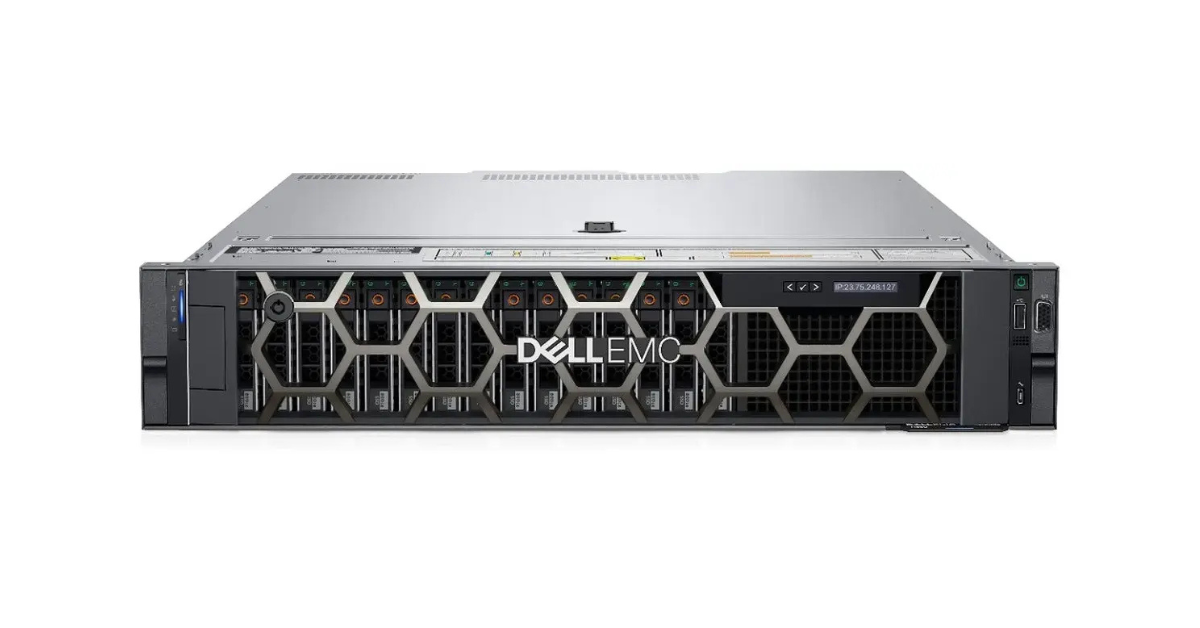
The DELL PowerEdge R550 model represents a versatile server in a compact 2U chassis, offering an optimal balance between performance, storage capacity, and cost. This solution is ideal for medium-sized organizations that require reliable file storage without the excess features of enterprise-level systems.
Technical Specifications
- Processors: Up to two Intel Xeon Scalable 3rd Generation processors with maximum 24 cores per processor
- Memory: 16 DDR4 DIMM slots, supports RDIMM up to 1 TB, speeds up to 2933 MHz
- Drive Bays: Up to 16 x 2.5" SAS/SATA (maximum 122.88 TB) or up to 8 x 3.5" SAS/SATA (maximum 128 TB)
- RAID Controllers: PERC H345, H355, HBA355i, H745, H755, S150
- Network Adapters: 2 x 1 GbE LOM, optional OCP 3.0
- Power Supplies: Hot-plug, 600W/800W Platinum Mixed Mode
- Management: iDRAC9, Quick Sync 2
- Expansion: 3 PCIe Gen4 slots + 1 PCIe Gen3 slot
File Storage Advantages
DELL PowerEdge R550 combines sufficient computing power to serve file requests from 50-150 users with flexible data storage options. The configuration with eight 3.5" bays allows the use of economical high-capacity HDDs for storing archives and rarely used data, while the option with 16 x 2.5" bays opens possibilities for creating hybrid configurations using SSDs for hot data and HDDs for cold storage.
The built-in S150 controller provides basic RAID capabilities for SATA disks at no additional cost, while optional PERC H745 or H755 controllers with hardware RAID and cache memory significantly increase disk subsystem performance. Support for hot-swap drives and power supplies minimizes downtime during maintenance or component failure.
Who Is It For
The server is ideally suited for companies with 30-100 employees, departments of large enterprises, educational institutions, and small data centers. DELL PowerEdge R550 will be an excellent choice for organizing centralized document storage, collaborative project work, storing media files of medium volumes, or as a backup file server in distributed infrastructure.
HPE ProLiant DL380 Gen11 — Flagship Next-Generation Solution
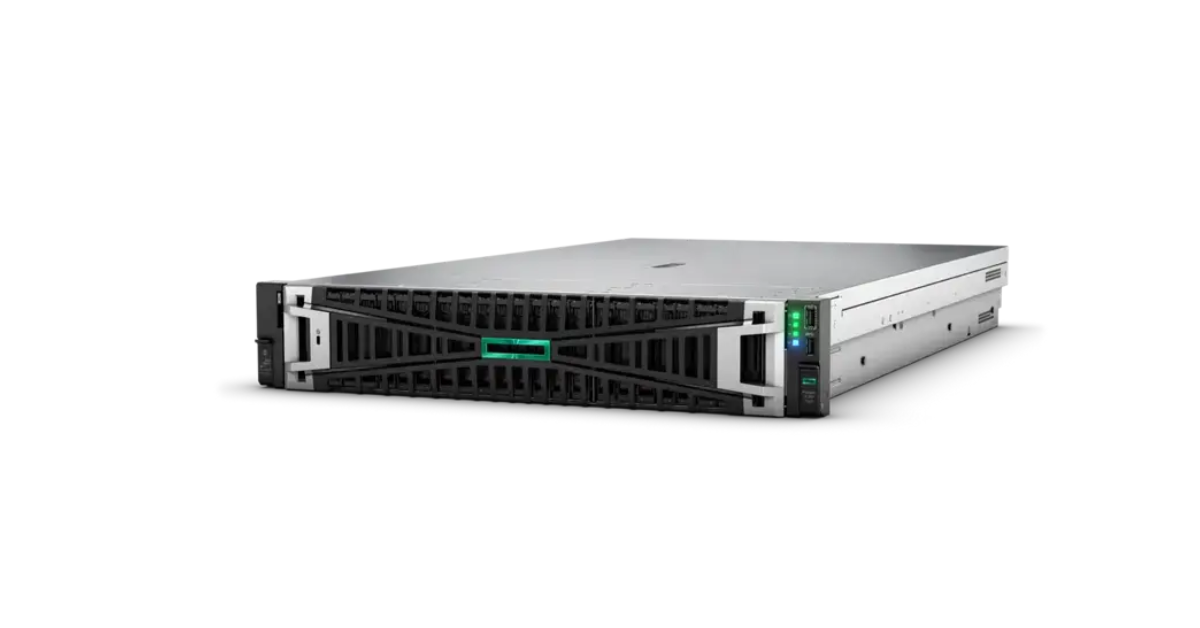
The HPE ProLiant DL380 Gen11 server represents the flagship latest-generation model built on the Intel Xeon Scalable 5th and 4th generation platform. This enterprise-class solution offers unparalleled performance, scalability, and modern technologies for the most demanding file storage tasks.
Technical Specifications
- Processors: Up to two Intel Xeon Scalable 5th/4th Generation processors with maximum 60 cores per processor
- Memory: 32 DDR5 SmartMemory slots, up to 8 TB with 256 GB modules
- Drive Bays: 8 or 12 LFF SAS/SATA/SSD, 8, 16, or 24 SFF SAS/SATA/SSD, optional 20 SFF NVMe
- RAID Controllers: HPE SR932i-p, MR216i-o, MR416i-o, MR216i-p, MR416i-p, MR408i-o
- Network Adapters: Wide selection from 1 Gb to 200 Gb in PCIe and OCP 3.0 formats
- Power Supplies: 800W, 1000W, or 1600W Platinum/Titanium with hot-swap
- Management: HPE iLO6 Standard with Intelligent Provisioning
- Expansion: Up to 8 PCIe Gen5 slots and 2 OCP 3.0 slots
File Storage Advantages
HPE ProLiant DL380 Gen11 sets new performance standards thanks to Intel Xeon Scalable 5th generation processors with increased core counts and improved architecture. DDR5 memory with double the bandwidth compared to DDR4 significantly accelerates read and write operations, especially when working with many small files or with intensive caching use.
The ability to install up to 24 SFF drives or 12 LFF drives provides flexibility in building storage of any configuration — from maximum capacity on HDDs to ultra-fast arrays on NVMe SSDs. Advanced HPE MR416i RAID controllers with large cache memory and NVMe support provide exceptional disk subsystem performance. Built-in iLO6 capabilities allow complete remote server management, including disk health monitoring, firmware updates, and fault diagnostics.
Who Is It For
This server is oriented towards large enterprises, data centers, government organizations, and companies for whom maximum performance, 99.999% reliability, and modern technologies are critically important. HPE ProLiant DL380 Gen11 is ideally suited for high-load file servers serving 500+ concurrent users, for storing mission-critical data, working with large databases, or as a foundation for software-defined storage (SDS).
DELL PowerEdge T550 — Powerful Tower Server for Office
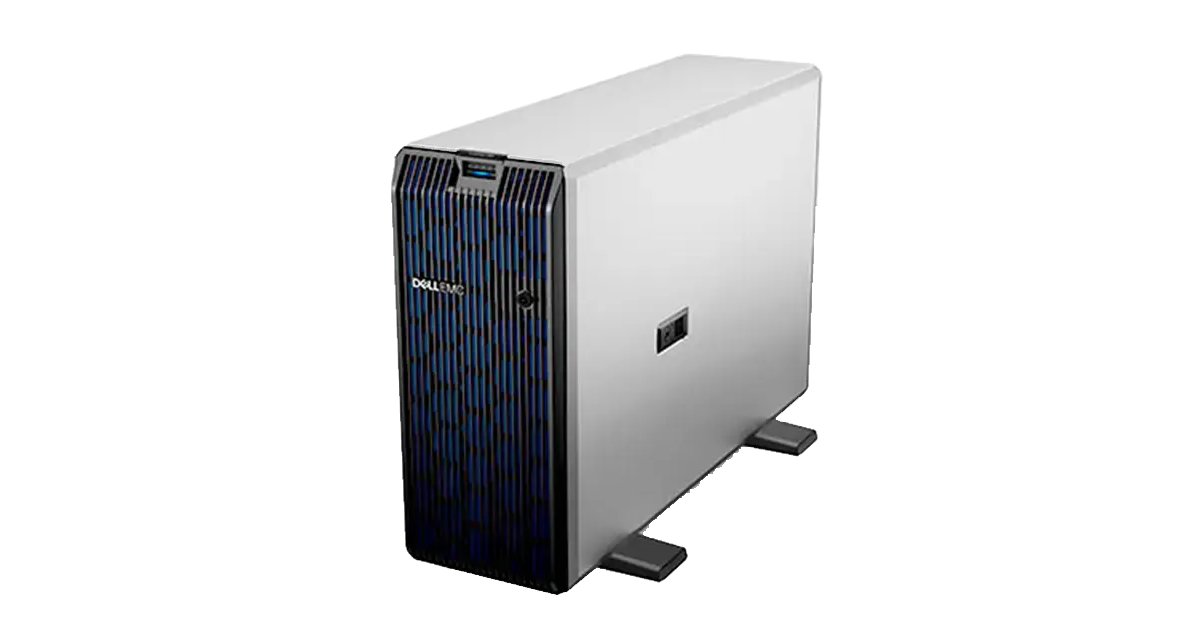
The DELL PowerEdge T550 model represents a 5U tower server that combines enterprise performance with the ability to install directly in an office environment. This solution is ideal for organizations that need the power of a rack server but without the necessity of deploying a server rack.
Technical Specifications
- Processors: Up to two Intel Xeon Scalable 3rd Generation processors with maximum 36 cores per processor
- Memory: 16 DDR4 DIMM slots, supports RDIMM up to 2 TB, speeds up to 3200 MHz
- Drive Bays: Up to 24 x 2.5" SAS/SATA (maximum 360 TB) or up to 8 x 3.5" SAS/SATA + 8 x 2.5" NVMe (maximum 240 TB)
- RAID Controllers: HBA345, H345, H355, H745, H755, S150, H755N, HBA355i
- Network Adapters: 2 x 1 GbE LOM, optional OCP 3.0
- Power Supplies: Wide selection from 600W to 2400W, hot-swap
- Management: iDRAC9, Quick Sync 2, iDRAC Service Module
- Expansion: Up to 6 PCIe Gen4 slots
- Cooling: Up to 8 hot-swap fans with N+1 redundancy
File Storage Advantages
DELL PowerEdge T550 stands out with impressive storage expansion capabilities — up to 24 x 2.5" drives provide maximum flexibility in building multi-tier storage using SSDs for active data and HDDs for archives. This configuration allows implementing automatic data movement between storage tiers (tiering) to optimize performance and cost.
The tower form factor has several advantages: reduced noise levels compared to rack servers, ability to install in a regular office space without a special server room, ease of maintenance and upgrades. At the same time, T550 matches rack models in performance and reliability, offering the same enterprise management features through iDRAC9 and hot-swap support for all critical components.
Who Is It For
Ideal choice for small to medium businesses without a dedicated server room, distributed offices of large companies, educational institutions, medical organizations, and creative studios. DELL PowerEdge T550 will excellently handle the file server role for a team of 20-100 people, providing sufficient storage capacity for documents, projects, media files, and workstation backups.
HPE ProLiant ML350 Gen11 — Maximum Capacity in Tower Format
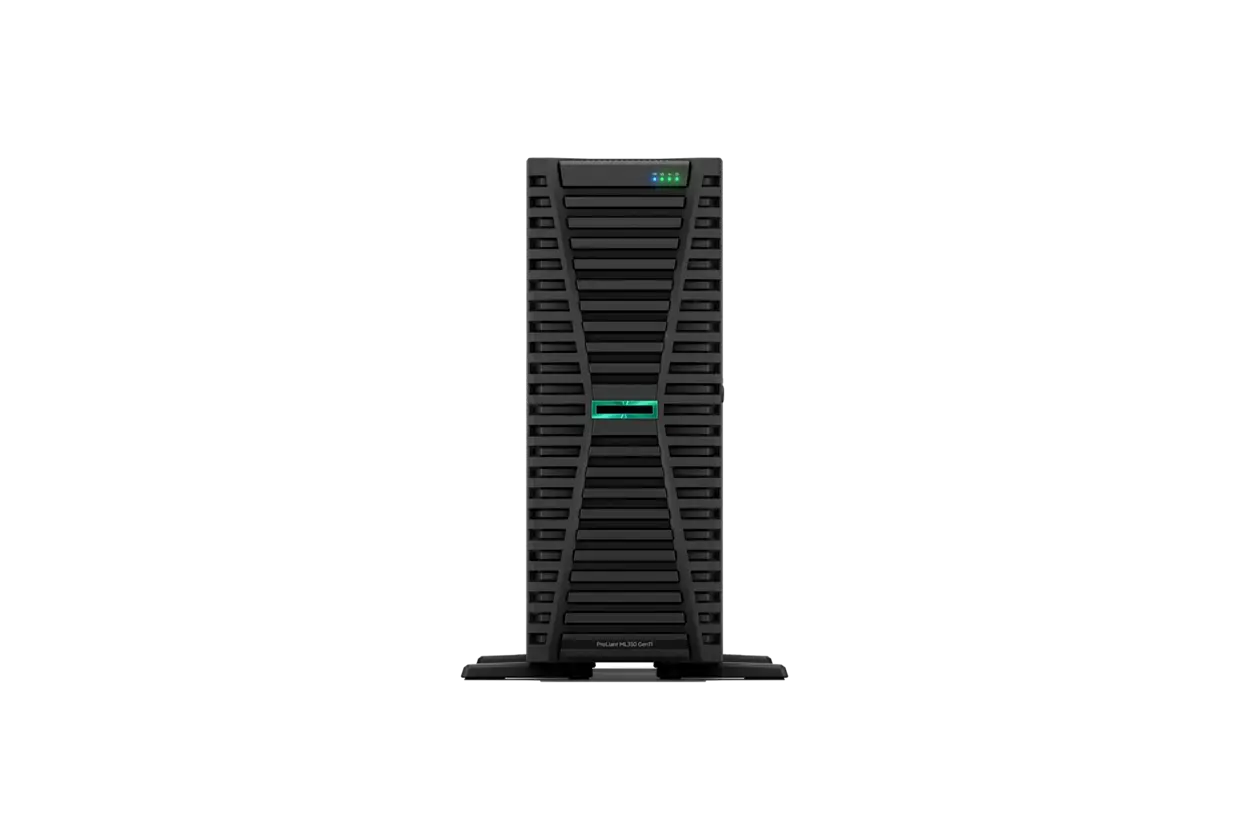
The HPE ProLiant ML350 Gen11 server represents a flagship tower solution of the latest generation, combining the advantages of the newest Intel platform with maximum storage expansion capabilities. This is the ideal option for organizations that need enterprise-level performance and capacity in a form factor suitable for office installation.
Technical Specifications
- Processors: Up to two Intel Xeon Scalable 5th/4th Generation processors with maximum 64 cores per processor
- Memory: 32 DDR5 SmartMemory slots, up to 8 TB with 256 GB modules
- Drive Bays: 4 to 24 SFF SAS/SATA/NVMe or 4 to 12 LFF SAS/SATA depending on configuration
- RAID Controllers: Intel VROC SATA or optional HPE Smart Array Gen11 controllers
- Network Adapters: Wide selection of OCP and PCIe adapters from 1 GbE to 100 GbE
- Power Supplies: 500W, 800W, 1000W, 1600W, and 1800W-2200W with various efficiency certifications
- Management: HPE iLO Standard with Intelligent Provisioning, optional iLO Advanced
- Form Factor: 4U Tower with rack-mount conversion capability to 1U
- Cooling: Standard 3 fans, optional up to 5 additional hot-swap with N+1
File Storage Advantages
HPE ProLiant ML350 Gen11 sets a new bar for tower servers thanks to the use of Intel Xeon Scalable 5th generation processors and DDR5 memory. This combination provides up to 50% performance improvement over the previous generation, which is critically important for file servers with many concurrent connections and intensive I/O operations.
The ability to install up to 24 drives in 2.5" format or 12 drives in 3.5" format allows creating storage with capacity of several hundred terabytes right in the office. NVMe SSD support opens possibilities for building ultra-fast file systems capable of serving tens of thousands of I/O operations per second. Advanced HPE Smart Array Gen11 RAID controllers with support for various protocols (SAS/SATA/NVMe) provide maximum flexibility and performance.
A unique feature of this model is the conversion capability from tower format to rack-mount, providing investment protection when future relocation to a server room or data center occurs. The built-in iLO management system allows complete remote server control, including remote console, monitoring of all component states, and automatic problem notifications.
Who Is It For
This server is oriented towards medium and large businesses requiring maximum performance and storage capacity in an office environment. HPE ProLiant ML350 Gen11 is ideal for companies with 50-200 employees working with large data volumes — video production, architectural firms, engineering companies, medical institutions with digital archives. It's also an excellent choice for branches of large corporations requiring autonomous storage with replication capability to headquarters.
File Server Selection Recommendations
Key Selection Criteria
When choosing a server for file storage, you need to consider several important factors that will determine the effectiveness and lifespan of your solution. The first and main criterion is the volume of stored data. Calculate the current volume of corporate files and add 50-100% for future growth over 3-5 years. Don't forget to account for space for backups if they will be stored on the same server.
The second important parameter is the number of concurrent users. For 20-50 users, a single-processor solution with basic specifications is sufficient; for 50-150 users, a dual-processor system with adequate RAM (minimum 32-64 GB) is required; and for 150+ users, powerful servers with latest-generation processors and large memory volumes (128-256 GB and more) are needed.
The third criterion is the type of stored data and performance requirements. If the main task is storing office application documents, an HDD configuration in RAID 5 or RAID 6 is sufficient. For working with databases, virtual machines, or many small files, SSDs or a hybrid configuration are required. For media production with high-resolution video, NVMe SSD arrays with maximum throughput are necessary.
Recommendations for Different Scenarios
Small Business (up to 30 users, up to 20 TB data): The optimal choice would be DELL PowerEdge T550 in basic configuration with one processor, 32 GB memory, and 4-6 x 3.5" drives with 4-8 TB capacity each in RAID 5. This configuration will provide sufficient performance, reliability, and ease of maintenance at minimal initial costs.
Medium Business (30-100 users, 20-80 TB data): DELL PowerEdge R550 with two processors, 64-128 GB memory, and 8 x 3.5" drives with 8-12 TB capacity in RAID 6 is recommended. Adding a PERC H745 RAID controller with cache memory will significantly increase performance. Such a system will handle intensive loads and provide power reserve for growth.
Large Business (100-300 users, 80-200 TB data): The ideal solution would be DELL PowerEdge R750xs or HPE ProLiant DL380 Gen11 with two powerful processors, 256 GB memory, and hybrid storage configuration: 2-4 SSDs for hot data and 8-12 high-capacity HDDs for primary storage. Advanced RAID controllers with large cache volumes are mandatory.
Enterprise Level (300+ users, 200+ TB data): For such requirements, HPE ProLiant DL380 Gen11 or ML350 Gen11 with maximum specifications is necessary: two Intel Xeon Scalable 5th generation processors, 512 GB - 1 TB memory, multi-tier storage with NVMe SSDs for critical data, SSDs for active files, and HDDs for archives. Implementation of monitoring systems, automated backup, and data replication is required.
Media Production and Video Work: The specifics of working with large video files require maximum disk subsystem throughput. Best choice — HPE ProLiant DL380 Gen11 or DELL PowerEdge R750xs with NVMe SSD array in RAID 10 for working projects and a separate high-capacity HDD array for archival storage. Installation of 10 GbE or higher network adapters is critically important to ensure sufficient network bandwidth.
Important Additional Aspects
RAID Arrays: Data protection is critically important for a file server. RAID 5 is suitable for systems with low write loads; RAID 6 provides better protection against two simultaneous disk failures; RAID 10 delivers maximum performance with adequate reliability but at 50% redundancy cost. For particularly critical systems, RAID 60 (combination of RAID 6 and RAID 0) is recommended.
Network Infrastructure: The most powerful file server won't realize its potential without appropriate network infrastructure. For offices up to 50 people, standard 1 GbE adapters are sufficient; for 50-150 users, aggregation of two 1 GbE or installation of 10 GbE adapters is recommended; for large systems, 10/25 GbE or even 40/100 GbE adapters are necessary.
Backup: The file server must be integrated into a backup system. Plan additional equipment for storing backups — either a separate NAS/SAN device, an additional server, or cloud storage. Remember the 3-2-1 rule: three data copies, on two different media, one copy offsite.
Scalability: When choosing a server, consider future expansion possibilities. Ensure there are free memory slots, space for additional drives, available PCIe slots for network adapters or RAID controllers. Also pay attention to the maximum supported configuration — sometimes it's more profitable to take a more powerful model with basic configuration and expand it as you grow than to replace the server in a couple of years.
Conclusion
Choosing the right server for file storage is a strategic decision that affects the performance of the entire company for years to come. Each of the reviewed models has its strengths and optimal usage scenarios.
DELL PowerEdge R750xs and HPE ProLiant DL380 Gen11 represent enterprise-class solutions for large organizations with high performance and scalability requirements. DELL PowerEdge R550 offers an optimal balance of specifications and cost for medium businesses. Tower servers DELL PowerEdge T550 and HPE ProLiant ML350 Gen11 are ideal for office installation, providing enterprise capabilities without the need to deploy a server rack.
When choosing a server, be guided not only by current needs but also by development plans for 3-5 years. Investment in quality server equipment with performance reserve and expansion capabilities pays off with reliable operation, absence of downtime, and the ability to grow without replacing core equipment.
ServerMall specialists are ready to help you select the optimal file server configuration for your specific tasks and budget. Browse the complete catalog of server equipment on our website or contact our experts for individual consultation.