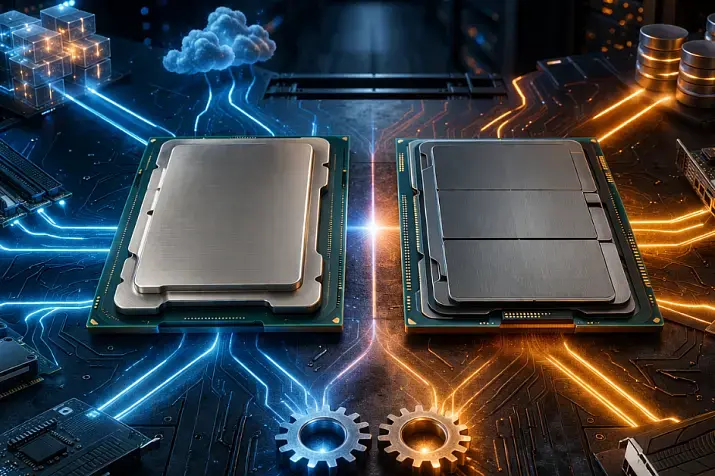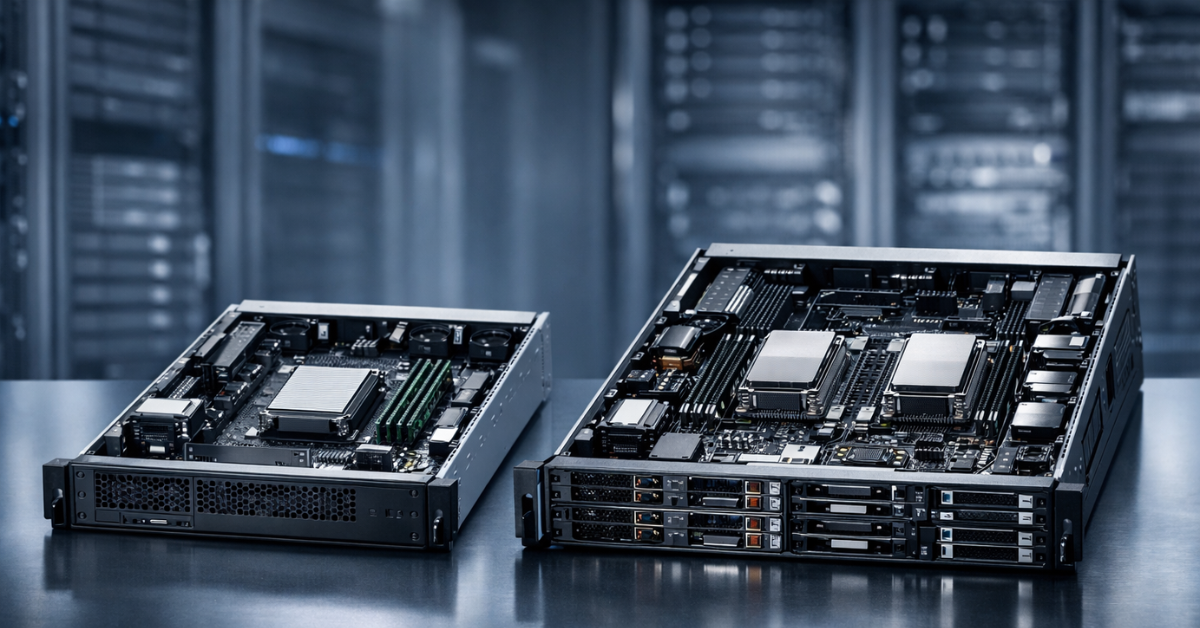
If a company does not run heavy virtualization, does not need a very large memory footprint, and can reasonably distribute workloads across several nodes, a single-socket server is usually the smarter choice: it is simpler, less expensive to buy and maintain, and often handles production workloads without any noticeable compromises. A dual-socket platform is justified when the business truly needs a higher ceiling for cores, memory, expansion devices, and service density on a single host.
Why this choice matters more than it seems
The question of “one socket or two” affects more than performance alone. In practice, it is a choice of platform class, and with it come implications for budget, growth headroom, upgrade strategy, virtualization density, the number of expansion cards, and even future licensing costs. The mistake here usually does not look like an immediate failure. Instead, it tends to lead to one of two unpleasant scenarios: either the company overpays for capacity it never ends up using, or after a year or a year and a half it turns out that compute power is still sufficient, but the server has already hit its limits in memory, slots, storage, or networking.
Modern servers can no longer be compared using the old simplified logic of “one processor means entry level, two means a serious machine.” Vendors themselves describe platforms by the number of supported sockets as part of the overall architecture, and in new single-socket models they specifically emphasize the balance of compute, memory, and I/O bandwidth for workloads where businesses previously often looked only at dual-socket configurations.
What single-socket and dual-socket servers mean in practice
A socket is the place on the system board where a server processor is installed. But for choosing a server, what matters is not the physical slot itself, but how the entire system is built around it.
In a single-socket server, all key resources are concentrated around one processor. It handles memory, expansion lanes, storage, network adapters, and virtual machines. This design is simpler: fewer components, fewer configuration challenges, more predictable performance, and a lower base platform cost.
In a dual-socket server, there are two processors. That means not only more compute resources, but also a more complex internal topology. Each processor has its own resources, its own portion of memory, and its own communication paths. For heavy parallel workloads, this can provide a real advantage, but not every application can use such an architecture equally well. So the second processor is not a “double the performance” button, but a way to raise the platform ceiling and expand what the node can do.
That leads to the main practical conclusion: you are not choosing between “one” and “two” as abstract numbers, but between two different approaches to building a server node.
When a single-socket server is the right choice
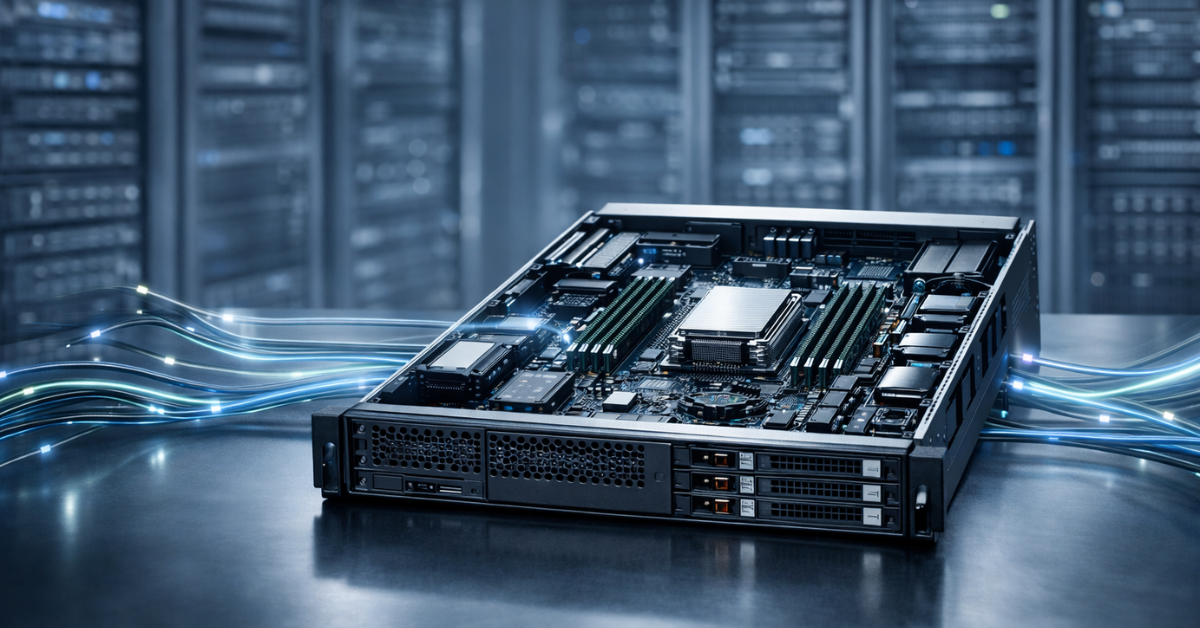
For a large share of small and medium-sized businesses, a single-socket system today is not a compromise, but a rational option. This is especially true where workloads are moderate, growth is predictable, and the IT team values simplicity, manageability, and a clear total cost of ownership.
Most often, a single-socket server fits these scenarios:
- file server;
- backup server;
- domain controller and related infrastructure roles;
- small or medium-sized 1C infrastructure;
- CRM, ERP, and internal business applications without extreme user density;
- web services and internal company applications;
- small-scale virtualization;
- nodes for branches, regional sites, and edge infrastructure.
The advantage of this choice is not only the lower entry price. Related costs are usually lower as well: lower power requirements, simpler cooling, a less expensive base configuration, and a lower risk of buying an overly expensive platform for a workload that may never appear. In a recent article on single-socket PowerEdge systems, Dell directly emphasizes that such systems can reduce total cost of ownership and cut costs related, among other things, to per-core licensing and power consumption in typical infrastructure refresh scenarios.
Signs that one socket will most likely be enough for the business
- A small or moderate number of virtual machines is planned on the server.
- The main constraint is budget, not maximum workload density.
- A very large amount of RAM is not required.
- There is no need to install several high-speed network cards, controllers, and accelerators at the same time.
- The infrastructure is expected to grow gradually, and new tasks can be covered by adding another node.
- Simplicity of operation is more important than maximum consolidation.
A single-socket server is especially good where infrastructure grows step by step. Today, one node may be enough for office services, backup, and part of the virtual machine load, and later it may be more cost-effective to add a second separate server than to buy an expensive dual-socket platform “just in case” from the start. This approach gives flexibility: resources are distributed across several nodes, and the risk of having a single concentration point is reduced.
Storage systems

Free shipping on orders over 500 € in the EU, £500 in the UK, and $3,000 in the USA

Free shipping on orders over 500 € in the EU, £500 in the UK, and $3,000 in the USA

Free shipping on orders over 500 € in the EU, £500 in the UK, and $3,000 in the USA

Free shipping on orders over 500 € in the EU, £500 in the UK, and $3,000 in the USA
Choosing the Right Equipment
Our specialists will contact you and answer all your questions
When a dual-socket server is justified

There are also opposite scenarios in which a single-socket platform quickly becomes too tight — sometimes not because of the processor, but because of the combined resource demand. That is where a dual-socket server brings real, not merely nominal, value.
It is usually justified if the business needs to:
- run dense virtualization on a single host;
- run a large database;
- consolidate several heavy roles on one server;
- get a high memory ceiling;
- install several high-speed network adapters, controllers, NVMe drives, and accelerators;
- use a platform with a long service life and significant workload growth in mind;
- fit more services into a smaller number of nodes.
It is important to understand this: the second processor is valuable not by itself, but because with it the platform usually gains more memory, more I/O resources, more room for expansion, and a higher consolidation ceiling. If the business is building one “dense” node for many virtual machines or a heavy database, a dual-socket system may be the most logical choice.
Signs that you should seriously look toward a dual-socket platform
- Dozens of virtual machines are planned on a single host.
- Workloads are steadily growing in terms of memory.
- More slots and lanes are needed for networking, storage, and add-in cards.
- There is a task to replace several services with one powerful node rather than spreading them across several servers.
- It is undesirable to hit the platform limit in just 1–2 years.
- The business is deliberately aiming for high workload density on a single server.
Why comparing by cores alone often leads to the wrong choice
The most common mistake when choosing is to look only at core count and configuration price. In practice, that is not enough.
One modern processor may be more advantageous than two weaker ones for several reasons. First, different processor generations vary greatly in performance per core. Second, for some workloads, what matters is not only total compute power, but also a simpler, less distributed architecture. Third, a second processor does not guarantee a linear performance gain: much depends on the nature of the workload, the amount of memory, data exchange between processors, and whether the application can scale well at all.
This is especially noticeable in latency-sensitive workloads, in certain transactional applications, in databases of a particular profile, and in cases where the real bottleneck is not the processor at all, but memory or I/O.
Conversely, if the workload involves dense virtualization, large parallel computations, analytics, a large database, or the consolidation of many roles on one host, the gain from a dual-socket platform can be very significant. But it still needs to be evaluated in the context of the whole system, not just by core count.
Memory is often more important than the second processor
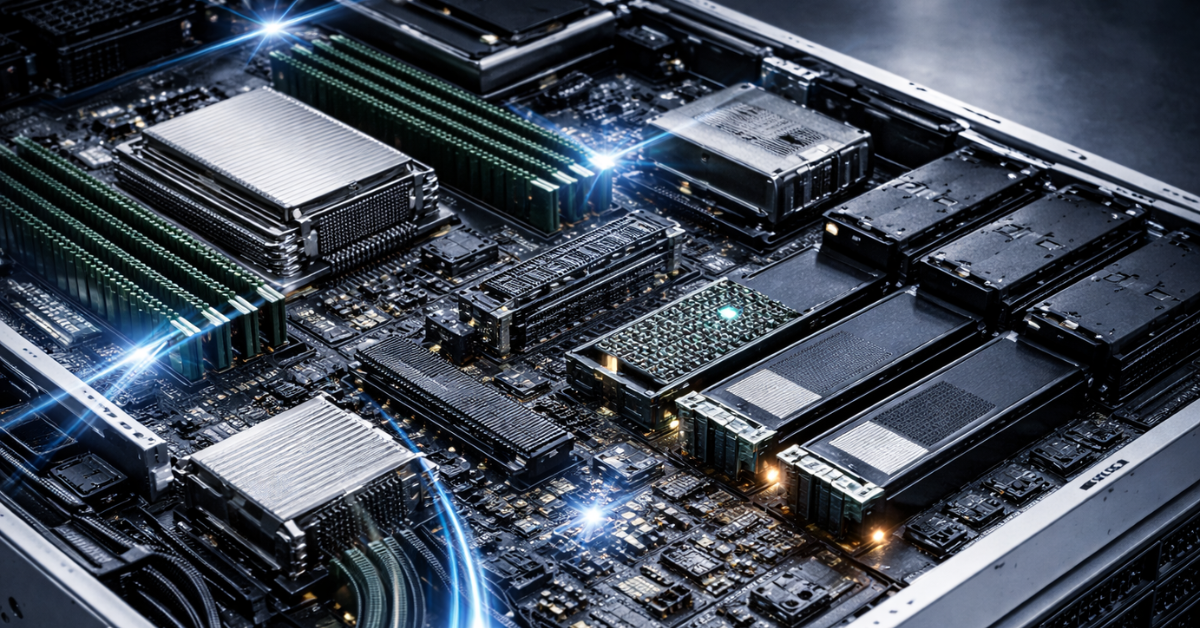
In many projects, the choice between 1P and 2P is actually determined not by compute power, but by memory. Memory becomes the critical resource in virtualization, databases, caching, analytics, backup with deduplication, and any workload with large working data sets.
If the server still looks “alive” from the CPU perspective but no longer has enough memory, the system starts losing its value as a platform. That is why you need to look not only at the current RAM capacity, but also at the growth ceiling: how much memory can actually be installed, how many slots are available, and how expensive future expansion will be.
This is where dual-socket systems often win: they usually provide more slots and a higher memory ceiling. But modern single-socket servers have grown substantially as well. For example, HPE explicitly positions its modern single-socket models as platforms with a balance of compute, memory, and network bandwidth, and for single-socket ProLiant systems it highlights their suitability even for virtualized environments when configured properly.
The practical takeaway here is simple: if the business needs a high RAM ceiling right now or will almost certainly need it within a year or two, the question of a second socket becomes much more serious. But if memory fits comfortably within the capabilities of a single-socket platform, buying a dual-socket system solely for the sake of “extra headroom” is not always rational.
Expansion lanes, networking, and storage: what people often remember too late
In real infrastructure, a server is limited not only by cores and memory. Very often, the limit appears elsewhere: there are not enough expansion lanes, not enough slots for network cards, not enough room for additional NVMe drives, a controller, or an accelerator.
A typical mistake looks like this: a company chooses a single-socket server for several virtual machines and file storage, and a year later a need appears for faster networking, additional NVMe, and another controller. Formally, the processor is coping, and memory is still sufficient, but the platform is already cramped. In such a case, moving to a dual-socket architecture from the start could have been justified not because of “pure power,” but because of expandability.
But the opposite mistake also happens: a company buys a dual-socket server for a workload where no real growth in networking, storage, or additional cards is expected. As a result, the business pays for a complex platform, while its capabilities remain unused.
That is why the question should not be framed as “will the processor be enough,” but as “will the platform as a whole be enough.”
Virtualization: one large node or several simpler ones

Virtualization is one of the areas where the 1P vs 2P question is especially important. But even here, there is no universal answer.
If a company has a small set of virtual machines, moderate memory requirements, and no goal of packing everything as densely as possible into one host, a single-socket server is often a sufficiently good solution. It is cheaper at the start, simpler to operate, and makes it possible to launch a cluster or at least split roles across two simpler nodes instead of one large one.
If, however, the business wants to place many virtual machines on one server, build in a large memory reserve, and get a high consolidation ceiling, a dual-socket option looks more natural. In that architecture, it is easier to build a dense host for serious virtualization.
But there is an important caveat here: “one powerful server” and “a fault-tolerant infrastructure” are not the same thing. Sometimes several single-socket nodes are more useful than one dual-socket server simply because they provide better flexibility, better workload distribution, and a healthier architecture at the system level. If one node is very large, it is convenient for consolidating services, but it also becomes a more prominent point of risk.
So when choosing for virtualization, you need to decide what matters more for the business: maximum density on a single host or a more flexible infrastructure built from several nodes.
Licensing can completely change the economics of the choice
This is the part companies often underestimate before procurement — and they should not. For some software, the choice between a single-socket and dual-socket platform affects not only the hardware, but also total cost of ownership for years ahead.
Microsoft uses a physical-core licensing model for Windows Server: each processor requires a minimum of eight core licenses, and each physical server requires a minimum of sixteen. This means that even a single-processor server is licensed no lower than that threshold, and the further economics depend on the actual number of cores and whether the scenario uses Standard or Datacenter. In other words, comparing 1P and 2P without taking into account the actual number of cores and the virtualization model is simply incorrect.
Oracle is even more sensitive to platform choice: the company applies a Processor Core Factor Table, where different processor types use different coefficients in license calculations. This means that the processor model and core count directly affect cost, and a “more powerful” configuration can turn out to be much more expensive not only at the server purchase stage, but throughout the entire software lifecycle.
That leads to one of the most important practical conclusions of the entire article: sometimes a single-socket server wins not because it is cheaper as hardware, but because licensing critical software on it is significantly less expensive. And conversely, sometimes consolidation on a more powerful platform is justified if it reduces the number of separate servers, system instances, and related costs. But this needs to be calculated before the purchase, not after it.
What actually changes when moving from one socket to two
| Criterion | Single-socket server | Dual-socket server | What it means for the business |
|---|---|---|---|
| Starting cost | Lower | Higher | Easier to start a project with a limited budget |
| Compute ceiling | Lower, but often sufficient | Higher | Important for dense consolidation and heavy workloads |
| Memory ceiling | Usually lower | Usually higher | Critical for virtualization, databases, and analytics |
| Vertical scalability | More limited | Broader | More room for networking, storage, and accelerators |
| Horizontal scalability | Less expensive | More expensive | It may be more practical to add single-socket nodes than dual-socket ones |
| Configuration complexity | Lower | Higher | A single-socket node is easier to size and maintain |
| Power consumption and cooling | Usually lower | Usually higher | Affects hosting and operating costs |
| Software licensing | Often more cost-effective | Can be more expensive | Especially important for products licensed per core |
| Growth model | More often through adding new nodes | More often through consolidation in one node | You need to choose the infrastructure growth logic |
| Cost of a wrong choice | Lower overpayment, but an earlier risk of hitting the ceiling | Higher overpayment if the extra headroom is not needed | The mistake is especially costly without understanding the real workload |
Choosing the Right Equipment
Our specialists will contact you and answer all your questions
Total cost of ownership: you need to calculate more than the server price

A server is rarely evaluated by purchase price alone. It is far more useful to look at the full picture:
- the cost of the chassis and platform;
- the cost of one processor or two processors;
- the cost of memory;
- storage and controllers;
- power and cooling;
- rack space;
- licenses;
- future upgrade costs;
- the risk of premature replacement because the wrong platform was chosen.
A single-socket server often wins at the start and in basic operation. A dual-socket server wins in cases where its higher resource ceiling is actually used and where consolidation justifies the higher entry cost. The mistake happens when a company pays for a top-tier platform and then uses it like an ordinary server for moderate workloads.
There is also the opposite distortion: excessive savings at the beginning. If it is already clear at the procurement stage that the project is moving toward dense virtualization, a large memory footprint, and several high-speed network connections, trying to stay within a single-socket platform may end up costing more: first in compromises, then in an early replacement cycle.
Most popular refurbished servers

Free shipping on orders over 500 € in the EU, £500 in the UK, and $3,000 in the USA

Free shipping on orders over 500 € in the EU, £500 in the UK, and $3,000 in the USA

Free shipping on orders over 500 € in the EU, £500 in the UK, and $3,000 in the USA

Free shipping on orders over 500 € in the EU, £500 in the UK, and $3,000 in the USA
What happens in two or three years
You need to choose a server not only for the current situation, but also for the growth horizon. At the same time, both extremes are risky: buying a server that is too small “and somehow upgrading later,” or buying an oversized platform for hypothetical workloads that never appear.
It is useful to ask yourself a few questions here.
- How will the number of users, services, and virtual machines grow?
- What will become the main constraint: cores, memory, networking, storage, or licenses?
- Does the company want to scale vertically by strengthening one node, or horizontally by adding new ones?
If growth will be gradual and the architecture allows distribution across several servers, a single-socket strategy often looks more reasonable. But if it is already known that one large node is needed with a high ceiling for memory, expansion, and consolidation, a dual-socket platform often proves more honest and less expensive in the long run than a series of forced compromises.
Typical mistakes when making the choice
- Looking only at core count. This is almost always too crude a criterion.
- Ignoring memory. In practice, it often limits virtualization and databases before the processor does.
- Not calculating licenses. Sometimes licensing is exactly what makes a more compact configuration economically advantageous.
- Forgetting about networking and storage. The bottleneck becomes not the processor, but the platform.
- Buying a dual-socket server “just in case.” Such extra headroom often turns into an unnecessarily expensive server without meaningful return.
- Trying to save where growth is already obvious. If the project is clearly moving toward high workload density, an overly modest platform becomes outdated very quickly.
- Confusing a powerful node with fault tolerance. One large server does not replace a well-designed architecture.
- Not considering the upgrade path. Sometimes it is cheaper to add a new node than to keep scaling the old one at any cost.
- Comparing different server generations using a “1 versus 2” formula. A modern single-socket server may be stronger and more cost-effective than an older dual-socket system.
- Choosing a server without a workload scenario. Without understanding the actual tasks, the choice turns into guesswork.
- Not evaluating power consumption and cooling. A more powerful server may simply not “fit” into the rack from a power standpoint
How to make the decision without too much theory
- Determine what workloads will live on the server: files, database, virtual machines, backup, internal services.
- Calculate not only the current need for cores and memory, but also the expected one.
- Check how many network cards, drives, controllers, and other expansion devices are actually required.
- Evaluate the licensing model of the key software right away.
- Decide what matters more: one dense node or several simpler servers.
- Compare purchase cost with total cost of ownership over 3–5 years.
- Choose a platform with reasonable headroom, not with the maximum possible ceiling “just in case.”
Which option more often fits different scenarios
| Scenario | More often suitable | Why |
|---|---|---|
| File server | 1 socket | Usually, a sensible price and sufficient — rather than maximum — resources matter more |
| Backup | 1 socket | The emphasis is more often on storage and networking than on extreme compute power |
| Small office server | 1 socket | Simplicity and cost matter more than excess headroom |
| Small-scale virtualization | 1 socket | It is often enough with the right choice of memory and storage |
| Dense virtualization | 2 sockets | A higher ceiling for memory and consolidation is needed |
| Large database | 2 sockets | More memory and compute reserve are often required |
| Several heavy business systems on one node | 2 sockets | There is a higher chance that a large overall platform resource pool will be required |
| Branch infrastructure | 1 socket | Compactness, predictability, and price usually matter most |
| A long growth cycle with high memory demands | 2 sockets | The memory and expansion ceiling is higher |
Conclusion
For most typical business workloads today, a dual-socket server is not necessary simply because it looks “more serious.” If the workload is moderate, memory fits within the platform’s capabilities, and the infrastructure can grow in stages, a single-socket server is more often the more sensible choice: it is cheaper, simpler, and often delivers exactly the result the company needs.
A dual-socket system makes sense where the business is deliberately moving toward dense virtualization, large memory capacity, serious consolidation, high expandability, and a long growth horizon for a single node. In other words, the choice is not between “smaller” and “larger,” but between two different models of infrastructure growth. The right server is not the one with the maximum resources on paper, but the one that covers the business’s tasks without unnecessary overspending today and without hitting the ceiling too early tomorrow.
Choosing the Right Equipment
Our specialists will contact you and answer all your questions
Content:
Free shipping on orders over 500 € in the EU, £500 in the UK, and $3,000 in the USA
Free shipping on orders over 500 € in the EU, £500 in the UK, and $3,000 in the USA

Free shipping on orders over 500 € in the EU, £500 in the UK, and $3,000 in the USA
Free shipping on orders over 500 € in the EU, £500 in the UK, and $3,000 in the USA
Free shipping on orders over 500 € in the EU, £500 in the UK, and $3,000 in the USA
Free shipping on orders over 500 € in the EU, £500 in the UK, and $3,000 in the USA