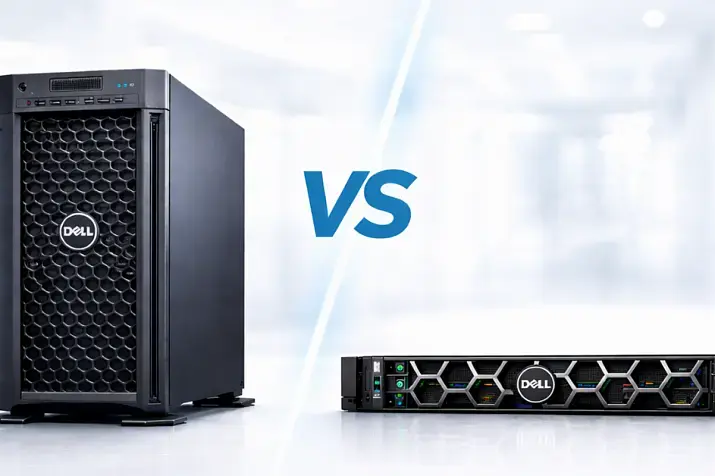
When choosing between DELL PowerEdge R650 and DELL PowerEdge R660 servers, many IT administrators and business owners face the question: what exactly is the difference between these models, and which one is better suited for specific tasks? Both servers belong to the PowerEdge generation lineup, but they have important differences in architecture, performance, and application areas.
The DELL PowerEdge R650 is a compact 1U rack server optimized for high-density computing environments where efficient use of rack space is critical. In turn, the DELL PowerEdge R660 is a 2U platform with expanded memory and storage configuration capabilities, making it an ideal solution for tasks requiring maximum flexibility and performance.
The main difference between the models lies in the form factor and the resulting expansion capabilities. The R650 in 1U format offers up to 10 bays for 2.5" drives or 4 bays for 3.5" drives, while the R660 in 2U format supports up to 8 bays for 2.5" drives. Both models run on 3rd Generation Intel Xeon Scalable processors and support DDR4 memory, equipped with iDRAC9 remote management controller, but the R660 offers support for faster DDR5 memory and 4th Generation Intel Xeon processors.
In this article, we will examine in detail the technical specifications of both models, compare their performance and expansion capabilities, and help determine which server will be the optimal choice for your business tasks in 2026.
DELL PowerEdge R650 vs R660 Comparison Table
| Feature | DELL PowerEdge R650 | DELL PowerEdge R660 |
|---|---|---|
| Form Factor | 1U Rack Server | 2U Rack Server |
| Processors | Up to two 3rd Gen Intel Xeon Scalable (up to 40 cores) | Up to two 4th Gen Intel Xeon Scalable (up to 60 cores) |
| Memory | DDR4, up to 32 DIMM slots | DDR5, up to 32 DIMM slots |
| Maximum RAM | Up to 2 TB (RDIMM) | Up to 8 TB (LRDIMM) |
| Memory Speed | Up to 3200 MT/s | Up to 4800 MT/s |
| Drive Bays (Front) | Up to 10 x 2.5" SAS/SATA/NVMe or up to 4 x 3.5" SAS/SATA | Up to 8 x 2.5" NVMe |
| Drive Bays (Rear) | Up to 2 x 2.5" SAS/SATA/NVMe | None |
| Maximum Storage Capacity | Up to 153 TB | Up to 122.88 TB |
| RAID Controllers | PERC H745, HBA355I, S150, H355, H345, H755, H755N | PERC H755 (8GB+BBU) |
| PCIe Expansion Slots | Up to 3 x PCIe Gen4 (low profile) | Up to 3 x PCIe Gen5 |
| GPU Support | Up to three 75W single-width GPUs | None |
| Power Supplies | 800W, 1100W, 1400W Platinum/Titanium | 2 x 800W Hot-Plug |
| Remote Management | iDRAC9 | iDRAC 9 Express |
| Cooling | Air, optional liquid processor cooling | Air |
| Use Cases | Virtualization, databases, web hosting, high-density computing | AI/ML, HPC, big data, NVMe storage |
| Link | Buy R650 | Buy R660 |
DELL PowerEdge R650: Detailed Overview

The DELL PowerEdge R650 server is a versatile platform in 1U format designed for a wide range of workloads. Its compact design makes it an ideal choice for data centers with limited space, where every rack unit matters.
DELL R650 Technical Specifications
- Processors: Up to two 3rd Gen Intel Xeon Scalable with support for up to 40 cores per processor
- Memory: 32 DDR4 DIMM slots, RDIMM support up to 2 TB or LRDIMM up to 4 TB, speeds up to 3200 MT/s
- Storage Controllers: PERC H745, HBA355I, S150, H355, H345, H755, H755N
- Boot Modules: BOSS-S1 or BOSS-S2 (RAID of 2 x M.2 SSDs 240 GB or 480 GB)
- Front Bays: Up to 10 x 2.5" SAS/SATA/NVMe (up to 153 TB) or up to 4 x 3.5" SAS/SATA (up to 64 TB) or up to 8 x 2.5" SAS/SATA/NVMe (up to 122.8 TB)
- Rear Bays: Up to 2 x 2.5" SAS/SATA/NVMe (up to 30.7 TB)
- Power Supplies: 800W Platinum AC/240 Mixed Mode, 1100W Titanium AC/240 Mixed Mode, 1400W Platinum AC/240 Mixed Mode, 1100W DC -48 to -60V
- Cooling: Air cooling, optional liquid processor cooling, up to four dual fan modules (standard/high performance SLVR/GOLD)
- Dimensions: Height 42.8 mm (1.7"), width 482 mm (18.97"), depth 809 mm (31.85") without bezel and 822.84 mm (32.39") with bezel
- Management: iDRAC9, iDRAC Direct, iDRAC Service Module, Quick Sync 2 wireless module
- Network Interfaces: 2 x 1 GbE LOM, optional OCP 3.0 (x8 PCIe lanes)
- PCIe Expansion Slots: Up to 3 x PCIe Gen4 low profile slots (all x16 except one x8 with SNAP I/O modules) or 2 x PCIe Gen4 full height slots
- GPU Support: Up to three 75W single-width GPUs
- Ports (Front): 1 x micro-USB for iDRAC Direct, 1 x USB 3.0, 1 x VGA
- Ports (Internal): 1 x USB 3.0
- Ports (Rear): 1 x USB 2.0, 1 x Serial (optional), 1 x USB 3.0, 2 x RJ-45, 1 x VGA (optional for liquid cooling configuration)
- Security: Cryptographically signed firmware, Secure Boot, Secure Erase, Silicon Root of Trust, System Lockdown (requires iDRAC9 Enterprise or Datacenter), TPM 1.2/2.0 FIPS, CC-TCG certified, TPM 2.0 China NationZ
- Operating Systems: Canonical Ubuntu Server LTS, Citrix Hypervisor, Microsoft Windows Server with Hyper-V, Red Hat Enterprise Linux, SUSE Linux Enterprise Server, VMware ESXi
Who Should Choose DELL PowerEdge R650
The DELL PowerEdge R650 is the optimal choice for organizations that require:
- Virtualization and Cloud Computing: Powerful processors and large memory capacity allow efficient operation of multiple virtual machines
- Databases: High processor performance and NVMe support ensure fast transaction processing
- Web Hosting and Edge Computing: Compact 1U form factor allows more servers in limited space
- Enterprise Applications: Platform versatility and wide configuration options suit various business applications
- High-Density Computing Environments: GPU addition capability makes the server suitable for entry-level AI/ML
DELL PowerEdge R660: Detailed Overview

The DELL PowerEdge R660 server represents a new generation of server technologies built on 4th Gen Intel Xeon Scalable processors and DDR5 memory. This 2U server is specifically designed for demanding workloads including artificial intelligence, machine learning, and high-performance computing.
DELL R660 Technical Specifications
- Processors: Up to two 4th Gen Intel Xeon Scalable with support for up to 60 cores per processor
- Base Processor Configuration: Intel Xeon Bronze 3408U (8 cores, 22.5 MB cache, 1.80 GHz)
- Memory: 32 DDR5 DIMM slots, RDIMM support up to 2 TB or LRDIMM up to 8 TB, speeds up to 4800 MT/s
- Base Memory Configuration: 16 GB DDR5 RDIMM 4800 MHz
- Storage Controller: RAID DELL H755 (8GB+BBU)
- Front Bays: Up to 8 x 2.5" NVMe SSD (up to 122.88 TB)
- Power Supplies: 2 x DELL 800W Hot-Plug
- Cooling: Air cooling
- Management: iDRAC 9 Express
- Network Interfaces: 2 ports 1 Gb/s (integrated)
- PCIe Expansion Slots: Up to 3 x PCIe Gen5 for maximum bandwidth
- GPU Support: Not supported in standard configuration
- Operating System: Without pre-installed OS
- Mounting: 19" rack mount kit
- Condition: New
Who Should Choose DELL PowerEdge R660
The DELL PowerEdge R660 is the ideal solution for organizations that need:
- Artificial Intelligence and Machine Learning: 4th Gen Intel Xeon processors with extended AI instructions and DDR5 memory support provide high performance for model training
- High-Performance Computing (HPC): PCIe Gen5 and NVMe drives ensure maximum data processing speed
- Big Data and Analytics: Large RAM capacity (up to 8 TB) allows processing large datasets in memory
- NVMe Storage: Up to 8 NVMe drive bays provide exceptional storage performance
- Next-Generation Virtualization: 4th Gen Intel Xeon architecture optimized for modern hypervisors
- Demanding Databases: Combination of fast DDR5 memory and NVMe drives ideal for transactional systems
Detailed R650 vs R660 Comparison
Processor Performance
The main difference between the models lies in processor generation. The R650 uses 3rd Gen Intel Xeon Scalable (Ice Lake), while the R660 is built on 4th Gen (Sapphire Rapids). Fourth-generation processors offer significant improvements:
- Increase in core count to 60 versus 40 in the previous generation
- Built-in accelerators for AI/ML tasks (Intel AMX)
- Improved energy efficiency with higher performance
- Enhanced security features at silicon level
- PCIe 5.0 support for double the bandwidth
Memory and Performance
The R660 supports DDR5 memory at speeds up to 4800 MT/s, which is 50% faster than DDR4-3200 in the R650. This is critical for applications working with large data volumes. Additionally, the R660 supports up to 8 TB of RAM with LRDIMM, which is twice the R650 maximum.
Data Storage
The R650 offers greater flexibility in storage configuration with support for various drive combinations and maximum capacity up to 153 TB. The R660 specializes in NVMe storage with 8 bays for 2.5" NVMe drives, providing maximum I/O speed for demanding applications.
Expandability and PCIe Slots
The R660 offers PCIe Gen5 slots, providing 32 GT/s bandwidth versus 16 GT/s for PCIe Gen4 in the R650. This is critical for connecting high-speed network adapters and NVMe controllers. However, the R650 supports GPU addition, making it more versatile for tasks with graphics accelerators.
Form Factor and Density
The R650 in 1U format occupies half the rack space compared to the 2U R660. This allows placing twice as many R650 servers in the same rack, which is critical for hosting providers and cloud services. However, the R650's compactness leads to some limitations in cooling and expandability.
Cooling
The R650 offers both air and optional liquid processor cooling, which is important for high-load configurations in dense environments. The R660 uses only air cooling, but the 2U form factor provides more efficient airflow.
Energy Efficiency
The R660 with 4th Gen processors and DDR5 memory provides better performance per watt ratio. Despite higher performance, modern architecture consumes less energy per operation performed.
R650 vs R660 Selection Recommendations
Choose DELL PowerEdge R650 if:
- Rack Space is Critical: 1U format allows maximum efficient use of rack height
- Versatility is Needed: Wide choice of storage configurations and GPU addition capability
- High Storage Capacity Required: Up to 153 TB in a single server with 3.5" drive support
- Existing DDR4 Infrastructure: Can use existing memory modules
- Budget is Limited: R650 is typically more affordable with comparable configuration
- Virtualization and Database Tasks: 3rd Gen Intel Xeon performance sufficient for most enterprise applications
Choose DELL PowerEdge R660 if:
- Maximum Performance Needed: 4th Gen Intel Xeon processors and DDR5 provide leading performance
- Working with AI/ML: Built-in AI accelerators in 4th Gen processors critical for machine learning
- Large RAM Required: Up to 8 TB RAM for working with big data in memory
- Storage Speed is Important: Focus on NVMe drives ensures maximum IOPS
- Long-Term Use Planned: Latest architecture ensures relevance for years ahead
- PCIe 5.0 Needed: For connecting next-generation devices with double bandwidth
- High-Performance Computing: HPC tasks require maximum compute power and memory bandwidth
Selection Criteria by Workload Type
| Workload Type | Recommended Model | Reason |
|---|---|---|
| Web Hosting | R650 | 1U compactness, sufficient performance, flexible storage |
| Virtualization (up to 50 VMs) | R650 | Optimal price/performance ratio |
| Virtualization (50+ VMs) | R660 | More DDR5 memory, more processor cores |
| OLTP Databases | R660 | Fast DDR5 memory, NVMe drives for maximum IOPS |
| OLAP Databases | R660 | Large RAM volume (up to 8 TB) for in-memory analytics |
| File Servers | R650 | Larger storage capacity (up to 153 TB), 3.5" drive support |
| AI/ML Model Training | R660 | Intel AMX AI accelerators, fast DDR5 memory, PCIe 5.0 |
| AI/ML Inference | R650 | GPU support, sufficient performance |
| HPC | R660 | Maximum compute power, PCIe 5.0, DDR5 |
| VDI (Virtual Desktops) | R650 | GPU support, high density |
| Containers and Kubernetes | R660 | More cores, fast memory for microservices |
| Edge Computing | R650 | Compact 1U form factor |
Scalability and Future Development
When choosing a server, it's important to consider not only current but also future needs. The R660 with PCIe 5.0 and DDR5 support provides greater readiness for next-generation technologies. These interfaces have already become industry standard in 2026, and choosing the R660 ensures compatibility with the latest equipment.
The R650, despite using previous generation technologies, remains a relevant solution thanks to its proven platform and wide ecosystem of compatible hardware. For many workloads, R650 performance is more than sufficient, and savings on server cost can be directed to other infrastructure components.
Price-Performance Ratio
With identical processor and memory configurations, the R650 typically offers a better price-performance ratio for typical enterprise workloads. However, for specialized tasks such as AI/ML or HPC, the additional cost of the R660 is justified by significant performance gains.
It's important to consider not only the initial acquisition cost but also the total cost of ownership (TCO). The R660 with more modern architecture provides better energy efficiency, reducing operational costs for electricity and cooling. Over a 3-5 year operation period, these savings can be substantial, especially in large data centers.
Factors Affecting TCO
- Power Consumption: R660 consumes less energy per unit of performance
- Cooling: More efficient processors require less cooling
- Density: R650 allows placing more servers in rack, reducing space costs
- Performance: Faster task completion can reduce required number of servers
- Service Life: R660 with latest architecture will remain relevant longer
Management and Security Features
Both models are equipped with the iDRAC9 remote management controller, providing full control over the server regardless of operating system status. iDRAC9 allows remote OS installation, hardware monitoring, firmware updates, and problem diagnosis.
Security Features
Both servers include modern security features critical for enterprise environments in 2026:
- Cryptographically Signed Firmware: Protection against unauthorized firmware modifications
- Secure Boot: Guarantee of booting only trusted software
- Secure Erase: Safe data deletion during decommissioning
- Silicon Root of Trust: Hardware root of trust at silicon level
- System Lockdown: Protection against unauthorized configuration changes
- TPM 2.0: Trusted Platform Module for encryption and authentication
The R660 with 4th Gen processors gains additional processor-level security capabilities, including enhanced memory encryption features and side-channel attack protection.
Compatibility and Ecosystem
When choosing between R650 and R660, consider compatibility with existing infrastructure and ecosystem. The R650 uses DDR4 memory, allowing transfer of memory modules from previous generation servers during upgrade. The R660 requires new DDR5 memory, increasing initial investment.
Operating System Support
Both models support a wide range of operating systems and hypervisors:
- Canonical Ubuntu Server LTS
- Citrix Hypervisor
- Microsoft Windows Server with Hyper-V
- Red Hat Enterprise Linux
- SUSE Linux Enterprise Server
- VMware ESXi
The R660 receives optimization for the latest versions of these operating systems, which can leverage the advantages of the newest processor architecture.
Upgrade and Modernization Paths
Both servers offer flexible upgrade options, but with different emphases. The R650 allows expanding storage capacity and adding GPUs for new workloads. The R660 provides a path to maximum performance through adding more powerful 4th Gen processors and increasing DDR5 memory volume.
Typical Upgrade Scenarios
For R650:
- Adding NVMe drives to increase storage performance
- Installing GPUs for AI/ML inference tasks or VDI
- Increasing memory volume to 4 TB for expanded virtualization
- Adding high-speed network adapters 25/100 GbE
For R660:
- Moving to more powerful processors within 4th Gen Intel Xeon
- Expanding memory to 8 TB for big data applications
- Adding PCIe 5.0 NVMe controllers for maximum IOPS
- Installing next-generation 200/400 GbE network adapters
Conclusion
The choice between DELL PowerEdge R650 and DELL PowerEdge R660 depends on your specific business requirements, workload type, and budget.
DELL PowerEdge R650 remains an excellent choice for most enterprise applications thanks to its compact 1U form factor, proven platform, and wide configuration capabilities. It's a versatile server that handles virtualization, databases, web hosting, and many other tasks at an optimal price-performance ratio.
DELL PowerEdge R660 represents a solution for organizations that need maximum performance and future readiness. 4th Gen Intel Xeon processors, DDR5 memory, PCIe 5.0, and specialization in NVMe storage make it an ideal platform for AI/ML, HPC, demanding databases, and other high-performance applications.
Both servers offer enterprise-level reliability, security, and manageability from DELL. Regardless of choice, you'll get a server capable of supporting your business's mission-critical workloads.
For personalized consultation and selecting the optimal server configuration for your tasks, visit the DELL servers catalog at ServerMall. Our specialists will help choose exactly the solution that will ensure maximum efficiency of your IT infrastructure in 2026 and beyond.