Table of Contents
A Smart Investment in IT Infrastructure?
As business grows beyond the startup stage, its IT infrastructure often struggles to keep up. A larger workforce, a growing client base, and more complex processes place increasing strain on servers. Systems that once performed reliably begin to slow down: websites lag, shared resources are delayed, and databases demand more and more computing power. At some point, a new and more powerful server becomes essential to scale the business.
Here, companies face a choice: invest in brand-new servers from official vendors or purchase used hardware on second-hands marketplaces. The first option guarantees performance but comes with a significant price tag. The second offers discounts of up to 80%—a tempting saving, but with hidden risks.
At first, used equipment may seem to work just fine, sometimes for weeks or even months. But when workloads peak—such as during quarterly sales or project deadlines—the system can collapse. Websites go offline, customer requests are left unprocessed, and financial operations are disrupted.
Some issues may be resolved quickly if an in-house IT specialist is available. Others, like incomplete backups or failing hardware, can halt operations for weeks. In the worst case, without reserve funds for emergency replacements, business continuity may be jeopardized entirely.
So, is there a middle ground between costly but reliable new hardware and cheap but unstable used systems? The answer lies in refurbished servers—a balance of enterprise-grade reliability and financial efficiency. But what exactly makes them different from regular used servers?
The Hidden Problems of Used Servers
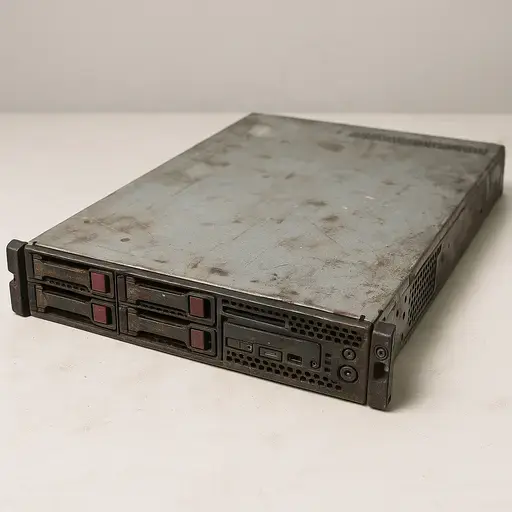
A used server is sold strictly “as is.” Once its replacement arrives, the server is unplugged, unmounted, and put up for sale without inspection or warranty. The seller takes no responsibility for how the equipment was previously used—or how long it will last for the next owner.
This creates a high level of uncertainty. For example, was the server housed in a clean, climate-controlled data center? Or was it running for years in a dusty, overheated back office, enduring power surges and thermal stress? Each incident leaves microscopic damage on components, silently reducing their lifespan.
Dust buildup in fans and radiators causes chronic overheating, degrading silicon chips and drying out capacitors. Bearings in fans wear down, power delivery becomes unstable, and eventually processors crash.
One of the most dangerous risks is intermittent memory errors (RAM). These subtle faults surface only under heavy, sustained load and may corrupt databases one bit at a time—going unnoticed until critical data becomes unusable.
Even when sellers provide a warranty, it rarely exceeds 14 days. But true server reliability can only be proven after months of uninterrupted operation under full load. When a RAID controller or power supply fails on day 15, the buyer is left scrambling for replacement parts—often for models that are no longer manufactured.
Worse still, spares can be costly. Replacing a single failed drive may cost 10% of the entire server’s price. Over time, owners of used servers often end up paying 30% more than expected just to keep them running.
Compatibility issues are also common. Outdated RAID controller firmware may not support modern SSDs, leading to severe performance drops or even catastrophic data loss. Manufacturers invest thousands of engineering hours in firmware testing—something skipped entirely when buying secondhand.
For businesses that cannot afford downtime, these risks make used servers an unreliable choice. Which is why many turn to refurbished solutions.
Refurbished Servers – What Sets Them Apart?
A refurbished server is not just resold—it is re-engineered and restored through a structured process designed to bring the system as close to factory condition as possible. The goal is predictability and reliability.
Each unit undergoes a strict, multi-stage process, including:
-
Initial inspection. Engineers check for bent pins, bulging capacitors, and structural damage. Units with serious defects are rejected outright.
-
Deep diagnostics. Every component is stress-tested individually and as a system using professional tools (Prime95, Linpack, Memtest86+). Storage drives are checked for S.M.A.R.T. errors—any showing early wear are discarded.
-
Comprehensive cleaning. Systems are fully disassembled, fans and heatsinks are cleaned, and new thermal paste is applied to CPUs for optimal cooling.
-
Preventive replacement. Components with limited lifespans (e.g., CMOS batteries, RAID cache batteries) are proactively replaced regardless of test results.
-
Firmware updates. BIOS, RAID controllers, disks, and NICs are all upgraded to the latest stable releases, fixing bugs and security vulnerabilities such as Spectre and Meltdown.
-
Final burn-in. The rebuilt server is stress-tested under 100% load for 24–72 hours to expose any hidden defects—ensuring failures happen in the lab, not in the client’s server room.
Thanks to this industrial-grade process, reputable vendors can back refurbished servers with multi-year warranties. For example, Servermall offers up to five years of coverage, giving businesses confidence in long-term reliability.
Which Businesses Benefit Most from Refurbished Servers?

Small businesses.
With limited budgets and no in-house IT team, a refurbished server backed by a warranty is a practical way to access enterprise-class reliability. This allows founders to focus on growth, not troubleshooting.
Mid-sized companies.
Standardizing on refurbished servers makes it possible to unify infrastructure around a proven, cost-effective model—even if it’s officially out of production. Standardization simplifies administration and reduces future spare-parts costs.
Large enterprises.
Not every workload requires cutting-edge hardware. Refurbished servers are ideal for software development environments, test systems, cold storage of backups, and disaster-recovery infrastructure. In such cases, they deliver significant CAPEX savings without compromising performance or reliability.
|
Parameter |
Used Server |
Refurbished Server |
|
Warranty |
None or up to 14 days |
Multi-year, full coverage |
|
Reliability |
Low, unpredictable |
High, proven through testing |
|
Pre-sale checks |
None |
Mandatory 6-step industrial process |
|
Component condition |
Unknown, potentialwear |
Verified, worn parts replaced |
|
Firmware updates |
None, security risks remain |
Updated to latest stable versions |
|
Total Cost of Ownership |
Often very high due to downtime |
Predictable, low, warranty included |
|
Business risk |
High |
Minimal |
Conclusion: Where Should You Place Your Bet?
Buying a used server is like purchasing a second-hand car from a classified ad. The price looks attractive, but you never truly know its history—whether the oil was changed regularly, whether it was ever in an accident, or when hidden issues might surface. You’re buying hope, not certainty.
In contrast, a refurbished server is more like a certified pre-owned car from an authorized dealer. It undergoes complete inspection, replacement of worn parts, and comes with a real warranty. The higher upfront cost isn’t an expense—it’s an investment in reliability and insurance against unpredictable risks.
Content: