
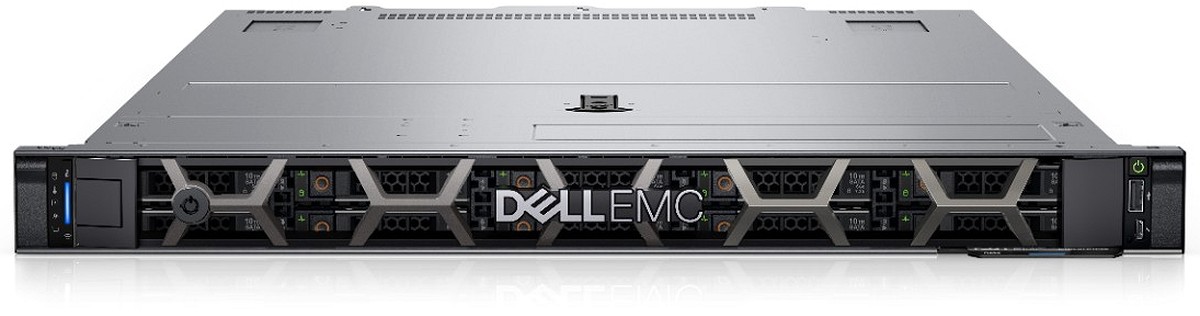
DELL PowerEdge R650 Server
You might be interested in




-
Condition
Refurbished
-
CPU
2×8GB DDR4 RDIMM 2133MHz
-
RAM
noHDD (up to 8 HDD 2.5'' SFF)
-
Condition
Refurbished
-
CPU
2×8GB DDR4 RDIMM 2133MHz
-
RAM
noHDD (up to 8 HDD 2.5'' SFF)
-
Condition
Refurbished
-
CPU
2×8GB DDR4 RDIMM 2133MHz
-
RAM
noHDD (up to 8 HDD 2.5'' SFF)
-
Condition
Refurbished
-
CPU
2×8GB DDR4 RDIMM 2133MHz
-
RAM
noHDD (up to 8 HDD 2.5'' SFF)



- Processors
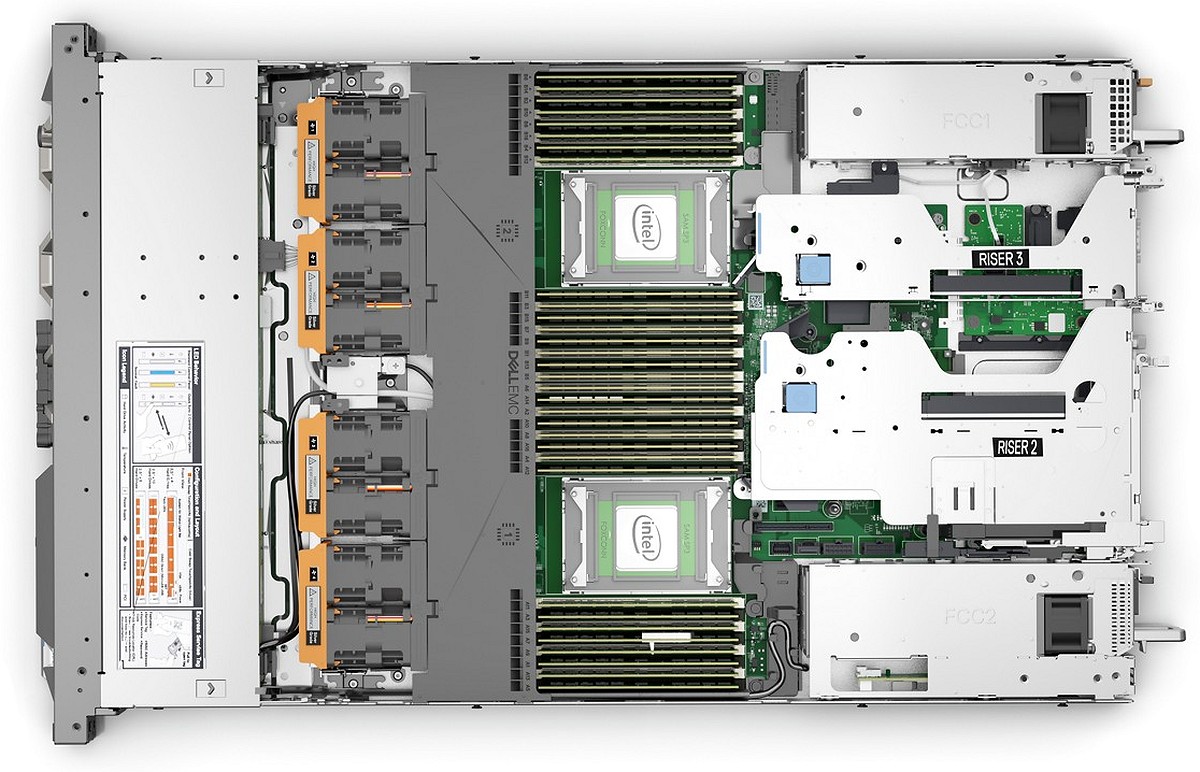
- Up to two 3rd Generation Intel Xeon Scalable processors, with up to 40 cores per processor
- Storage controllers
- Internal Controllers: PERC H745, HBA355I, S150, H355, H345, H755, H755N Boot Optimized Storage Subsystem (BOSS-S1): HW RAID 2 x M.2 SSDs 240 GB or 480 GB Boot Optimized Storage Subsystem (BOSS-S2): HW RAID 2 x M.2 SSDs 240 GB or 480 GB External PERC (RAID): PERC H840, HBA355E
- Drive bays
- Front bays: Up to 10 x 2.5-inch SAS/SATA/NVMe (HDD/SSD) max 153 TB Up to 4 x 3.5-inch SAS/SATA (HDD/SSD) max 64 TB Up to 8 x 2.5-inch SAS/SATA/NVMe (HDD/SSD) max 122.8 TB Rear bays: Up to 2 x 2.5-inch SAS/SATA/NVMe (HDD/SSD) max 30.7 TB
- Power supplies
- 800 W Platinum AC/240 Mixed Mode 1100 W Titanium AC/240 Mixed Mode 1400 W Platinum AC/240 Mixed Mode 1100 W DC -48 - 60 V
- Cooling options
- Air cooling, optional processor liquid cooling
- Fans
- Standard fan/High performance SLVR fan/High performance GOLD fan Up to four sets (dual fan module) hot plug fans
- Dimension
- Height – 42.8 mm (1.7 inches) Width – 482 mm (18.97 inches) Depth – 809 mm (31.85 inches) – without bezel and 822.84 mm (32.39 inches) – with bezel
- Form Factor
- 1U rack server
- Embedded management
- iDRAC9 iDRAC Direct iDRAC Service Module Quick Sync 2 wireless module
- Bezel
- Optional bezel or security bezel
- OpenManage Software
- OpenManage Enterprise OpenManage Power Manager plugin OpenManage SupportAssist plugin OpenManage Update Manager plugin
- Mobility
- OpenManage Mobile
- Integrations and Connections
- OpenManage Integrations BMC Truesight Microsoft System Center Red Hat Ansible Modules VMware vCenter and vRealize Operations Manager OpenManage Connections IBM Tivoli Netcool/OMNIbus IBM Tivoli Network Manager IP Edition Micro Focus Operations Manager Nagios Core Nagios XI
- Security
- Cryptographically signed firmware Secure Boot Secure Erase Silicon Root of Trust System Lockdown (requires iDRAC9 Enterprise or Datacenter) TPM 1.2/2.0 FIPS, CC-TCG certified, TPM 2.0 China NationZ
- Embedded NIC
- 2 x 1 GbE LOM
- Network Options
- 1 x OCP 3.0 (x8 PCIe lanes)
- GPU options
- Up to three 75 W single-width GPU
- Ports
- Front Ports 1 x Dedicated iDRAC Direct micro-USB 1 x USB 3.0 1 x VGA Internal Ports 1 x USB 3.0 Rear Ports 1 x USB 2.0 1 x Serial (optional) 1 x USB 3.0 2 x RJ-45 1 x VGA (optional for liquid cooling configuration)
- PCIe
- Up to 3 x PCIe Gen4 low profile slots (all x16 except one x8 slot with SNAP I/O modules) or 2 x PCIe (Gen4) full height slots
- Operating System and Hypervisors
- Canonical Ubuntu Server LTS Citrix Hypervisor Microsoft Windows Server with Hyper-V Red Hat Enterprise Linux SUSE Linux Enterprise Server VMware ESXi
- OEM-ready version availabe
- From bezel to BIOS to packaging, your servers can look and feel as if they were designed and built by you.
Dell PowerEdge R650 overview
Dell PowerEdge R650 is a high-density 1U dual-socket rack server for virtualization, private cloud, container platforms and space-constrained data centers. It is based on 3rd Generation Intel Xeon Scalable processors, DDR4 memory and PCIe Gen4 expansion. In the Dell PowerEdge 15th Generation lineup, the R650 is the more flexible and performance-oriented 1U platform compared with cost-optimized xs models.
The Dell R650 server is suitable when compute density matters: multiple hosts per rack, virtualization clusters, dense application nodes, private cloud infrastructure, database nodes and high-performance networking. It can also be configured with SSD or NVMe storage layouts where supported. Because it is a compact 1U platform, the exact Dell R650 configuration should be checked for thermals, risers, NICs, drives and validated GPU or accelerator options before ordering.
When to choose Dell PowerEdge R650
Choose Dell PowerEdge R650 when the workload needs dual-socket Intel Xeon Scalable performance in a 1U chassis. It is a good fit for VMware ESXi, Microsoft Hyper-V, Proxmox, KVM, Kubernetes platforms, container hosts, private cloud nodes and dense enterprise application environments.
For virtualization clusters, the R650 is useful when rack space is expensive or limited. Its role is not only to provide CPU cores, but also to support high RAM density, fast networking and low-latency local storage where required. For database use, it can be sized around CPU frequency, memory and SSD/NVMe latency. For container platforms, consistent node configuration is often more important than maximizing a single server.
The Dell PowerEdge R650 server should be compared with R650xs when budget and scale-out economics are the priority, and with R750xs or R750 when 2U space and storage flexibility are more important. For newer DDR5 infrastructure, compare it with Dell PowerEdge R760.
Chassis and drive bay options
The Servermall page lists Dell R650 8SFF and Dell R650 10SFF configurations. Both are compact 2.5-inch drive layouts designed for performance-oriented 1U deployments.
| Chassis option | Best for | Comment |
|---|---|---|
| Dell R650 8SFF | Dense compute nodes with moderate local storage | Suitable when the server mainly uses shared storage or needs a small local SSD layout. |
| Dell R650 10SFF | Virtualization, private cloud and low-latency local storage | More flexible for SSD/NVMe-oriented configurations where supported by the exact backplane. |
Dell R650 8SFF is a practical choice for compute-heavy nodes where SAN, NAS or external storage handles most data. Dell R650 10SFF is more attractive for local datastores, cache tiers or database nodes. NVMe can be relevant for low latency and high IOPS, but only when the selected backplane, controller, cabling and configuration support it.
Final drive compatibility depends on the selected backplane, storage controller and exact server configuration.
Recommended Dell PowerEdge R650 configurations by workload
| Workload | Recommended focus |
|---|---|
| Virtualization cluster | Higher core count, large RAM, 10/25GbE or faster networking and SSD/NVMe storage where local datastores are used. |
| Private cloud node | Consistent CPU/RAM layout across nodes, redundant networking and storage aligned with the cloud platform. |
| Container platform | Balanced CPU core count, RAM for pod density, fast networking and predictable node standardization. |
| Database node | CPU frequency/core balance, RAM for cache and low-latency SSD/NVMe where supported. |
| Dense compute | Dual CPUs, high RAM density and minimal local storage if the workload is network or shared-storage based. |
| High-performance networking | PCIe Gen4 NIC planning, airflow validation and redundant network paths. |
The Dell R650 configuration should be built as part of an infrastructure design. For clusters, matching CPU family, RAM layout, NICs and drive types across hosts can reduce operational complexity.
How to choose CPU, RAM, RAID and storage
With Intel Xeon Scalable processors, more cores are useful for virtualization, containers and multi-user workloads. Higher clock speed can matter for databases and applications sensitive to single-thread performance. For the R650, avoid selecting the highest core-count CPU automatically; software licensing and workload behavior may make a balanced processor more cost-effective. CPU and core count may affect software licensing for VMware, Windows Server, Microsoft SQL Server and other commercial platforms.
RAM is often the limiting factor in virtualization and private cloud deployments. The Dell PowerEdge R650 is frequently chosen for dense RAM in a 1U footprint, so plan capacity for current VM density, failover, maintenance mode and future growth. For databases, RAM can reduce storage pressure by improving cache efficiency.
Hardware RAID fits traditional local storage deployments. HBA/JBOD mode is preferred for ZFS, Ceph, vSAN, Proxmox/ZFS and software-defined storage when the software layer needs direct disk control. BOSS or boot SSD options, where available, can separate hypervisor boot from data storage.
For storage, SFF SSDs provide balanced performance. NVMe is suitable for low latency and high IOPS when supported by the exact R650 build. Check controller, backplane, riser, thermals and serviceability before finalizing. Review RAID controllers, server SSDs and network options together rather than as separate choices.
Dell PowerEdge R650 vs related Dell models
| Model | When to consider |
|---|---|
| Dell PowerEdge R450 | Choose R450 for lower-cost dual-socket 1U workloads with more moderate density requirements. |
| Dell PowerEdge R550 | Choose R550 when 2U storage flexibility is more important than 1U compute density. |
| Dell PowerEdge R650xs | Choose R650xs for cost-optimized mainstream virtualization where maximum expandability is not required. |
| Dell PowerEdge R750xs | Choose R750xs when a cost-optimized 2U chassis better fits storage-oriented enterprise workloads. |
| Dell PowerEdge R760 | Consider R760 for a newer 16G platform with DDR5 and newer CPUs, usually at a higher price point. |
Dell PowerEdge R650 is the more flexible high-density 1U platform, while R650xs is a cost-optimized option for a narrower set of mainstream workloads.
New and refurbished Dell PowerEdge R650 servers
A refurbished Dell R650 can be a practical choice for production clusters when the hardware is tested, consistently configured and supplied with warranty. It is especially relevant when expanding an existing 15G cluster or standardizing on DDR4 infrastructure.
New units may be preferable when a company requires new hardware, a specific factory-level configuration or long-term standardization. Servermall offers EU delivery and warranty options; depending on the offer, Dell R650 servers may be available with a 5-year warranty. Confirm CPU generation, RAM layout, storage backplane, network adapters, PSU, cooling and warranty terms before ordering.
Summary: is Dell PowerEdge R650 the right server for your workload×
Dell PowerEdge R650 is a strong candidate for dense 1U virtualization, private cloud, containers, database nodes and compute-focused data center deployments. Choose it when rack density, dual-socket performance, DDR4 memory capacity and PCIe Gen4 expansion matter. Consider R650xs for cost-optimized mainstream workloads, R550 or R750xs for more 2U storage flexibility, and R760 for a newer DDR5 platform. Before purchase, confirm CPU, RAM, storage, RAID/HBA, network, PSU, cooling and warranty requirements.
asked
questions
Ask to consultant
The Servermall warranty includes:
- Access on a 24x7 basis (including holidays) to the Servermall Customer Service and Support organization for troubleshooting assistance of Servermall Refurbished Servers and Associated Goods and select software issues.
- 5 year warranty. In case of problem diagnostics or repair, we will do on the server installation site. For free.
- On-site dispatch of replacement parts to the Installation Site or other mutually agreed upon Customer’s business location approved by Servermall to address a Product problem.
Subscribe to our news and get a 50 € discount on the server.
Free shipping across EU if ordering equipment from 500 €. Delivery from 4 working days.
to buy a servers
at Servermall
warranty
testing
We want to make sure that our equipment is fully reliable for you. That’s why all our equipment (even new) is subject to complete diagnostics, testing, and part replacement.
testing
We fully load our equipment with various utilities and software. Rest assured, it’ll work for a very long time.
Power supply
The components work at full capacity and are tested for several days. If we are not sure about something, we replace it.
of all equipment
Our regulations imply the same testing for both used and new equipment. Oh, and by the way, we complement the official manufacturer’s warranty with our own warranty.